Macro reality check: Why US$4,000 gold and falling BTC go hand in hand

Macro reality check: Why US$4,000 gold and falling BTC go hand in hand

Risk sentiment has retreated sharply, not due to a sudden economic contraction, but rather to growing investor unease over the sustainability of surging artificial intelligence-related capital expenditures and a surprisingly hawkish pivot from the US Federal Reserve.

Despite delivering a widely anticipated 25-basis-point rate cut to a target range of 3.75 per cent to 4.00 per cent, Chair Jerome Powell used the post-decision press conference to push back firmly against expectations of further easing, warning that inflation remains sticky and that the labour market, while cooling, still shows signs of underlying strength. This messaging effectively neutralised the dovish implications of the cut itself, triggering a repricing across asset classes.

Equity markets responded with a clear rotation out of high-duration tech names. The Nasdaq fell 1.6 per cent, significantly underperforming the Dow Jones, which declined only 0.2 per cent. This divergence underscores a market increasingly sceptical of the lofty valuations underpinning the AI trade, which had been a primary driver of the year’s gains. The repricing was mirrored in the bond market, where yields edged higher.

The benchmark 10-year Treasury yield climbed by two basis points to settle at 4.097 per cent, while the two-year yield rose one basis point to 3.608 per cent. This steepening of the yield curve, albeit modest, signals that traders are now pricing in a more prolonged period of elevated rates than previously expected. The US Dollar Index capitalised on this shift in sentiment, rising 0.3 per cent to 99.53, its highest level in three months, as global capital sought the relative safety of the greenback.

This risk-off environment spilt over into commodities and, more acutely, into the cryptocurrency market. Gold, often a haven during uncertainty, surged by 2.4 per cent to close at an extraordinary US$4,023.20 per ounce, a level that speaks to deep-seated anxieties about long-term monetary debasement and a potential flight from traditional financial assets. In the oil market, Brent crude was relatively stable, gaining just 0.1 per cent to settle at US$65 per barrel.

This calm, however, belies a complex backdrop. The market is digesting news that OPEC+ is poised to approve another modest output increase of 137,000 barrels per day for December, a move that would continue its gradual unwinding of production cuts. This potential supply boost is being counterbalanced by new US sanctions on Russia, which have stoked uncertainty about the reliability of global oil supply, creating a tense equilibrium that has so far prevented a major price move in either direction.

Against this macroeconomic tapestry, the cryptocurrency market has entered a period of pronounced weakness. Over the past 24 hours, the total market capitalisation has fallen by two per cent, extending a monthly decline of 6.46 per cent. The current market cap stands at approximately US$3.67 trillion, a figure that has broken below both its seven-day and 30-day simple moving averages, signalling a clear deterioration in its technical structure. This downturn is not a simple market correction but the result of a confluence of powerful, bearish forces operating in unison.

The most significant driver of this weakness is a sudden and substantial exodus of institutional capital from Bitcoin spot ETFs. On October 30, these funds recorded a net outflow of US$488 million, the largest single-day withdrawal since June 2025. The selling was led by the market’s two heaviest weights: BlackRock’s IBIT saw US$291 million flee its coffers, while Ark Invest’s ARKB bled a further US$65.6 million. This synchronised institutional retreat is a critical development.

For much of 2025, the steady inflow of capital into these ETFs had been the bedrock of Bitcoin’s price stability and its primary source of new demand. The abrupt reversal suggests that large, sophisticated players are either taking profits after a strong run or, more ominously, are repositioning their portfolios in anticipation of a more challenging macro environment ahead. With total ETF assets now at US$143.9 billion, the market is now on high alert for November’s flow data, which will be the key indicator of whether this is a temporary pause or the beginning of a sustained institutional withdrawal.

Compounding this problem is a sharp contraction in the derivatives market. Total open interest, a measure of the total value of outstanding leveraged bets, has plummeted by 4.4 per cent, falling from US$848 billion to US$812 billion. At the same time, average funding rates on perpetual futures contracts have turned negative, settling at -0.0018 per cent. This combination is a classic sign of market deleveraging.

Traders are actively closing their long positions, often at a loss, to reduce their risk exposure. While this process of forced liquidation removes the immediate threat of a cascading crash, it also strips the market of its bullish momentum. The negative funding rate confirms that the short-term sentiment is firmly bearish, as those holding short positions are now being paid to do so by the longs who remain in the market.

From a technical perspective, the picture is equally grim. The market has not only broken key moving averages but has also seen its Relative Strength Index (RSI) fall to 40.9, entering oversold territory. The Moving Average Convergence Divergence (MACD) indicator remains in negative territory, suggesting that the bearish momentum is still in control.

This creates a precarious situation where the market is technically primed for a bounce, but the underlying trend remains firmly down. The next major support level appears to be the US$3.6 trillion mark, a 78.6 per cent Fibonacci retracement level, which will be a critical test of the market’s resilience.

The prevailing sentiment is one of fear. The market’s Fear and Greed Index has plunged to 31, a level categorised as Extreme Fear and the lowest it has been in a week. This psychological state is further amplified by a rising Bitcoin dominance index, which now sits at 59.3 per cent.

When Bitcoin’s share of the total crypto market cap increases during a downturn, it typically indicates that investors are fleeing from riskier altcoins and rotating into what they perceive as the safest asset in the space. This dynamic suggests that if the current pressure continues, altcoins could face even more severe selling than Bitcoin itself.

In conclusion, the crypto market’s current malaise is a direct reflection of a broader macroeconomic shift. The trifecta of institutional caution, derivatives deleveraging, and a broken technical structure has created a formidable headwind. While the oversold conditions may eventually attract bargain hunters, the market is in desperate need of a catalyst to reverse its course.

That catalyst could come in the form of a renewed wave of ETF inflows, signaling that institutions have regained their confidence, or from a more dovish signal from the Federal Reserve that eases the pressure on risk assets. Until then, the path of least resistance remains lower, and all eyes will be on whether Bitcoin can hold its October low near US$105,000 as the ultimate test of its underlying support.




Anndy Lian is an early blockchain adopter and experienced serial entrepreneur who is known for his work in the government sector. He is a best selling book author- “NFT: From Zero to Hero” and “Blockchain Revolution 2030”.

Currently, he is appointed as the Chief Digital Advisor at Mongolia Productivity Organization, championing national digitization. Prior to his current appointments, he was the Chairman of BigONE Exchange, a global top 30 ranked crypto spot exchange and was also the Advisory Board Member for Hyundai DAC, the blockchain arm of South Korea’s largest car manufacturer Hyundai Motor Group. Lian played a pivotal role as the Blockchain Advisor for Asian Productivity Organisation (APO), an intergovernmental organization committed to improving productivity in the Asia-Pacific region.

An avid supporter of incubating start-ups, Anndy has also been a private investor for the past eight years. With a growth investment mindset, Anndy strategically demonstrates this in the companies he chooses to be involved with. He believes that what he is doing through blockchain technology currently will revolutionise and redefine traditional businesses. He also believes that the blockchain industry has to be “redecentralised”.

j j j

Price analysis 1/20: SPX, DXY, BTC, TRUMP, ETH, XRP, BNB, SOL, DOGE, ADA, LINK

Price analysis 1/20: SPX, DXY, BTC, TRUMP, ETH, XRP, BNB, SOL, DOGE, ADA, LINK

Bitcoin BTCUSD hit a new all-time high above $109,500 on Jan. 20, after the odds for a strategic Bitcoin reserve skyrocketed to 69% on DeFi betting market Polymarket.

The newly launched Trump family-related memecoins, Official Trump (TRUMP) and Official Melania (MELANIA), have also seen massive interest from the cryptocurrency trading community. Intergovernmental blockchain expert and author Anndy Lian told Cointelegraph that the memecoin launches will usher in a “new era for memecoins and altcoins.”

Euphoric times offer several trading opportunities, but they come with a risk. Vertical rallies are generally non-sustainable and are followed by sharp pullbacks. The deep pullback in TRUMP and Solana’s (SOL) volatility suggests that traders should exercise caution.

Can Bitcoin recapture its all-time high and trigger buying in altcoins? Let’s analyze the charts to find out.

S&P 500 Index price analysis

The S&P 500 Index (SPX) reversed strongly last week and broke above the moving averages, indicating that the break below 5,853 on Jan. 10 may have been a bear trap.

The 20-day exponential moving average (5,934) has flattened out, and the relative strength index (RSI) has risen into positive territory, suggesting a balance between supply and demand. Sellers are expected to fiercely defend the zone between 6,050 and 6,100.

If the price turns down from the overhead zone, the index may form a range between 6,050 and 5,853. The next trending move is expected to begin on a break above 6,100 or below 5,773.

US Dollar Index price analysis

The US Dollar Index once again took support at the 20-day EMA (108.62) on Jan. 15, indicating that every minor dip is being purchased.

The RSI is showing signs of forming a negative divergence, suggesting that the bullish momentum is weakening. Sellers will have to yank the price below the 20-day EMA to open the doors for a deeper fall to 108 and then to the 50-day SMA (107.32).

Contrarily, a break and close above 110.17 will signal the continuation of the uptrend. The index could rally to 113.14 and eventually to 114.77. Buyers may find it challenging to clear the 114.77 hurdle.

Bitcoin price analysis

Bitcoin rebounded off the 20-day EMA ($99,257) on Jan. 20 and skyrocketed to a new all-time high of $109,588.

If buyers maintain the price above $108,353, it will suggest the start of the next leg of the uptrend. The bulls will then try to thrust the price toward $126,706.

On the contrary, if the price fails to sustain above $108,353, it will suggest that the bears are fiercely defending the level. Sellers will have to pull the price below the moving averages to weaken the bullish momentum. The BTCUSDT pair could then consolidate between $109,588 and $90,000 for a few days.

Official Trump price analysis 

Due to the enormous popularity and volatility of the TRUMP memecoin, Cointelegraph is providing short-term analysis. A 30-minute chart has been used since there is little price history to look to for deeper insights.

The TRUMPUSDT pair has dipped below the symmetrical triangle pattern, signaling that the bulls are losing their grip. If the price maintains below the uptrend line, the pair could tumble to $38. This is a critical level to watch out for in the near term because a break below it may sink the pair to $24.

On the contrary, a strong bounce off the current level will suggest buying at lower levels. The bulls will then try to push the pair back into the triangle. Buyers will be back in command on a close above the downtrend line.

Ether price analysis

Ether (ETH) bulls are defending the neckline of the head-and-shoulders pattern but are facing selling near the 50-day SMA ($3,537).

The downsloping 20-day EMA ($3,362) and the RSI near the midpoint indicate a slight edge to the bears. A break and close below $3,125 could accelerate selling, pulling the ETHUSDT pair toward $2,850.

Buyers will have to push and maintain the price above the 50-day SMA to indicate that the selling pressure is reducing. The pair could then rally to $3,745, which is likely to behave as a stiff hurdle.

XRP price analysis

XRP (XRP) bounced off the breakout level of $2.91 on Jan. 20, indicating that the bulls are trying to flip the level into support.

The XRPUSDT pair is likely to pick up momentum after buyers push and sustain the price above the $3.40 overhead resistance. That could start the next leg of the uptrend toward the pattern target of $4.84.

The first sign of weakness will be a break and close below the 20-day EMA ($2.75). The pair may then sink to the 50-day SMA ($2.46). This is an important level to watch out for because a drop below the 50-day SMA could start a decline to $2.

BNB price analysis

BNB (BNB) has been trading between the uptrend line and the overhead resistance at $745 for the past few days.

The flattish moving averages and the RSI just below the midpoint do not give a clear advantage either to the bulls or the bears. If the price rises above the moving averages, the BNBUSDT pair will again attempt to rally above $745. If that happens, the pair could surge to $794.

Contrarily, a break and close below the uptrend line will signal that the bulls are closing their positions. That could sink the pair to the $635 support, which is likely to attract solid buying by the bulls.

Solana price analysis

Solana has been hugely volatile for the past two days, indicating an intense battle between the bulls and the bears.

The upsloping 20-day EMA ($214) and the RSI near the overbought zone suggest that buyers are in command. A close above $260 improves the prospects of a retest of the all-time high at $295. If this level is scaled, the SOLUSDT pair may surge to $300 and eventually $375.

Contrary to this assumption, if the price turns down and breaks below $229, it will signal that the bulls are rushing to the exit. The pair may then drop to the 20-day EMA. A deep correction is likely to delay the start of the next leg of the uptrend.

Dogecoin price analysis

Dogecoin (DOGE) has been rising inside an ascending channel pattern for the past few days, indicating buying on dips and selling on rallies.

The 20-day EMA ($0.36) is flattening out, and the RSI is near the midpoint, signaling a balance between supply and demand. If the price dips below the channel, the DOGEUSDT pair could slide to the $0.27 to $0.23 support zone. Buyers are expected to fiercely defend the zone.

The bulls will be back in the driver’s seat on a close above the channel. That could clear the path for a rally to $0.48. Sellers are expected to vigorously defend the $0.48 level because a break above it may propel the pair to $0.59.

Cardano price analysis

Cardano (ADA) has been trading inside the symmetrical triangle pattern, indicating indecision between the bulls and the bears.

It is difficult to predict the direction of the breakout with certainty as the flattish moving averages and the RSI just above the midpoint do not give a clear advantage either to the bulls or the bears.

If buyers drive the price above the triangle, the ADAUSDT pair could pick up momentum and rally to $1.33. If this level is crossed, the rally could extend to $1.64. On the other hand, a break and close below the triangle could sink the pair to $0.80.

Chainlink price analysis

Chainlink (LINK) bounced off the 20-day EMA ($22.72) on Jan. 19, indicating that the sentiment remains positive, and traders are buying on dips.

The LINKUSDT pair rose above the $26 overhead resistance on Jan. 20, indicating that the bulls remain in control. If the price sustains above $26, the pair could retest the overhead resistance at $31.

Instead, if the price fails to maintain above $26, it will suggest selling on rallies. The bears will have to tug the price below the 20-day EMA to signal strength. That increases the risk of a fall to $20.

This article does not contain investment advice or recommendations. Every investment and trading move involves risk, and readers should conduct their own research when making a decision.


Source: https://www.tradingview.com/news/cointelegraph:a8013c3aa094b:0-price-analysis-1-20-spx-dxy-btc-trump-eth-xrp-bnb-sol-doge-ada-link/

Anndy Lian is an early blockchain adopter and experienced serial entrepreneur who is known for his work in the government sector. He is a best selling book author- “NFT: From Zero to Hero” and “Blockchain Revolution 2030”.

Currently, he is appointed as the Chief Digital Advisor at Mongolia Productivity Organization, championing national digitization. Prior to his current appointments, he was the Chairman of BigONE Exchange, a global top 30 ranked crypto spot exchange and was also the Advisory Board Member for Hyundai DAC, the blockchain arm of South Korea’s largest car manufacturer Hyundai Motor Group. Lian played a pivotal role as the Blockchain Advisor for Asian Productivity Organisation (APO), an intergovernmental organization committed to improving productivity in the Asia-Pacific region.

An avid supporter of incubating start-ups, Anndy has also been a private investor for the past eight years. With a growth investment mindset, Anndy strategically demonstrates this in the companies he chooses to be involved with. He believes that what he is doing through blockchain technology currently will revolutionise and redefine traditional businesses. He also believes that the blockchain industry has to be “redecentralised”.

j j j

SOL /BTC prediction: Can Solana arrest year-long decline, return to growth?

SOL /BTC prediction: Can Solana arrest year-long decline, return to growth?

Solana’s SOL has been seeing a surge in investor interest as it continues to expand its network with more exciting projects coming up. Despite dipping by 87.8% since its all-time high in November 2021, experts are saying that a rebound is near while bitcoin (BTC) is down by around 70% since November 2021 gains.

How do the two coins trade against each other and what does the SOL to BTC forecast suggest amid a bear market? Let’s take a look at the SOL/BTC pair and some of the factors that may shape its exchange rate.

What is SOL/BTC?

SOL/BTC is the exchange rate between SOL, the native cryptocurrency of the Solana blockchain platform, and BTC, the native token of the Bitcoin Network.

Bitcoin was first mined in 2009 by its creator or group of creators who prefer to keep their identity a secret using the pseudonym Satoshi Nakamoto. It is also the first ever platform to use a blockchain to build, exchange, store and distribute the digital coin.

The cryptocurrency is used as a peer-to-peer payments method, and over the last 10 years it has also become an investment vehicle.

Bitcoin uses a Proof-of-Work (PoW) consensus mechanism. The cryptocurrency is given as a reward to miners who solve mathematical equations to prove the legitimacy of BTC transactions.

The maximum number of newly mined bitcoins is limited at 21 million. After every 210,000 mined BTC blocks (this takes around four years), the blockchain experiences a halving event, which cuts the number of BTC coins in circulation by half.

Solana is a public, open-source blockchain that hosts a number of projects in the likes of decentralised finance (DeFi) applications, non-fungible tokens (NFTs) and Web3.

It prides itself in its low transaction costs (at less than $0.01), fast speed (at 400 milliseconds per block) and security (it is censorship resistant). The blockchain was nicknamed the ‘Ethereum killer’, as it aims to improve what the Ethereum blockchain is lacking.

It was founded in 2017 by a former Qualcomm (QCOM) employee and Dropbox software engineer Anatoly Yakovenko and his colleague Greg Fitzgerald. In contrast to BTC, Solana uses a Proof of History (PoH) consensus mechanism for verifying transactions on the blockchain, which uses an alternative method for calculating time.

Some of the network’s key functions allow users to mint, sell and trade NFTs, create their own DeFi projects, write smart contracts, build Web3 games and accept payments in crypto form.

SOL coins are ERC-20 standard, meaning that they were developed on the Ethereum (ETH) network and are primarily used for interacting on the blockchain.

SOL to BTC price history

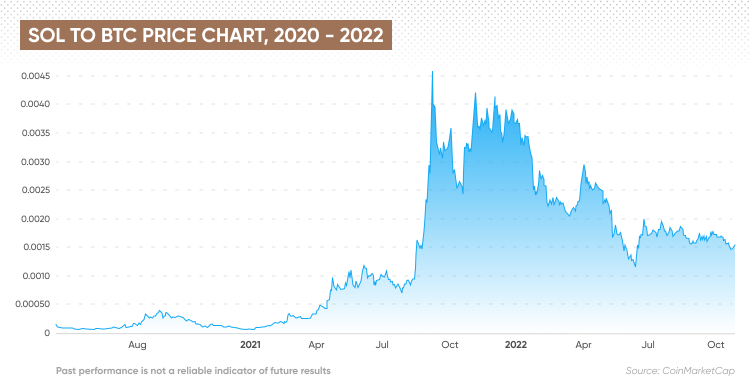
Since SOL’s launch in 2020, the SOL to BTC rate struggled to pick up momentum, moving sideways for around 10 months before starting to gain speed at the end of February 2021.

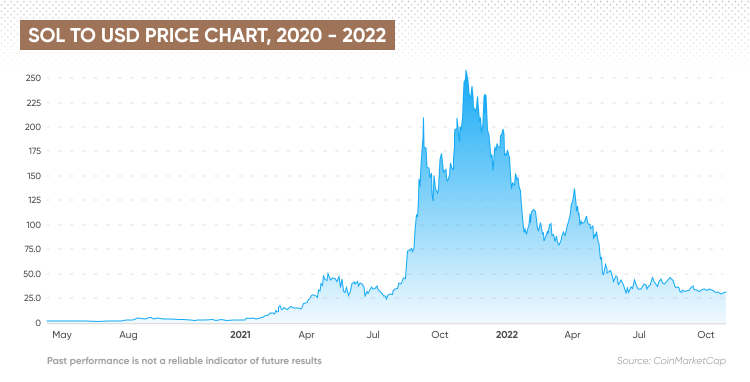
Between late February 2021 and mid-August 2021 the pairing fluctuated between values as low as 0.0001781BTC and as high as 0.001179BTC. The SOL to USD price chart followed a similar trend, fluctuating between $13 and $49.

SOL to BTC price chart, 2020 - 2022

Between 15 August 2021 and 9 September 2021, however, the SOL/BTC pair surged, rising by more than 385%, up from 0.0009374BTC to 0.004576BTC as Solana was being discovered by a number of celebrities, such as Mike Tyson and Jason Derulo. This was also the time when the SOL to BTC reached its all-time high, as seen on the price chart above.

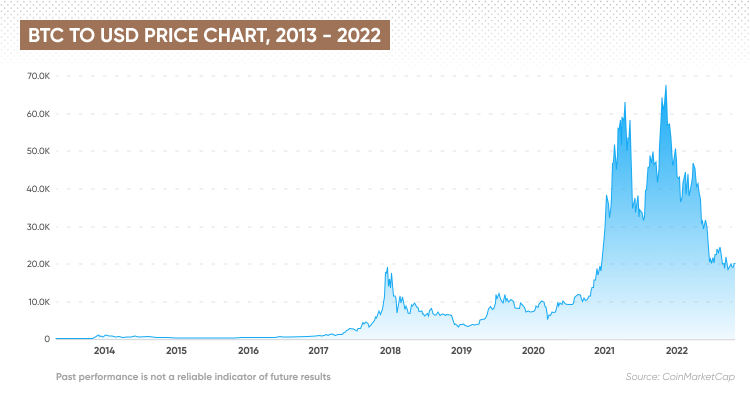
Between 9 September 2021 and 20 October 2021 the SOL/BTC price lost nearly 50% of its gains, dropping to 0.002425BTC as the BTC price in US dollars started to see major gains, surging by around 39% within the period from $46,000 to $64,000.

BTC to USD price chart, 2013 - 2022

In line with other major cryptocurrencies, the SOL/BTC rate regained a big portion of its losses as it rose to 0.004202BTC by 7 November 2021, at the time when the SOL value in USD reached its all-time high of $258.78.

SOL to USD price chart, 2020 - 2022

Up until the start of January 2022, the SOL to BTC exchange rate was fluctuating between 0.004000BTC and 0.003000BTC before falling more than 60% to 0.001149BTC on 13 June 2022, amid overall broad negative investor sentiment.

In terms of technical analysis, the chief digital advisor at the Mongolian Productivity Organisation and author of NFT: From Zero to Hero, Anndy Lian, told Capital.com that the SOL price could be headed towards a trend reversal, as of 28 October.

“The Relative Strength Index (RSI) indicates that the token is in the overbought zone, signalling a reversal could be on the way,” he said.

The pairing’s current exchange rate (28 October) is 0.00151BTC, up by 31.4% since its 13 June 2022 dip.

What is driving SOL/BTC?

On 30 September 2022, the Solana Mainnet Beta cluster experienced an outage, which led to a temporary collapse in the blockchain. This saw the SOL to BTC exchange rate drop by 3.1% within a week, down to 0.001682BTC by 7 October 2022, from 0.001735BTC on the day of the outage.

Dr. Pooja Lekhi, professor of global financial institutions, risk management approach and financial management at University Canada West, told Capital.com:

“Solana has experienced several recent network outages and failures. In the beginning of June, validators in the network stopped processing new blocks for several hours and apps built on Solana’s blockchain were taken offline, which sent its price down more than 12%.”

Projects built on Solana have potential to affect the token’s future price. On 27 October, the Web3 platforms built on Solana Decentralised Engineering Corporation (DEC) and Teleport announced that they have raised funding to bring a Web3 Uber rival (TRIP) to the Solana blockchain, something Ethereum co-creator Vitalik Buterin theorised a while back.

Lian noted that bringing the ridesharing industry to the Solana ecosystem “would surely put SOL into a high utility mode”.

In addition, Solana had partnered with artist Nancy Baker Cahill. She launched her first NFT collection on the blockchain that was shown across 90 billboards on Times Square. Metaplex, an NFT ecosystem built on Solana, also announced it was bringing a new asset class that will allow “creators to enforce royalties at the protocol level by extending the Token Metadata program, which powers 99%+ of all NFTs on Solana.”

Dr. Lekhi noted that until Solana network’s upgrade, “stability will remain a major concern for the SOL, adding:

“It is expected that the Mainnet version will stop the power outage issue. The SOL market had set higher benchmarks for its prices, along with developments in decentralised exchanges, Solana NFT marketplace, Yield aggregators and online games.”

The date for the upgrade launch is yet to be announced.

The enthusiasm surrounding Solana also comes following the news about Saga, its flagship Android phone, which will start shipping in 2023, Lian noted. Solana announced that Saga will have its first mint event on 28 October, which will only be available to those who pre-ordered the phone.

SOL/BTC price prediction

Based on the analysis of past performance, as of 28 October, algorithm-based forecasting service Wallet Investor predicted that SOL/USD could fall to $2.947 in 2023. The platform did not provide a price prediction for 2027.

In terms of its BTC value forecast, the site saw BTC/USD trade at $23,107.27 in 2023 and reach $36,574.97 by 2027.

While Wallet Investor did not provide a direct SOL to BTC forecast, data suggested that the exchange rate could be 0.00012754BTC in 2023.

DigitalCoinPrice predicted that SOL/USD could rise to $36.55 by the end of 2022. The site’s data, as of 28 October, showed that the coin was expected to trade at $49.68 in 2023 and $80.94 in 2025. Its long-term prediction saw the coin reaching $169.10 in 2030.

The site also gave an upbeat BTC/USD forecast, as of 28 October, expecting the coin to grow to $25,646.42 by the end of 2022, reach $33,474.34 in 2023, $53,010.14 in 2025 and surpass $112,000 in 2030.

DigitalCoinPrice’s SOL to BTC forecast for 2022 expected the pair to reach 0.0014252BTC and 0.0014841BTC in 2023. The site’s SOL/BTC forecast for 2025 stood at 0.0015269BTC. Its long-term SOL/BTC forecast for 2030 was 0.0015098BTC.

Dr. Lekhi noted that 2022 was not a good year for SOL, however, the coin may observe a steady growth in the coming months as a rebound in SOL’s price is anticipated.

Lian added that interest in SOL is “extremely high” which could mean that its future movement could be “overall positive”, adding that “with the strong ecosystem backing its value, the rebound can be promising.”

Remember that analysts’ and algorithm-based predictions can be wrong and shouldn’t be used as a substitute for your own research.

Always conduct your own due diligence on a cryptocurrency project before trading, looking at the latest news, a wide range of analyst commentary and technical analysis. Note that past performance does not guarantee future returns. And never trade money you cannot afford to lose.


Source: https://capital.com/sol-btc-prediction-solana-bitcoin-exchange

Anndy Lian is an early blockchain adopter and experienced serial entrepreneur who is known for his work in the government sector. He is a best selling book author- “NFT: From Zero to Hero” and “Blockchain Revolution 2030”.

Currently, he is appointed as the Chief Digital Advisor at Mongolia Productivity Organization, championing national digitization. Prior to his current appointments, he was the Chairman of BigONE Exchange, a global top 30 ranked crypto spot exchange and was also the Advisory Board Member for Hyundai DAC, the blockchain arm of South Korea’s largest car manufacturer Hyundai Motor Group. Lian played a pivotal role as the Blockchain Advisor for Asian Productivity Organisation (APO), an intergovernmental organization committed to improving productivity in the Asia-Pacific region.

An avid supporter of incubating start-ups, Anndy has also been a private investor for the past eight years. With a growth investment mindset, Anndy strategically demonstrates this in the companies he chooses to be involved with. He believes that what he is doing through blockchain technology currently will revolutionise and redefine traditional businesses. He also believes that the blockchain industry has to be “redecentralised”.

j j j