Why Building Community is the SECRET to Project Success! Interview with Anndy Lian X Eddy Gonzalez

Why Building Community is the SECRET to Project Success! Interview with Anndy Lian X Eddy Gonzalez

At Consensus 2025 in Hong Kong, Eddy Gonzalez, a Taiwan-based YouTuber, sat down with Anndy Lian, a renowned blockchain expert, best-selling author, to discuss the critical role of community in project success. The interview, titled “Why Building Community is the SECRET to Project Success!”, offered profound insights into the importance of community-driven strategies in the blockchain and Web3 space.

The Foundation of Success: Community

Anndy Lian opened the conversation with a powerful statement: “If you are a project owner trying to build a big project, you have to focus on community. And if you are an investor, please invest in projects that are sustainable.” This set the tone for the discussion, emphasizing that community is not just a marketing tool but the backbone of any successful venture in the blockchain ecosystem.

Lian elaborated on the shift from traditional marketing to community-driven approaches, stating, “In Web3, the community is not just an audience; it’s the backbone of every project. Unlike traditional marketing, where brands talk at consumers, Web3 thrives on co-creation and shared ownership. Communities are the ones who breathe life into projects, and their engagement can make or break a venture.” This sentiment underscores the transformative power of communities in the decentralized world.

The Evolution of Blockchain and Community

Reflecting on his journey in the blockchain space, Lian shared how he first encountered Bitcoin in 2013, primarily for transactional purposes. “Back then, I didn’t fully understand what Bitcoin could do, but I saw its potential for anonymous transactions in the advertising industry,” he recalled. Over time, his involvement deepened, and he became a key advisor to governments and a vocal advocate for blockchain technology.

Lian highlighted the importance of authenticity and transparency in building trust within communities. “People can sense when a project is genuine. At OG Peanut, we prioritize open communication and honesty. If we make a mistake, we own up to it and involve the community in finding solutions. This builds credibility and strengthens our bond with members,” he explained. This approach fosters loyalty and long-term engagement, which are crucial for project sustainability.

Challenges in Community Building

While the benefits of community-driven marketing are undeniable, Lian also addressed the challenges associated with it. He pointed out the difficulty of scaling community engagement as projects grow. “As your community expands, maintaining the same level of personal connection becomes challenging. At OG Peanut, we’ve had to invest in tools and processes to ensure that every member feels heard, even as our numbers grow,” he shared.

Another challenge is managing toxic behavior within communities. “Not all community members have positive intentions. We’ve had to implement strict moderation policies to prevent harassment and misinformation. Balancing openness with safety is a delicate act, but it’s crucial for maintaining a healthy community,” Lian explained. This highlights the need for robust governance structures to ensure a positive and inclusive environment.

The Role of AI in Community Engagement

The conversation also touched on the impact of AI on community interactions. Lian shared his experience testing AI agents, including one that cloned a friend of his. “The AI agent was incredibly smooth and almost indistinguishable from the real person. It’s a powerful tool, but it’s also a bit scary,” he noted. While AI can enhance community engagement, Lian emphasized the importance of maintaining genuine human connections. “AI is a good utility for projects, but it should supplement, not replace, real human interaction,” he advised.

Lian also highlighted the limitations of AI in handling volatile data. “AI agents struggle with up-to-date information, especially in fast-changing markets like cryptocurrency. Simple conversations are fine, but when it comes to real-time data, they fall short,” he explained. This underscores the need for a balanced approach, leveraging AI for efficiency while ensuring that human oversight remains central.

The Future of Community-Driven Marketing

Looking ahead, Lian expressed optimism about the continued evolution of community-driven marketing. “As technology advances, we’ll have even more tools to connect with and empower our communities. The key will be staying true to our values and prioritizing the human element,” he said. This vision aligns with the ethos of Web3, where decentralization and inclusivity are key principles.

Lian also emphasized the importance of sustainability in project development. “If you are a project owner, please work hard for your project. A lot of project owners are not focused, and that’s a big problem. To build a big project, you have to focus on community,” he advised. For investors, he recommended prioritizing projects that demonstrate long-term viability and a strong commitment to their communities.

Key Takeaways

The interview with Anndy Lian offered valuable insights into the role of communities as the secret to project success in the Web3 era. Key takeaways include:

  1. Authenticity and Transparency: Building trust through open communication and honesty is essential for fostering loyal communities.
  2. Scalability and Governance: As communities grow, maintaining personal connections and implementing robust governance structures are critical challenges.
  3. The Role of AI: AI can enhance community engagement but should supplement, not replace, genuine human interaction.
  4. Sustainability: Project owners must focus on building sustainable projects, and investors should prioritize ventures with long-term viability.
  5. Education and Safety: Newcomers to the blockchain space should take the time to educate themselves and prioritize safety in their investments.

Anndy Lian’s insights underscore the transformative potential of communities in the blockchain space, offering a roadmap for projects looking to harness this powerful marketing tool. As the industry continues to evolve, the principles of authenticity, transparency, and sustainability will remain central to building successful and impactful projects.

For those interested in learning more from Anndy Lian, he can be found on Twitter and his personal website, where he regularly shares valuable insights and advice on blockchain and community building.

Anndy Lian is an early blockchain adopter and experienced serial entrepreneur who is known for his work in the government sector. He is a best selling book author- “NFT: From Zero to Hero” and “Blockchain Revolution 2030”.

Currently, he is appointed as the Chief Digital Advisor at Mongolia Productivity Organization, championing national digitization. Prior to his current appointments, he was the Chairman of BigONE Exchange, a global top 30 ranked crypto spot exchange and was also the Advisory Board Member for Hyundai DAC, the blockchain arm of South Korea’s largest car manufacturer Hyundai Motor Group. Lian played a pivotal role as the Blockchain Advisor for Asian Productivity Organisation (APO), an intergovernmental organization committed to improving productivity in the Asia-Pacific region.

An avid supporter of incubating start-ups, Anndy has also been a private investor for the past eight years. With a growth investment mindset, Anndy strategically demonstrates this in the companies he chooses to be involved with. He believes that what he is doing through blockchain technology currently will revolutionise and redefine traditional businesses. He also believes that the blockchain industry has to be “redecentralised”.

j j j

Fostering Trust and Building Communities: Anndy Lian’s Vision for the Future of Web3 at Hong Kong Consensus 2025

Fostering Trust and Building Communities: Anndy Lian’s Vision for the Future of Web3 at Hong Kong Consensus 2025

The Hong Kong Consensus 2025 spotlight stage brought together some of the most influential voices in the blockchain and Web3 space. Among the key highlights was a presentation by Thomas Kay, Vice President of WEEX Global, followed by a fireside chat with Anndy Lian, a best-selling author and blockchain strategist. While Thomas Kay’s presentation showcased WEEX Global’s impressive growth and innovative features, the fireside chat with Anndy Lian provided a deeper exploration of the challenges and opportunities in Web3, with a particular focus on community building, the evolving role of exchanges, and the sustainability of blockchain projects.


WEEX Global: A Rapidly Growing Exchange

Thomas Kay opened the session with an overview of WEEX Global’s remarkable journey since its founding in 2018. The exchange has grown exponentially, now serving over 6 million users globally and achieving a daily trading volume of $5 billion. WEEX has distinguished itself with its extensive range of trading pairs, top-tier liquidity, and innovative features such as 400x leverage.

Thomas also emphasized WEEX’s commitment to security, highlighting the establishment of a 1,000 BTC protection fund and robust risk management systems. With a focus on global expansion and compliance, WEEX is positioning itself as a leader in the cryptocurrency exchange space.

While the presentation underscored WEEX’s achievements, the fireside chat with Anndy Lian shifted the focus to broader industry challenges and the critical role of community building in the Web3 ecosystem.

Anndy Lian, a best-selling author and blockchain strategist


Fireside Chat: The Complexities of Building Communities

The fireside chat began with Thomas asking Anndy about the challenges of building communities in the Web3 space. Anndy, known for his candid and insightful commentary, shared his perspective on the evolving dynamics of community engagement.

“Building a community is far more challenging than it appears,” Anndy remarked. He explained that the landscape has changed significantly since 2018. Back then, users were less informed, and simple incentives like airdrops were enough to attract attention. Today, however, users are more sophisticated and demand genuine value. “You can’t just throw airdrops at people and expect them to stay. Communities need to be built on trust, value, and a long-term vision,” he emphasized.

Anndy stressed the importance of creating a loyal community that aligns with a project’s goals. “We don’t need communities that come for the incentives and leave the next day. We need communities that stay because they believe in what you’re building,” he added.

Anndy Lian, a best-selling author and blockchain strategist


The Role of Exchanges in Supporting Communities

Thomas and Anndy also explored the role of exchanges in fostering strong communities. Thomas highlighted WEEX’s commitment to backing projects that prioritize meaningful community engagement. “We want to support projects that are building loyal communities, not just chasing short-term gains,” he said.

Anndy agreed, emphasizing the need for unity within the Web3 ecosystem. “Exchanges, big projects, and smaller projects need to work together. Emerging markets like Russia, Kenya, and Brazil offer immense potential, and collaboration can unlock new opportunities,” he noted. He also underscored the importance of transparency, particularly regarding listing fees. “Users are getting smarter. They’re asking tough questions about how exchanges operate, and transparency is key to building trust,” he explained.

Anndy Lian, a best-selling author and blockchain strategist


The Future of Exchanges: Security and Accessibility

When asked about the future role of exchanges in the Web3 space, Anndy identified two critical areas: security and accessibility. “Users want exchanges that offer an extra layer of security. They also want seamless on-ramp and off-ramp solutions to move their funds safely and efficiently,” he said.

Thomas echoed this sentiment, pointing to WEEX’s efforts to enhance security through its protection fund and compliance initiatives. He also acknowledged the challenges posed by “key opinion leaders” (KOLs) who often prioritize short-term traffic over long-term value. “Not every KOL is worth partnering with. We focus on working with genuine users and communities,” he stated.

Anndy Lian, a best-selling author and blockchain strategist


Meme Coins: A Gateway to Web3 Adoption

The conversation then shifted to the role of meme coins in the Web3 ecosystem. Anndy described meme coins as “door openers” that attract new users to the space. However, he cautioned that their success depends on strong community backing and a clear roadmap. “A typical roadmap starts with a meme, followed by utility, and eventually evolves into something bigger, like merchandise or even global franchises,” he explained.

Anndy shared an example of how a meme-based project could transition into a sustainable business. “Imagine an ‘Anndy Café’ that becomes a global clubhouse for networking. The revenue from the café could be used to support the project, creating a self-sustaining ecosystem,” he suggested.

He also highlighted the importance of partnerships in ensuring the longevity of meme projects. “If you’re not in the top 300 or 500, survival is tough. Partnering with exchanges and other Web3 players can make a big difference,” he said.


Sustainability in Web3 Projects

Anndy didn’t shy away from addressing the challenges faced by Web3 projects. He criticized projects with poor leadership and no clear plans for sustainability. “Most memes fail because they have no roadmap and no real leaders. They’re just boosting sentiment without delivering results,” he said.

He urged projects to focus on building real value for their communities. “Your community should work for their own bags. If they’re invested in the project’s success, it will last much longer,” he advised. He also called on exchanges to prioritize quality over quantity when listing projects. “Instead of giving money to KOLs, give it to the projects that are building something meaningful,” he suggested.


Transparency and Trust: The Cornerstones of Web3

The fireside chat concluded with a discussion on the importance of transparency in the Web3 space. Anndy praised WEEX for its efforts to be transparent about its operations and partnerships. “Transparency builds trust, and trust is the foundation of any successful community,” he said.

Thomas agreed, emphasizing that WEEX is committed to supporting projects that align with their values. “We’re not just looking for short-term gains. We want to build long-term partnerships with projects that share our vision,” he said.


Final Thoughts

The fireside chat between Thomas Kay and Anndy Lian at Hong Kong Consensus 2025 offered a wealth of insights into the challenges and opportunities in the Web3 space. From the importance of community building to the evolving role of exchanges, the discussion highlighted the need for collaboration, transparency, and long-term vision.

As the Web3 ecosystem continues to grow, the lessons shared by Anndy and Thomas will undoubtedly serve as a valuable guide for projects, exchanges, and communities alike. Whether through innovative features, strong partnerships, or a commitment to transparency, the future of Web3 will be shaped by those who prioritize value and trust above all else.


Read more at: https://anndy.com/event/fostering-trust-and-building-communities-anndy-lians-vision-for-the-future-of-web3-at-hong-kong-consensus-2025/


Anndy Lian is an early blockchain adopter and experienced serial entrepreneur who is known for his work in the government sector. He is a best selling book author- “NFT: From Zero to Hero” and “Blockchain Revolution 2030”.

Currently, he is appointed as the Chief Digital Advisor at Mongolia Productivity Organization, championing national digitization. Prior to his current appointments, he was the Chairman of BigONE Exchange, a global top 30 ranked crypto spot exchange and was also the Advisory Board Member for Hyundai DAC, the blockchain arm of South Korea’s largest car manufacturer Hyundai Motor Group. Lian played a pivotal role as the Blockchain Advisor for Asian Productivity Organisation (APO), an intergovernmental organization committed to improving productivity in the Asia-Pacific region.

An avid supporter of incubating start-ups, Anndy has also been a private investor for the past eight years. With a growth investment mindset, Anndy strategically demonstrates this in the companies he chooses to be involved with. He believes that what he is doing through blockchain technology currently will revolutionise and redefine traditional businesses. He also believes that the blockchain industry has to be “redecentralised”.

j j j

JASMY/USD forecast: Building JasmyCoin trading volumes may be setting stage for price rebound

JASMY/USD forecast: Building JasmyCoin trading volumes may be setting stage for price rebound

Jasmycoin (JASMY) has been spiralling downwards for over a year, losing more than 99% of its value since its $1.8 peak at the end of May 2021. At the time of writing on 4 November 2022, the coin traded at $0.005728.

However, its trading volumes have been on a rise, up at $119m on 4 November 2022, surpassing its 31 July 2021 high of $97m.

With a number of projects on the way, can the cryptocurrency pick up its pace?

Let’s take a deep dive into the jasmycoin universe, including the latest JASMY/USD forecast round-up.

What is Jasmy/USD?

Jasmy is a Tokyo-based IoT company that specialises in data management, and the safe purchasing and selling of data. It was established in April 2016 and dubbed “Japan’s bitcoin”.

The company is headed by former Sony (SNE) executives Kunitake Ando and Kazumasa Sato, and Hiroshi Harada, a former employee at KPMG AZSA LLP.

The Jasmy platform combines blockchain and Internet of things (IoT) technologies “to provide an infrastructure that allows anyone to use data safely and securely”.

In an interview with Binance, Jasmy’s CFO, Hiroshi Harada noted that the blockchain’s main purpose is to “create a mechanism/platform which allows all users to take ownership of their own data in a secure and private manner.

“Instead of letting a handful of big tech corporations take control of such sensitive data, Jasmy aims to help enable a world where everyone can feel safe and secure about the use of their own data.”

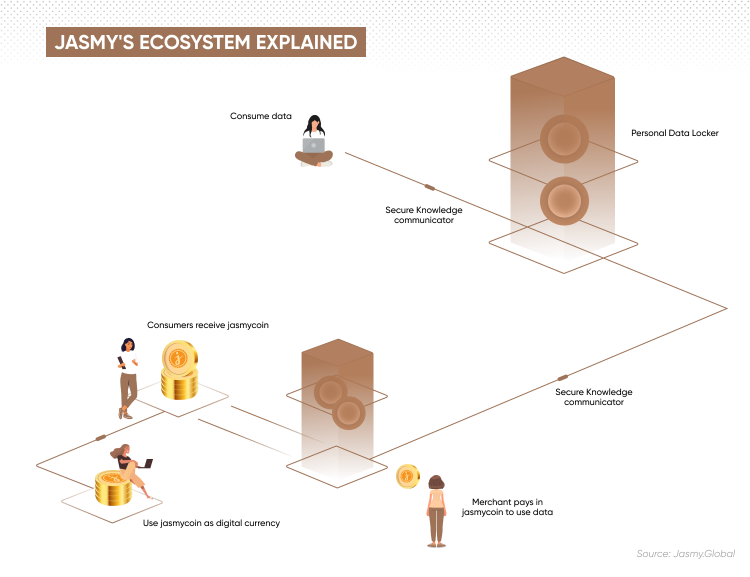
The platform allows for the safe storage of personal information through its Personal Data Locker (PDL) which provides users with full ownership over their data. In addition to that, Jasmy also has a Secure Knowledge Communicator (SKC), its core service responsible for the achievement of data democratisation.

Jasmy's ecosystem explained

Merchants pay users who store their data on Jasmy for access using the platform’s native cryptocurrency, JasmyCoin (JASMY), which can be used by users for investment purposes, governance and metaverse utility. JASMY is an ERC-20 token built on the Ethereum (ETH) ecosystem.

In the future, Jasmy also aims to provide IoT solutions to manufacturers interested in the smart home market and local governments in pursuit of a smart city.

The maximum number of JASMY coins is capped at 50 billion, with over 4.7 billion tokens in circulation, based on data provided by CoinMarketCap, as of 2 November. According to the platform, the token has a market capitalisation surpassing $24m.

A dip in the price trend

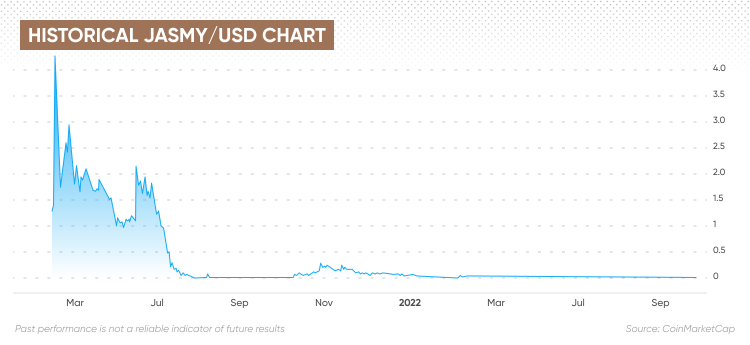
Historical JASMY/USD chartJasmycoin started its journey well, surging by around 230% in just four days, up from $1.3024 on 12 February 2021 to its all-time high of $4.2929 on 16 February 2021 as the coin was listed on Gate.io.

In the next four days, however, JASMY dropped more than 58% to $1.7. It surged in the following weeks, jumping by 67% to $2.9628 by 2 March 2021, ahead of its listing on the Jubi exchange.

After falling by around 39% to $1.8 on 7 March 2021, JASMY managed to surge past the $2 barrier as the project joined GitHub, a platform where users could discuss it.

By 24 April 2021, JASMY had lost over 50% of its value, falling to $0.9866, a then all-time low. The token continued to move sideways before skyrocketing to $2.1586 on 6 May 2021 following a staking campaign organised by Gate.io, which ran for 14 days between late April 2021 and early May 2021.

Since the mini-hike at the start of May 2021, JASMY has been struggling to pick up pace, embarking on a bear dip and losing over 97% of its value, down to $0.05456 by 20 June 2021.

In the final quarter of 2021, JASMY saw a brief spike, in line with overall positive market sentiment and its listing on the crypto exchange Coinbase, as its price surged 409.7% to $0.2781 on 3 November 2021.

The positive trend diminished as the token entered the new year, with its value falling by 95% by the start of March 2022. Since then, JASMY has been trading in bear territory at $0.005728, as of 4 November 2022.

Why the dip?

A few analysts brought up a number of reasons as to why JASMY had crashed in June 2021.

Martin Škorjanc, the CEO of NiceHash, told Capital.com that the bearish trend was likely driven by unfriendly crypto news in Japan and the fact that Jasmy Inc. decided to release too many tokens at the same time with no solid mechanism for managing their circulation.

The token’s unfamiliarity among investors was also a reason for its price to significantly drop, Dr Pooja Lekhi, Professor of Global Financial Institutions, Risk Management Approach and Financial Management at University Canada West said.

“Secondly, some rivals have advantages over Jasmy. IOTA crypto was an early mover in this space with many established partnerships. Therefore, it took more time for Jasmy to prove its worth.”

News driving the Jasmy/USD rate

On 31 October 2022, JasmyCoin was listed on the Stealth crypto exchange making it eligible to trade with more than 600 other assets. This saw the token’s trading volume reach an all-time high of $99.4m on the day.

On 5 September 2022, Jasmy announced that the token became the official sponsor of the Japanese professional football club, Sagan Tosu. In addition to becoming a sponsor, Jasmy also launched the Sagan Tosu Fan Token, a new cryptocurrency that uses non-fungible tokens (NFTs) and is based on the Jasmy blockchain, thus seeing the company enter an entirely new market.

In an interview with Binance recorded in early September 2022, the blockchain’s CFO, Harada, noted that Jasmy was exploring the idea of launching its NFTs onto other broader marketplaces such as Binance NFT, OpenSea and Magic Eden in the future, thus further expanding their niche.

Harada also mentioned a number of projects that Jasmy is working on in the third quarter of 2022, which have the potential to influence the future of the JASMY/USD forecast including:

  • The development of the DD coin, the Japanese Yen-backed stablecoin that will be incorporated into the ecosystem
  • The development of the Platinum Data Happiness Discovery Project, that will award users who participate in the project JASMY tokens and help them identify which data is tied to their happiness through the use of artificial intelligence

JASMY/USD forecast 2023 and beyond

At the time of writing, the algorithm-based forecasting service Wallet Investor gave a mixed jasmycoin to the US dollar forecast. The site noted that JASMY was “a bad long-term investment”, expecting the token to fall to $0.000350 in 2023 but surge to $0.009099 in 2027.

DigitalCoinPrice on the other hand gave a more positive JASMY/USD forecast. Based on its analysis of past price performance, the website predicted that the JASMY/USD forecast for 2022 could reach $0.00706 by the end of the year and surge to an average of $0.00949 in 2023.

Its JASMY/USD forecast for 2025 showed the cryptocurrency reaching $0.0149 on average and $0.0179 in 2027. The platform’s long-term JASMY/USD forecast for 2030 expected the cryptocurrency to surge to $0.0316 on average.

The founder of SmartBlocks and host of Cryptonized, Mark Fidelman, told Capital.com that in the long run the token has potential to surge due to it being known as “the Japanese bitcoin”.

“I wouldn’t be a buyer at this point, but a token to watch,” Fidelman added.

Anndy Lian, chief digital advisor at the Mongolian Productivity Organisation and author of NFT: From Zero to Hero, also brought up the fact that because JASMY is known as the local bitcoin, it is supported by many.

He noted that in order for JASMY to grow, the company must start to develop it “outside of Japan and grow their footprint in key market”, noting:

“Additionally, I do hope to also see their enterprise services get more adoption instead of moving into offering fan token. They should focus on real utilisation according to their mission and this is the only way the project will grow in value.”

When considering JASMY/USD predictions, it’s important to keep in mind that cryptocurrency markets remain extremely volatile, making it difficult to accurately predict what a coin or token’s price will be in a few hours, and even harder to give long-term estimates. As such, analysts and algorithm-based forecasters can and do get their predictions wrong.

We recommend that you always conduct your own due diligence on the asset before trading, looking at the latest news, a wide range of analyst commentary, and technical and fundamental analysis. Keep in mind that past performance is no guarantee of future returns. And never invest money that you cannot afford to lose.


Source: https://capital.com/jasmy-usd-forecast-dollar-jasmycoin-crypto-price-volume

Anndy Lian is an early blockchain adopter and experienced serial entrepreneur who is known for his work in the government sector. He is a best selling book author- “NFT: From Zero to Hero” and “Blockchain Revolution 2030”.

Currently, he is appointed as the Chief Digital Advisor at Mongolia Productivity Organization, championing national digitization. Prior to his current appointments, he was the Chairman of BigONE Exchange, a global top 30 ranked crypto spot exchange and was also the Advisory Board Member for Hyundai DAC, the blockchain arm of South Korea’s largest car manufacturer Hyundai Motor Group. Lian played a pivotal role as the Blockchain Advisor for Asian Productivity Organisation (APO), an intergovernmental organization committed to improving productivity in the Asia-Pacific region.

An avid supporter of incubating start-ups, Anndy has also been a private investor for the past eight years. With a growth investment mindset, Anndy strategically demonstrates this in the companies he chooses to be involved with. He believes that what he is doing through blockchain technology currently will revolutionise and redefine traditional businesses. He also believes that the blockchain industry has to be “redecentralised”.

j j j