Coinbase’s MPI License: A Game-Changer For Crypto In Singapore, But A Challenge For Competitors

Coinbase’s MPI License: A Game-Changer For Crypto In Singapore, But A Challenge For Competitors

Coinbase, the largest cryptocurrency exchange in the US, has recently obtained a Major Payment Institution (MPI) licence from the Monetary Authority of Singapore (MAS), the country’s central bank and financial regulator. This licence will allow Coinbase to offer regulated digital payment token (DPT) products and services in Singapore, such as buying and selling cryptocurrencies, storing them in wallets, and transferring them to other users.

They not the first crypto exchange to receive an MPI licence from MAS. In June 2023, two other platforms, Crypto.com and Circle, were also granted full licences after obtaining in-principle approvals in 2021. However, Coinbase is arguably the most prominent and influential one among them, given its global reach, market capitalization, and reputation.

Coinbase’s entry into the Singaporean market is seen by many as a positive sign for the crypto industry in the region, as it reflects the country’s openness and support for innovation and digital finance. Singapore has been widely regarded as a crypto-friendly jurisdiction, with a clear and progressive regulatory framework for DPT service providers under the Payment Services Act (PSA) that came into effect in 2020.

According to the PSA, any entity that provides DPT services in Singapore must obtain a licence from MAS, either as a standard payment institution (SPI) or as an MPI. The difference between the two types of licences lies in the scale and scope of their operations. SPIs can provide any combination of regulated payment services, but are subject to transactional volume or e-money limits. MPIs have no such limits, but are subject to more stringent requirements, such as safeguarding customer funds, complying with anti-money laundering and counter-terrorism financing rules, and submitting regular audits and reports to MAS.

By obtaining an MPI licence, Coinbase has demonstrated its ability and willingness to meet the high standards set by MAS for DPT service providers. This could give it a competitive edge over other crypto exchanges that operate in Singapore, especially those that have not yet obtained a licence or are still waiting for approval.

As mentioned on MAS’s website, there are currently 170 entities that have applied for a licence under the PSA, but only three have been granted full licences so far (Coinbase, Crypto.com, and Circle). Among the applicants are some of the most popular and well-known crypto exchanges in Singapore, such as Binance, Kraken, Coinhako, Gemini, and Independent Reserve. These exchanges have been allowed to continue their operations while their applications are being processed by MAS, under a grace period that was initially supposed to end on July 28, 2021. However, due to the large number of applications and the complexity of the assessment process, MAS has extended the grace period for most applicants until January 28, 2023.

This means that these exchanges have less than four months left to obtain their licences from MAS, or they will have to cease their DPT services in Singapore. This could pose a significant challenge and risk for them, as they may lose their market share and customer base to Coinbase and other licensed platforms.

Competitive Challenges For Other Crypto Exchanges

While Coinbase’s MPI license is undoubtedly a boon for the company, it also presents a competitive challenge for other crypto exchanges operating in Singapore. Here are some key challenges they are likely to face:

  • Regulatory Compliance Pressure: The foremost challenge for competitors is the need to meet the stringent regulatory standards set by MAS. Coinbase’s compliance with these standards sets a high bar, and other exchanges will need to invest significant resources to achieve similar levels of regulatory approval.
  • Increased Competition: Coinbase’s entry into the Singaporean market intensifies competition. As a well-established global exchange, Coinbase has a strong brand presence and the resources to invest in marketing, user acquisition, and product development. Competitors will need to step up their game to compete effectively.
  • User Trust and Confidence: Coinbase’s MPI license not only signifies regulatory compliance but also implies a higher degree of trust and confidence from users. Competitors will need to work harder to gain the trust of customers and differentiate themselves in a market where regulatory compliance and security are paramount.

Recommendations For Success In The Singaporean Crypto Market

To thrive in this evolving landscape and address the challenges posed by Coinbase’s MPI license, crypto exchanges in Singapore should consider several strategic approaches:

  • Collaborate with Local Partners: Building relationships with local financial institutions, fintech companies, and government agencies can help crypto exchanges navigate the complex regulatory landscape in Singapore. Collaborations can also open doors to new markets and customer segments.
  • Innovate New Products and Services: To stand out in a competitive market, exchanges should focus on innovation. Developing new products and services that cater to the unique needs and preferences of Singaporean users can help differentiate them from Coinbase and other competitors.
  • Educate Customers and Regulators: Crypto exchanges should actively engage in educational initiatives aimed at both customers and regulators. Providing resources and information on responsible crypto use, security practices, and the benefits of blockchain technology can help build trust and bridge knowledge gaps.
  • Adapt to Changing Market Conditions: The crypto industry is known for its rapid evolution. Exchanges must remain agile and adaptable to changing market conditions, regulatory updates, and technological advancements. Staying ahead of the curve can be a key differentiator.
  • Foster Regulatory Relationships: Building positive relationships with regulators is essential. Exchanges should actively engage with regulatory authorities, participate in industry consultations, and contribute to the development of fair and effective crypto regulations.
  • Emphasize Security and Compliance: Like Coinbase, prioritizing security measures and regulatory compliance is non-negotiable. Exchanges should invest in robust security infrastructure and continuously monitor for potential vulnerabilities or risks.
  • Customer-Centric Approach: To succeed in a competitive market, exchanges should prioritize the needs and concerns of their customers. Providing excellent customer service, transparent fee structures, and responsive support channels can help build loyalty and trust.
  • Diversify Product Offerings: Beyond trading, exchanges should consider diversifying their product offerings. This could include services like staking, lending, or even non-fungible tokens (NFTs). Diversification can attract a broader user base and increase revenue streams.

In Conclusion

Coinbase’s MPI license from MAS is a watershed moment for the cryptocurrency industry in Singapore. It signifies not only the legitimization of digital assets but also the importance of regulatory compliance and security within the sector. While this development poses competitive challenges for other crypto exchanges operating in the country, it also sets a high standard that can benefit the entire industry.

Success in the Singaporean crypto market will require a combination of regulatory adherence, innovation, customer education, and adaptability. By focusing on these aspects and strategically positioning themselves, other exchanges can thrive alongside Coinbase in this dynamic and rapidly evolving sector. Ultimately, the success of these exchanges will contribute to the broader adoption and acceptance of cryptocurrencies in Singapore and around the world.



Source: https://www.benzinga.com/23/10/35201460/coinbases-mpi-license-a-game-changer-for-crypto-in-singapore-but-a-challenge-for-competitors

Anndy Lian is an early blockchain adopter and experienced serial entrepreneur who is known for his work in the government sector. He is a best selling book author- “NFT: From Zero to Hero” and “Blockchain Revolution 2030”.

Currently, he is appointed as the Chief Digital Advisor at Mongolia Productivity Organization, championing national digitization. Prior to his current appointments, he was the Chairman of BigONE Exchange, a global top 30 ranked crypto spot exchange and was also the Advisory Board Member for Hyundai DAC, the blockchain arm of South Korea’s largest car manufacturer Hyundai Motor Group. Lian played a pivotal role as the Blockchain Advisor for Asian Productivity Organisation (APO), an intergovernmental organization committed to improving productivity in the Asia-Pacific region.

An avid supporter of incubating start-ups, Anndy has also been a private investor for the past eight years. With a growth investment mindset, Anndy strategically demonstrates this in the companies he chooses to be involved with. He believes that what he is doing through blockchain technology currently will revolutionise and redefine traditional businesses. He also believes that the blockchain industry has to be “redecentralised”.

j j j

ETH to BTC prediction: Will post-Merge Ethereum rise to challenge Bitcoin domination?

ETH to BTC prediction: Will post-Merge Ethereum rise to challenge Bitcoin domination?

Bitcoin (BTC), the crypto market pioneer, is, by market capitalisation, twice the size of ethereum (ETH), the second largest coin. Will ETH eclipse BTH following successful completion of The Merge that saw it switch to the proof-of-stake (PoS) consensus mechanism?

Here we take a look at the ETH to BTC exchange rate, and what factors are shaping ETH/BTC in 2022 and beyond.

What is ETH/BTC?

ETH/BTC represents the exchange rate between ether, the Ethereum blockchain’s native coin, and bitcoin, the native coin on the Bitcoin Network.

ETH/BTC represents how many bitcoins can be bought for one ether, with the rise in ETH/BTC signifying either a rise in ETH or fall in BTC, and vice-versa.

BTC was meant to be “a purely peer-to-peer version of electronic cash”. However, over the years the cryptocurrency has also become a store of value and a comparison to gold as a hedge against rising inflation.

Bitcoin mining relies on a blockchain that connects all public transactions. Using a proof-of-work (PoW) consensus, BTC miners compete against one another to solve mathematical equations and confirm the legitimacy of transactions. They are rewarded in BTC tokens.

In order to reduce the rate at which new BTCs are given as rewards, the cryptocurrency was designed to undergo halving events roughly every four years. A halving reduces the number of bitcoins released into circulation by half, limiting supply.

Ethereum, a programmable network for building decentralised applications (dApps), was launched in 2015, and was inspired by bitcoin’s limitations.

“While Bitcoin is only a payment network, Ethereum is more like a marketplace of financial services, games, social networks and other apps that respect your privacy and cannot censor you,” Ethereum’s website says.

Another key element of Ethereum is the blockchain’s ability to run smart contracts – computer programmes on the blockchain that allow for the creation and smooth running of dApps.

Just like BTC, ETH initially used a PoW mechanism, but since 15 September 2022 relies on PoS. The change became known as ‘The Merge’, and was designed to reduce Ethereum’s energy consumption by around 99.95%.

The Merge is one of a series of upgrades. In a July presentation, the platform’s co-founder, Vitalik Bouterin, named the following development stages, but did not specify when they will happen:

  • The Surge – the addition of Ethereum sharding, which will lower the cost of bundle transactions and make operating easier.
  • The Verge – users will be able to become validators without having to store large amounts of data.
  • The Purge – will simplify the Ethereum protocol and cut down on the amount of space the blockchain uses.
  • The Splurge – this upgrade includes “all of the other fun stuff”.

These updates also have potential to affect the ETH price  shaping the ETH to BTC exchange rate.

ETH to BTC historical rate chart

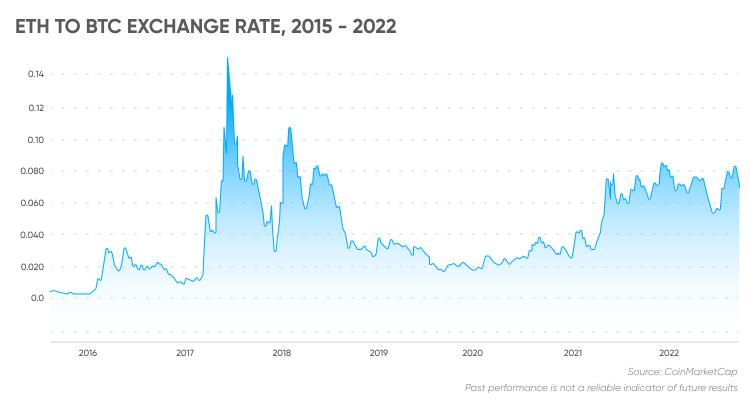
The ETH to BTC exchange rate surged by 2,518% in the first two years after the pair started trading, from 0.005767BTC in August 2015 to the all-time high of 0.151BTC in June 2017, signifying the quicker rise in ether’s price.

However, this peak in the ETH to BTC price chart did not last long. The exchange rate fell to 0.02427BTC in December 2017 – down 83.9% since the June peak.ETH to BTC exchange rate, 2015 - 2022

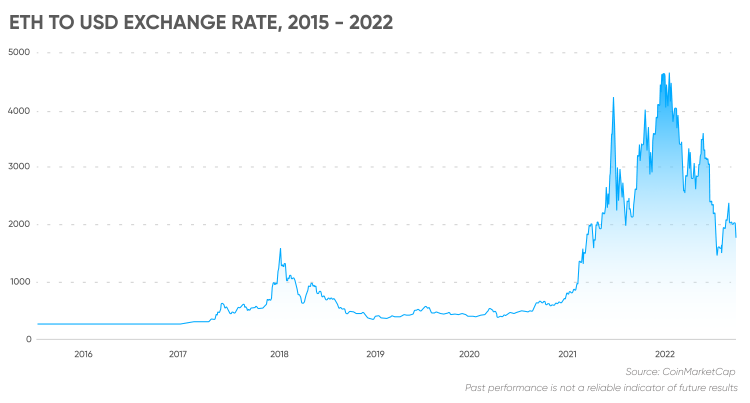
The ETH value reached $1,396.42 in January 2018, and the ETH to BTC rate jumped to 0.09724 BTC.

ETH to USD exchange rate, 2015 - 2022

ETH managed to uphold its positive trend against BTC for the next three weeks as the price chart gained 16% more, peaking at 0.1131BTC on 1 February 2018.

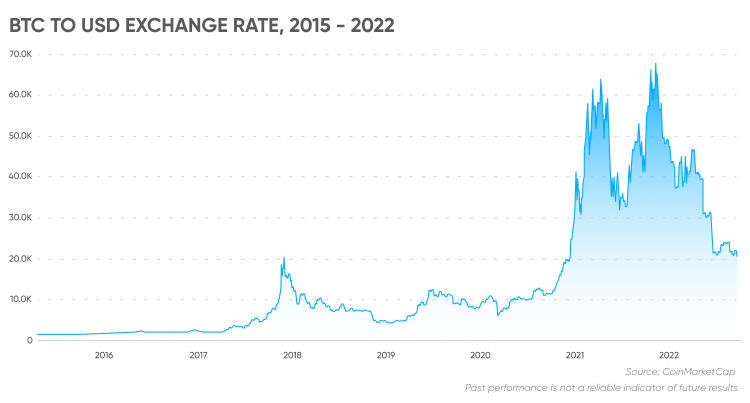
ETH to BTC performed fairly well for the duration of 2021, peaking in mid-May at 0.08178BTC, when the ETH price reached $4,168.7 and BTC was trading at $50,000.

The ETH/BTC pairing was not hugely affected when the BTC value reached its all-time high of $66,971.83 in November 2021, It did peak in December 2021 at 0.0879BTC after briefly falling to 0.06034BTC on 19 October 2021.

BTC to USD exchange rate, 2015 - 2022

Following the collapse of the TerraUSD (UST) stablecoin and its sister token LUNA and the wider crypto crash that followed, the ETH to BTC exchange rate fell by nearly 30% from 0.07554BTC in May 2022 to 0.05373BTC in July, indicating a faster decline of ETH price.

ETH’s price dipped to as low as $993 in June, with BTC slumping to $19,017 amid the bearish sentiment in the cryptocurrency world sparked by LUNA collapse and tightening monetary policy.

Ether rose  to 0.0846BTC in September 2022 in anticipation of The Merge. The current exchange rate stood at 0.07088 BTC, as of 20 September.

Is The Merge driving ETH/BTC?

On 15 September Ethereum successfully upgraded its system from PoW to PoS after a six-year build-up. However, the ETH price did not rally as much as investors were anticipating.

Anndy Lian, chief digital advisor at the Mongolian Productivity Organisation and author of NFT: From Zero to Hero. noted that right after The Merge, the price swung above $1,640 and fell shortly after:

“This is very much expected. There was much influx of ETH into various exchanges since the 12th and then building up to around 1.8 million ETH before the completion. In this case, I see that investors could be planning to sell off before the price fell.”

Lars Seier Christensen, chairman of the Concordium Foundation and founder of Saxo Bank, said that the Ethereum community anticipated a “much more positive reaction to the successful Merge”. He added that the recent rally was what in TradFi we call “buy the rumour, sell the fact” and that whoever saw The Merge as upbeat news had already bought ETH.

“Merge is really a non-event. It changes nothing in terms of scalability or fees, and actually antagonises a number of long-term Ethereum supporters – the miners,” he added.

Eugene Zomchak, CoinLoan’s head of product, told Capital.com that the value of ETH to BTC is likely affected by other microeconomic factors such as the cryptowinter and the Fed’s policy tightening than The Merge, noting:

“There are some positive forecasts coming in from enthusiasts who note that the Merge was a landmark event and the price of ether could surge by two, three and even five times.”

Since The Merge, the BTC price has been fluctuating between $19,000 and $20,000. ETH reached $1,469.74 on 17 September before falling to around $1,300, as of 20 September.

Lian stressed that it is important investors remind themselves that the effects of The Merge, possibly including the ETH to BTC price, will only be felt in the long-term:

“The gas fees will remain the same, and other scalability issues are still unsolved. The community at large must wait for Surge, Verge, Purge, and Splurge improvements to see a reduction in transaction costs and boost scalability significantly.”

Concordium Foundation’s Christensen also noted that the current market environment is challenging:

“The correlation to broader asset markets is very clear, and if stocks don’t recover, this will add to negative sentiment. If Ethereum goes decisively below 1,400, I think we could see a significant sell-off.”

Christensen added that the next Ethereum upgrades will be in focus:

“The most important thing is increased scalability, which will reduce fees. Until that happens, Ethereum is in effect not much use, and entirely reliant on Layer 2 solutions that provide much less security than Ethereum itself.
“Considering how difficult the Merge has been to execute, with years of delay, my personal belief that Ethereum can deliver the next stages in a speedy fashion is limited. Ethereum has one advantage and one advantage only: a very loyal ecosystem that will go through the most extraordinary and irrational hurdles, just to stay loyal. I wonder how long that will last.”

ETH/BTC exchange rate forecasts

Based on its analysis of past price performance as of 20 September, algorithm-based forecasting service Wallet Investor predicted that ETH/USD could trade at $2,391.383 in 2023 and reach $7,135.056 by 2027.

In terms of bitcoin prediction, the site saw BTC/USD trade at $33,668.92 in 2023 and reach $79,969.28 by 2027.

While Wallet Investor did not provide a direct ETH/BTC exchange rate forecast, the data suggests that they expected the rate to be 0.335BTC in 2023 and 0.421BTC in 2027.

DigitalCoinPrice supported a positive ETH/USD forecast, as of 20 September, and expected the coin to grow to $1,832.85 by the end of 2022, $3,032.72 in 2023 and $5,417.40 in 2025. Its long-term prediction saw the token surge past $18,000 in 2030.

The site also gave an upbeat BTC/USD forecast, expecting the coin to grow to $27,580.79 by the end of 2022, $41,874.03 in 2023 and $76,453.11 by 2025, passing $264,000 in 2030.

DigitalCoinPrice expected the rate to be 0.0665BTC by the end of 2022, 0.0724BTC in 2023, 0.708BTC  by 2025 and 0.068BTC by 2030.

Note that forecasts and analysts’ expectations shouldn’t be used as a substitute for your own research. Always conduct your own due diligence and rely on your own projections. And never trade money you cannot afford to lose.


Source: https://capital.com/eth-btc-prediction-ethereum-bitcoin-merge-domination

Anndy Lian is an early blockchain adopter and experienced serial entrepreneur who is known for his work in the government sector. He is a best selling book author- “NFT: From Zero to Hero” and “Blockchain Revolution 2030”.

Currently, he is appointed as the Chief Digital Advisor at Mongolia Productivity Organization, championing national digitization. Prior to his current appointments, he was the Chairman of BigONE Exchange, a global top 30 ranked crypto spot exchange and was also the Advisory Board Member for Hyundai DAC, the blockchain arm of South Korea’s largest car manufacturer Hyundai Motor Group. Lian played a pivotal role as the Blockchain Advisor for Asian Productivity Organisation (APO), an intergovernmental organization committed to improving productivity in the Asia-Pacific region.

An avid supporter of incubating start-ups, Anndy has also been a private investor for the past eight years. With a growth investment mindset, Anndy strategically demonstrates this in the companies he chooses to be involved with. He believes that what he is doing through blockchain technology currently will revolutionise and redefine traditional businesses. He also believes that the blockchain industry has to be “redecentralised”.

j j j