Crypto trends of 2024: My predictions and disruptions

Crypto trends of 2024: My predictions and disruptions

As we turn our gaze to the future of the cryptocurrency industry, it is vital to anticipate the trends and developments that will shape the landscape in 2024. Let’s delve deeper into each of the discussed predictions:

Artificial Intelligence: Transforming everyday life

AI is expected to have a significant impact across various sectors, seamlessly integrating into our daily lives. Its influence will be profound, reshaping industries and revolutionising how we interact and conduct business.

AI has the potential to optimise processes, enhance decision-making, and unlock new possibilities in areas like healthcare, finance, and transportation. As AI technology advances, it will transform our everyday experiences and pave the way for a more efficient and interconnected world.

CBDC: A game-changer for the crypto industry

Central Bank Digital Currency (CBDC) holds immense significance in tracking, tracing, and taxing financial transactions. The introduction of CBDCs has the potential to drive widespread adoption of digital assets and revolutionise the entire crypto industry.

CBDCs offer enhanced transparency and accountability, reshaping the way we perceive and engage with cryptocurrencies. With the support and endorsement of central banks, CBDCs can bridge the gap between traditional finance and the crypto ecosystem, fostering greater trust and regulatory clarity.

Crypto travel rule: Advancing traceability and taxation

The imminent advancement of the crypto travel rule is set to elevate traceability and taxation within the crypto space. By implementing stricter regulations, authorities can closely monitor transactions, creating a more secure and transparent ecosystem for all participants.

This increased oversight will enhance the industry’s integrity, reduce the risk of illicit activities, and foster greater trust among users. As the crypto market matures, regulatory measures like the travel rule will become crucial for its sustainable growth and widespread adoption.

Layer 2: The growing influence of Bitcoin and Ethereum

Bitcoin and Ethereum, as the leading cryptocurrencies, will continue their upward trajectory in 2024. The emergence of BRC20 tokens and the development of zero-knowledge proofs (ZK) will contribute to the expansion of Layer 2 solutions.

These advancements promise to enhance scalability, security, and efficiency within blockchain networks, addressing some of the limitations that hinder mass adoption. Layer 2 solutions will enable faster and more cost-effective transactions, making cryptocurrencies more viable for everyday use and driving their integration into various industries.

Next level NFT: Adoption and brand recognition

NFTs have gained significant adoption thanks to the support and endorsement of major brands. While sales volumes may not have seen exponential growth, the relevance and influence of NFTs continue to expand.

NFTs provide unique digital assets with inherent value, securely traded on blockchain platforms. This revolutionises the concept of ownership and collectibles, opening up new avenues for artists, creators, and collectors. In 2024, we can expect NFTs to permeate further various industries, including gaming, virtual real estate, and intellectual property rights management.

Web4: A decentralised and autonomous web

The emergence of Web4 signifies a shift toward a more decentralised and autonomous web. Internet natives actively participate in building decentralised narratives, fostering inclusivity, and empowering individuals in digital spaces.

This transition aims to ensure a democratic and accessible online environment free from centralised control. Web4 envisions a future where individuals have more control over their data, privacy, and online experiences. It promotes collaboration, transparency, and user-centricity as foundational principles, enabling a more equitable and empowering digital landscape.

Security tokens: Advancing crypto’s potential

Security tokens play a crucial role in unlocking the full potential of the crypto market. By tokenising traditional financial assets such as stocks and bonds, security tokens have the potential to revolutionise traditional markets.

This democratisation of access to financial assets reshapes the investment landscape, allowing a broader investor base to participate in the crypto space. Security tokens provide fractional ownership, increased liquidity, and programmable functionality, enhancing the efficiency and accessibility of traditional financial instruments.

Commodity trading with crypto: Expanding possibilities

The integration of cryptocurrencies into commodity trading markets introduces exciting new possibilities for investors. From oil to gold, crypto enables individuals to seamlessly trade popular commodities, providing greater flexibility and choice while reducing traditional barriers to entry.

By leveraging blockchain technology, commodity trading becomes more transparent, efficient, and accessible to a wider range of participants. This integration paves the way for a more inclusive and globalised commodity market, with cryptocurrencies acting as a bridge between traditional and digital assets.

Mainstream adoption: Defi and financial institutions

Decentralised finance (Defi) is gaining traction among mainstream financial companies. Banks, their clients, and family offices are increasingly allocating a significant portion of their assets to crypto. This mainstream acceptance solidifies the legitimacy and potential of Defi as an integral part of the financial ecosystem.

The integration of Defi into traditional finance offers opportunities for greater financial inclusivity, transparency, and efficiency. Collaboration between traditional financial institutions and Defi protocols will drive the development of innovative financial products and services, catering to the evolving needs of investors.

Final thoughts

In conclusion, embracing the disruptions brought about by artificial intelligence, CBDCs, decentralised governance, and other emerging trends will be essential for individuals and businesses to thrive in an ever-changing world.

By leveraging these transformative forces, we can unlock new opportunities, reshape traditional models, and shape a future that is both innovative and inclusive. The crypto industry is poised for continued growth and evolution, and those who adapt and embrace these trends will be at the forefront of this transformative journey.

The article highlights the insightful keynote speech I delivered at the Web3 Creator Summit, focusing on the crypto trends expected to shape the year 2024.


Source: https://e27.co/crypto-trends-of-2024-my-predictions-and-disruptions-20230706/
Anndy Lian is an early blockchain adopter and experienced serial entrepreneur who is known for his work in the government sector. He is a best selling book author- “NFT: From Zero to Hero” and “Blockchain Revolution 2030”.

Currently, he is appointed as the Chief Digital Advisor at Mongolia Productivity Organization, championing national digitization. Prior to his current appointments, he was the Chairman of BigONE Exchange, a global top 30 ranked crypto spot exchange and was also the Advisory Board Member for Hyundai DAC, the blockchain arm of South Korea’s largest car manufacturer Hyundai Motor Group. Lian played a pivotal role as the Blockchain Advisor for Asian Productivity Organisation (APO), an intergovernmental organization committed to improving productivity in the Asia-Pacific region.

An avid supporter of incubating start-ups, Anndy has also been a private investor for the past eight years. With a growth investment mindset, Anndy strategically demonstrates this in the companies he chooses to be involved with. He believes that what he is doing through blockchain technology currently will revolutionise and redefine traditional businesses. He also believes that the blockchain industry has to be “redecentralised”.

j j j

Panel Discussion at Crypto Expo Asia 2023: The Institutionalisation of Blockchain Staking

Panel Discussion at Crypto Expo Asia 2023: The Institutionalisation of Blockchain Staking

In a panel discussion titled “The Institutionalization of Blockchain,” experts gathered to delve into the topics of blockchain decentralization, the future of Ethereum, and self-regulating technologies. Moderated by Anndy Lian, author of the book “NFT from Zero to Hero,” the panelists shared their insights on these critical subjects. Panelists included Anuj Shankar, CEO (Luganodes); Igneus Terrenus, Head of Communications and Business Development (Mantle Network by BitDAO); Ken Nizam, Founder & CEO (AsiaTokenFund Group); and Zhuling Chen, CEO (RockX).

The panel discussion commenced with a focus on how institutional investors can effectively manage risks when participating in blockchain staking. Ken emphasized the significance of conducting due diligence on the network’s security and governance. He stressed the importance of understanding the team behind the network and its track record in terms of security and resilience. Additionally, Ken highlighted the need for diversification, where institutions choose multiple staking providers to mitigate overall risk. Regulatory compliance was also deemed crucial, with staying updated on the latest regulations being a recommended practice.

Zhuling Chen added that institutional investors must comprehend the fundamental risks associated with crypto staking. These risks include crypto market volatility, network security, and platform safety. He mentioned the potential benefits of employing custodian services as an extra layer of protection, especially for those new to the crypto space. Insurance coverage was also suggested as a means to safeguard assets from hacks or loss.

Igneous Terraneans reiterated the notion that staking is an active contribution to the network’s security. It involves working to secure the network rather than merely earning passive income. Trust in the network’s robustness and team, as well as the proper management of rewards and counterparty risks, were highlighted as critical considerations. Diversification was mentioned as a prudent strategy, particularly for institutional investors with substantial assets.

The conversation then shifted towards zero trust and zero knowledge mechanisms and their applicability to institutional investors. Anndy Lian pointed out that staking is comparable to mining in the proof-of-work world, where physical machines secure the network. Staking, on the other hand, represents a virtual mining process, utilizing tokens and servers to safeguard the network. It was noted that institutions, especially those familiar with mining Bitcoin, may find it easier to understand staking as a form of fixed income derived from the network itself.

The panelists acknowledged that zero trust and zero knowledge principles lie at the core of blockchain technology, offering decentralized and trustless systems. While these mechanisms are not infallible, they are steadily improving, and teams are actively building on them. The power shift from centralized authorities to decentralized systems aligned with the ethos of blockchain. Institutions were encouraged to participate in these systems, contributing to a more distributed and secure network.

To facilitate broader institutional participation, the panelists stressed the need for simplicity in the staking process. Anuj from Luganotes highlighted the technical complexities involved in setting up and maintaining validators. While staking presents significant security considerations, it is crucial to streamline the process for institutional validators, especially newcomers to the space. Simplification would aid mass adoption and allow individuals without extensive technical knowledge to participate.

The panel discussion shed light on essential considerations for institutional investors. Risk management, due diligence, diversification, regulatory compliance, and custodian services were highlighted as crucial elements in managing risks effectively. The panelists emphasized the active role of staking in securing the network and discussed the importance of zero trust and zero knowledge mechanisms. Ultimately, the experts agreed that simplicity and security should be prioritized to encourage broader institutional participation in staking and contribute to the growth and decentralization of blockchain networks.

Crypto Expo Asia 2023 is a premier virtual asset and Blockchain Conference, organized by HQMena announced in Singapore 2023 with its large audience attending globally. Over 100+ Crypto companies are expected to participate in this event, with an estimated 3000+ attendees, Featured conference with 60+ Speakers, and many attendees from 30+ Countries.

Socials:

Facebook: http://www.facebook.com/anndylian
Twitter: http://www.twitter.com/anndylian
Instagram: http://www.instagram.com/liananndy
LinkedIn: https://www.linkedin.com/in/anndylian/
Homepage: http://www.anndy.com
YouTube: https://www.youtube.com/@AnndyLian

Anndy Lian is an early blockchain adopter and experienced serial entrepreneur who is known for his work in the government sector. He is a best selling book author- “NFT: From Zero to Hero” and “Blockchain Revolution 2030”.

Currently, he is appointed as the Chief Digital Advisor at Mongolia Productivity Organization, championing national digitization. Prior to his current appointments, he was the Chairman of BigONE Exchange, a global top 30 ranked crypto spot exchange and was also the Advisory Board Member for Hyundai DAC, the blockchain arm of South Korea’s largest car manufacturer Hyundai Motor Group. Lian played a pivotal role as the Blockchain Advisor for Asian Productivity Organisation (APO), an intergovernmental organization committed to improving productivity in the Asia-Pacific region.

An avid supporter of incubating start-ups, Anndy has also been a private investor for the past eight years. With a growth investment mindset, Anndy strategically demonstrates this in the companies he chooses to be involved with. He believes that what he is doing through blockchain technology currently will revolutionise and redefine traditional businesses. He also believes that the blockchain industry has to be “redecentralised”.

j j j

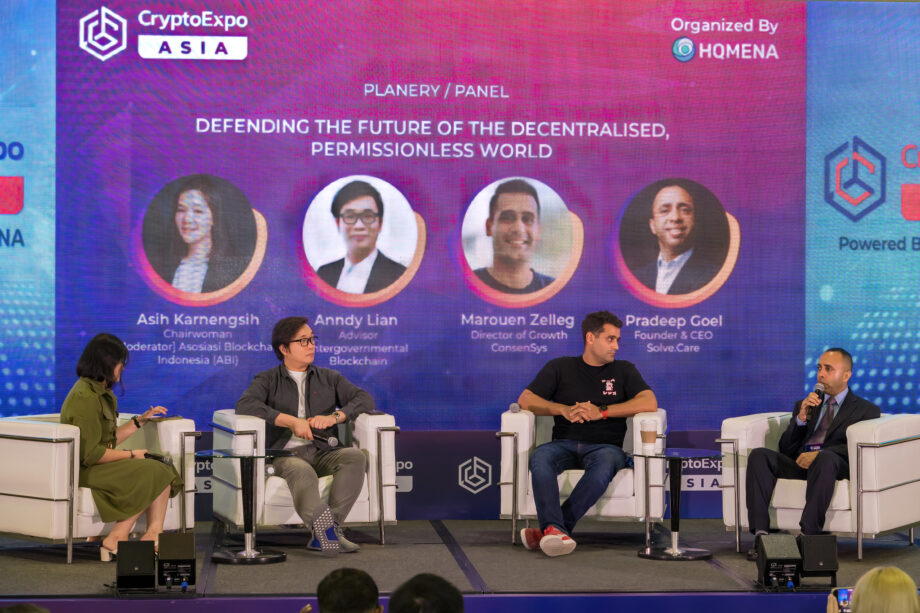
Crypto Expo Asia Panel Discussion: Defending the Future of the Decentralised, Permissionless World

Crypto Expo Asia Panel Discussion: Defending the Future of the Decentralised, Permissionless World

Topic- Defending the Future of the Decentralised, Permissionless World

Crypto Expo Asia, 7-8th June 2023, Singapore

Moderator- Asih Karnengsih, Chairwoman (Asosiasi Blockchain Indonesia)

Panelists:
– Anndy Lian (Intergovernmental Blockchain Advisor)
– Marouen Zelleg, Director of Growth (ConsenSys)
– Pradeep Goel, Founder & CEO (Solve.Care)

Crypto Expo Asia 2023 is a premier virtual asset and Blockchain Conference, organized by HQMena announced in Singapore 2023 with its large audience attending globally. Over 100+ Crypto companies are expected to participate in this event, with an estimated 3000+ attendees, Featured conference with 60+ Speakers, and many attendees from 30+ Countries.

One of the key discussions we have lined up is focused on “Defending the Future of the Decentralized Permissionless World.” This panel discussion brings together experts from different backgrounds to share their perspectives. The panelists include Asih Karnengsih, the moderator, Chairwoman of the Asosiasi Blockchain Indonesia; Anndy Lian, NFT from Zero to Hero book author; Marouen Zelleg, Director of Growth at ConsenSys, and Pradeep Goel, Founder and CEO of Solve Care.

Pradeep Goel emphasized the importance of user-centric security in the blockchain industry. He highlighted the challenges faced by users, especially in regulated industries such as healthcare. According to him, user-friendly solutions that protect identities, assets, and roles are crucial for driving adoption. Pradeep stressed the need for a holistic approach to security that combines nuanced identity management, asset protection, and role-based access.

Marouen Zelleg spoke about his commitment to decentralization. He shared his personal experiences from Tunisia, a country known for its centralized bureaucracy, and the limitations it imposes on individuals and businesses. Marwan expressed his passion for blockchain technology’s potential to transform economies and people’s lives. Consensus, through its software solutions, contributes to this mission by enabling developers to build on the blockchain.

Anndy Lian highlighted his role in advising companies and governments on blockchain adoption. He emphasized the importance of educating governments about the potential of blockchain technology and its benefits. Andy also mentioned his book, “NFT from Zero to Hero,” where he aims to educate people about decentralization and its implications.

The panelists further discussed the role of security in the decentralized world. Pradeep emphasized the significance of tying identity, assets, and roles together to provide a secure user experience. Marouen highlighted the need for a balance between security and decentralization. He drew parallels with the traditional taxi system, showcasing how decentralization can provide security and safety without relying on centralized entities. Anndy emphasized the role of artificial intelligence and blockchain analytics in enhancing security measures.

The conversation also touched upon the involvement of governments in the blockchain space. Anndy shared insights into the diverse perspectives of governments, ranging from concerns about regulation and taxation to promoting innovation and harnessing blockchain’s potential. He mentioned the increasing interest of governments in regulating aspects like wallets and monitoring crypto activities.

The panelists concluded that the implementation of blockchain technology in traditional institutions varies based on use cases and regulatory environments. While some institutions explore blockchain to revamp their infrastructure and benefit from quicker settlement times, others aim to cater to customer demands, such as providing crypto-related services within existing banking systems.

Socials:

Facebook: http://www.facebook.com/anndylian
Twitter: http://www.twitter.com/anndylian
Instagram: http://www.instagram.com/liananndy
LinkedIn: https://www.linkedin.com/in/anndylian/
Homepage: http://www.anndy.com
YouTube: https://www.youtube.com/@AnndyLian


Anndy Lian is an early blockchain adopter and experienced serial entrepreneur who is known for his work in the government sector. He is a best selling book author- “NFT: From Zero to Hero” and “Blockchain Revolution 2030”.

Currently, he is appointed as the Chief Digital Advisor at Mongolia Productivity Organization, championing national digitization. Prior to his current appointments, he was the Chairman of BigONE Exchange, a global top 30 ranked crypto spot exchange and was also the Advisory Board Member for Hyundai DAC, the blockchain arm of South Korea’s largest car manufacturer Hyundai Motor Group. Lian played a pivotal role as the Blockchain Advisor for Asian Productivity Organisation (APO), an intergovernmental organization committed to improving productivity in the Asia-Pacific region.

An avid supporter of incubating start-ups, Anndy has also been a private investor for the past eight years. With a growth investment mindset, Anndy strategically demonstrates this in the companies he chooses to be involved with. He believes that what he is doing through blockchain technology currently will revolutionise and redefine traditional businesses. He also believes that the blockchain industry has to be “redecentralised”.

j j j