Short Bitcoin ETF: Is BITI a good hedge against the crypto winter?

Short Bitcoin ETF: Is BITI a good hedge against the crypto winter?

Additional comments:

BITI is designed to give investors a way to profit from declines in the price of Bitcoin. It is the first U.S. fund of its kind. On hearing this before the launch, I know many naysayers were piling into this ETF to short Bitcoin. This also resulted that this vehicle is now the second-largest bitcoin-themed ETF (behind BITO) in the U.S. market with just a few days of trading.

The challenge with a short ETF is timing the market. At this moment of time, I think this ETF started off slower than expected as Bitcoin started climbing back to over $21,000. If they were to be launched in November when Bitcoin hits its all-time high at $69,000, then perhaps you will see more influx of investors jumping in.

Analysts also told me that if investors also bought into BITO and BITI, and if you time right to follow the market’s momentum, you will still be a winner. I agree and disagree with this strategy as timing is the key factor to this.

I have always thought that a spot-based Bitcoin ETF product will be launched first. By seeing another derivatives products launched before the spot-based product, this reinforces my thinking further. I think the regulators are worried about subscriptions of the spot product because they know it will be popular. That is why they approved futures-based ETF, thinking that most risk-conscious investors are unlikely to buy the futures-products. Well, based on the trading figures, I still think the demand is there and it is rising.

Will history repeat itself? Only time will tell.


Short Bitcoin ETF: Is BITI a good hedge against the crypto winter?

ProShares has launched another bitcoin-linked exchange-traded fund (ETF). This new instrument is shorting the coin amid the wider cryptocurrency bear market.

The ETF issuer previously launched a bitcoin futures ETF BITO when the cryptocurrency was enjoying record highs and risk-on sentiment was prevailing.

Both funds trade futures contracts on the Chicago Mercantile Exchange (CME). The difference is only between their short and long positions.

What is a short bitcoin ETF, and what is the long-term sentiment on its performance?

What is ProShares bitcoin ETF?

An exchange-traded fund (ETF) is a basket of securities that tracks an underlying index or instrument, if it’s passive, or it could be actively managed with fund managers picking stocks based on their analysis and financial modelling. ETF prices fluctuate throughout a trading session as they are sold and bought on an exchange.

ETFs typically contain bonds and stocks but more recently have ventured into cryptocurrency territory. Cryptocurrency ETFs were highly anticipated by the community as they aim to boost liquidity and the adoption of digital assets in the world of investing.

In order for an ETF to be established, the company willing to create a fund must file a proposal with the US Securities and Exchange Commission (SEC).

A bitcoin ETF is made up of bitcoin or instruments linked to its price. How does it work?

In theory, bitcoin tokens would have been purchased by the company that owns the fund, securitised and sold or traded on an exchange. But, the SEC is yet to accept such a proposal. The underlying assets in bitcoin ETFs are linked to bitcoin futures contracts traded on the CME.

A futures contract is a standard contract where two parties agree to exchange a specific quantity of assets on a specific day for a certain price. A bitcoin futures contract is an agreement between two sides for the exchange of a contract unit of bitcoin.

Bitcoin short ETF explained

Similarly to BITO, the ProShares Short Bitcoin Strategy ETF, BITI, trades in futures contracts on the CME. The difference is that BITI is a short bitcoin ETF, meaning that it trades short positions. BITI allows investors to profit from the falling price of the cryptocurrency, which could be used as a part of a hedging strategy.

“BITI affords investors who believe that the price of bitcoin will drop with an opportunity to potentially profit or to hedge their cryptocurrency holdings. BITI enables investors to conveniently obtain short exposure to bitcoin through buying an ETF in a traditional brokerage account,”  ProShares CEO Michael L. Sapir said in a statement on 20 June 2022.

The fund tracks the nearest maturing monthly bitcoin futures contract trading on CME and is a rolling index, meaning that the index operates in accordance with a set of predetermined rolling methodology. In BITI’s case, the roll occurs over a five-day period every month, effective prior to the opening of trading and preceding the last trading date of the futures contract.

The last trading date for bitcoin futures contracts is the last Friday of the contract month. The index rolls monthly and distributes the weights 20% each day over a five-day roll period.

BITO has a gross expense ratio of 0.97% and a net expense ratio of 0.95%.

Are you wondering how to buy short bitcoin ETF? As ETFs are bought and sold on an exchange, bitcoin ETFs can be purchased via online brokers and most trading platforms.

For those investors who prefer to put their money in a mutual fund, which trades only once a day,  ProShares’ affiliate mutual fund company launched a Short Bitcoin Strategy ProFund (BITIX), which has the same investment objective as BITI.

“With the additions of BITI and BITIX, ProShares and ProFunds will be the only fund families in the US offering funds that allow investors to express their view on the direction of bitcoin—no matter whether they believe the price will go up or down,” Sapir noted.

Short BTC ETF analysis

It is important to note that investing in a futures-based bitcoin ETF is not a direct investment in the cryptocurrency because the fund tracks CME BTC futures – contracts speculating on the future price of BTC rather than bitcoin itself. Investors should be aware that the price of the ETF could be different to the price of the cryptocurrency itself.

The introduction of the new short bitcoin ETF had “many naysayers were piling into [it] to short bitcoin”, said Anndy Lian, best-selling author of Blockchain Revolution 2030 and chief digital advisor to the Mongolian Productivity Organisation.

What is your sentiment on BTC/USD?

“This also resulted that this vehicle is now the second largest bitcoin themed ETF (behind BITO) in the US market with just a few days of trading.”

According to Lars Seier Christense, chairman of the Concordium Foundation and founder of Saxo Bank, “such reversed price-action investment products are well known in the traditional finance sector, and are typically used for hedging.

“Typically, they cater for investors in markets where shorting is difficult, or where they would not have a relationship with their brokers allowing them to short or where margins of such short positions are very high,” he added.
“I believe such a vehicle could become quite popular for hedging and shorting purposes, being easier to invest in than outright shorts.”

However, Lian also highlighted that the key challenge when trading short ETFs is timing the market. He told Capital.com:

“At this moment in time, I think this ETF started off slower than expected as bitcoin started climbing back to over $21,000. If they were to be launched in November when Bitcoin hit its all-time high at $69,000, then perhaps you will see more influx of investors jumping in [now, as the token has been going down].”

Dan Hoover, Director at Castle Funds,  explained that the futures market in which BITI trades uses CME-listed futures, which close for an hour a day Monday through Thursday, and on Friday until Sunday (Chicago time). BTC can be bought and sold 24/7.

“This delay can create some unexpected price action in the futures as the prices ‘catch up’ to market news in Asia, especially over the US weekend. Additionally, BITI only trades on US trading days, which is even narrower than CME futures trading (9:30AM – 4PM NY time, M-F, observing most major holidays),” Hoover added.

Other competitors are spot or physically-backed bitcoin ETF projects. But, they have been pending SEC approval for a few years now.

“These ETF’s could be used to replicate the BITI strategy much more efficiently, as they avoid the compounding risks of the inverse ETF and the carrying costs of the underlying futures,” Hoover noted.

Short BTC ETF forecast

Within a day after its launch, BITI had risen to $41.3 on 22 June, up 3.6% from closing at $39.84 the day before. The fund has pulled back since and is currently (29 June) trading at $39.81.
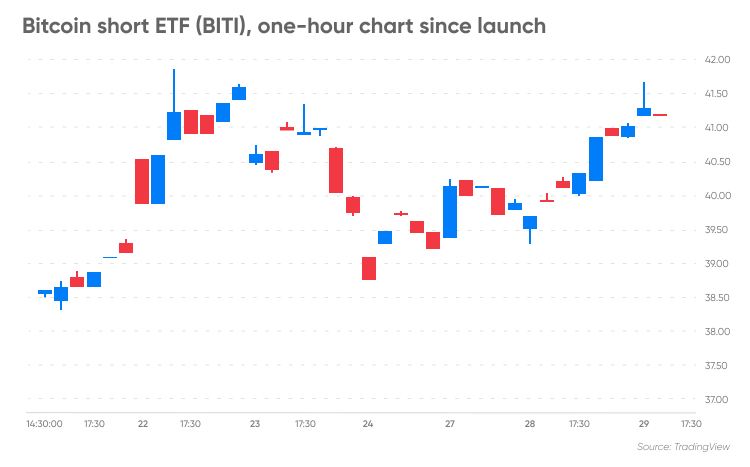
Source: TradingView

Analysts appear to have mixed feelings on how the short bitcoin ETF will perform, as it was launched at such an uncertain time for cryptocurrencies and BTC.

In a note published on 21 June, Laith Khalaf, head of investment analysis at AJ Bell, noted that “bitcoin isn’t behaving particularly unusually and losses of this magnitude are to be expected, especially after periods of equally extreme price appreciation.”

According to Khalaf, this is not the coin’s worst performance and BTC has suffered worse “crypto winters before and come back to have its day in the sun”.

“The popularity of short BTC ETF’s, such as this latest iteration from ProShares, highlights quite how bearish a run the cryptocurrency market has been on. Short ETFs are suddenly popping up more often, as Bitcoin struggles to find a bid,” Invezz’s data analyst Dan Ashmore told Capital.com.

Long-term, Ashmore is bullish on bitcoin, however, in the short and medium-term, the ETF could perform well as the US Federal Reserve is still struggling to tackle rising inflation and a tight geopolitical situation, according to the analyst.

Saxo Bank’s Christensen agreed with Ashmore, noting that the ETF could be interesting for short-term trading.

“Unless the BTC community is completely wrong about higher levels for BTC longer-term, it would clearly not have a great investment in its own right, but more suited for short-term speculation and hedging of crypto portfolios,” he added.

Note that analysts’ predictions can be wrong. Forecasts shouldn’t be used as substitutes for your own research. Always conduct your own diligence, and remember that your decision to trade or invest should depend on your risk tolerance, expertise in the market, portfolio size and goals.

Keep in mind that past performance doesn’t guarantee future returns. And never invest or trade money you cannot afford to lose.


Original Source: https://capital.com/short-bitcoin-etf-explained


Anndy Lian is an early blockchain adopter and experienced serial entrepreneur who is known for his work in the government sector. He is a best selling book author- “NFT: From Zero to Hero” and “Blockchain Revolution 2030”.

Currently, he is appointed as the Chief Digital Advisor at Mongolia Productivity Organization, championing national digitization. Prior to his current appointments, he was the Chairman of BigONE Exchange, a global top 30 ranked crypto spot exchange and was also the Advisory Board Member for Hyundai DAC, the blockchain arm of South Korea’s largest car manufacturer Hyundai Motor Group. Lian played a pivotal role as the Blockchain Advisor for Asian Productivity Organisation (APO), an intergovernmental organization committed to improving productivity in the Asia-Pacific region.

An avid supporter of incubating start-ups, Anndy has also been a private investor for the past eight years. With a growth investment mindset, Anndy strategically demonstrates this in the companies he chooses to be involved with. He believes that what he is doing through blockchain technology currently will revolutionise and redefine traditional businesses. He also believes that the blockchain industry has to be “redecentralised”.

j j j

Do Crypto Airdrops Benefit the Community in the Long Term?

Do Crypto Airdrops Benefit the Community in the Long Term?

Airdrops became mainstream in the ICO boom years starting around 2016 as a means to incentivize users to promote a new token on social media for example. More recently, in 2020, decentralized exchange Uniswap changed the outlook on incentives and rewards when the ecosystem gave away tokens for free to anyone who had utilized the Uniswap platform before a specific date. The 400 UNI tokens distributed provided many investors with their first big break. Putting aside the popularity of airdrops, it’s a good time to consider how effective they are for users and for startups, and to look at both the upsides and downsides for this sometimes controversial mechanism for driving crypto growth, especially in a bear market.

A good way to start this analysis on the ‘state of airdrops’ is to begin with a little academic rigor! Late last year a quartet of academics took a close look at the rise of DEXs, including the role of airdrops and governance tokens, using data from CoinGecko. They found that DEXs typically use airdrops to reward their early supporters, serve as marketing tools to reach potential users on other DEXs. But they also found that, “airdrops can backfire, because they put governance tokens in the hand of individuals who do not believe in the long-term viability of the exchange and want to maximize their short-run returns. Moreover, airdrops may unintentionally signal that the tokens are lower quality, influencing expectations about the exchange’s longevity.”

Despite those risks, overwhelmingly from the same of 51 exchanges they analyzed, they did find a positive relationship between airdrops and growth in DEXs market cap and volume, but with the important caveat that such benefits were concentrated on exchanges offering a governance token. Specifically, that DEXs which airdrop manifest an average 16.1% rise in their growth rate. “We also find some evidence, although the estimates are not statistically significant at conventional levels, that DEXs who airdrop governance tokens experience higher volume growth than those who do not,” the paper’s authors added.

The successful Optimism airdrop at the start of June was a rare example of good news in the crypto sphere following the collapse of Terra. Back in April Optimism, the layer-2 scaling solution for Ethereum, said it planned to launch a decentralized autonomous organization (DAO) along with the OP token which enables users to vote with. In turn the DAO will use money raised from Optimism fees to fund grants for the community. While this tends to point to the value of airdrops to build crypto communities, how safe is this assumption? Indeed, there was criticism from within the Optimism community that users who sold their tokens straight after receiving them should be ineligible for further airdrops.

Following the Optimism airdrop, and a sharp drop of 40% in price, “a member of the governance community named OxJohn submitted a proposal to the Optimism Governance forum to exclude addresses that dumped 100% of their tokens. The post, titled ‘Users who sold the initial OP airdrop should become ineligible for all future airdrops’ attracted considerable attention from the community with 11,200 views, 305 replies and 595 likes,” it was reported. His contention was that wallet accounts that simply collected the OP airdrop and swapped straight to Uniswap were “not playing a constructive role in Optimism governance. Instead of contributing to governance, they are maximising for profit..Hence, this proposal is to discuss excluding such accounts in all the future distribution of Optimism’s airdrop. Also, we can make a public list of accounts that engage in this behaviour, so that other projects and DAOs can also choose to borrow from our work – I believe many projects will be interested in rewarding those who actually contribute to governance, rather than those who just see ownership given into a protocol as a short term liquidity bonus.” While it provoked quite a negative reaction Bankless host, Ryan Sean Adams said it came down to deciding who you were trying to incentivize, whether for the settlers of the community, those that will stick around, rather than the people who are just dumping. “But I’m probably more in favor of let’s try to incent the network towards governors and towards settlers and away from the traders and that sort of thing. So, I can definitely understand this governance post,” Adams added.

Airdrops and community-building

Without a doubt, many established crypto communities owe their longevity to the proper distribution of airdrops. It appears to be one of the finest strategies to attract new users to a new crypto project. What makes it even more unique is that these airdropped tokens also function as governance tokens for some of these projects, thereby increasing their value and utility. Clearly, the issue for projects that distribute airdrops has always been: how do you avoid giving your airdrop to people who would simply dump and devalue your tokens without contributing anything? There is a fine line between an airdrop negatively impacting ecosystem growth and being a useful tool for developing a sustainable community. As Michael J. Casey, chairman of CoinDesk’s advisory board wrote on the subject, “I think the debate could be better served by, first, viewing airdrops as a marketing expense in the service of promoting community adoption and, second, recognizing that, one way or another, adoption requires some level of marketing. A currency is nothing if it is not widely used. And that can’t be achieved unless people make some cost-incurring effort to encourage widespread usage.”

Airdrops should be utilized carefully as a reward for dedicated and loyal members of a crypto community and should work for the benefit of the community. Unfortunately, one of the issues that always affects the value and usability of an airdrop is that the mechanics occasionally favor users who are not long-term believers in a certain project and regard it as easy money.

The Terra (CRYPTO: LUNA) ecosystem also faced the downside of airdrops when Luna V2 tokens were distributed to investors to compensate them for their losses. However, the airdrop did not go as planned, as some investors complained on social media about the uneven distribution of new Luna tokens. Many investors received a relative handful of Luna tokens compared to what the Terra ecosystem promised. The Terra ecosystem admitted that token distribution was uneven and vowed to rectify the issue. The uneven distribution of airdrop was undoubtedly one of the factors that caused Luna to drop from an all-time high of $19.2 to an all-time low of $4.08.

Chairman of BigONE Exchange Anndy Lian said: “Airdrop mechanisms should be improved and strategically implemented to ensure that committed community members who understand the long-term goals of a crypto project benefit more than short-term holders who are only interested in profits. Accepting tokens from a project without a plan and a clear value proposition is, at most, a short-term play, not a long-term wealth development approach. I do believe that airdrops can help build the necessary momentum and buzz for a crypto project but that if they are poorly executed, they may negatively impact the community’s growth. Therefore, it is critical airdrops get the balance right for the long-term, and target long-term holders who are true community builders rather than simply short-term holders.”


Original source: https://uk.investing.com/news/cryptocurrency-news/do-crypto-airdrops-benefit-the-community-in-the-long-term-2674845

Anndy Lian is an early blockchain adopter and experienced serial entrepreneur who is known for his work in the government sector. He is a best selling book author- “NFT: From Zero to Hero” and “Blockchain Revolution 2030”.

Currently, he is appointed as the Chief Digital Advisor at Mongolia Productivity Organization, championing national digitization. Prior to his current appointments, he was the Chairman of BigONE Exchange, a global top 30 ranked crypto spot exchange and was also the Advisory Board Member for Hyundai DAC, the blockchain arm of South Korea’s largest car manufacturer Hyundai Motor Group. Lian played a pivotal role as the Blockchain Advisor for Asian Productivity Organisation (APO), an intergovernmental organization committed to improving productivity in the Asia-Pacific region.

An avid supporter of incubating start-ups, Anndy has also been a private investor for the past eight years. With a growth investment mindset, Anndy strategically demonstrates this in the companies he chooses to be involved with. He believes that what he is doing through blockchain technology currently will revolutionise and redefine traditional businesses. He also believes that the blockchain industry has to be “redecentralised”.

j j j

Do Crypto Airdrops Benefit the Community in the Long Term?

Do Crypto Airdrops Benefit the Community in the Long Term?

Airdrops became mainstream in the ICO boom years starting around 2016 as a means to incentivize users to promote a new token on social media for example. More recently, in 2020, decentralized exchange Uniswap changed the outlook on incentives and rewards when the ecosystem gave away tokens for free to anyone who had utilized the Uniswap platform before a specific date. The 400 UNI tokens distributed provided many investors with their first big break. Putting aside the popularity of airdrops, it’s a good time to consider how effective they are for users and for startups, and to look at both the upsides and downsides for this sometimes controversial mechanism for driving crypto growth, especially in a bear market.

A good way to start this analysis on the ‘state of airdrops’ is to begin with a little academic rigor! Late last year a quartet of academics took a close look at the rise of DEXs, including the role of airdrops and governance tokens, using data from CoinGecko. They found that DEXs typically use airdrops to reward their early supporters, serve as marketing tools to reach potential users on other DEXs. But they also found that, “airdrops can backfire, because they put governance tokens in the hand of individuals who do not believe in the long-term viability of the exchange and want to maximize their short-run returns. Moreover, airdrops may unintentionally signal that the tokens are lower quality, influencing expectations about the exchange’s longevity.”

Despite those risks, overwhelmingly from the same of 51 exchanges they analyzed, they did find a positive relationship between airdrops and growth in DEXs market cap and volume, but with the important caveat that such benefits were concentrated on exchanges offering a governance token. Specifically, that DEXs which airdrop manifest an average 16.1% rise in their growth rate. “We also find some evidence, although the estimates are not statistically significant at conventional levels, that DEXs who airdrop governance tokens experience higher volume growth than those who do not,” the paper’s authors added.

The successful Optimism airdrop at the start of June was a rare example of good news in the crypto sphere following the collapse of Terra. Back in April Optimism, the layer-2 scaling solution for Ethereum, said it planned to launch a decentralized autonomous organization (DAO) along with the OP token which enables users to vote with. In turn the DAO will use money raised from Optimism fees to fund grants for the community. While this tends to point to the value of airdrops to build crypto communities, how safe is this assumption? Indeed, there was criticism from within the Optimism community that users who sold their tokens straight after receiving them should be ineligible for further airdrops.

Following the Optimism airdrop, and a sharp drop of 40% in price, “a member of the governance community named OxJohn submitted a proposal to the Optimism Governance forum to exclude addresses that dumped 100% of their tokens. The post, titled ‘Users who sold the initial OP airdrop should become ineligible for all future airdrops’ attracted considerable attention from the community with 11,200 views, 305 replies and 595 likes,” it was reported. His contention was that wallet accounts that simply collected the OP airdrop and swapped straight to Uniswap were “not playing a constructive role in Optimism governance. Instead of contributing to governance, they are maximising for profit..Hence, this proposal is to discuss excluding such accounts in all the future distribution of Optimism’s airdrop. Also, we can make a public list of accounts that engage in this behaviour, so that other projects and DAOs can also choose to borrow from our work – I believe many projects will be interested in rewarding those who actually contribute to governance, rather than those who just see ownership given into a protocol as a short term liquidity bonus.” While it provoked quite a negative reaction Bankless host, Ryan Sean Adams said it came down to deciding who you were trying to incentivize, whether for the settlers of the community, those that will stick around, rather than the people who are just dumping. “But I’m probably more in favor of let’s try to incent the network towards governors and towards settlers and away from the traders and that sort of thing. So, I can definitely understand this governance post,” Adams added.

Airdrops and community-building

Without a doubt, many established crypto communities owe their longevity to the proper distribution of airdrops. It appears to be one of the finest strategies to attract new users to a new crypto project. What makes it even more unique is that these airdropped tokens also function as governance tokens for some of these projects, thereby increasing their value and utility. Clearly, the issue for projects that distribute airdrops has always been: how do you avoid giving your airdrop to people who would simply dump and devalue your tokens without contributing anything? There is a fine line between an airdrop negatively impacting ecosystem growth and being a useful tool for developing a sustainable community. As Michael J. Casey, chairman of CoinDesk’s advisory board wrote on the subject, “I think the debate could be better served by, first, viewing airdrops as a marketing expense in the service of promoting community adoption and, second, recognizing that, one way or another, adoption requires some level of marketing. A currency is nothing if it is not widely used. And that can’t be achieved unless people make some cost-incurring effort to encourage widespread usage.”

Airdrops should be utilized carefully as a reward for dedicated and loyal members of a crypto community and should work for the benefit of the community. Unfortunately, one of the issues that always affects the value and usability of an airdrop is that the mechanics occasionally favor users who are not long-term believers in a certain project and regard it as easy money.

The Terra (CRYPTO: LUNA) ecosystem also faced the downside of airdrops when Luna V2 tokens were distributed to investors to compensate them for their losses. However, the airdrop did not go as planned, as some investors complained on social media about the uneven distribution of new Luna tokens. Many investors received a relative handful of Luna tokens compared to what the Terra ecosystem promised. The Terra ecosystem admitted that token distribution was uneven and vowed to rectify the issue. The uneven distribution of airdrop was undoubtedly one of the factors that caused Luna to drop from an all-time high of $19.2 to an all-time low of $4.08.

Chairman of BigONE Exchange Anndy Lian said: “Airdrop mechanisms should be improved and strategically implemented to ensure that committed community members who understand the long-term goals of a crypto project benefit more than short-term holders who are only interested in profits. Accepting tokens from a project without a plan and a clear value proposition is, at most, a short-term play, not a long-term wealth development approach. I do believe that airdrops can help build the necessary momentum and buzz for a crypto project but that if they are poorly executed, they may negatively impact the community’s growth. Therefore, it is critical airdrops get the balance right for the long-term, and target long-term holders who are true community builders rather than simply short-term holders.”


Original source: https://www.benzinga.com/22/06/27833827/do-crypto-airdrops-benefit-the-community-in-the-long-term

Anndy Lian is an early blockchain adopter and experienced serial entrepreneur who is known for his work in the government sector. He is a best selling book author- “NFT: From Zero to Hero” and “Blockchain Revolution 2030”.

Currently, he is appointed as the Chief Digital Advisor at Mongolia Productivity Organization, championing national digitization. Prior to his current appointments, he was the Chairman of BigONE Exchange, a global top 30 ranked crypto spot exchange and was also the Advisory Board Member for Hyundai DAC, the blockchain arm of South Korea’s largest car manufacturer Hyundai Motor Group. Lian played a pivotal role as the Blockchain Advisor for Asian Productivity Organisation (APO), an intergovernmental organization committed to improving productivity in the Asia-Pacific region.

An avid supporter of incubating start-ups, Anndy has also been a private investor for the past eight years. With a growth investment mindset, Anndy strategically demonstrates this in the companies he chooses to be involved with. He believes that what he is doing through blockchain technology currently will revolutionise and redefine traditional businesses. He also believes that the blockchain industry has to be “redecentralised”.

j j j