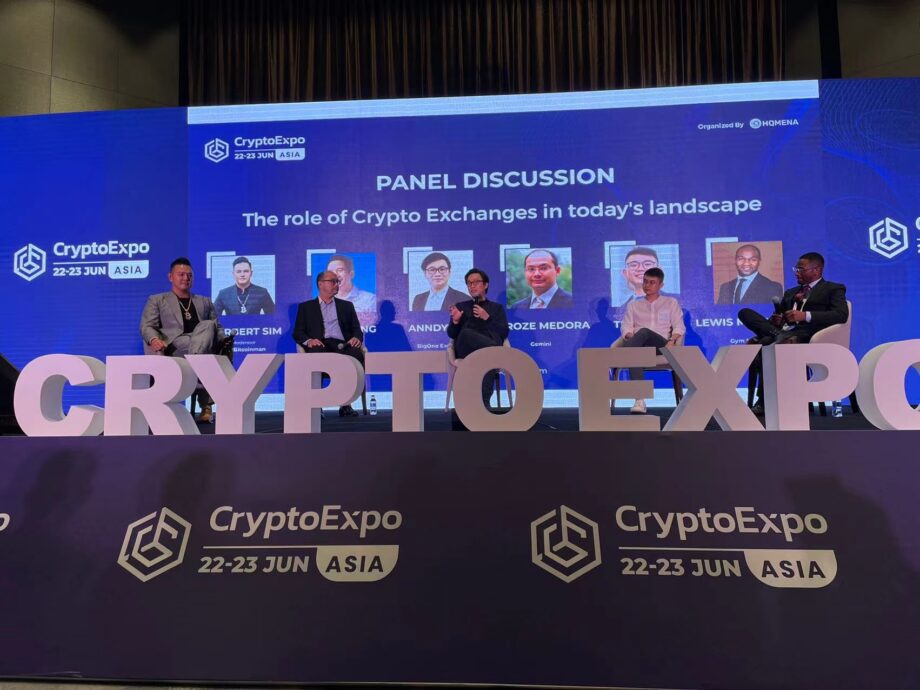
Crypto Expo Asia 2022 Singapore: The Role of Crypto Exchanges in Today’s Landscape

Crypto Expo Asia 2022 Singapore: The Role of Crypto Exchanges in Today’s Landscape

Crypto Expo Asia is the largest event in Asia for Investors and Crypto industry leaders to network and explore more business opportunities in the crypto space. They provide the market’s leading content & updates on the Crypto and Blockchain industry that will help you explore the investment opportunities available as smartly and securely.

A crypto exchange is a platform on which you can buy and sell cryptocurrency. You can use exchanges to trade one crypto for another — converting Bitcoin to Binance Coin, for example — or to buy crypto using regular currency, like the U.S. Dollar. Cryptocurrencies make it easier for people in different countries to pay each other, negating financial borders currently controlled by banks and governments. The panel comprises experts and practitioners from centralized exchanges. They will share insights on the role of Crypto Exchanges in today’s landscape.

The session is moderated by Herbert Sim, Bitcoin Man and with panelists Feroze Medora, Gemini; Anndy Lian, BigONE; Travis Teo, Tokenize and Lewis Mahlanga, Gym Network.

The following questions were addressed:

#1 The explosion of thus many crypto exchanges is the white-labelling phenomena, which allows for almost instant creation of an exchange. With all this proliferation, the nature of platforms continues to diversify. What is the current role of exchanges today, besides crypto trading?

Lewis Mahlanga: “We need to educate the market about cryptocurrencies.”

#2 Centralized Exchanges versus Decentralized Exchanges. What are your thoughts? Pros and cons?

Travis Teo: “As a new user, you might not know how the wallets work. You are also may not know where to obtain ETH or SOL. CEX will act as a bridge for these new users to guide them through the process.”

#3 To list out some more roles that a crypto exchange could play – Payment services (Remittance, Escrow Service, Micropayments, Merchant Services – Gateway processor, Mobile PoS card reader, Debit card; and more); Mobile wallet, ATM. What are the differentiating factors which sets apart each of the exchanges?

Herbert Sim: “Security of the exchange, how credible it is.”

#4 A big challenge for centralized crypto exchanges over the years is custodial. Users are required to perform mandatory tasks to sign up and verify their identity. Fees can be expensive because platform takes a percentage of initial investment, and off every trade. While there is high level of trust in the CEX from the users, the CEX actually holds the private keys to the tokens and the funds, which makes it subject to hacking. And we have all seen massive multi-million, even close to billion dollar hacks taken place, even in the present day. What are your thoughts about CEX’s custodial today?

#5 Possibly the toughest, most controversial question for crypto exchanges. What are your thoughts on wash-trading? And rankings on CoinMarketCap?

Feroze Medora: “Even though we are in a very new industry, I like the expression ‘Nothing is new under the sun’. Wash trading falls under the border category of market manipulation. Which are features of regular financial market for very time.”

#6 The question that is probably the biggest challenge for crypto exchanges. What are your thoughts on regulations by regulators across the world – from US SEC, to China’s PBoC, and here in Singapore Monetary Authority of Singapore (MAS)?

#7 Let’s talk about crypto trading specifically. Mobile Financial Trading, Derivatives Trading, Future Trading, Financial Trading. What’s next? What do you think is the future of trading?

Anndy Lian: “I think derivatives trading would be the strongest and will be one of the key crypto highlights. NFT trading and NFT marketplace would be the next to look at too. The current NFT market has not reached its fullest potential in terms of trading, because it has not hit a critical volume. We should look at this market seriously, build products on top of NFT, facilitate it with real utility and link back to spot/ derivatives trading to optimize its full potential.”

Crypto Expo Asia 2022 is held on 22 – 23 June 2022, at Raffles City Convention Centre, Singapore. The second day of the event will feature speakers from ConsenSys, UOB, OKX, Bybit, Fireblocks and many more. More information can be obtained at https://cryptoexpoasia.com/.

This article is produced by BLOCKCAST.CC.

Anndy Lian is an early blockchain adopter and experienced serial entrepreneur who is known for his work in the government sector. He is a best selling book author- “NFT: From Zero to Hero” and “Blockchain Revolution 2030”.

Currently, he is appointed as the Chief Digital Advisor at Mongolia Productivity Organization, championing national digitization. Prior to his current appointments, he was the Chairman of BigONE Exchange, a global top 30 ranked crypto spot exchange and was also the Advisory Board Member for Hyundai DAC, the blockchain arm of South Korea’s largest car manufacturer Hyundai Motor Group. Lian played a pivotal role as the Blockchain Advisor for Asian Productivity Organisation (APO), an intergovernmental organization committed to improving productivity in the Asia-Pacific region.

An avid supporter of incubating start-ups, Anndy has also been a private investor for the past eight years. With a growth investment mindset, Anndy strategically demonstrates this in the companies he chooses to be involved with. He believes that what he is doing through blockchain technology currently will revolutionise and redefine traditional businesses. He also believes that the blockchain industry has to be “redecentralised”.

j j j

The growing popularity of crypto social trading: Quick review

The growing popularity of crypto social trading: Quick review

Social and copy trading tools are relatively new in the cryptocurrency scene. Basically, their trades are reflected in your account. Their profits are your profits and their losses are your losses.

Such tools are simple to use and have all the features that any trader will need. How would DeFi and social trading work together? Let’s look into it now.

Community-powered DeFi protocol Pollen aims to shake up the asset management industry with its bold attempt to really put the community in the driving seat, led by top-performing traders that emerge from the community.

As the first really tangible step to making that happen after two years’ development and several months of testing involving 7,000+ beta users, Pollen has now launched its trading simulation product after 99 per cent backing in a 100K strong community vote in line with Pollen’s merit-based DAO structure.

But in a growing market for social trading globally how does it stack up against existing startups in the space, such as eToro and League of Traders?

The mainnet launch is designed to create a community of crypto traders, so-called ‘Pollinators’ which in turn will identify a talent pool of the top performers. These users will provide the trading insights to power the asset-backed Pollen Indexes.

How it works is that Pollen Virtual enables traders to try out their trading strategies in a safe sandbox environment, based on staked tokens, in a portfolio composed of assets available on Pollen with the ability to rebalance the proportion of each asset to improve performance in real-time.

In turn, this encourages traders to compete in a leaderboard to earn reputation points and PLNs. Those less willing to risk their tokens can delegate them to the best performers for an 80% share of the trading profits.

Pollen’s social model fits a post-Terra DeFi world, where the trust is put in the decentralised community rather than the founders. Of course, the downside is the gains are not going to be crazy DeFi gains where you stake a dollar and have a million in your wallet in a couple of days!

Instead, as Agova explained, the aim of Pollen is to bring some much-needed balance to DeFi and reduce the risk, reduce the volatility through indexes. “DeFi for grownups. It’s DeFi if you’re not necessarily crypto savvy, but an average person with some disposable income that wants to get into DeFi but can’t get into DeFi.”

The virtual assets users allocate in their Pollen Virtual portfolio (with the protocol based on the Avalanche and Ethereum ecosystem) represent real assets, meaning that they rise and fall depending on each asset’s performance in real life.

However, there is no exposure to the underlying assets in the Pollen Virtual portfolio: they are purely simulations, with only PLN earned or burned depending on the portfolio’s performance. The Pollen Virtual protocol actually has two tokens available to users, the PLN is the native token, and vePLN is what they call the “voter escrow token” which users obtain when they lock their PLN.

While you can earn PLN as a reward you cannot earn vePLN, as a locked token, it simply allows you to earn rewards up to 20 per cent more. However, to add a gamification element you can lose vePLN as a result of poor performance of your trading activity.

How eToro compares

In comparison one of the market leaders eToro offers is the ability to see how other investors and traders manage their crypto portfolios which allows you to take advantage of their tactics.

In addition, eToro provides a service called copy trading which automates the copying of the best-performing investors. A third layer of social trading is access to forums where traders can discuss their strategies.

In a way similar to Pollen eToro also offers a virtual trading account. However, a key difference is that you don’t need to buy eToro’s own token to participate, instead, you use US$100,000 in fake money so the quality of the learning is probably not as great as with Pollen where you can lose PLN and reputation ranking for poor performance.

Bethany Garner of Forbes Advisor in reviewing eToro confirmed that it lets users buy and sell more than 60 crypto assets and offers its own crypto wallet for users to store their tokens.

Plus, as well as the social trading tools. “Anyone, even those who aren’t users, can visit eToro and gain access to lessons on investment terms, interpreting the markets, and different types of assets through the eToro Academy.”

That educational support is certainly lacking from Pollen currently, but no doubt will be something they’ll want to develop once the asset management service launches later in the year.

Gamifying trading

A neat twist on the social trading concept is the leading social trading service in Asia League of Traders, a crypto app that runs a leaderboard similar to Pollen, where the best performers are rewarded.

League of Traders has ‘doubled down’ on social trading by gamifying crypto trading with features including real-time leaderboards, monthly competitions, and trader profiles, transforming trading into a social, competitive experience. Each user’s profile includes a growth chart, token distribution pie chart, volatility risk assessment and current positions which allows speedy insight into one’s portfolio’s strength.

And unlike Pollen, which works as a closed ecosystem, or eToro which aims to make money from your crypto purchases, using the app you can link your portfolios across different exchanges to see their performance aggregated in one place. Like eToro however you can also click on the profile of top traders to check out their portfolio, with the option to copy another account.

Barrister and Attorney at Law at BlockchainLex.io, Brian Sanya Mondoh, said, “In my view, the delegation of tokens to make profits by delegators is likely to interact with the Howey Test, as there is an investment of money in a common enterprise with a reasonable expectation of profits to be derived from the efforts of others.”

Mondoh added that crypto regulation is rapidly underway with many DeFi protocols presented as real risks to consumers, businesses, national security, and the financial system. The recent Terra collapse is still fresh in our minds and has further highlighted the need for appropriate regulation to help mitigate consumer, market integrity and financial stability risks,” he added.

Anndy Lian, Chairman of BigONE Exchange said Pollen was a great example of what DeFi can offer following the Terra collapse. “The risky returns offered by Terra’s Anchor Protocol proved that you need to base DeFi on sound first principles, a decentralised offering which empowers users rather than encouraging them to take unsustainable risks.

“I’m impressed by Pollen’s careful stepped approach to their social offering driven by community-led adoption and testing to get it right. I particularly like the fact that anyone can create their own asset pools, and then turn successful indexes public, and earn tokens. But of course, for the newcomer, a service like eToro or League of Traders has a lot to offer where you can learn from the best traders.

“And while eToro like Pollen wants you to stick to its ecosystem I like the flexibility of League of Traders, aggregating your traders under one roof, while also gamifying the experience through the regular trading competitions. Clearly, the social trading market in crypto is only going to grow further in the future, as Web3 is the perfect architecture for a networked decentralised people-led approach to trading and investing.”


Original Source: https://e27.co/the-growing-popularity-of-crypto-social-trading-quick-review-20220620/

Anndy Lian is an early blockchain adopter and experienced serial entrepreneur who is known for his work in the government sector. He is a best selling book author- “NFT: From Zero to Hero” and “Blockchain Revolution 2030”.

Currently, he is appointed as the Chief Digital Advisor at Mongolia Productivity Organization, championing national digitization. Prior to his current appointments, he was the Chairman of BigONE Exchange, a global top 30 ranked crypto spot exchange and was also the Advisory Board Member for Hyundai DAC, the blockchain arm of South Korea’s largest car manufacturer Hyundai Motor Group. Lian played a pivotal role as the Blockchain Advisor for Asian Productivity Organisation (APO), an intergovernmental organization committed to improving productivity in the Asia-Pacific region.

An avid supporter of incubating start-ups, Anndy has also been a private investor for the past eight years. With a growth investment mindset, Anndy strategically demonstrates this in the companies he chooses to be involved with. He believes that what he is doing through blockchain technology currently will revolutionise and redefine traditional businesses. He also believes that the blockchain industry has to be “redecentralised”.

j j j

Crypto carnage: Bitcoin breaks $19k, Ethereum below $1k

Crypto carnage: Bitcoin breaks $19k, Ethereum below $1k

My full comments to the reporter is as such:

Bitcoin falls below $20,000 for the first time since 2020 is expected by many after a series of unfortunate events. The confidence level dropped when the market capitalization falls below to $900 million and over $100 million of Bitcoin future contracts in the last 24 hours were liquidated.

Bitcoin falling below this range means we will see more liquidation triggers especially so for investors who are using leverage to short these positions. This will result to margin calls for investors who borrowed against it. I know many big funds who have liquidation positions around the price of $19,000 to $20,000.

Given the level of confidence lowering, “sharks” sees the opportunity as there is a lot of incentives to trade it down to pass the threshold point of many long term holders.

If Bitcoin falls between $14,000 to $19,000, the free falling effect will kick in. Many Bitcoin pledged as collateral would be forced to be sold. When that happens, Bitcoin may fall to a $12,000 range or lower.

With the rising inflation, hiking interest rates, projected recession, ongoing war and trying to recover from COVID-19 aftermath, Bitcoin is been testing under all these factors for the very first time. In order for Bitcoin and crypto market to recover, we also need to have some certainties over these macroeconomic concerns.

_______________________________________________________________


Crypto carnage: Bitcoin breaks $19k, Ethereum below $1k

According to experts, the confidence level among investors dropped when the market capitalisation fell below $900 million and over $100m of Bitcoin futures contracts in the last 24 hours were liquidated.

Amid a wider cryptocurrency market carnage on the weekend, the largest digital currency by market capitalisation Bitcoin (BTC) has broken the $19,000 levels, the first time since December 2020, while the second largest crypto Ethereum (ETH) has broken the psychological $1,000 mark.

Bitcoin is currently down about 10% and trading at $19,040, after making a low of $18,905, according to data from Coinmarketcap.

ETH is down around 10%, trading at $992, after making a low of $986.

The overall market capitalisation of cryptocurrencies has fallen by 5% in the last 24 hours and currently stands at $853 billion.

According to experts, the confidence level among investors dropped when the market capitalisation fell below $900 million and over $100m of Bitcoin futures contracts in the last 24 hours were liquidated.

According to Anndy Lian, Chairman, BigONE Exchange, BTC falling below the $20,000 range will lead to more liquidation triggers, especially for investors who are using leverage to short these positions.

Former CEO of BitMEX Arthur Hayes says massive sell pressure can be expected in the spot markets as key levels for BTC – $20,000 and ETH – $1,000 break, as dealers hedge themselves.

We can also expect that there will be some OTC dealers that will be unable to hedge properly and might go belly up,” he says.


Original Source: https://www.moneycontrol.com/news/business/cryptocurrency/crypto-carnage-bitcoin-breaks-19k-ethereum-below-1k-8704271.html

Anndy Lian is an early blockchain adopter and experienced serial entrepreneur who is known for his work in the government sector. He is a best selling book author- “NFT: From Zero to Hero” and “Blockchain Revolution 2030”.

Currently, he is appointed as the Chief Digital Advisor at Mongolia Productivity Organization, championing national digitization. Prior to his current appointments, he was the Chairman of BigONE Exchange, a global top 30 ranked crypto spot exchange and was also the Advisory Board Member for Hyundai DAC, the blockchain arm of South Korea’s largest car manufacturer Hyundai Motor Group. Lian played a pivotal role as the Blockchain Advisor for Asian Productivity Organisation (APO), an intergovernmental organization committed to improving productivity in the Asia-Pacific region.

An avid supporter of incubating start-ups, Anndy has also been a private investor for the past eight years. With a growth investment mindset, Anndy strategically demonstrates this in the companies he chooses to be involved with. He believes that what he is doing through blockchain technology currently will revolutionise and redefine traditional businesses. He also believes that the blockchain industry has to be “redecentralised”.

j j j