From PMIs to CPI: The data that could make or break crypto’s rally

From PMIs to CPI: The data that could make or break crypto’s rally

In the current macroeconomic landscape of October 2025, the world finds itself in a precarious balancing act between fading momentum in major economies and the uncertain ripple effects of fiscal and monetary policy shifts. With the United States in the midst of a federal government shutdown that began on October 1, the usual flow of official economic data has been disrupted, leaving market participants increasingly reliant on private-sector indicators.

Among these, the flash Purchasing Managers’ Index (PMI) readings for October have assumed outsized importance. Scheduled for release during the week of October 20 across all major developed economies, these preliminary surveys offer the earliest glimpse into whether the modest growth seen in September can be sustained or whether deeper structural weaknesses are emerging.

The United States, long the standout performer among advanced economies, now faces growing scrutiny over the durability of its expansion. Although the Federal Open Market Committee delivered its first interest rate cut of the year in September, hopes that this would catalyse a renewed upswing are tempered by underlying vulnerabilities. The boost from tariff front-running appears to be waning, and growth remains disproportionately concentrated in financial services and technology sectors.

Compounding the uncertainty is the delayed release of official inflation data. The September Consumer Price Index (CPI), originally due earlier in October, is now expected on October 24, with forecasts pointing to a rise from 2.9 per cent to 3.1 per cent. However, recent PMI data have shown some easing in tariff-related cost pressures, suggesting that if this trend continues into October, it could presage a moderation in headline inflation in the months ahead.

Meanwhile, Europe presents a mixed picture. The eurozone recorded its fastest pace of business activity growth in 16 months in September, a promising signal that the bloc may be regaining some traction. Yet this momentum must be weighed against significant political headwinds, most notably the ongoing crisis in France, which risks undermining consumer and business confidence. In Germany, there is cautious optimism that fiscal measures could stimulate domestic demand, but the net effect on regional growth remains to be seen. The UK, for its part, is navigating a fragile recovery.

September’s PMI data indicated that the economic upturn had nearly stalled, accompanied by substantial job losses. On the inflation front, there is a glimmer of hope. Survey-based measures of price growth have moderated compared to the first half of the year, which should translate into softer official CPI figures in the coming months. Nevertheless, the August CPI reading stood at 3.8 per cent, with core inflation at 3.6 per cent, both well above the Bank of England’s two per cent target, leaving policymakers in a difficult position.

In Asia, mainland China’s economic slowdown has become more pronounced. According to a Reuters consensus, third-quarter GDP growth is expected to have decelerated to 4.8 per cent year-over-year, down from 5.2 per cent in the second quarter. This marks the weakest pace of expansion in a year, driven by a persistent property sector slump, ongoing trade tensions, and tepid domestic demand. The data underscores the challenges Beijing faces in meeting its full-year growth target of “around five per cent” and intensifies calls for more aggressive stimulus measures.

Against this complex macro backdrop, the cryptocurrency market has exhibited a characteristic blend of volatility and forward-looking speculation. Over the past 24 hours, the market has risen by 2.82 per cent, a rebound that appears to be fuelled more by anticipation than by concrete developments.

A key driver of this optimism is the positioning ahead of the delayed US CPI release. Traders are betting on a softer-than-expected inflation print, which could bolster the case for further Federal Reserve rate cuts and create a more favourable environment for risk assets. This sentiment is reflected in Bitcoin’s rising correlation with gold, which has climbed to +0.35, signalling a shared role as a safe-haven asset amidst geopolitical uncertainty.

A significant structural catalyst has also emerged from Japan. The country’s Financial Services Agency has proposed a landmark regulatory shift that would allow banks to hold and trade cryptocurrencies. This move, which follows initiatives like Mitsubishi UFJ’s stablecoin project, represents a major step toward mainstream institutional adoption.

Given Japan’s banking sector manages assets worth approximately US$5 trillion, this regulatory pivot could unlock a vast new pool of capital for the crypto ecosystem. This potential is further amplified by the yen’s persistent weakness, having depreciated by nine per cent against the US dollar year-to-date, which incentivises Japanese investors to seek alternative stores of value.

However, the market’s fragility is laid bare by the dynamics of leveraged trading. CoinGlass data reveals that over US$510 million in Bitcoin short positions are clustered above the US$112,000 price level, creating the potential for a powerful short squeeze if the price can sustain a breakout.

While funding rates have turned slightly positive, indicating renewed interest from leveraged longs, this optimism is counterbalanced by a stark reality. Spot Bitcoin ETFs in the United States experienced a staggering $1.23 billion in net outflows during the week ending October 17, the second-largest weekly outflow in history. This persistent capital flight from the most regulated and institutional-facing segment of the market suggests a deep-seated caution among traditional investors.

Sentiment indicators further validate this caution. The Crypto Fear & Greed Index currently sits at 30, firmly in the “Fear” territory. This level of anxiety, combined with the massive ETF outflows, acts as a powerful counterweight to the bullish narratives. The market is at a critical juncture.

A successful hold above US$110,000, followed by a break above the US$112,000 liquidation cluster, could trigger a powerful short squeeze and reignite a broader rally. Conversely, a failure to maintain this level could quickly reverse the recent gains and re-ignite the month-to-date downtrend, which currently stands at -7.1 per cent.

In conclusion, the current market environment is defined by a tension between hopeful macro speculation and sobering on-chain and fund flow realities. The flash PMI data will be a crucial barometer for the health of the real economy, while the delayed US CPI will be the immediate trigger for market direction.

Japan’s regulatory overture offers a long-term structural tailwind, but in the short term, the crypto market’s fate appears to hinge on the interplay between Fed policy expectations and the willingness of institutional capital to return to the space. Until the fear dissipates and ETF outflows reverse, any rally is likely to remain fragile and vulnerable to sharp corrections.


Source: https://e27.co/from-pmis-to-cpi-the-data-that-could-make-or-break-cryptos-rally-20251020/


Anndy Lian is an early blockchain adopter and experienced serial entrepreneur who is known for his work in the government sector. He is a best selling book author- “NFT: From Zero to Hero” and “Blockchain Revolution 2030”.

Currently, he is appointed as the Chief Digital Advisor at Mongolia Productivity Organization, championing national digitization. Prior to his current appointments, he was the Chairman of BigONE Exchange, a global top 30 ranked crypto spot exchange and was also the Advisory Board Member for Hyundai DAC, the blockchain arm of South Korea’s largest car manufacturer Hyundai Motor Group. Lian played a pivotal role as the Blockchain Advisor for Asian Productivity Organisation (APO), an intergovernmental organization committed to improving productivity in the Asia-Pacific region.

An avid supporter of incubating start-ups, Anndy has also been a private investor for the past eight years. With a growth investment mindset, Anndy strategically demonstrates this in the companies he chooses to be involved with. He believes that what he is doing through blockchain technology currently will revolutionise and redefine traditional businesses. He also believes that the blockchain industry has to be “redecentralised”.

j j j

YZi Labs-Backed Perp DEX Aster Delays Airdrop Over Data Issues

YZi Labs-Backed Perp DEX Aster Delays Airdrop Over Data Issues

Aster (ASTER), the decentralized exchange backed by Binance founder Changpeng Zhao’s investment firm YZi Labs, has postponed its upcoming airdrop after identifying “potential data inconsistencies.”

Key Takeaways:

  • Aster delayed its airdrop after uncovering potential data inconsistencies affecting some user allocations.

  • The postponement follows user complaints about inaccurate results from the project’s “S2 airdrop checker” tool.

  • DeFiLlama also suspended Aster’s trading data amid Binance-like volume correlations.

Originally set for October 14, the airdrop will now take place on October 20, pending internal verification, the team announced on Friday.

Aster Promises Fair Adjustments After Users Flag Airdrop Allocation Errors

The Aster team said it would update “certain users’ allocations where needed,” noting that “for most users, allocations should not fall below the final snapshot RH% in each epoch.”

The cause of the discrepancies was not fully detailed, but the decision follows user complaints about inaccurate results from the “S2 airdrop checker” tool released earlier in the day.

One trader claimed an allocation of only 336 ASTER tokens despite having generated over $9 million in trading volume. In total, 153,000 wallets are eligible for the Aster Genesis: Stage 2 airdrop.

Formerly known as APX Finance, Aster is a cross-chain perpetual futures DEX operating on Solana, Ethereum, Arbitrum, and BNB Chain.

The platform, which aims to rival Hyperliquid, recorded more than $420 billion in trading activity last month, according to The Block.

At the time of writing, ASTER is trading near $1.69, largely steady despite broader market weakness driven by renewed trade tensions following Donald Trump’s announcement of 100% tariffs on Chinese imports.

Last week, DeFiLlama temporarily removed trading volume data for Aster after detecting unusually high correlations with Binance’s perpetual volumes.

Co-founder 0xngmi announced the delisting on October 5, citing data integrity concerns after Aster’s XRP/USDT and ETH/USDT pairs showed nearly 1:1 correlation ratios with Binance.

The analytics site said it lacks the granular data needed to confirm potential wash trading, prompting the suspension until verification becomes possible.

The move has divided the crypto community, sparking debate over whether the volumes were manipulated or simply reflected a liquidity migration from Binance to Aster.

Blockchain investigator ZachXBT criticized Anndy Lian for downplaying the issue, while Lian argued that volume alignment across major projects is normal and that Aster’s activity mirrors broader market behavior.

He added that aggressive spending to gain market share is a business decision, not necessarily manipulation.

Aster Reimburses Traders After XPL Price Glitch Triggers Liquidations

Last month, Aster reimbursed users in USDT after a sudden price spike in the XPL perpetual contract triggered forced liquidations.

The anomaly, which occurred during the transition from pre-launch to live trading, saw the price of XPL briefly surge to over $4, well above its $1.30 average on other platforms.

The exchange responded quickly, completing the first round of reimbursements within hours and compensating affected traders for liquidation and trading fees.

While the exact cause remains unconfirmed, early speculation points to a misconfigured index price or missing sync with live market data. Aster has pledged to continue its investigation into the incident.

The glitch followed the mainnet launch of Plasma, a stablecoin-focused Layer 1 whose native token XPL rapidly hit a $12 billion valuation.


Source: https://finance.yahoo.com/news/yzi-labs-backed-perp-dex-112000943.html

Anndy Lian is an early blockchain adopter and experienced serial entrepreneur who is known for his work in the government sector. He is a best selling book author- “NFT: From Zero to Hero” and “Blockchain Revolution 2030”.

Currently, he is appointed as the Chief Digital Advisor at Mongolia Productivity Organization, championing national digitization. Prior to his current appointments, he was the Chairman of BigONE Exchange, a global top 30 ranked crypto spot exchange and was also the Advisory Board Member for Hyundai DAC, the blockchain arm of South Korea’s largest car manufacturer Hyundai Motor Group. Lian played a pivotal role as the Blockchain Advisor for Asian Productivity Organisation (APO), an intergovernmental organization committed to improving productivity in the Asia-Pacific region.

An avid supporter of incubating start-ups, Anndy has also been a private investor for the past eight years. With a growth investment mindset, Anndy strategically demonstrates this in the companies he chooses to be involved with. He believes that what he is doing through blockchain technology currently will revolutionise and redefine traditional businesses. He also believes that the blockchain industry has to be “redecentralised”.

j j j

DefiLlama to Delist Aster Volume Data Over Suspected Wash Trading

DefiLlama to Delist Aster Volume Data Over Suspected Wash Trading

DeFiLlama has removed perpetual futures volume data for Aster, a decentralized exchange backed by figures linked to former Binance CEO Changpeng Zhao, after detecting trading volumes that mirrored Binance’s nearly 1:1 across multiple trading pairs.

Co-founder 0xngmi announced the delisting on October 5, 2025, citing concerns over data integrity.

According to the announcement, Aster’s volumes for pairs like XRP/USDT matched Binance perpetual volumes with a correlation ratio of approximately 1, whereas competitor Hyperliquid showed decorrelation in similar pairs.

The analytics platform cannot access lower-level data, such as maker and taker order information from Aster, to verify whether wash trading occurred, prompting the temporary removal until such verification becomes possible.

0xngmi noted that correlation patterns appeared even more extreme for other assets, such as ETH, with similar patterns visible across all trading pairs.

The DeFiLlama co-founder emphasized that the decision centered on maintaining data integrity for users who make investing decisions based on the platform’s analytics.

Crypto Community Splits Between Wash Trading Accusations and Liquidity Migration Defense

The delisting triggered sharp divisions within the crypto community, with critics questioning DeFiLlama’s centralization while defenders attributed the correlation to legitimate liquidity migration from Binance.

Blockchain investigator ZachXBT criticized industry figure Anndy Lian for normalizing wash trading, after Lian argued that “all crypto projects have washed trades” and questioned why observers were “acting so saintly” about the situation.

Lian, who holds positions in both leading perpetual DEX tokens, claimed that most projects are not fully decentralized and that alignment in open interest and price action is common across top projects that draw charts similar to Bitcoin.

He argued that if a project and its backers agree to spend money acquiring market share, the level of spending is their prerogative.

ZachXBT countered that Lian’s post history showed zero mentions of HYPE and only two posts referencing Hyperliquid, where Aster was also mentioned, while almost every other post focused on Aster.

Supporters of Aster argued that Binance’s liquidity was moved on-chain to the platform, explaining why volumes appeared to be synchronized.

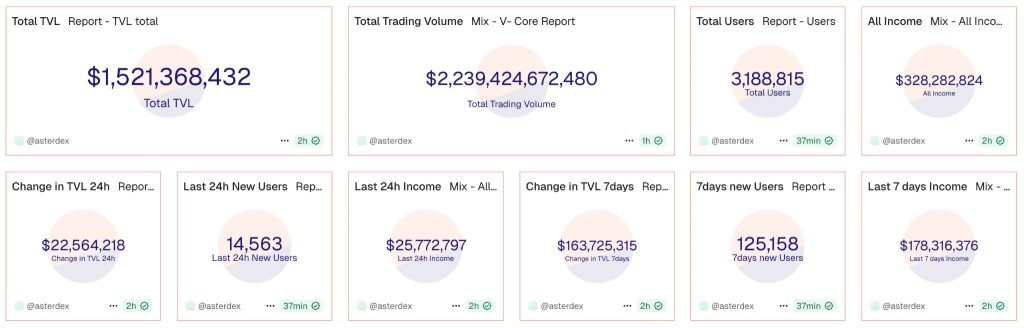
Multiple community members pointed to Dune Analytics data showing Aster’s total trading volume exceeding $2.2 trillion, with a total value locked of $1.52 billion, 3.18 million total users, and $328.28 million in all-time income.

The platform added 14,563 new users in the last 24 hours and 125,158 over seven days, according to the dashboard.

DefiLlama to Delist Aster Volume Data Over Suspected Wash Trading
Source: Dune Analytics

Dashboard creator Odbtc clarified that he used DeFiLlama’s public API as the data source, while Dune served only as a visualization layer to compare Aster, Hyperliquid, and Lighter.

He defended DeFiLlama’s decision, noting that the platform aggregates protocol-reported data while Dune allows users to query or visualize it, with dashboard quality depending entirely on the builder’s query logic.

Aster Launches Stage 3 Rewards Program as Binance Confirms Listing

Aster concluded its Genesis Stage 2 rewards program on October 5 and immediately launched Stage 3 Dawn, offering participants either their ASTER airdrop or a full refund of Stage 2 trading fees.

The claim page opens on October 10 for 48 hours, with airdropped tokens available on October 14.

Stage 3 runs for five weeks, ending November 9, introducing spot trading rewards, multi-dimensional scoring, symbol-specific boost multipliers, and team boosts that accumulate throughout the stage rather than resetting weekly.

At the same time, Binance announced it will list ASTER with a Seed Tag applied, while Aster implemented VIP fee tier updates starting October 6.

The platform updated its Market Maker Program with preferential fees and a monthly reward pool to strengthen liquidity.

The moves come as Aster recorded $493.61 billion in 30-day trading volume according to earlier DeFiLlama data, capturing nearly 50% of the perpetual DEX market share before the delisting.

At the time of publication, ASTER trades at $2.08 with a fully diluted valuation of $16.5 billion, having increased by over 29 times within four days following CZ’s endorsement, before reaching above $2.

The token was launched with an initial fully diluted valuation of $560 million at its token generation event.

On the other end, Hyperliquid’s HYPE token trades at $48.89 with a fully diluted valuation of $48.9 billion, maintaining approximately 70% of the perpetual DEX market share despite rising competition.


Source: https://cryptonews.com/news/defillama-to-delist-aster-volume-data-over-suspected-wash-trading/

Anndy Lian is an early blockchain adopter and experienced serial entrepreneur who is known for his work in the government sector. He is a best selling book author- “NFT: From Zero to Hero” and “Blockchain Revolution 2030”.

Currently, he is appointed as the Chief Digital Advisor at Mongolia Productivity Organization, championing national digitization. Prior to his current appointments, he was the Chairman of BigONE Exchange, a global top 30 ranked crypto spot exchange and was also the Advisory Board Member for Hyundai DAC, the blockchain arm of South Korea’s largest car manufacturer Hyundai Motor Group. Lian played a pivotal role as the Blockchain Advisor for Asian Productivity Organisation (APO), an intergovernmental organization committed to improving productivity in the Asia-Pacific region.

An avid supporter of incubating start-ups, Anndy has also been a private investor for the past eight years. With a growth investment mindset, Anndy strategically demonstrates this in the companies he chooses to be involved with. He believes that what he is doing through blockchain technology currently will revolutionise and redefine traditional businesses. He also believes that the blockchain industry has to be “redecentralised”.

j j j