DefiLlama to Delist Aster Volume Data Over Suspected Wash Trading

DefiLlama to Delist Aster Volume Data Over Suspected Wash Trading

DeFiLlama has removed perpetual futures volume data for Aster, a decentralized exchange backed by figures linked to former Binance CEO Changpeng Zhao, after detecting trading volumes that mirrored Binance’s nearly 1:1 across multiple trading pairs.

Co-founder 0xngmi announced the delisting on October 5, 2025, citing concerns over data integrity.

According to the announcement, Aster’s volumes for pairs like XRP/USDT matched Binance perpetual volumes with a correlation ratio of approximately 1, whereas competitor Hyperliquid showed decorrelation in similar pairs.

The analytics platform cannot access lower-level data, such as maker and taker order information from Aster, to verify whether wash trading occurred, prompting the temporary removal until such verification becomes possible.

0xngmi noted that correlation patterns appeared even more extreme for other assets, such as ETH, with similar patterns visible across all trading pairs.

The DeFiLlama co-founder emphasized that the decision centered on maintaining data integrity for users who make investing decisions based on the platform’s analytics.

Crypto Community Splits Between Wash Trading Accusations and Liquidity Migration Defense

The delisting triggered sharp divisions within the crypto community, with critics questioning DeFiLlama’s centralization while defenders attributed the correlation to legitimate liquidity migration from Binance.

Blockchain investigator ZachXBT criticized industry figure Anndy Lian for normalizing wash trading, after Lian argued that “all crypto projects have washed trades” and questioned why observers were “acting so saintly” about the situation.

Lian, who holds positions in both leading perpetual DEX tokens, claimed that most projects are not fully decentralized and that alignment in open interest and price action is common across top projects that draw charts similar to Bitcoin.

He argued that if a project and its backers agree to spend money acquiring market share, the level of spending is their prerogative.

ZachXBT countered that Lian’s post history showed zero mentions of HYPE and only two posts referencing Hyperliquid, where Aster was also mentioned, while almost every other post focused on Aster.

Supporters of Aster argued that Binance’s liquidity was moved on-chain to the platform, explaining why volumes appeared to be synchronized.

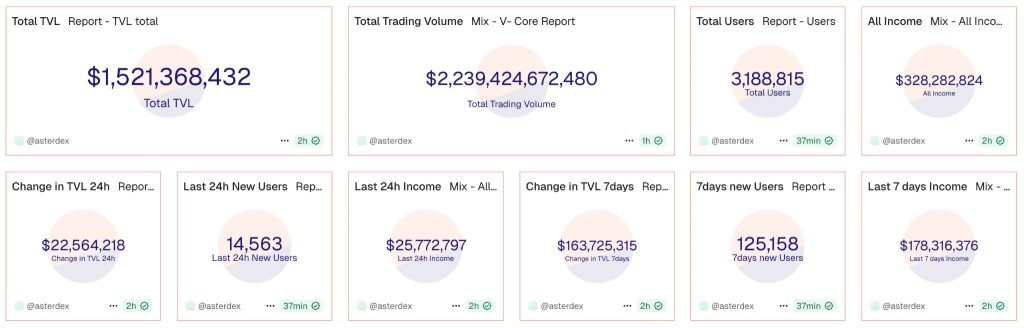
Multiple community members pointed to Dune Analytics data showing Aster’s total trading volume exceeding $2.2 trillion, with a total value locked of $1.52 billion, 3.18 million total users, and $328.28 million in all-time income.

The platform added 14,563 new users in the last 24 hours and 125,158 over seven days, according to the dashboard.
DefiLlama to Delist Aster Volume Data Over Suspected Wash Trading
Source: Dune Analytics

Dashboard creator Odbtc clarified that he used DeFiLlama’s public API as the data source, while Dune served only as a visualization layer to compare Aster, Hyperliquid, and Lighter.

He defended DeFiLlama’s decision, noting that the platform aggregates protocol-reported data while Dune allows users to query or visualize it, with dashboard quality depending entirely on the builder’s query logic.

Aster Launches Stage 3 Rewards Program as Binance Confirms Listing

Aster concluded its Genesis Stage 2 rewards program on October 5 and immediately launched Stage 3 Dawn, offering participants either their ASTER airdrop or a full refund of Stage 2 trading fees.

The claim page opens on October 10 for 48 hours, with airdropped tokens available on October 14.

Stage 3 runs for five weeks, ending November 9, introducing spot trading rewards, multi-dimensional scoring, symbol-specific boost multipliers, and team boosts that accumulate throughout the stage rather than resetting weekly.

At the same time, Binance announced it will list ASTER with a Seed Tag applied, while Aster implemented VIP fee tier updates starting October 6.

The platform updated its Market Maker Program with preferential fees and a monthly reward pool to strengthen liquidity.

The moves come as Aster recorded $493.61 billion in 30-day trading volume according to earlier DeFiLlama data, capturing nearly 50% of the perpetual DEX market share before the delisting.

At the time of publication, ASTER trades at $2.08 with a fully diluted valuation of $16.5 billion, having increased by over 29 times within four days following CZ’s endorsement, before reaching above $2.

The token was launched with an initial fully diluted valuation of $560 million at its token generation event.

On the other end, Hyperliquid’s HYPE token trades at $48.89 with a fully diluted valuation of $48.9 billion, maintaining approximately 70% of the perpetual DEX market share despite rising competition.

The post DefiLlama to Delist Aster Volume Data Over Suspected Wash Trading appeared first on Cryptonews.


Source: https://cryptorank.io/news/feed/6fb66-defillama-to-delist-aster-volume-data-over-suspected-wash-trading

Anndy Lian is an early blockchain adopter and experienced serial entrepreneur who is known for his work in the government sector. He is a best selling book author- “NFT: From Zero to Hero” and “Blockchain Revolution 2030”.

Currently, he is appointed as the Chief Digital Advisor at Mongolia Productivity Organization, championing national digitization. Prior to his current appointments, he was the Chairman of BigONE Exchange, a global top 30 ranked crypto spot exchange and was also the Advisory Board Member for Hyundai DAC, the blockchain arm of South Korea’s largest car manufacturer Hyundai Motor Group. Lian played a pivotal role as the Blockchain Advisor for Asian Productivity Organisation (APO), an intergovernmental organization committed to improving productivity in the Asia-Pacific region.

An avid supporter of incubating start-ups, Anndy has also been a private investor for the past eight years. With a growth investment mindset, Anndy strategically demonstrates this in the companies he chooses to be involved with. He believes that what he is doing through blockchain technology currently will revolutionise and redefine traditional businesses. He also believes that the blockchain industry has to be “redecentralised”.

j j j

Bitcoin News Today: Weaker Jobs Data Sparks 70% Odds of 25-Basis-Point Fed Rate Cut in September

Bitcoin News Today: Weaker Jobs Data Sparks 70% Odds of 25-Basis-Point Fed Rate Cut in September

Summary

– Weaker U.S. jobs data (73,000 new jobs in July) has raised 70% odds of a 25-basis-point Fed rate cut in September, boosting crypto markets like Bitcoin and Ethereum.

– Analysts highlight reduced opportunity costs for holding non-yielding crypto assets under lower rates, though market reactions depend on Fed communication clarity.

– Despite optimism, experts warn of traditional crypto weakness (August-October) and risks from economic deterioration or geopolitical tensions undermining gains.

– Political pressures on the Fed, including Trump’s criticism of Powell, complicate policy decisions while inflation and volatility remain key concerns.


The U.S. jobs market has weakened significantly, increasing speculation that the Federal Reserve will implement a 25-basis-point rate cut in September. This development has sparked renewed optimism in the cryptocurrency market, with Bitcoin, Ethereum, and XRP showing signs of stabilization after a period of underperformance [1].

Ask Aime: What will happen if the Federal Reserve cuts interest rates and how will it affect Bitcoin?

According to Polymarket data, the probability of a Fed rate cut in September has climbed to 70% as of August 1, up sharply from earlier in the week. The odds of a more aggressive 50-basis-point cut stand at 6.8% [1]. These expectations follow a disappointing July jobs report, which revealed a mere 73,000 new jobs, far below the estimated 110,000. This figure was compounded by downward revisions to May and June job figures, marking the largest two-month adjustment since the onset of the pandemic in 2020 [1].

The unemployment rate rose to 4.2%, and wage growth remained robust at 0.3% month-on-month and 3.9% year-on-year. Analysts suggest that the weaker labor market narrative weakens the Fed’s rationale for maintaining higher interest rates, potentially opening the door for easing measures without appearing to capitulate to political pressure [1].

Greg Magadini, Director of Derivatives at Amberdata, emphasized the market’s surprise at the sharp downward revisions and weak July data, which caused the U.S. dollar to weaken and bond yields to fall. He noted that this scenario provides the Fed with flexibility to cut rates without appearing to act under external pressure [1].

Anndy Lian, a blockchain advisor, pointed out that lower interest rates reduce the opportunity cost of holding non-yielding assets like Bitcoin and Ethereum. He stressed, however, that the market’s response will depend on the Fed’s communication strategy [1].

Prediction markets reflect this shift in sentiment. A contract for a December rate cut now shows over 60% of participants anticipating another 25-basis-point reduction [1].

Despite this optimism, experts caution that crypto markets face a traditionally weak period from August through mid-October. Tom Bruni of Stocktwits highlighted that recent ‘good news’ has failed to significantly boost prices, and while a Fed rate cut could provide support, economic deterioration could undermine any positive momentum [1].

Sunil Raina, CEO of CereBree, echoed these sentiments, stating that a September rate cut appears to be the only viable option unless the Fed risks damaging the economy. However, he warned that inflation and geopolitical risks remain, contributing to ongoing volatility [1].

The broader context is a divided Federal Reserve navigating political pressures, particularly from President Donald Trump, who has publicly criticized Jerome Powell and urged direct intervention by the Fed. While the Fed has avoided premature action, the weaker labor data may now serve as cover for a policy shift without appearing politically compromised [1].

This evolving situation has significant implications for Bitcoin and other risk assets in the coming weeks as investors closely watch for further developments in both the labor market and monetary policy [1].

Source: [1] Bitcoin, Ethereum, XRP Struggle After Underwhelming Jobs Report: Will A September Rate Cut Save The Bull Run? (https://www.benzinga.com/crypto/cryptocurrency/25/08/46802086/bitcoin-ethereum-xrp-struggle-after-underwhelming-jobs-report-will-a-september-rate-cut-save-the-bull-run?utm_source=coingecko&utm_campaign=partner_feed&utm_medium=partner_feed&utm_content=site)


Source: https://www.ainvest.com/news/bitcoin-news-today-weaker-jobs-data-sparks-70-odds-25-basis-point-fed-rate-cut-september-2508/

Bit

Anndy Lian is an early blockchain adopter and experienced serial entrepreneur who is known for his work in the government sector. He is a best selling book author- “NFT: From Zero to Hero” and “Blockchain Revolution 2030”.

Currently, he is appointed as the Chief Digital Advisor at Mongolia Productivity Organization, championing national digitization. Prior to his current appointments, he was the Chairman of BigONE Exchange, a global top 30 ranked crypto spot exchange and was also the Advisory Board Member for Hyundai DAC, the blockchain arm of South Korea’s largest car manufacturer Hyundai Motor Group. Lian played a pivotal role as the Blockchain Advisor for Asian Productivity Organisation (APO), an intergovernmental organization committed to improving productivity in the Asia-Pacific region.

An avid supporter of incubating start-ups, Anndy has also been a private investor for the past eight years. With a growth investment mindset, Anndy strategically demonstrates this in the companies he chooses to be involved with. He believes that what he is doing through blockchain technology currently will revolutionise and redefine traditional businesses. He also believes that the blockchain industry has to be “redecentralised”.

j j j

Crypto’s turning point: Legislation, data, and Bitcoin’s bull run

Crypto’s turning point: Legislation, data, and Bitcoin’s bull run

Global risk sentiment has been anything but stable lately, rocked by speculation that President Trump might move to replace Federal Reserve Chair Jerome Powell. This isn’t just political gossip. It’s a seismic event for markets. The Fed’s policies shape everything from interest rates to inflation expectations, and the mere hint of a leadership shakeup sends investors into a frenzy.

Are we facing a shift toward looser monetary policy, or could a new chair push for tighter controls? The uncertainty alone is enough to make markets jittery, and we’ve seen that play out in real time.

US equities, for instance, have been on a wild ride. The S&P 500 eked out a 0.3 per cent gain, the Dow Jones climbed 0.5 per cent, and the NASDAQ edged up 0.2 per cent, but these modest increases came after a day of whipsawing, sharp swings driven by conflicting headlines about Powell’s fate. It’s a classic case of markets trying to price in multiple scenarios at once, with no clear winner yet.

Meanwhile, US Treasury yields are telling a different story. The two-year yield dropped 4.8 basis points to 3.892 per cent, and the 10-year yield fell 2.6 basis points to 4.455 per cent after hitting a monthly peak. Lower yields often signal a flight to safety, investors piling into bonds when stocks feel too risky. That dovetails with gold’s 0.7 per cent rise to US$3,347 per ounce, a move fueLled by those same flight-to-quality bids.

The US Dollar Index adds another layer to this narrative. It took a steep 0.9 per cent dive before clawing back most of its losses to close at 98.39, down just 0.2 per cent. That resilience suggests underlying confidence in the dollar, even amidst the chaos.

In contrast, Brent crude slipped 0.3 per cent to US$69 per barrel, weighed down by government data showing weaker demand and growing inventories. Energy prices often reflect global growth expectations, and this dip hints at nagging concerns about a slowdown.

Across the Pacific, Asia’s markets are a mixed bag. Chinese tech stocks rallied briefly on news of resumed chip shipments to China, a lifeline in the ongoing US-China tech tussle, but the momentum fizzled out. Asian equity indices opened unevenly, and US equity futures suggest Wall Street might start the day in the red. It’s a fragmented picture, with no single trend dominating.

Economic data: A glimmer of relief?

Amid this turbulence, the latest US Producer Price Index (PPI) data offers a sliver of good news. It came in softer than expected, signaling that manufacturers aren’t passing on the full brunt of US tariffs to consumers. This is significant. Tariffs, especially those tied to Trump-era policies, have been a wildcard, could they spark inflation by driving up costs?

The weak PPI suggests not, at least not yet. If inflationary pressures stay muted, the Fed might not feel compelled to hike rates aggressively, which is generally a boon for risk assets like stocks and cryptocurrencies. It’s not a game-changer on its own, but it’s a counterweight to the political noise.

Elsewhere, Bank Indonesia’s decision to cut its policy rate by 25 basis points to 5.25 per cent caught my eye. With a stable currency and lower inflation forecasts, they’re prioritising growth, a reminder that not every central bank is in tightening mode. This divergence in monetary policy could influence capital flows, potentially supporting riskier assets in emerging markets and, by extension, cryptocurrencies.

Crypto legislation: A turning point?

Now, let’s pivot to the cryptocurrency space, where something monumental is brewing. This week, the US House of Representatives is considering three bills that could redefine the role of digital assets in the financial world.

First, the GENIUS Act, already greenlit by the Senate, would bring stablecoin issuers under federal oversight, mandating strict reserve, audit, and registration rules. Stablecoins like Tether and USDC are the backbone of crypto trading, and this move could shore up their credibility, making them more palatable to traditional finance.

Second, the Digital Asset Market Clarity Act aims to end the regulatory tug-of-war over whether cryptocurrencies are securities or commodities. By splitting oversight between the SEC and CFTC and setting clear guidelines for token issuers and trading platforms, it could resolve years of ambiguity. I’ve long argued that regulatory uncertainty has been a millstone around crypto’s neck; clarity here could unleash a wave of institutional money.

Finally, the Anti-CBDC Surveillance State Act would bar the Fed from issuing a central bank digital currency. This is a win for crypto purists who view CBDCs as a threat to decentralised finance, although it also acknowledges privacy concerns that resonate beyond the crypto community. If these bills pass, we’re looking at a seismic shift; crypto could move from the fringes to the mainstream, with rules that legitimise it without stifling innovation.

Bitcoin’s technical strength

Against this backdrop, Bitcoin is flexing its muscles. On the daily chart, it’s trading well above its key exponential moving averages: the 20-day at US$112,065, the 50-day at US$107,900, the 100-day at US$103,322, and the 200-day at US$96,920. That’s a textbook bullish setup. The recent breakout above the US$118,000–US$120,000 resistance zone, a level that had capped gains for weeks, is a big deal. Add in rising trading volume and a bullish MACD crossover, and the technicals are screaming upward momentum.

If Bitcoin holds above US$121,000, the next stop could be US$125,000. But markets aren’t one-way streets. If it stumbles, the 20-day EMA at US$112,065 provides immediate support, with stronger buying likely to occur near the 50-day EMA at US$107,900. This resilience is no fluke, it’s fueled by record-high institutional flows and ETF demand, a sign that big players are doubling down.

Mid-July 2025 prediction

So, where does Bitcoin land by mid-July 2025? I’m bullish, and here’s why. After hitting a new all-time high near US$122,000, the momentum feels sustainable. Institutional adoption is accelerating—look no further than Cantor Fitzgerald’s looming US$3.5 billion acquisition of 30,000 BTC, valued at US$117,321 each, through its SPAC vehicle.

This echoes MicroStrategy’s playbook of treating Bitcoin as a treasury asset, and it’s a powerful signal to other firms. With ETF demand soaring and the potential for regulatory clarity from those bills, I see Bitcoin climbing three per cent–five per cent from current levels, hitting US$125,000–US$128,000 by mid-to-late July.

That said, I’m not blind to risks. If the rally falters and Bitcoin dips below US$114,000, a pullback to US$110,000–US$112,000 could occur. That wouldn’t derail the trend; it’d be a healthy breather before the next push. As long as it stays above the 20-day EMA, the bias is up.

Zoom out, and the outlook gets even brighter. By Q4 2025, Bitcoin could reach US$130,000–US$150,000, propelled by institutional heavyweights, possible IMF endorsements, and macro tailwinds like a weaker dollar or persistent inflation fears. But that’s contingent on a stable global stage, no major wars, recessions, or black swan events. In a world this volatile, that’s a big “if.”

Stay sharp, things are about to get interesting.


Source: https://e27.co/cryptos-turning-point-legislation-data-and-bitcoins-bull-run-20250717/

Anndy Lian is an early blockchain adopter and experienced serial entrepreneur who is known for his work in the government sector. He is a best selling book author- “NFT: From Zero to Hero” and “Blockchain Revolution 2030”.

Currently, he is appointed as the Chief Digital Advisor at Mongolia Productivity Organization, championing national digitization. Prior to his current appointments, he was the Chairman of BigONE Exchange, a global top 30 ranked crypto spot exchange and was also the Advisory Board Member for Hyundai DAC, the blockchain arm of South Korea’s largest car manufacturer Hyundai Motor Group. Lian played a pivotal role as the Blockchain Advisor for Asian Productivity Organisation (APO), an intergovernmental organization committed to improving productivity in the Asia-Pacific region.

An avid supporter of incubating start-ups, Anndy has also been a private investor for the past eight years. With a growth investment mindset, Anndy strategically demonstrates this in the companies he chooses to be involved with. He believes that what he is doing through blockchain technology currently will revolutionise and redefine traditional businesses. He also believes that the blockchain industry has to be “redecentralised”.

j j j
