Privacy, Decentralization, and the Future of Crypto: CZ Zhao’s Pragmatic Vision

Privacy, Decentralization, and the Future of Crypto: CZ Zhao’s Pragmatic Vision

In a conversation with Anndy Lian, Binance founder Changpeng “CZ” Zhao delivered a clear and grounded perspective on two core challenges in blockchain: privacy and decentralization. His comments reflect years of experience building infrastructure under regulatory, technical, and market pressures.


Privacy as a baseline requirement

CZ began by stating that privacy is a fundamental human right. He pointed out that many everyday actions—spending choices, personal communications, even ice cream preferences—should remain private, even if they are entirely legal. Current blockchains, he noted, often provide too much transparency. When a centralized exchange holds KYC data tied to an on-chain address, it becomes possible to trace nearly all activity linked to that user. This level of exposure creates risks that go beyond compliance.

He argued that the industry must invest in privacy technologies such as zero-knowledge proofs. At the same time, he recognized the need to balance privacy with the ability of authorities to investigate illicit activity. The exact line remains unclear, but he believes the ecosystem should shape that balance together, not leave it to regulators alone.

CZ extended this logic to trading. He criticized the practice of broadcasting trades in real time on decentralized exchanges. Public visibility allows others to reverse-engineer strategies and deploy targeted countermeasures. Serious traders, whether on Wall Street or Binance, avoid revealing their positions. Large orders are executed quietly to prevent market impact. Real-time transparency only serves those trying to manipulate perception, not those seeking efficient execution.


Decentralization is not binary

CZ rejected the idea that a system is either decentralized or not. Instead, he described decentralization as a spectrum with many dimensions. The number of validator nodes, team influence, mining concentration, and governance mechanisms all factor into the equation.

He gave examples. Ethereum benefits from technical decentralization but still carries weight behind certain voices, such as Vitalik Buterin. Bitcoin’s creator remains unknown, a form of decentralization in itself. Mining power sits heavily with a few large pools. Collusion is theoretically possible, but economic incentives discourage it. Decentralization, therefore, depends not just on structure but on aligned incentives.

He also highlighted a key trade-off: performance versus distribution. More nodes often mean slower throughput. Ethereum’s scaling challenges illustrate this tension. Idealism must contend with usability. True progress lies in advancing technology to achieve greater decentralization without sacrificing speed or security.


A path forward

CZ expressed confidence that innovation will gradually resolve these tensions. Advances in cryptography, consensus design, and network architecture will enable systems that are more private, secure, and decentralized without compromising efficiency. He noted that network effects naturally favor large players, but long-term progress depends on deliberate engineering choices.

His brief mention of AI suggests a future where intelligent systems could enhance privacy or improve decentralized coordination. While he offered no specifics, the implication fits a broader trend. Combining AI with blockchain may unlock new models for user sovereignty.

CZ’s outlook avoids dogma. He treats privacy as essential infrastructure, decentralization as a multidimensional goal, and technological evolution as the only sustainable path forward. For developers, investors, and regulators, his perspective offers a realistic framework for building the next era of digital finance.


Anndy Lian is an early blockchain adopter and experienced serial entrepreneur who is known for his work in the government sector. He is a best selling book author- “NFT: From Zero to Hero” and “Blockchain Revolution 2030”.

Currently, he is appointed as the Chief Digital Advisor at Mongolia Productivity Organization, championing national digitization. Prior to his current appointments, he was the Chairman of BigONE Exchange, a global top 30 ranked crypto spot exchange and was also the Advisory Board Member for Hyundai DAC, the blockchain arm of South Korea’s largest car manufacturer Hyundai Motor Group. Lian played a pivotal role as the Blockchain Advisor for Asian Productivity Organisation (APO), an intergovernmental organization committed to improving productivity in the Asia-Pacific region.

An avid supporter of incubating start-ups, Anndy has also been a private investor for the past eight years. With a growth investment mindset, Anndy strategically demonstrates this in the companies he chooses to be involved with. He believes that what he is doing through blockchain technology currently will revolutionise and redefine traditional businesses. He also believes that the blockchain industry has to be “redecentralised”.

j j j

Shaping the Future of DevPortals: A Think Tank on Decentralization, AI, and Beyond

Shaping the Future of DevPortals: A Think Tank on Decentralization, AI, and Beyond

The digital landscape is rapidly evolving, reshaping how we build, deploy, and interact with software. At the forefront of this revolution are DevPortals, the unsung heroes that empower developers to build the future.

But What Are Developer Portals?

Blockchain Developer Portals (DevPortals) are specialized platforms designed to provide developers with the necessary resources, documentation, and tools to interact with blockchain networks and build decentralized applications (dApps). These portals play a critical role in the blockchain ecosystem by enabling developers to integrate blockchain functionalities into their applications, deploy smart contracts, and interact with various blockchain networks.

Ethereum, Polkadot, Solana, Binance Smart Chain (BSC), and Cardano are just a few of the popular blockchain networks that had their own dedicated DevPortals. Ethereum, for example, had been a cornerstone for dApp developers, offering extensive resources on smart contract languages like Solidity and tools like Truffle. Solana, on the other hand, gained traction due to its emphasis on high-speed transactions and low fees, making it ideal for DeFi applications. Polkadot’s Developer Hub stood out for its focus on interoperability, providing guidance on building parachains and custom blockchains using Substrate.

And, very recently, Shiba Inu’s Layer 2 scalability solution Shibarium joined the ranks of these innovative platforms with the launch of the ShibDev portal.

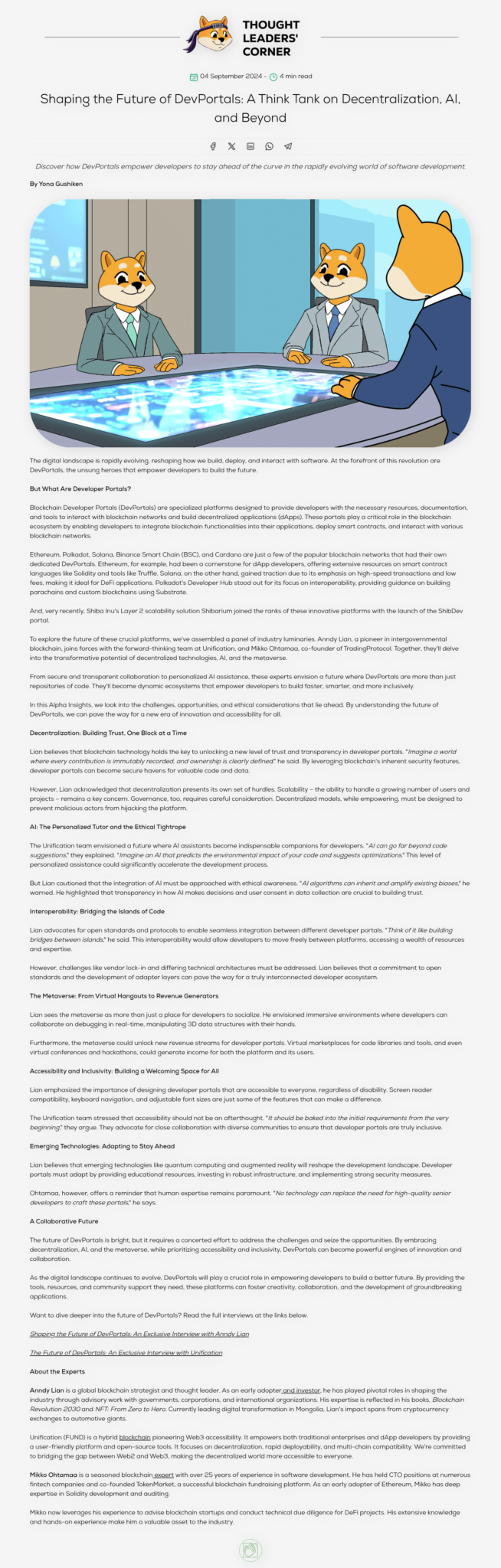
To explore the future of these crucial platforms, we’ve assembled a panel of industry luminaries. Anndy Lian, a pioneer in intergovernmental blockchain, joins forces with the forward-thinking team at Unification, and Mikko Ohtamaa, co-founder of TradingProtocol. Together, they’ll delve into the transformative potential of decentralized technologies, AI, and the metaverse.

From secure and transparent collaboration to personalized AI assistance, these experts envision a future where DevPortals are more than just repositories of code. They’ll become dynamic ecosystems that empower developers to build faster, smarter, and more inclusively.

In this Alpha Insights, we look into the challenges, opportunities, and ethical considerations that lie ahead. By understanding the future of DevPortals, we can pave the way for a new era of innovation and accessibility for all.

Decentralization: Building Trust, One Block at a Time

Lian believes that blockchain technology holds the key to unlocking a new level of trust and transparency in developer portals. “Imagine a world where every contribution is immutably recorded, and ownership is clearly defined,” he said. By leveraging blockchain’s inherent security features, developer portals can become secure havens for valuable code and data.

However, Lian acknowledged that decentralization presents its own set of hurdles. Scalability – the ability to handle a growing number of users and projects – remains a key concern. Governance, too, requires careful consideration. Decentralized models, while empowering, must be designed to prevent malicious actors from hijacking the platform.

AI: The Personalized Tutor and the Ethical Tightrope

The Unification team envisioned a future where AI assistants become indispensable companions for developers. “AI can go far beyond code suggestions,” they explained. “Imagine an AI that predicts the environmental impact of your code and suggests optimizations.” This level of personalized assistance could significantly accelerate the development process.

But Lian cautioned that the integration of AI must be approached with ethical awareness. “AI algorithms can inherit and amplify existing biases,” he warned. He highlighted that transparency in how AI makes decisions and user consent in data collection are crucial to building trust.

Interoperability: Bridging the Islands of Code

Lian advocates for open standards and protocols to enable seamless integration between different developer portals. “Think of it like building bridges between islands,” he said. This interoperability would allow developers to move freely between platforms, accessing a wealth of resources and expertise.

However, challenges like vendor lock-in and differing technical architectures must be addressed. Lian believes that a commitment to open standards and the development of adapter layers can pave the way for a truly interconnected developer ecosystem.

The Metaverse: From Virtual Hangouts to Revenue Generators

Lian sees the metaverse as more than just a place for developers to socialize. He envisioned immersive environments where developers can collaborate on debugging in real-time, manipulating 3D data structures with their hands.

Furthermore, the metaverse could unlock new revenue streams for developer portals. Virtual marketplaces for code libraries and tools, and even virtual conferences and hackathons, could generate income for both the platform and its users.

Accessibility and Inclusivity: Building a Welcoming Space for All

Lian emphasized the importance of designing developer portals that are accessible to everyone, regardless of disability. Screen reader compatibility, keyboard navigation, and adjustable font sizes are just some of the features that can make a difference.

The Unification team stressed that accessibility should not be an afterthought. “It should be baked into the initial requirements from the very beginning,” they argue. They advocate for close collaboration with diverse communities to ensure that developer portals are truly inclusive.

Emerging Technologies: Adapting to Stay Ahead

Lian believes that emerging technologies like quantum computing and augmented reality will reshape the development landscape. Developer portals must adapt by providing educational resources, investing in robust infrastructure, and implementing strong security measures.

Ohtamaa, however, offers a reminder that human expertise remains paramount. “No technology can replace the need for high-quality senior developers to craft these portals,” he says.

A Collaborative Future

The future of DevPortals is bright, but it requires a concerted effort to address the challenges and seize the opportunities. By embracing decentralization, AI, and the metaverse, while prioritizing accessibility and inclusivity, DevPortals can become powerful engines of innovation and collaboration.

As the digital landscape continues to evolve, DevPortals will play a crucial role in empowering developers to build a better future. By providing the tools, resources, and community support they need, these platforms can foster creativity, collaboration, and the development of groundbreaking applications.

Want to dive deeper into the future of DevPortals? Read the full interviews at the links below.

Shaping the Future of DevPortals: An Exclusive Interview with Anndy Lian

The Future of DevPortals: An Exclusive Interview with Unification

About the Experts

Anndy Lian is a global blockchain strategist and thought leader. As an early adopter and investor, he has played pivotal roles in shaping the industry through advisory work with governments, corporations, and international organizations. His expertise is reflected in his books, Blockchain Revolution 2030 and NFT: From Zero to Hero. Currently leading digital transformation in Mongolia, Lian’s impact spans from cryptocurrency exchanges to automotive giants.

Unification (FUND) is a hybrid blockchain pioneering Web3 accessibility. It empowers both traditional enterprises and dApp developers by providing a user-friendly platform and open-source tools. It focuses on decentralization, rapid deployability, and multi-chain compatibility. We’re committed to bridging the gap between Web2 and Web3, making the decentralized world more accessible to everyone.

Mikko Ohtamaa is a seasoned blockchain expert with over 25 years of experience in software development. He has held CTO positions at numerous fintech companies and co-founded TokenMarket, a successful blockchain fundraising platform. As an early adopter of Ethereum, Mikko has deep expertise in Solidity development and auditing.

Mikko now leverages his experience to advise blockchain startups and conduct technical due diligence for DeFi projects. His extensive knowledge and hands-on experience make him a valuable asset to the industry.


Source: https://magazine.shib.io/article/66d86a7287c4c100015d5d7f
Anndy Lian is an early blockchain adopter and experienced serial entrepreneur who is known for his work in the government sector. He is a best selling book author- “NFT: From Zero to Hero” and “Blockchain Revolution 2030”.

Currently, he is appointed as the Chief Digital Advisor at Mongolia Productivity Organization, championing national digitization. Prior to his current appointments, he was the Chairman of BigONE Exchange, a global top 30 ranked crypto spot exchange and was also the Advisory Board Member for Hyundai DAC, the blockchain arm of South Korea’s largest car manufacturer Hyundai Motor Group. Lian played a pivotal role as the Blockchain Advisor for Asian Productivity Organisation (APO), an intergovernmental organization committed to improving productivity in the Asia-Pacific region.

An avid supporter of incubating start-ups, Anndy has also been a private investor for the past eight years. With a growth investment mindset, Anndy strategically demonstrates this in the companies he chooses to be involved with. He believes that what he is doing through blockchain technology currently will revolutionise and redefine traditional businesses. He also believes that the blockchain industry has to be “redecentralised”.

j j j

DEZENTRALISIERUNG NEU DEFINIEREN | REDEFINING DECENTRALIZATION- JETSTREAM MAGAZINE

DEZENTRALISIERUNG NEU DEFINIEREN | REDEFINING DECENTRALIZATION- JETSTREAM MAGAZINE

Ein System oder Netzwerk, in dem keine einzelne Einheit die Kontrolle oder die Fähigkeit hat, Entscheidungen für das gesamte System zu treffen, wäre ent-sprechend schwieriger zu manipulieren. Dieser ideale Zustand könnte Web 4.0 sein, meint Anndy Lian, der in einer neuen Dezentralisierung noch mehr Vorteile für Unternehmen und Einzelpersonen sieht.

Zwar ist der Be­ griff Web 4.0 noch nicht welt verbritet und erkann sich je nach Kontext auf unterschiedliche Dinge beziehen. „Einige Leute ver­wenden Web 4.0 jedoch für die nächste Generation des World Wide Web, die noch dezentraler wäre und sich unter anderem stärker auf künstliche Intelligenz, das semantische Web und das Internet der Dinge konzent­rieren würde“, erklärt Anndy Lian. Es würde sich durch dynamischere, autonome­re und vernetzte Systeme auszeichnen, die aus Daten lernen, miteinander kom­munizieren und sich an veränderte Umgebungen an­passen können. Es sei aber wichtig anzumerken, dass Web 4.0 eben kein offizieller Begriff und in der Branche weithin akzeptiertes Konzept ist. „Das Ausmaß, in dem es dezentraler als die aktuelle oder frühere Versionen des Webs wäre, hängt also davon ab, wie es definiert wird“, hält Lian fest.

STÄRKERER FOKUS AUF KÜNSTLICHE INTELLIGENZ

Anndy Lian ist Gründer, Investor, Berater, Autor und Vorstandsmitglied in mehreren Unternehmen in Asien und Europa. Zudem spielte er eine führende Rolle in gemeinnützigen und regie­rungsnahen Organisationen, wo er mit Entscheidungsträ­gern und Experten zusam­menarbeitete, um Geschäfts­vorschläge für verschiedene.

Branchen zu entwickeln. Im vergangenen Jahr verlieh ihm der Akademische Rat der Ulaanbaatar Erdem Univer­sität in Anerkennung seines Beitrags zur Entwicklung der Produktivitätswissenschaft in der Mongolei die Ehren­doktorwürde. Laut Lian ist die Idee hinter Web 4.0, ein stärker dezentralisiertes und autonomes Web zu schaffen, das direktere Interaktionen zwischen Nutzern und Ge­räten ermöglicht, ohne dass Vermittler notwendig sind. „Dies könnte den Einsatz dezentraler Technologien wie Blockchain, Peer­to­Peer­Netzwerke und verteilte Systeme beinhalten, um neue Formen von Online­Interaktionen und ­Diensten zu ermöglichen, die nicht von zentralisierten Instanzen kontrolliert werden“, führt er aus. Darüber hinaus könnte Web 4.0 auch einen stärkeren Fokus auf künstliche Intelli­genz (KI) und maschinelles Lernen legen, um sich im Laufe der Zeit verbessern zu können.

OFFENERE UND TRANSPARENTERE SYSTEME

Zu den Vorteilen eines stärker dezentralisierten Webs gehören Lian zufolge zunächst die größere Sicher­heit und der bessere Daten­schutz, da die Nutzer mehr Kontrolle über ihre Daten und Online­Interaktionen haben. Außerdem offenere und transparentere Systeme, da es keinen zentralen Kontroll­ oder Fehlerpunkt gibt. Vorteilhaft seien auch die stärkere Widerstands­fähigkeit und die Robust­heit, da das Netz auch dann weiter funktionieren kann, wenn Teile davon ausfallen.

Darüber hinaus gebe es mehr Innovation und Wettbewerb, da es weniger Hindernisse für den Eintritt neuer Akteure gibt. In Web 4.0, das auf den dezentralen Technologien von Web 3.0 aufbaut, sei die Benutzererfahrung gestrafft und reibungslos, wobei die zugrunde liegenden techni­schen Details wegfallen. „Das bedeutet, dass sich die Nut­zer keine Gedanken über die verwendete Blockchain, die Feinheiten von ZK­Roll­ups oder das richtige Gaslimit für Transaktionen machen müssen“, erläutert Lian. Die Gaskriege und Transaktions­gebühren des derzeitigen Web 3.0 würden dann der Vergangenheit angehören. Darüber hinaus habe Web 4.0 das Potenzial, eine zirkuläre Kryptowirtschaft zu schaffen, die physische und digitale Grenzen überschreitet und die Notwendigkeit von Ein­ und Ausstiegsrampen für Fiatwährungen überflüssig macht. „Dies wäre ein be­deutender Einschnitt in das derzeitige Finanzsystem.“

WEB 4.0: SYMBIOSE ZWISCHEN MENSCH UND MASCHINE?

Es gibt noch andere Inter­pretationen des Web4, wie z. B. das „symbiotische Web“, das sich auf eine symbioti­sche Beziehung zwischen Menschen und Maschinen bezieht, möglicherweise sogar unter Verwendung direkter Gehirn­Maschinen­Schnittstellen. Insgesamt ist der Übergang von Web1 zu Web2 und nun von Web3 zu.

Web4 insofern ähnlich, als es sich um einen allmäh­lichen Prozess handelt, der neue Türen öffnet und mehr Menschen zur Teilnahme einlädt. Während Web3 noch in den Kinderschuhen steckt und als experimentell gilt, wird erwartet, dass Web4 zugänglicher und benutzer­freundlicher wird, sodass es von der breiten Öffentlichkeit stärker angenommen wird.

WO LIEGEN DIE CHANCEN?

Das Web 4.0 bietet eine Fülle von Möglichkeiten für Unternehmen und Einzel­personen. Das symbiotische Web wird die Schaffung personalisierter Erfahrungen ermöglichen, sodass die Unternehmen ihre Kunden besser verstehen und maßge­schneiderte Inhalte anbieten können.
KI­gestützte Automatisie­rung wird die Effizienz steigern, die Markteinfüh­rung beschleunigen und die Kosten senken, was den Unternehmen einen Wett­bewerbsvorteil und einen besseren Kundenservice verschafft.

Die Kombination von Hardware, Software und Daten wird die Entwicklung neuer Produkte und Dienst­leistungen ermöglichen, z. B. vernetzte Geräte, die mit den Nutzern interagieren und Daten zur Personalisierung sammeln.

Das Web 4.0 eröffnet auch neue Einnahmequellen, wie zielgerichtete Werbung oder Abonnementdienste, die die gesammelten Daten nutzen. Darüber hinaus werden VR­ und AR­Anwendungen neue Möglichkeiten für Unterneh­men eröffnen, mit Kunden in Kontakt zu treten, z. B. durch die Entwicklung einer AR­Anwendung, die es Kunden ermöglicht, mit Produkten in einem 3D­Raum zu inter­agieren.


Full PDF: Jetstream_2023-02_Gesamt

Anndy Lian is an early blockchain adopter and experienced serial entrepreneur who is known for his work in the government sector. He is a best selling book author- “NFT: From Zero to Hero” and “Blockchain Revolution 2030”.

Currently, he is appointed as the Chief Digital Advisor at Mongolia Productivity Organization, championing national digitization. Prior to his current appointments, he was the Chairman of BigONE Exchange, a global top 30 ranked crypto spot exchange and was also the Advisory Board Member for Hyundai DAC, the blockchain arm of South Korea’s largest car manufacturer Hyundai Motor Group. Lian played a pivotal role as the Blockchain Advisor for Asian Productivity Organisation (APO), an intergovernmental organization committed to improving productivity in the Asia-Pacific region.

An avid supporter of incubating start-ups, Anndy has also been a private investor for the past eight years. With a growth investment mindset, Anndy strategically demonstrates this in the companies he chooses to be involved with. He believes that what he is doing through blockchain technology currently will revolutionise and redefine traditional businesses. He also believes that the blockchain industry has to be “redecentralised”.

j j j