Web4 – The Next Wave of Decentralization

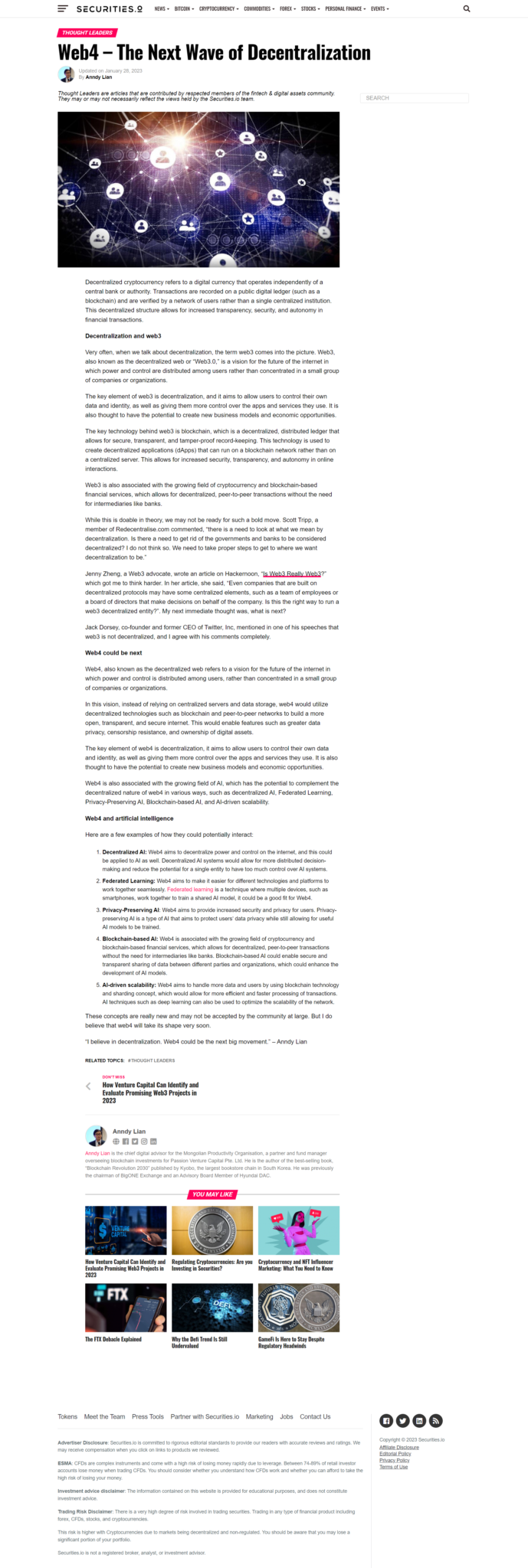
Web4 – The Next Wave of Decentralization

Decentralized cryptocurrency refers to a digital currency that operates independently of a central bank or authority. Transactions are recorded on a public digital ledger (such as a blockchain) and are verified by a network of users rather than a single centralized institution. This decentralized structure allows for increased transparency, security, and autonomy in financial transactions.

Decentralization and web3

Very often, when we talk about decentralization, the term web3 comes into the picture. Web3, also known as the decentralized web or “Web3.0,” is a vision for the future of the internet in which power and control are distributed among users rather than concentrated in a small group of companies or organizations.

The key element of web3 is decentralization, and it aims to allow users to control their own data and identity, as well as giving them more control over the apps and services they use. It is also thought to have the potential to create new business models and economic opportunities.

The key technology behind web3 is blockchain, which is a decentralized, distributed ledger that allows for secure, transparent, and tamper-proof record-keeping. This technology is used to create decentralized applications (dApps) that can run on a blockchain network rather than on a centralized server. This allows for increased security, transparency, and autonomy in online interactions.

Web3 is also associated with the growing field of cryptocurrency and blockchain-based financial services, which allows for decentralized, peer-to-peer transactions without the need for intermediaries like banks.

While this is doable in theory, we may not be ready for such a bold move. Scott Tripp, a member of Redecentralise.com commented, “there is a need to look at what we mean by decentralization. Is there a need to get rid of the governments and banks to be considered decentralized? I do not think so. We need to take proper steps to get to where we want decentralization to be.”

Jenny Zheng, a Web3 advocate, wrote an article on Hackernoon, “Is Web3 Really Web3?” which got me to think harder. In her article, she said, “Even companies that are built on decentralized protocols may have some centralized elements, such as a team of employees or a board of directors that make decisions on behalf of the company. Is this the right way to run a web3 decentralized entity?”. My next immediate thought was, what is next?

Jack Dorsey, co-founder and former CEO of Twitter, Inc, mentioned in one of his speeches that web3 is not decentralized, and I agree with his comments completely.

Web4 could be next

Web4, also known as the decentralized web refers to a vision for the future of the internet in which power and control is distributed among users, rather than concentrated in a small group of companies or organizations.

In this vision, instead of relying on centralized servers and data storage, web4 would utilize decentralized technologies such as blockchain and peer-to-peer networks to build a more open, transparent, and secure internet. This would enable features such as greater data privacy, censorship resistance, and ownership of digital assets.

The key element of web4 is decentralization, it aims to allow users to control their own data and identity, as well as giving them more control over the apps and services they use. It is also thought to have the potential to create new business models and economic opportunities.

Web4 is also associated with the growing field of AI, which has the potential to complement the decentralized nature of web4 in various ways, such as decentralized AI, Federated Learning, Privacy-Preserving AI, Blockchain-based AI, and AI-driven scalability.

Web4 and artificial intelligence

Here are a few examples of how they could potentially interact:

  1. Decentralized AI: Web4 aims to decentralize power and control on the internet, and this could be applied to AI as well. Decentralized AI systems would allow for more distributed decision-making and reduce the potential for a single entity to have too much control over AI systems.
  2. Federated Learning: Web4 aims to make it easier for different technologies and platforms to work together seamlessly. Federated learning is a technique where multiple devices, such as smartphones, work together to train a shared AI model, it could be a good fit for Web4.
  3. Privacy-Preserving AI: Web4 aims to provide increased security and privacy for users. Privacy-preserving AI is a type of AI that aims to protect users’ data privacy while still allowing for useful AI models to be trained.
  4. Blockchain-based AI: Web4 is associated with the growing field of cryptocurrency and blockchain-based financial services, which allows for decentralized, peer-to-peer transactions without the need for intermediaries like banks. Blockchain-based AI could enable secure and transparent sharing of data between different parties and organizations, which could enhance the development of AI models.
  5. AI-driven scalability: Web4 aims to handle more data and users by using blockchain technology and sharding concept, which would allow for more efficient and faster processing of transactions. AI techniques such as deep learning can also be used to optimize the scalability of the network.

These concepts are really new and may not be accepted by the community at large. But I do believe that web4 will take its shape very soon.

“I believe in decentralization. Web4 could be the next big movement.” – Anndy Lian


Source: https://www.securities.io/we4-the-next-wave-of-decentralization/

Anndy Lian is an early blockchain adopter and experienced serial entrepreneur who is known for his work in the government sector. He is a best selling book author- “NFT: From Zero to Hero” and “Blockchain Revolution 2030”.

Currently, he is appointed as the Chief Digital Advisor at Mongolia Productivity Organization, championing national digitization. Prior to his current appointments, he was the Chairman of BigONE Exchange, a global top 30 ranked crypto spot exchange and was also the Advisory Board Member for Hyundai DAC, the blockchain arm of South Korea’s largest car manufacturer Hyundai Motor Group. Lian played a pivotal role as the Blockchain Advisor for Asian Productivity Organisation (APO), an intergovernmental organization committed to improving productivity in the Asia-Pacific region.

An avid supporter of incubating start-ups, Anndy has also been a private investor for the past eight years. With a growth investment mindset, Anndy strategically demonstrates this in the companies he chooses to be involved with. He believes that what he is doing through blockchain technology currently will revolutionise and redefine traditional businesses. He also believes that the blockchain industry has to be “redecentralised”.

j j j

Why True Decentralization Is Missing? – Redecentralization Needed To Go Beyond Web3 to Web4

Why True Decentralization Is Missing? – Redecentralization Needed To Go Beyond Web3 to Web4
In 2019, I began to speak publicly about a concept I called re-decentralization. At the time, the narrative was already drifting. The cypherpunk ethos was being co-opted by a libertarian fervor that misunderstood the assignment. I argued then, as I do now, that the mission of Web3 was never about removing the government or abolishing banks out of spite. It was not an exercise in anarchy. Rather, it was about building a decentralized crypto ecosystem that could serve as the future of finance. This system would rely on mathematical trust instead of institutional trust.
The goal was to create a parallel financial infrastructure that was more efficient, transparent, and accessible than the legacy system. We wanted to build a better mousetrap, not burn down the house. Many people misunderstood this distinction. They thought decentralization meant eliminating all oversight. My view was that we needed a system that could operate alongside traditional finance while offering superior technology. We needed rails that allowed value to move as freely as information moves on the internet. This vision required true decentralization at the protocol level. It required that no single entity could halt transactions or seize funds without consensus.
As the years progressed and I moved from observing the space to actively investing in it, a disturbing pattern emerged. The promise was beginning to fray. I began to realize that Web3, in its current iteration, is not truly decentralized. In fact, much of it is a sophisticated mirage. My realization did not come from reading whitepapers or listening to keynote speeches. It came from the trenches of due diligence. When you invest capital in a project, you gain a level of visibility that the average retail user never sees. You get to look under the hood. What I found was that most projects were merely pretending to be decentralized.
They used the aesthetics of Web3, including tokens, DAOs, and governance portals. The control structures remained stubbornly Web2. I saw smart contracts with admin keys held by a single founder. I saw treasury funds controlled by multisig wallets, with all signers being employees of the same venture capital firm. I saw community governance where the voting power was so concentrated among early insiders that the average token holder’s vote was mathematically irrelevant. This was decentralization theater. It was a performance designed to attract liquidity and hype without ceding actual power.
The infrastructure was built on public blockchains, yes. The switches that controlled the flow of value were held in private hands. This centralization creates single points of failure. It invites regulatory crackdowns because there is always a human to subpoena. It defeats the purpose of censorship resistance. If a small group of humans can pause the contract, blacklist an address, or change the tokenomics overnight, the system is not trustless. It is simply a digital bank with a worse user interface and higher volatility. This defeats the technology’s original purpose. We built these systems to remove intermediaries, not to create new ones with better marketing.
As I analyzed why this centralization persisted, I identified the root cause. It was not just greed or malice. It was a structural limitation. The human element is stopping how we can grow in this DeFi space. Humans are the bottleneck. In the current DeFi model, humans are required to make almost every critical decision. Humans set the interest rates. Humans decide which collateral is acceptable. Humans vote on governance proposals. Humans monitor the protocols for exploits. This reliance on human intervention introduces latency, emotion, and corruption into a system that was designed to be objective.
Human governance is slow. By the time a DAO votes on a parameter change to mitigate a risk, the market has often already moved. Human decision-making is emotional. Panic selling or FOMO-driven investment strategies destabilize protocols. Furthermore, human governance is susceptible to social engineering and bribery. We have seen countless instances of whales accumulating governance tokens to push through proposals that drain treasuries. As long as humans are the brain of the operation, the system will remain centralized. Humans naturally congregate power. We form committees, we elect leaders, and we create hierarchies. This is antithetical to the concept of a decentralized web.
To achieve the vision, we must remove the human from the decision-making loop, not just the settlement layer. We need a system that thinks faster than a human, acts more objectively than a human, and cannot be bribed. This realization led me to a new conclusion. The evolution of the internet and finance cannot stop at Web3. Web3 provided the ledger, but it lacks the intelligence to manage it autonomously. This is why I term the next phase Web4.
The definition of Web4 is distinct. If Web3 is the decentralized web of ownership, Web4 is the decentralized web of intelligence. In this paradigm, Artificial Intelligence serves as the brain, and the Blockchain serves as the verifier. This symbiosis solves the centralization dilemma. AI agents, unlike humans, can monitor markets 24/7 without fatigue. They can adjust liquidity pools, rebalance collateral, and execute trades in milliseconds based on complex datasets that no human could process in real time. An AI-driven DeFi protocol could autonomously optimize yield strategies. It would react to on-chain data and off-chain oracle inputs instantly. This removes the emotional and slow nature of human management.
AI alone presents its own risks. An AI is a black box. If an AI makes a decision that drains a fund, how do we know it was not malicious? How do we trust the code running the mind? This is where the blockchain becomes critical. In Web4, the blockchain does not necessarily execute the complex logic. That is too expensive and slow for current chains. Instead, the blockchain verifies the outcome. The AI operates off-chain or on layer-two solutions to perform heavy computation. It then submits proof of its actions to the main blockchain. The smart contract verifies that the AI’s actions comply with the protocol’s pre-agreed rules before settling the transaction. The blockchain acts as the immutable truth layer. It ensures that the AI, the brain, did not hallucinate or deviate from its mandate.
This architecture allows for true re-decentralization. We no longer need a human council to vote on every parameter change. The AI adjusts parameters based on algorithmic stability targets, and the blockchain records the change immutably. We no longer need a centralized risk committee to approve collateral. The AI assesses the risk profile of assets in real-time, and the blockchain secures the custody. This is not about creating a rogue AI that controls the world money. It is about creating autonomous economic agents that operate within the strict, trustless confines of cryptographic verification. The rules are coded on-chain. The execution is handled by AI.
When I started talking about re-decentralization, I envisioned a future where finance was open and permissionless. We are closer than ever, but we hit a wall. That wall was human nature. We tried to build decentralized systems, then handed the keys to centralized groups. It was a contradiction that could not hold. Web4 resolves this contradiction. By delegating cognitive load to AI and trust load to the blockchain, we create a truly autonomous system. It is a system that does not sleep, does not feel fear, and cannot be coerced. It fulfills the original promise of the crypto movement. The aim was not to destroy the existing financial order. The aim was to build a superior one that renders the old inefficiencies obsolete.
The journey from 2019 to today has been one of disillusionment, but also of clarity. We stripped away the hype and found the structural flaws. Now, we have the blueprint to fix them. The future of finance is not just decentralized. It is intelligent. It is Web4. This shift represents the industry’s maturation. We are moving from speculative assets to functional utility. We are moving from human error to algorithmic precision. The banks and governments will remain, but their role will change. They will interact with these new protocols rather than control them. The interoperability between legacy finance and Web4 will define the next decade.
We must remain vigilant against centralization creep. Every time a project introduces a human admin key, it introduces risk. Every time a governance vote is dominated by insiders, it reduces security. The path forward requires strict adherence to code-based law. It requires us to trust math over men. It requires us to trust verification over reputation. This is the only way to build a system that lasts. The technology is ready. The AI models are capable. The blockchains are secure. The only missing piece was the integration of these two powerful forces. Web4 brings them together. 

Anndy Lian is an early blockchain adopter and experienced serial entrepreneur who is known for his work in the government sector. He is a best selling book author- “NFT: From Zero to Hero” and “Blockchain Revolution 2030”.

Currently, he is appointed as the Chief Digital Advisor at Mongolia Productivity Organization, championing national digitization. Prior to his current appointments, he was the Chairman of BigONE Exchange, a global top 30 ranked crypto spot exchange and was also the Advisory Board Member for Hyundai DAC, the blockchain arm of South Korea’s largest car manufacturer Hyundai Motor Group. Lian played a pivotal role as the Blockchain Advisor for Asian Productivity Organisation (APO), an intergovernmental organization committed to improving productivity in the Asia-Pacific region.

An avid supporter of incubating start-ups, Anndy has also been a private investor for the past eight years. With a growth investment mindset, Anndy strategically demonstrates this in the companies he chooses to be involved with. He believes that what he is doing through blockchain technology currently will revolutionise and redefine traditional businesses. He also believes that the blockchain industry has to be “redecentralised”.

j j j

India Should Embrace Decentralization for the Benefit of All Its Citizens

India Should Embrace Decentralization for the Benefit of All Its Citizens

The government of India’s plans to ban cryptocurrency are the actions of a reforming administration which is struggling to understand the forces of cryptocurrency decentralization and decentralized finance (DeFi). The proposed ban by the Indian government against private cryptocurrency also needs to be put in context of the real-world politics and economic concerns driving the legislative agenda.

Back in 2016 the Prime Minister, Narendra Modi, declared that 1,000- and 500-rupee notes would no longer be valid. This meant that around 86% of currency in circulation was no longer legal tender. And in a similar fashion to today’s proposed crypto move, its set to target tax evasion, with data from 2013 showing only 1% of India’s then 1.28 billion inhabitants paid any tax. Then in 2018 the Reserve Bank of India sent shock waves through the crypto community when it announced that financial institutions were to stop doing business with retail and business crypto users. While in 2020 the Supreme Court overturned this order as in breach of the constitution’s safeguard to free trade, it’s clear the Indian Government is still very much concerned about the welfare of its citizens, particularly young people, by take control of cryptocurrencies.

The challenge is that at a time when India is seeking to boost its attractiveness for business innovation and entrepreneurship that one of the most dynamic sectors is the rapidly growing DeFi sector. Compared to neighboring economies such as Pakistan and Vietnam, DeFi in India is not only much bigger but also a more mature sector. With India’s crypto adoption ranking second in the world in the recent 2021 Global Crypto Adoption Index from Chainalysis, the report confirmed that large institutional-sized transfers above $10 million worth of cryptocurrency represent 42% of transactions sent from India-based addresses, versus 28% for Pakistan and 29% for Vietnam, with the highest rate of crypto adoption in the world. The argument from the crypto industry is that what is needed is better regulation and education to support the estimated 15-20 million crypto investors in India, who are benefiting from using cryptocurrency to send and receive money around the world, this includes young people earning money from playing blockchain-based games such as Axie Infinity.

The continued attractiveness of cryptocurrency, despite policy shifts in the last few years, derives in part from the reality of the current equity market for Indian investors. Compared to the ease of holding crypto, an equity investment is still much more bureaucratic, with a process that can reportedly take up to four days to process from start to finish. Indeed, it’s estimated that there are as many as four times more crypto investors in India compared to equity investors, suggesting that the government’s agenda would benefit from including equity market reform.

A third challenge for the Indian Government tackling cryptocurrency is the fact that an increasing numbers of IT professionals and freelancers from the fintech through to IT sector now get paid in crypto. Indeed, these crypto savvy professionals have a good selection of decentralized exchanges for their transactions, thanks to the growth of the DeFi sector. While it’s understandable that the Government wishes to roll out their own central bank digital currency (CBDC) to facilitate payments, it needs to therefore consider the needs of India’s growing crypto and blockchain business community.

With the crypto industry in India currently seeing over 100% growth month-on-month growth, these are some of the complex challenges facing the government more so than is suggested by simplistic headline on India banning crypto. As we’ve seen recently with the all too predictable ban on cryptocurrency in China, leading to a mass exodus of the highly profitable crypto mining industry to the US, Russia and Kazakhstan, there are important economic issues to consider for India in the context of a global economy, in addition longstanding concerns about tax evasion and cryptocurrency volatility.

Despite the gradual softening of the Indian government’s attitude to crypto currency since the 2018 ban the Indian Government is reminiscent of Chinese state policy, seeing the advantages of a central bank currency, and the benefits of blockchain based innovation, but without wider decentralization. So, the question remains to what degree will the Indian Government be able to seize the opportunities provided by decentralized technologies and DeFi, faced with conflicting pressures from a global economy and crypto entrepreneurs on the one hand, and a central bank looking to take control over an unregulated cash economy on the other?

For further confirmation of the power of decentralized crypto sector in a global economy still struggling to recover from COVID-19, you need look no further than the US which recently passed the much-awaited $1.2 trillion infrastructure bill into law. In crypto circles the hype around the bill’s positive features was overshadowed by its poorly worded and ambiguous sections on tax reporting provisions that apply to digital assets. Despite intense lobbying before the bill was passed, the imperatives of the US Treasury Department won the day. Now it’s left to new amendments to the law to sort out the mess. In India where policy is guided by the best of intentions to help solve the issue of a ‘volatile’ cryptocurrency market, there are also risks in undermining a successful crypto sector that is estimated to directly and indirectly employ approximately 50,000 people.

The Indian Government is at a crossroads in terms of the development of decentralized finance and the blockchain sector. It can learn from the impact of the ban in China, and the poorly worded legislation in the US, for a country competing in a global economy. There are more pragmatic approaches to crypto in smaller territories and countries such as Singapore and Switzerland worth considering. Singapore is trying to build its own crypto ecosystem by embracing crypto exchanges and startups, and I think that is a model that India could adapt to fit its specific policy needs. After all, even for Singapore it’s still a tricky balancing act to achieve, to embrace crypto, and regulate the crypto sector to protect investors and the public at large, to be a leading hub for cryptocurrencies in Southeast Asia and globally.

It remains to be seen whether the Indian Government’s approach will work in the long run, seeking to ban cryptocurrency for payments (hence the use of the term “private cryptocurrency” in the proposed legislation), while at the same time allowing for digital assets to be regulated by the Securities and Exchange Board of India. This cryptocurrency ban is at odds with the decentralized economy where crypto payments and assets go hand in hand. Ripple in the US recently brought out its vision of public and private sector working together, in a regulatory framework that is fit for purpose. In India the crypto sector also needs to recognize the need for regulation, to unlock the potential of both crypto and blockchain to power the economy, while also protecting the estimated 15 to 20 million retailer investors, and the market as a whole.

There is certainly room for optimism regarding the Indian Government’s plans for crypto regulation, drawing on the lessons from the US and China, and the successes of crypto ecosystems in Singapore and Switzerland. But this learning curve over the last year, set against the desire for tax reform in the last five years, needs to start sooner rather than later. By the nature of a decentralized economy its not one where assets and crypto currency can be easily divided. Bitcoin is largely seen as a store of value, a digital asset to rival gold. But at the same time in El Salvador its now legal tender for payments from small to large businesses, for both citizens and government. India needs to clamp down on tax evasion, but it also needs to prioritize growing an economy for all its citizens.

It’s also true that with about 190 million unbanked adults, India is second only to China for the number of people without bank accounts or a stake in the formal financial sector, according to the World Bank. Government initiatives have worked best when in collaboration with the private sector have taken on a more decentralized approach, providing services without the need for banking and service fees. In other words, there’s already a model for adoption of decentralized crypto solutions for the unbanked. With the political motivation to see cryptocurrencies as tools to help India compete in the post-pandemic global economy, it could also help lift millions of its citizens out of poverty. Let’s hope therefore that these insights help guide the final form of the new regulation, and decentralization plays its part in the heart of the world’s largest democracy. #anndyliansays


Original Source: https://www.securities.io/india-should-embrace-decentralization-for-the-benefit-of-all-its-citizens/

Anndy Lian is an early blockchain adopter and experienced serial entrepreneur who is known for his work in the government sector. He is a best selling book author- “NFT: From Zero to Hero” and “Blockchain Revolution 2030”.

Currently, he is appointed as the Chief Digital Advisor at Mongolia Productivity Organization, championing national digitization. Prior to his current appointments, he was the Chairman of BigONE Exchange, a global top 30 ranked crypto spot exchange and was also the Advisory Board Member for Hyundai DAC, the blockchain arm of South Korea’s largest car manufacturer Hyundai Motor Group. Lian played a pivotal role as the Blockchain Advisor for Asian Productivity Organisation (APO), an intergovernmental organization committed to improving productivity in the Asia-Pacific region.

An avid supporter of incubating start-ups, Anndy has also been a private investor for the past eight years. With a growth investment mindset, Anndy strategically demonstrates this in the companies he chooses to be involved with. He believes that what he is doing through blockchain technology currently will revolutionise and redefine traditional businesses. He also believes that the blockchain industry has to be “redecentralised”.

j j j