Bitcoin falls 3.12% to $75,697.61: Did Washington just kill the rally?

Bitcoin falls 3.12% to $75,697.61: Did Washington just kill the rally?

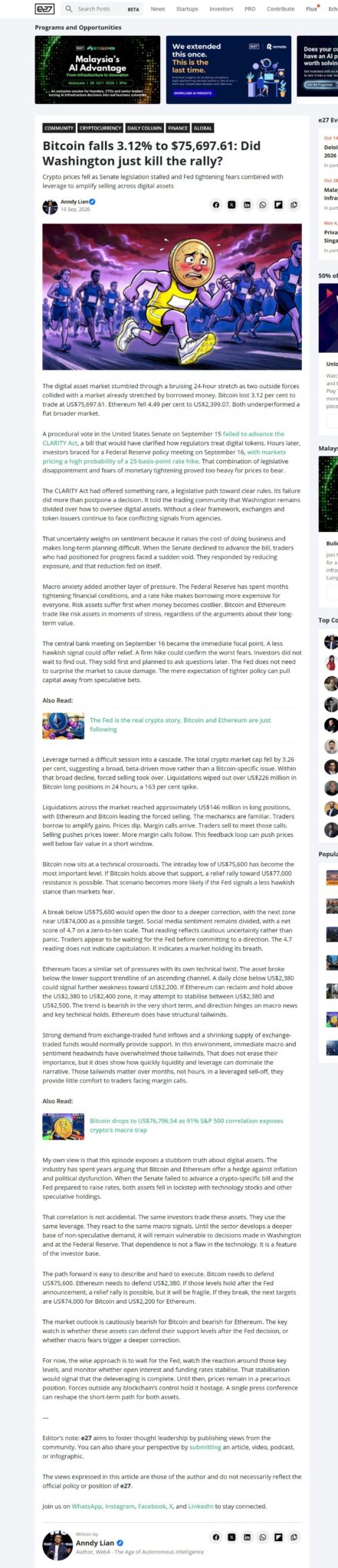
The digital asset market stumbled through a bruising 24-hour stretch as two outside forces collided with a market already stretched by borrowed money. Bitcoin lost 3.12 per cent to trade at US$75,697.61. Ethereum fell 4.49 per cent to US$2,399.07. Both underperformed a flat broader market.

A procedural vote in the United States Senate on September 15 failed to advance the CLARITY Act, a bill that would have clarified how regulators treat digital tokens. Hours later, investors braced for a Federal Reserve policy meeting on September 16, with markets pricing a high probability of a 25-basis-point rate hike. That combination of legislative disappointment and fears of monetary tightening proved too heavy for prices to bear.

The CLARITY Act had offered something rare, a legislative path toward clear rules. Its failure did more than postpone a decision. It told the trading community that Washington remains divided over how to oversee digital assets. Without a clear framework, exchanges and token issuers continue to face conflicting signals from agencies.

That uncertainty weighs on sentiment because it raises the cost of doing business and makes long-term planning difficult. When the Senate declined to advance the bill, traders who had positioned for progress faced a sudden void. They responded by reducing exposure, and that reduction fed on itself.

Macro anxiety added another layer of pressure. The Federal Reserve has spent months tightening financial conditions, and a rate hike makes borrowing more expensive for everyone. Risk assets suffer first when money becomes costlier. Bitcoin and Ethereum trade like risk assets in moments of stress, regardless of the arguments about their long-term value.

The central bank meeting on September 16 became the immediate focal point. A less hawkish signal could offer relief. A firm hike could confirm the worst fears. Investors did not wait to find out. They sold first and planned to ask questions later. The Fed does not need to surprise the market to cause damage. The mere expectation of tighter policy can pull capital away from speculative bets.

Leverage turned a difficult session into a cascade. The total crypto market cap fell by 3.26 per cent, suggesting a broad, beta-driven move rather than a Bitcoin-specific issue. Within that broad decline, forced selling took over. Liquidations wiped out over US$226 million in Bitcoin long positions in 24 hours, a 163 per cent spike.

Liquidations across the market reached approximately US$146 million in long positions, with Ethereum and Bitcoin leading the forced selling. The mechanics are familiar. Traders borrow to amplify gains. Prices dip. Margin calls arrive. Traders sell to meet those calls. Selling pushes prices lower. More margin calls follow. This feedback loop can push prices well below fair value in a short window.

Bitcoin now sits at a technical crossroads. The intraday low of US$75,600 has become the most important level. If Bitcoin holds above that support, a relief rally toward US$77,000 resistance is possible. That scenario becomes more likely if the Fed signals a less hawkish stance than markets fear.

A break below US$75,600 would open the door to a deeper correction, with the next zone near US$74,000 as a possible target. Social media sentiment remains divided, with a net score of 4.7 on a zero-to-ten scale. That reading reflects cautious uncertainty rather than panic. Traders appear to be waiting for the Fed before committing to a direction. The 4.7 reading does not indicate capitulation. It indicates a market holding its breath.

Ethereum faces a similar set of pressures with its own technical twist. The asset broke below the lower support trendline of an ascending channel. A daily close below US$2,380 could signal further weakness toward US$2,200. If Ethereum can reclaim and hold above the US$2,380 to US$2,400 zone, it may attempt to stabilise between US$2,380 and US$2,500. The trend is bearish in the very short term, and direction hinges on macro news and key technical holds. Ethereum does have structural tailwinds.

Strong demand from exchange-traded fund inflows and a shrinking supply of exchange-traded funds would normally provide support. In this environment, immediate macro and sentiment headwinds have overwhelmed those tailwinds. That does not erase their importance, but it does show how quickly liquidity and leverage can dominate the narrative. Those tailwinds matter over months, not hours. In a leveraged sell-off, they provide little comfort to traders facing margin calls.

My own view is that this episode exposes a stubborn truth about digital assets. The industry has spent years arguing that Bitcoin and Ethereum offer a hedge against inflation and political dysfunction. When the Senate failed to advance a crypto-specific bill and the Fed prepared to raise rates, both assets fell in lockstep with technology stocks and other speculative holdings.

That correlation is not accidental. The same investors trade these assets. They use the same leverage. They react to the same macro signals. Until the sector develops a deeper base of non-speculative demand, it will remain vulnerable to decisions made in Washington and at the Federal Reserve. That dependence is not a flaw in the technology. It is a feature of the investor base.

The path forward is easy to describe and hard to execute. Bitcoin needs to defend US$75,600. Ethereum needs to defend US$2,380. If those levels hold after the Fed announcement, a relief rally is possible, but it will be fragile. If they break, the next targets are US$74,000 for Bitcoin and US$2,200 for Ethereum.

The market outlook is cautiously bearish for Bitcoin and bearish for Ethereum. The key watch is whether these assets can defend their support levels after the Fed decision, or whether macro fears trigger a deeper correction.

For now, the wise approach is to wait for the Fed, watch the reaction around those key levels, and monitor whether open interest and funding rates stabilise. That stabilisation would signal that the deleveraging is complete. Until then, prices remain in a precarious position. Forces outside any blockchain’s control hold it hostage. A single press conference can reshape the short-term path for both assets.


Source: https://e27.co/bitcoin-falls-3-12-to-75697-61-did-washington-just-kill-the-rally-20260916/

Anndy Lian is an early blockchain adopter and experienced serial entrepreneur who is known for his work in the government sector. He is a best selling book author. The latest book is Web4: The Age of Autonomous Intelligence.

j j j

China Can’t Export Electricity, So It Did Something Smarter: The AI Token Revolution Explained

China Can’t Export Electricity, So It Did Something Smarter: The AI Token Revolution Explained

China’s electricity cannot cross its borders, but Chinese tokens are already sold globally. These two phenomena are essentially the same thing. Tokens are China’s true electricity export. I know this concept may not have fully clicked yet, but every sentence I share is backed by data.

China generates 10 trillion kilowatt-hours of electricity annually, surpassing the EU, Russia, India, and Japan combined. This is not because China lacks the desire to sell. It is physically impossible. Electricity cannot be stored or loaded onto ships. Extending high-voltage transmission lines across national borders involves negotiations that can drag on for a decade. It is like holding the world’s largest gold mine where the gold is too heavy to transport, leaving it piled up in your own backyard.

Tokens have shattered this bottleneck.

First, let us clarify what a token represents. When you converse with an AI like DeepSeek, every character and line of code it returns consists of tokens. On the surface, they appear as text or dialogue. Fundamentally, they are digitally encapsulated electrical energy. If you doubt this, consider the math. In the cost structure of AI inference, electricity plus compute depreciation together account for a staggering 80% to 90%. In other words, nearly 90 cents of every dollar spent on a token effectively pays for electricity.

A token is a compressed packet of electrical energy, representing the final product refined from China’s northwestern green electricity through GPU computation.

So how does this relate to exports? When a Silicon Valley developer sits at their computer and calls a Chinese large language model API, data instantly traverses undersea fiber-optic cables to reach computing centers in Ningxia or Inner Mongolia. Thousands of GPUs roar to life, consuming China’s cheapest northwestern green power to perform logical inference. They return the result to a screen in San Francisco within seconds. Throughout this entire process, not a drop of oil was burned, and not a single power cable crossed a border. The value of Chinese electricity has already been delivered across borders via tokens. This is dimensional warfare involving zero physical output, light-speed cross-border transfer, and near-zero loss.

The most powerful insight is yet to come. Why is China uniquely positioned to execute this? The answer lies in two words. Electricity prices.

China is uniquely positioned to lead in the AI race because it has solved the “physical” constraint of intelligence: electricity prices. While algorithms are digital, running them requires massive amounts of power, and China’s ability to provide this power at a fraction of the cost in the West is becoming a decisive competitive edge.

Electricity for data centres in China can be as low as 3 cents per kilowatt-hour, roughly one-third the price in the U.S.. Unlike the U.S., where regional grids often operate with thin reserve margins, China maintains a deliberate surplus of electricity. This allows them to “soak up” the massive power demands of AI without destabilising the grid.

The State Grid Corporation of China plans to invest approximately 4 trillion RMB (US$579 billion) between 2026 and 2030 to further upgrade the power grid, specifically to support the future “intelligent economy”. Local governments often provide electricity subsidies for data centres, sometimes cutting power bills by up to 50% if they use domestic chips, further offsetting other costs.

In northwestern China, the situation is different. In specialized wind and solar power zones in Zhongwei, Ningxia, or Qingyang, Gansu, electricity prices can drop as low as 0.20 RMB (0.029 USD) per kilowatt-hour. This represents the absolute global price trough. The per-token cost gap between China and the U.S. can be seen from here.

Now you understand why DeepSeek API pricing can be nearly 20 to 30 times cheaper than OpenAI. This is not due to subsidies. This is not dumping. This is northwestern green electricity pushing cost advantages to their absolute limit within large language models.

Even more ingenious is the export mechanism for tokens. When you export electric vehicles, you face tariffs, trade barriers, and customs inspections at ports. Tokens travel via fiber optics. Under current WTO rules, electronic transmissions are temporarily exempt from tariffs. There are no containers, no cargo ships, and no customs declarations. Chinese electricity, cloaked in data, walks boldly into every terminal device worldwide. This is, without question, the strongest strategic backdoor available for China’s energy strategy.

Now consider another set of data that may surprise you. Recent statistics show that 4 out of the top 5 models on OpenRouter are Chinese large models, including MiniMax’s M2.5, Moonshot AI’s Kimi K2.5, Zhipu’s GLM-5, and DeepSeek’s V3.2. Their combined consumption reaches 85.7%. Chinese AI models have evolved from followers to price setters. This is only the beginning.

NVIDIA CEO Jensen Huang has long predicted that the inflection point for the AI Agent era has arrived. In the future, a single AI completing a task may consume 10 to 50 times as many tokens as it does today. Institutional forecasts project that by 2030, China’s AI inference token consumption will grow from 100 trillion in 2025 to 390,000 trillion by 2030. The ceiling for demand is not even visible yet.

So what is the essence of this transformation? Throughout human history, every reconstruction of the great-power order has begun with a revolution in the form of energy. The British Empire rose on coal and steam. The United States rose on oil and internal combustion. Today, China is quietly rewriting the rules through the ultimate coupling of electricity and computing.

Those northwestern green power resources that once had to be curtailed, causing heartache due to the inability to absorb them, are now being repriced and redeployed as tokens. Previously, we exchanged sweat for foreign exchange. Now, we exchange algorithms for foreign exchange. This is not overtaking on a curve. This is switching to an entirely new track.

Have you noticed? The changes that truly reshape the world often do not happen in headlines. They happen when an ordinary person opens a chat window on their phone, types a line of text, and waits for a reply. Behind that moment lies the wind of Inner Mongolia, the hydropower of Sichuan, and the sunlight of Xinjiang. They travel thousands of kilometers, burn inside GPUs, transform into tokens, cross the Pacific, and land on their screen.

What we are exporting is not merely data. It is the confidence of a civilization.

After reading this, do you believe token exports represent the smartest strategic move in China’s energy history? Pay attention. This is just the beginning.


Source: https://www.benzinga.com/Opinion/26/03/51533819/china-cant-export-electricity-so-it-did-something-smarter-the-ai-token-revolution-explained

Anndy Lian is an early blockchain adopter and experienced serial entrepreneur who is known for his work in the government sector. He is a best selling book author. The latest book is Web4: The Age of Autonomous Intelligence.

j j j

CZ: “Binance Did Not Support Bybit… It Was a Whale Transfer”

CZ: “Binance Did Not Support Bybit… It Was a Whale Transfer”
  • The large transfer of Ethereum from Binance to Bybit was revealed to be a personal transaction by a specific whale, not official support from Binance.
  • Binance founder CZ explained that he cannot take credit for the transfer as it was not official support from Binance.
  • Despite recent hacking damages, Bybit announced that customer assets are safe and they have processed over 99% of withdrawal requests.

It has been revealed that the large transfer of Ethereum (ETH) from Binance to Bybit was not an official support from Binance but rather a personal transaction by a specific whale investor.

On the 21st (local time), blockchain expert Andy Lian stated through his X, “Binance has stepped up to support liquidity stability for its competitor Bybit,” noting that “this contrasts with typical industry competition.” He mentioned Binance founder CZ, saying “protecting consumers comes first, and the community is the top priority.”

However, Binance founder CZ directly commented on this, explaining “The transfer appears to be from users,” and “It’s likely that a specific whale provided a loan to Bybit.” He added, “We cannot take credit for this as it’s not official support from Binance.”

Previously, when a large amount of Ethereum was transferred from Binance to Bybit, industry speculation suggested that Binance had stepped in to support liquidity for Bybit, which recently suffered massive hacking damages. However, through the founder CZ’s explanation, it was confirmed that this was simply a large-scale personal transaction.

Meanwhile, Bybit recently suffered damages from a hacking attack that resulted in the theft of approximately 401,347 Ethereum. Bybit CEO Ben Zhou stated, “Customer assets are safely stored, and we have processed over 99% of withdrawal requests,” confirming that there are no issues with the exchange’s ability to pay.


Source: https://bloomingbit.io/en/feed/news/83728

Anndy Lian is an early blockchain adopter and experienced serial entrepreneur who is known for his work in the government sector. He is a best selling book author. The latest book is Web4: The Age of Autonomous Intelligence.

j j j