What is Decentraland and how does it work?

What is Decentraland and how does it work?

Imagine living in an alternate reality where you can move seamlessly from place to place and socialise in real-time with thousands of other people, all within the same digital universe.

This is the metaverse, a term first coined in Neal Stephenson’s science fiction novel Snow Crash, which refers to a combination of virtual reality, augmented reality and the internet.

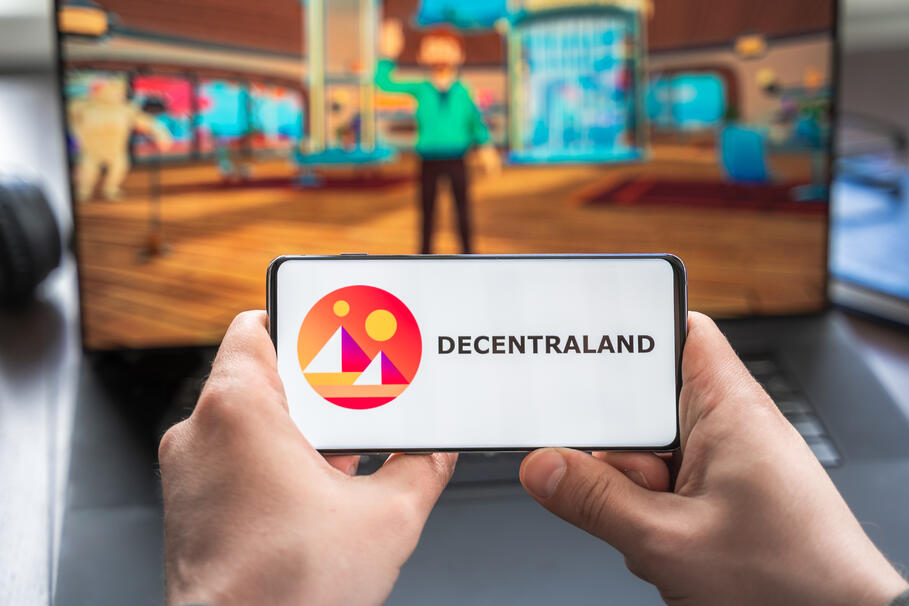
Decentraland is a three-dimensional (3D) virtual reality platform that stands at the forefront of this growing metaverse trend which has seen meta-related coins proliferate by up to 37,000% this year according to data from Macro Hive.

Founded in 2015 by Ari Meilich and Esteban Ordano, and launched in 2017, Decentraland is powered by Ethereum and its native ERC-20 token known as MANA allows users to purchase plots of LAND, monetise LAND parcels and avatars and pay for in-world goods and services.

More specifically, LAND can be bought by burning MANA, which destroys the token in order to create a new entry in the registry. Decentraland is also governed by a decentralised autonomous organisation (DAO) that enables token holders to vote on policies within the metaverse.

Although the company claims that it is the first ever virtual world owned by its users, Decentraland began simply as a proof of concept for allocating ownership of digital real estate to users on a blockchain. This digital real estate was initially implemented as a pixel on an infinite 2D grid where each pixel contained metadata identifying the owner. Decentraland has since evolved into a 3D virtual world which is divided according to different districts.

The platform has been growing at an accelerated rate and currently has a market capitalisation of $6.8bn (as of 6 December 2021). The company’s thirty-day non-fungible token (NFT) sales volume is up 417% at $41.5m, while its seven-day total sales volume is $15.7m, with 467 NFTs sold during that time, at an average price of $33,700.

How does Decentraland work?

Decentraland is most well-known for providing an infrastructure to support shared virtual worlds. The platform consists of a decentralised ledger for land ownership, a protocol for describing the contents of each LAND parcel and a peer-to-peer network for user interactions. Through the DAO, users can propose policy updates and vote on upcoming LAND auctions.

Decentraland’s protocol consists of three layers:

  • A consensus layer which tracks LAND ownership and content through smart contracts,
  • A LAND content layer which uses a decentralised distribution system to render content in the virtual world, and
  • A real-time layer which provides peer-to-peer connections for users to interact with each other.

Users claim ownership of virtual lands through a blockchain-based ledger of encoded parcels and each piece of LAND is marked by a distinct set of cartesian coordinates. Content can range from static 3D scenes to interactive systems such as games.

In addition to selling their creations, users can rent out plots such as buildings, parks, hotels and casinos to other players. Decentraland’s metaverse is divided into 90,601 individual LAND parcels which are exactly 16×16 in size and can be found at specific coordinates in the metaverse.

If you’re wondering what the main idea of Decentraland is, look no further than its thriving marketplace where users can create and sell items through a unique in-world economy. More generally, web 3.0 metaverse worlds are part of a larger interconnected crypto cloud economy in the sense that these decentralised protocols interoperate with and provide the technical infrastructure to support metaverse virtual economies.

Web 3.0 metaverse economies can use their own digital currency or the currency of the crypto cloud economy platform they’re built on – in Decentraland’s case, this is the MANA token.

Overall, this decentralised distribution system enables the platform to work without the need of a centralised server infrastructure.

In terms of identity verification, Decentraland uses a decentralised identity system which allows users to easily track and verify consent through cryptographic signatures.

An all-immersive digital world: Pros of the MANA coin

The pros of the MANA coin lie in the fact that it enables users to create games, applications, gambling services and even dynamic 3D scenes which can be monetised or rented out to other players. This in turn drives the expansion of digital goods and services within the Decentraland metaverse.

Through the LAND Estates function, users can easily manage their lands by associating adjacent plots – a feature which serves as a boost for the coin since users were unable to connect two or more parcels of LAND directly through the marketplace before Estates was introduced. Much to their dismay, users could only create, edit, transfer and dissolve Estates during the first release of Decentraland.

Another benefit of the MANA coin is that there are theoretically no limitations on how it can be used to facilitate the creation of LAND parcels within the metaverse. For those who want to earn MANA through Decentraland, there are no technical specifications in terms of what can be built in Decentraland which means that users are free to explore a range of different virtual structures.

“Decentraland has pioneered a type of virtual social space (or metaverse) that is operated entirely by its users,” Ari Meilich, Decentraland’s founder, told Capital.com.
“They serve the content that players publish on their virtual lands, streamline the communications between avatars, and vote with their MANA tokens to decide on the economic policies of the virtual world – all while distributing the DAO’s $1bn endowment among content creators,” he added.
“Decentraland’s success resided in its ability to accelerate growth even when the original development company was dissolved,” Meilich concluded.

An emerging DeFi space: Cons of the MANA coin

Decentraland is still a relatively new project that was only launched five years ago and it operates within a nascent decentralised finance (DeFi) space. Its coin is also hindered by scalability issues that are inherent to the blockchain network.

During times of high network congestion, blockchain transaction times are known to increase. In addition to processing delays, high transaction fees are also common on the blockchain network. For example, the average fee on Ethereum is currently $33.43, according to data from BitInfoCharts.

Also, MANA lacks real-world utility since only 205 merchants worldwide are accepting it as a payment, according to Cryptwerk – a scarcity which could serve as a con for the crypto.

Anndy Lian, chairman of BigONE Exchange and chief digital advisor for Mongolia’s national productivity agenda, believes that the Decentraland concept provides limitless opportunities for users.

“Decentraland has become a fertile breeding ground for businesses, artists, content creators and application developers,” Lian told Capital.com.

“For me, I don’t see many cons, however if you are going to go full steam ahead with Decentraland, I would suggest getting a suitable graphics card for an enhanced experience,” Lian added.

“Also, Grayscale launched its Decentraland Trust in February this year which proves the heightened demand for metaverse-related products. Investors who believe in the virtual world economy would surely see this as a potent sign of further growth to come,” Lian concluded.

Anndy Lian is an early blockchain adopter and experienced serial entrepreneur who is known for his work in the government sector. He is a best selling book author- “NFT: From Zero to Hero” and “Blockchain Revolution 2030”.

Currently, he is appointed as the Chief Digital Advisor at Mongolia Productivity Organization, championing national digitization. Prior to his current appointments, he was the Chairman of BigONE Exchange, a global top 30 ranked crypto spot exchange and was also the Advisory Board Member for Hyundai DAC, the blockchain arm of South Korea’s largest car manufacturer Hyundai Motor Group. Lian played a pivotal role as the Blockchain Advisor for Asian Productivity Organisation (APO), an intergovernmental organization committed to improving productivity in the Asia-Pacific region.

An avid supporter of incubating start-ups, Anndy has also been a private investor for the past eight years. With a growth investment mindset, Anndy strategically demonstrates this in the companies he chooses to be involved with. He believes that what he is doing through blockchain technology currently will revolutionise and redefine traditional businesses. He also believes that the blockchain industry has to be “redecentralised”.

j j j

What does the future hold for metaverse?

What does the future hold for metaverse?

Metaverse has been the talk of the town since Facebook’s decision to rebrand as Meta in October this year. However, the word “metaverse”, a portmanteau of “meta-“ (meaning beyond) and “universe”, existed way before this. The term “Metaverse” is often credited to Author Neal Stephenson’s 1992 dystopic, sci-fi novel Snow Crash, and many see a more recent inspiration in Earnest Cline’s 2011 novel Ready Player One. Unlike what is portrayed in movies and blockbusters, the metaverse I’m talking about is far from the stuff of sci-fi – and we’re not unfamiliar to it.


What is it?

Metaverse is a hypothesised iteration of the Internet; a digitalised layer of reality that hovers around and throughout the features of the real world – or, in some definitions, is entirely separate from it. Much like Christopher Nolan’s 2014 Interstellar, don’t you think?

Originally thought of as an idea of a centralised virtual world, a “place” parallel to the physical world, Cline’s Ready Player One portrayed that idea of a metaverse down to the T. When Facebook CEO Mark Zuckerberg announced his intention to build a more maximalist version of Facebook, spanning social presence, office work, and entertainment – coupled with Stephenson’s and Cline’s portrayal of metaverses as reference – it sounded like a far-fetched ambition.

Critics have stepped forward and named this version of metaverse a method of public relations building using a purely speculative and “over-hyped” concept based on existing technology. But what we do not realise is that it already exists in our world.

Online communities have existed since the dawn of the Internet’s existence and grew in the 1990s with various chatrooms and the first social media sites. Does anyone remember Friendster? It’s one of the earliest social media networks that ever existed. Apart from being known as a social network game, Friendster allowed communication between users, dating, and discovering new events, bands, and hobbies.

Metaverses, in a way, are currently present on platforms like VRChat or video games like Fortnite and Second Life. Today, logging onto Fortnite, joining a chat and launching into a game with friends is, especially to younger generations, just as social an experience as most other physical interactions.


Is that all there is to a metaverse?

(Hint: Nope)

The concept of metaverse, also known to many as “Web3.0”, clearly means extremely different things to different people. The metaverse is currently split into two categories – a world of gaming and game creations, and a blockchain-based digital world. The former is made up of a series of embryonic digital spaces such as Facebook’s HorizonFortnite, and Roblox, while the latter houses Decentraland. These spaces have clear boundaries, different rules and objectives, and differing rates of growth.

The metaverse could fundamentally change the way we interact with the digital world. In the same way non-fungible tokens (NFT) have brought new opportunities to creators, artists, and gamers, the metaverse could very possibly not just reshape the creator economy, but invent it anew.

The promise of the metaverse is to allow a greater assimilation of our digital and physical lives in wealth, productivity, shopping, socialisation, and entertainment. Instead of an extension of the Internet, the metaverse is best described as a successor of it. At its core, the metaverse is an evolution of our current Internet.


How does crypto fit in?

At the foundation of the metaverse, there will be a demand to deliver permission less identity, financial services, and high-speed exchange. Data will have to be stored and made available to millions, if not billions of people. The solution to this lies in the technology of cryptocurrency.

Vitual worlds that integrate cryptocurrencies have been developed by companies like Decentraland and The Sandbox. The purpose for this is so gamers can create structures like virtual casinos and theme parks, and monetise them. In Decentraland, the currency used is called MANA, and is available for purchase on exchanges like BigONE. Decentraland even has casinos where MANA is used for gambling and salaries for dealers.

NFTs, most of which are a part of the Ethereum blockchain, will give people complete ownership of their characters, and accrue in-game items including virtual land.


Decentraland (MANA) VS Sandbox (SAND)

Ever since Facebook virtualised the term “metaverse”, everyone seems to want to get into it. This has greatly benefited the crypto metaverse platforms, especially Decentraland and Sandbox where they are the top two metaverse projects right now.

Comparing their native tokens now, Decentraland’s $MANA has rallied more than 400%, while Sandbox’s $SAND has rallied more than 300% since 28th October 2021. An analysis of token growth alone is insufficient to get a true sense of which platform will be a leader in the metaverse space. So, let’s get to discussing!

At their foundation, Decentraland and Sandbox are a virtual reality platform powered by the Ethereum blockchain where users can create an experience and monetise their gaming experience. Land and virtual worlds are permanently owned by the community without a central authority.

Both $MANA and $SAND are ERC20 tokens, where users can use any ERC20 wallet in the market for both projects. However, Decentraland has recently linked up with wallet connect, giving better access to Polygon users.

Built on the Ethereum blockchain, Decntraland and Sandbox’s scalability capacity is limited by unstable tokens and high fees. With the upcoming update from ETH1 to ETH2, Decentraland and Sandbox may not have enough scalability capacity to adapt to massive adoption.

At this moment, Decentraland has a more structured governance mechanism compared to SandboxDecentraland has two tokens – $LAND and $MANA – resulting in having a Decentralised Autonomous Organisation (DAO). Sandbox users, on the other hand, need $SAND to participate in governance decisions of the platform via a DAO structure.

Let’s talk teams. Decentraland has a Security Advisory Board (SAB) that acts as a guarantor of Decentraland’s smart contract security. They have important leaders in blockchain engineering, computer science, venture capital, and data analytics. In contrast, the Sandbox team is distributed in four different countries specialising in startups, software development, finance, and blockchain business. Despite the difference in pedigrees between both teams, Sandbox has more members, hinting at the possibility of having better developments in the future.

Recent developments in projects are a good indication of where the projects are headed towards. Decentraland has announced their new partnerships and developments like an open virtual gallery with Sotheby’s, accompanied by the ability for users to shoot and edit videos within the platform. On the other hand, Sandbox’s has recently announced their liquidity mining launch and its migration to a Polygon NFT layer 2 to use 100 times less energy than Ethereum. Both projects are consistently developing new features, but Sandbox’s is a critical improvement that may very well allow for exceptional scalability.


Who will win?

Considering the factors that have been analysed, Sandbox seems to offer a truer and more technically comprehensive platform that is ready to dominate the metaverse. But, taking into account that the metaverse is still – in a sense – an infant, it is way too early to determine who will take the throne.

Let’s use the comparison of the top two most used search engines – Google and Yahoo – as an example. Yahoo was founded in 1994, while Google was founded in 1998. Despite the head-start Yahoo had, Google has created just as strong a brand name as Yahoo. Google and Yahoo offer different benefits but users will always prefer one search engine over the other without understanding and considering the pros and cons. Through the humongous developments of the Internet, both search engines have adapted very well that even till now, their rivalry is still going strong.

Similarly, the competition between the top two metaverse projects can be viewed as such. Sandbox was founded in 2013, while Decentraland was founded in 2015. Still in their infancy stage, both projects are developing rapidly without losing to each other holistically. Their developments may set them apart but will that determine which is a better or worse platform? Who’s to say there will even be a winner?


What does the future hold?

With Facebook’s extravagant entrance to the metaverse, and even rebranding themselves as Meta, Zuckerberg announced plans to fund $10 billion this year on the development of the metaverse – an ecosystem of interconnected digital experiences, services, and platforms that seamlessly blend with the real world. We certainly hope to see that Zuckerberg’s ambitions become our new reality.

Tech giants of all shapes and sizes, from Microsoft, Amazon, Tencent, and Alibaba, to Disney, and even Tinder, have announced their plans towards building a metaverse. What does this entail? Similar to Bitcoin, these whales will move and develop the metaverse faster than you can say “Supercalifragilisticexpialidocious”.

While it’s impossible to predict exactly how the metaverse will look like, or when it has reached its peak, the importance of cryptocurrencies for its growth is engraved in stone. As technologies like virtual reality develop, and current industry leaders like Facebook gets involved, advancements in blockchain technology and the world of cryptocurrency will play an equally important role in shaping the metaverse’s future.

“The metaverse currently has an independent, whole economy of its own, indicating that cryptocurrency and digital currency will likely become the key transactional method. Cryptocurrency is not new to us but more people have begun to get into it for various reasons as of late. One thing for sure, is that such currencies will be key to trading across the worlds – real and digital – all while being supported and distributed by technologies such as blockchain.” #anndylian


Author: Anndy Lian

Anndy Lian is an all-rounded business strategist in Asia. He has provided advisory across a variety of industries for local, international, public listed companies and governments. He is an early blockchain adopter and experienced serial entrepreneur, book author, investor, board member and keynote speaker.

Currently, he is appointed as the Chief Digital Advisor at Mongolia Productivity Organization, championing national digitization. He is also the Chairman, Asia for BigONE Exchange.


Original Source: https://metaverseinsider.tech/2021/12/05/what-does-the-future-hold-for-metaverse/

Anndy Lian is an early blockchain adopter and experienced serial entrepreneur who is known for his work in the government sector. He is a best selling book author- “NFT: From Zero to Hero” and “Blockchain Revolution 2030”.

Currently, he is appointed as the Chief Digital Advisor at Mongolia Productivity Organization, championing national digitization. Prior to his current appointments, he was the Chairman of BigONE Exchange, a global top 30 ranked crypto spot exchange and was also the Advisory Board Member for Hyundai DAC, the blockchain arm of South Korea’s largest car manufacturer Hyundai Motor Group. Lian played a pivotal role as the Blockchain Advisor for Asian Productivity Organisation (APO), an intergovernmental organization committed to improving productivity in the Asia-Pacific region.

An avid supporter of incubating start-ups, Anndy has also been a private investor for the past eight years. With a growth investment mindset, Anndy strategically demonstrates this in the companies he chooses to be involved with. He believes that what he is doing through blockchain technology currently will revolutionise and redefine traditional businesses. He also believes that the blockchain industry has to be “redecentralised”.

j j j

Anndy Lian Interviews Pavel Matveev, CEO of Wirex: “Our industry does not respect tradition — it only respects innovation.”

Anndy Lian Interviews Pavel Matveev, CEO of Wirex: “Our industry does not respect tradition — it only respects innovation.”

Blockcast.cc: The payment tech industry is growing and one of the main player in my opinion is Wirex. My name is Jenny Zheng, Cofounder of Blockcast.cc. We are based in Singapore and have presence in South Korea, China and the USA. This afternoon, I have the chance to speak to the man himself, CEO of Wirex, Pavel Matveev. We have brought Anndy Lian into the house as well for this interview. He is an inter-governmental blockchain advisor, book author for “Blockchain Revolution 2030”, investor and recently took on the role as Asia CEO of DECENT Group, previously he founded the world first blockchain supply chain solutions for fast consumer goods. He will be the one posting the questions to Pavel and facilitate this discussion.

Jenny: Dear Pavel, good to meet you. Can you give an introduction of yourself?

Pavel: Hi Jenny, thank you for the interview. Hi Anndy, thanks for being here as well despite your busy schedule.

My name is Pavel Matveev. I am the co-founder and CEO of Wirex. As well as ensuring that the company is constantly pushing the boundaries of payment tech, I believe that my role includes facilitating and evangelising the mainstream adoption of distributed ledger technology across a number of industries.

Jenny: Our readers would like to know more about you, your past and current experiences or even your hobbies too. Can you share that as well?

Pavel: Sure. Before Wirex, I helped top-tier investment banks like Morgan Stanley, Barclays Capital and Credit Suisse build trading platforms and algo-trading strategies. During this time, I recognised that the cost and inconvenience of off-boarding digital currencies was an impediment to their use by both consumers and businesses, despite the latent potential in a tokenised economy. Dmitry Lazarichev and I founded Wirex to solve some of these problems and allow people to use their cryptocurrencies in everyday situations.

In my free time, I like to swim, ski and play video games. Not all at the same time!

Anndy: Impressive background. Tell us more about Wirex. We would like to know more on the progress and the future roadmap. For your information, Blockcast.cc did the PR work for OKEX during your IEO stages for the South Korea market. I was in South Korea during that period of time and we know so much about your company. How was the last 12 months for WireX?

Pavel: It’s an exciting time at Wirex and we’ve recently hit some major milestones. Over the last 12 months, we have partnered with Stellar — preparing 26 fiat-backed stable coins to revolutionise international remittance.

The Wirex Token (WXT) — our own native utility token, built on the Stellar network was also released. We then launched our next-gen, multi-currency Wirex Visa travel card in APAC.

We went on with our development work and have completely overhauled and re-designed the Wirex platform and card in early 2019, including the introduction of interbank and OTC rates for fiat and crypto exchanges respectively.

Lastly, we have received JVCEA Type II membership in Japan.

Anndy: You must have great plans ahead after obtaining the Type II membership, maybe Type I? What geographical expansion plans do you have right now?

Pavel: In terms of geographical expansion, we will begin operating in Japan, Canada and the U.S this year. We’re currently working towards acquiring our Type I Licence from Japan’s Financial Services Agency (FSA) — this will establish the platform as a legal Crypto Asset Exchange Service Provider (only 19 companies have achieved this to date) and allow us to offer our full range of services to Japanese customers.

We’re also continuing to develop our business product, including merchant offers that will allow companies to circumvent traditional payment channels run by Visa or Mastercard and Stablecoin-powered remittance.

Anndy: One reason why I stepped up to be part of a government advisor for blockchain is that I do see that there are a lot of scams in the market and it is not getting any better, depending on how you see it. Of course in my line of work, I do see many companies trying their best to navigate this unregulated space to get the best-commercialised value for their business. How do you see the blockchain and cryptocurrency market in general?

Pavel: Blockchains first use was for the movement of money, e.g. — cryptocurrency or digital currencies. I believe digital currencies are the biggest thing to happen to the financial sector since the Bretton Woods agreement. Not only do they allow for a system of money that sits outside the authority and oversight of central banks and governments but they also enable businesses and consumers to circumvent conventional financial infrastructure.

Legacy banking rails are slow and expensive; cryptocurrencies allow for near-instant transactions at a fraction of the cost, with none of the fees associated with Mastercard and Visa payment infrastructures. Even cryptos market volatility can be mitigated through the use of asset-pegged stable coins such as Dai.

I certainly wouldn’t agree that it is ‘not getting any better.’ The introduction of the 5th Money Laundering Directive (5MLD) means measures are being taken to prevent digital assets being utilised for ransomware purpose. Generally, procedures in line with the regulatory requirements of the traditional financial service sector are being implemented across the industry — an important step in a previously unregulated space.

Anndy: How do you see the term decentralisation in the blockchain space? Do you think it is feasible? Or is there a need to “re-decentralise” it, giving a new meaning.

Pavel: It is feasible. In 2019, we’ve seen a lot of existing and new DeFi (decentralised finance) projects get traction and create real value for real users. Notable examples include MakerDAO launching its multi-collateral DAI upgrade. We expect this trend to continue and are keen on supporting and cooperating with the best projects in the space.

Anndy: What is the future of blockchain? How do you visualise it? Where are the breakthroughs?

Pavel: The future of blockchain is bright, as highlighted above. I believe it has positively changed the world and there are more industries it will have an impact on.

Whether blockchain will become mainstream is a question of when, not if. Cryptocurrencies and stable coins are already revolutionising payments, lending and other areas of finance. Blockchain overall holds huge potential in other areas, too — decentralised data storage, smart contracts and so on.

The overall quality of projects in the space is consistently improving. Real-life use cases beyond investment and trading are increasing and creating real value — this trend will continue.

Jenny: We have reached the end of the interview Pavel. Can you share an inspiring quote for our readers?

Pavel: A quote I admire from another giant in the tech space is:

“Our industry does not respect tradition — it only respects innovation.”

– Satya Nadella, CEO of Microsoft.

Jenny: Yes innovation is the key to the technology industry. Thank for your time Pavel and thanks Anndy for being here with us today.

For more information about Wirex, please go to www.wirexapp.com. You will discover a new way to pay, giving you total control of your crypto and traditional currency, wherever you are in the world.

Original Source: https://blockcast.cc/interviews/blockcast-cc-exclusive-interview-with-pavel-matveev-ceo-of-wirex-our-industry-does-not-respect-tradition-it-only-respects-innovation/

Anndy Lian is an early blockchain adopter and experienced serial entrepreneur who is known for his work in the government sector. He is a best selling book author- “NFT: From Zero to Hero” and “Blockchain Revolution 2030”.

Currently, he is appointed as the Chief Digital Advisor at Mongolia Productivity Organization, championing national digitization. Prior to his current appointments, he was the Chairman of BigONE Exchange, a global top 30 ranked crypto spot exchange and was also the Advisory Board Member for Hyundai DAC, the blockchain arm of South Korea’s largest car manufacturer Hyundai Motor Group. Lian played a pivotal role as the Blockchain Advisor for Asian Productivity Organisation (APO), an intergovernmental organization committed to improving productivity in the Asia-Pacific region.

An avid supporter of incubating start-ups, Anndy has also been a private investor for the past eight years. With a growth investment mindset, Anndy strategically demonstrates this in the companies he chooses to be involved with. He believes that what he is doing through blockchain technology currently will revolutionise and redefine traditional businesses. He also believes that the blockchain industry has to be “redecentralised”.

j j j