How to Prepare for Bitcoin Halving in April 2024: Expert Tips & Projections

How to Prepare for Bitcoin Halving in April 2024: Expert Tips & Projections

Bitcoin halving is the most anticipated event of the crypto industry that occurs once every four years. According to the Bitcoin halving countdown, April 18, 2024, is the date when Bitcoin is expected to mint its 840,000 block and subsequently undergo its fourth halving.

From an investor’s perspective, halvings are seen as milestone events that have ushered crypto bull markets. For miners, halvings bring challenging business conditions where miner revenues are cut by half and production costs per Bitcoin theoretically double.

In this article, we conduct an in-depth Bitcoin halving analysis, as well as provide potential post-halving price scenarios and tips for both investors and miners from industry experts on how to prepare for the fourth Bitcoin halving cycle.

Key Takeaways

  • Bitcoin is expected to undergo its fourth halving on April 18, 2024.
  • Historical charts showed Bitcoin prices took between 12 to 18 months to peak post-halving.
  • The introduction of spot BTC ETFs has created unprecedented market conditions.
  • Graeme Moore, the head of tokenization at Polymesh Association, predicted that the price of BTC could go as high as $100,000 past halving in 2024.
  • Anndy Lian, an intergovernmental blockchain expert, predicted that the BTC price post-halving has the potential to surge 10% higher than its all-time high, which currently surpasses $73,000.
  • With more funds flowing into BTC ETFs, Lian added, the BTC price could go up an additional 30% by the end of the next quarter.
  • Yuya Hasegawa, an analyst at the crypto exchange Bitbank, expected a strong rally during the latter half of this year.

How to Prepare for the Next Bitcoin Halving

Tips for Investors

The crypto market is unpredictable, but that shouldn’t keep investors from learning about historical patterns and possible outcomes to stay ahead of the curve.

Here is how investors can prepare for the Bitcoin halving event.

1. No Near-Term BTC Price Increase Guaranteed

Financial markets are forward-looking. Trades are made based on the potential of future returns. Therefore, it may come as no surprise that investors have been accumulating Bitcoin since the fourth quarter of 2023 in preparation for Bitcoin’s fourth halving, having seen BTC prices surge in past halving cycles.

As of March 13, 2024, Bitcoin prices have gained over 70% year-to-date and hit new all-time highs of over $73,000 without seeing a significant correction in the first three months of 2024.

Given the predictable and anticipated nature of halving events, you should keep in mind that rational investors are most likely to buy Bitcoins ahead of the event.

Therefore, the Bitcoin halving event does not guarantee an immediate uptick in Bitcoin prices. We could even see a sell-the-news event as euphoria around Bitcoin halving fades away.

2. Positive Long-Term Impact of Halving

Over the mid-to-long term, halving is expected to have a positive impact on the price of Bitcoin due to the reduction of BTC supply. Supporting this theory is the historical market data that showed that Bitcoin prices surged astronomically over the next 18-month period following past halving cycles.

  • According to Fidelity Asset Management, Bitcoin prices surged as much as 10,485% within 371 days after the first Bitcoin halving.
  • Following the second halving in July 2016, Bitcoin prices rose as much as 3,103% over the next 525 days.
  • Similarly, after the third halving period in May 2020, Bitcoin prices jumped as much as 707% within the next 546 days.

3. Impact of Spot BTC ETFs

The introduction of spot BTC ETFs has created unprecedented market conditions that halving cycles of the past did not encounter.

Since the spot BTC ETFs were approved on January 11, 2024, the popularity of the instrument has created a Bitcoin demand shock.

For reference, the average BTC daily demand on ETF trading days currently stands at 4500 Bitcoins surpassing an average of 921 new Bitcoins minted per day, Coinshares reported.

If the spot BTC ETF remains consistent when the supply of Bitcoins reduces by 50% post-halving, the supply-demand principles of economics tell us that Bitcoin prices might rise.

Tips for Miners

One of the biggest challenges that the BTC halving event poses for miners is the reduction in mining rewards.

Apart from the 50% cut, the halving might also increase competition, heightening mining difficulty and potentially increasing the price of transaction fees.

Yuya Hasegawa, an analyst at the crypto exchange Bitbank, told Techopedia in a note that miners often have to consider how they will manage to operate with 50% less revenue.

“This has affected Bitcoin’s hash rate and the network’s difficulty post-halving, as some of them halt operation until the difficulty drops low enough for them to make a profit again. Some others sell their Bitcoin holdings to make up for decreased cash flow.”

However, Hasegawa added that miners should also consider the release of spot BTC ETFs, which could make the situation a little different.

This is because spot BTC ETFs are buying more than they can produce almost every day, thus overwhelming the BTC supply.

“If the ETF inflow continues to overwhelm Bitcoin’s supply, which it probably will since it already is buying more than the network can produce in a day even before halving, the price may continue to rise post-halving, and that could maintain mining profitability.”

Moreover, miners should also prioritize energy efficiency as the cost of electricity is a major component of mining expenses, Anndy Lian, an intergovernmental blockchain expert and the author of NFT: From Zero to Hero, explained.

This can be done through the use of efficient hardware and access to low-cost energy sources, which can help maintain profitability post-halving.

Lian told Techopedia:

“In the past, most miners looked at standard operation costs. I hope they will do more research and stay informed about market behaviors and trends to make educated decisions regarding their operations. They should evaluate their financial health, including debt levels and capital reserves, to withstand potential revenue drops due to the halving. This would also give them a gauge on how fast they expand.”

Bitcoin Price Scenarios to Consider With Approaching BTC Halving Event

Post-Halving Bitcoin Price Action: Analyst Views

Historically, BTC halving events led to the cryptocurrency’s price increases due to the reduced supply of new Bitcoin tokens entering the market.

Lian predicted that the BTC price post-halving has the potential to surge 10% higher than its all-time high, which currently surpasses $73,000.

However, he added that post-halving and with more funds flowing into BTC ETFs, the BTC price could go up an additional 30% by the end of the next quarter.

“It’s also worth noting that predictions vary widely, and the actual outcome will depend on a multitude of factors, including market demand, investor sentiment, and broader economic conditions. Always remember that investing in cryptocurrencies carries risk, and prices can be highly volatile. It’s advisable to conduct thorough research and consider seeking advice from financial experts before making investment decisions,” Lian added.

The launch of spot BTC ETFs earlier this year was a huge success, and their demand could grow even bigger later in the year, according to Hasegawa.

He added that while the Federal Reserve is still waiting for inflation to calm down, there is a possibility they could start cutting rates, which could increase demand for both BTC and ETFs and facilitate more cash flow.

Bitbank’s Hasegawa concluded:

“Furthermore, halving will crunch Bitcoin’s supply, so we could expect that those three elements (rate cuts, ETFs, halving) will together create a strong rally sometime during the latter half of this year.”

Graeme Moore, the head of tokenization at Polymesh Association, predicted that the price of BTC could go as high as $100,000 past-halving in 2024 as the cryptocurrency is already experiencing massive heights.

“We are already seeing the effect of the upcoming halving with a 50% increase in price since February. Bitcoin is now over $72K. In addition, the relentless bid from the new Bitcoin ETFs is proving that the broader market is beginning to see the value in a global, decentralized, provably scarce asset. If the previous cycles are an indicator, the price of Bitcoin will continue to rally into the halving and after.”

Historical Bitcoin Halving Analysis

A study of historical Bitcoin halving charts showed that BTC consistently saw price increases in the weeks ahead of halving events. Following halving events, Bitcoin showed a tendency to trade within a range in the next months.

Following the second Bitcoin halving, BTC price traded range bound between $600 and $800 from July 2016 to November 2016.

Similarly, following the third Bitcoin halving cycle in May 2020, BTC traded in the $8,000-$14,000 range for the next six months before finally breaking out to scale new all-time highs.

Historical charts also showed that Bitcoin prices took between 12 months to 18 months to hit the peak price during the first three halving cycles.

Market catalysts that supported Bitcoin prices during each cycle included the European debt crisis of 2009-2012, the initial coin offering (ICO) boom of 2016, and ultra-low interest rates of the post-pandemic era.

The Bottom Line

The upcoming BTC halving is poised to impact both investors and miners. While historical data suggests a potential for long-term price increases, short-term volatility and uncertainty remain prevalent.

Investors should exercise caution, considering the unpredictability of market reactions post-halving, and conduct thorough research before making investment decisions.

Miners facing reduced rewards and heightened competition must prioritize efficiency and strategic planning to navigate the challenges ahead.

As the crypto landscape evolves with the introduction of spot BTC ETFs, staying informed and adaptable will be crucial for all stakeholders in the Bitcoin ecosystem.

Source: https://www.techopedia.com/how-to-prepare-for-bitcoin-halving

Anndy Lian is an early blockchain adopter and experienced serial entrepreneur who is known for his work in the government sector. He is a best selling book author- “NFT: From Zero to Hero” and “Blockchain Revolution 2030”.

Currently, he is appointed as the Chief Digital Advisor at Mongolia Productivity Organization, championing national digitization. Prior to his current appointments, he was the Chairman of BigONE Exchange, a global top 30 ranked crypto spot exchange and was also the Advisory Board Member for Hyundai DAC, the blockchain arm of South Korea’s largest car manufacturer Hyundai Motor Group. Lian played a pivotal role as the Blockchain Advisor for Asian Productivity Organisation (APO), an intergovernmental organization committed to improving productivity in the Asia-Pacific region.

An avid supporter of incubating start-ups, Anndy has also been a private investor for the past eight years. With a growth investment mindset, Anndy strategically demonstrates this in the companies he chooses to be involved with. He believes that what he is doing through blockchain technology currently will revolutionise and redefine traditional businesses. He also believes that the blockchain industry has to be “redecentralised”.

j j j

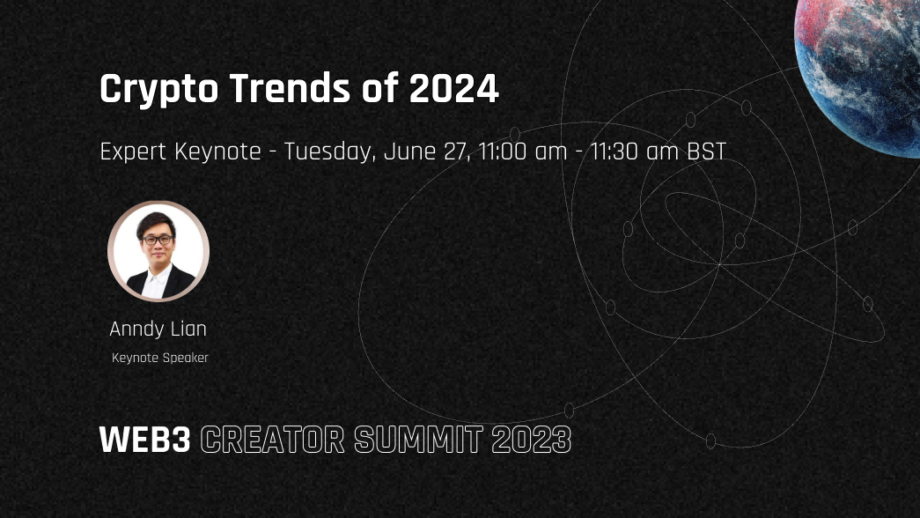
Web3 Creator Summit Expert Keynote: Crypto Trends of 2024 by Anndy Lian

Web3 Creator Summit Expert Keynote: Crypto Trends of 2024 by Anndy Lian

As we look into the future of the crypto industry, it’s essential to anticipate the trends and developments that will shape the landscape in 2024. I discussed the transformative power of artificial intelligence (AI), the significance of Central Bank Digital Currency (CBDC), the advancement of the crypto travel rule, and the shift towards decentralized governance, among other topics. Let’s explore these predictions further:

Artificial Intelligence: Transforming Everyday Life

I believe that AI will continue to disrupt various sectors and seamlessly integrate into our daily lives. Its impact is expected to be profound, reshaping industries and revolutionizing the way we interact and conduct business.

CBDC: A Game-Changer for the Crypto Industry

I place great emphasis on the significance of Central Bank Digital Currency (CBDC) as a pivotal element in tracking, tracing, and taxing financial transactions. The introduction of CBDCs holds the potential to drive the widespread adoption of digital assets and revolutionize the crypto industry as a whole. The enhanced transparency and accountability provided by CBDCs have the capacity to reshape our perception of and engagement with cryptocurrencies.

Crypto Travel Rule: Advancing Traceability and Taxation

The imminent advancement of the crypto travel rule aims to elevate traceability and taxation within the crypto space. By implementing stricter regulations, authorities can ensure that transactions are closely monitored, leading to a more secure and transparent ecosystem for all participants.

Layer 2: The Growing Influence of Bitcoin and Ethereum

I highlight the continued growth of Bitcoin and Ethereum, the two leading cryptocurrencies. Additionally, the rise of BRC20 tokens and the development of zero-knowledge proofs (ZK) are expected to contribute to the expansion of Layer 2 solutions. These advancements promise to enhance scalability, security, and efficiency within blockchain networks, fostering an environment conducive to widespread adoption.

Next Level NFT: Adoption and Brand Recognition

Non-Fungible Tokens (NFTs) have experienced increased adoption, thanks to the support and endorsement of major brands. Although the sales volume of NFTs has not seen significant growth, their relevance and influence continue to expand. NFTs provide unique digital assets that hold intrinsic value and can be securely traded on blockchain platforms, revolutionizing the concept of ownership and collectibles.

Web4: A Decentralized and Autonomous Web

The emergence of Web4 signifies a paradigm shift towards a more decentralized and autonomous web. Internet natives are actively participating in building decentralized narratives and fostering a more inclusive online environment. This transition aims to empower individuals and ensure that digital spaces remain democratic and accessible to all, free from the control of centralized entities.

Security Tokens: Advancing Crypto’s Potential

Security tokens play a vital role in unlocking the full potential of the crypto market. By tokenizing traditional financial assets such as stocks and bonds, the adoption of security tokens has the potential to revolutionize traditional markets and attract a broader investor base to the world of crypto. This democratization of access to financial assets promises to reshape the investment landscape.

Commodity Trading with Crypto: Expanding Possibilities

The integration of cryptocurrencies into commodity trading markets opens up exciting new possibilities for investors. From oil to gold, crypto enables individuals to seamlessly trade popular commodities, providing greater flexibility and choice while reducing traditional barriers to entry.

Mainstream Adoption: Defi and Financial Institutions

Decentralized finance (Defi) is gaining traction among mainstream financial companies. Banks, their clients, and family offices are increasingly allocating a significant portion of their assets to crypto. This mainstream acceptance further solidifies the legitimacy and potential of Defi as an integral part of the financial ecosystem, encouraging wider adoption and collaboration.

In conclusion, these predictions offer valuable insights into the future of various industries. Embracing the disruptions brought about by artificial intelligence, CBDCs, decentralized governance, and other emerging trends will be essential for individuals and businesses to thrive in an ever-changing world. By leveraging these transformative forces, we can unlock new opportunities, reshape traditional models, and shape a future that is both innovative and inclusive.


Anndy Lian is an early blockchain adopter and experienced serial entrepreneur who is known for his work in the government sector. He is a best selling book author- “NFT: From Zero to Hero” and “Blockchain Revolution 2030”.

Currently, he is appointed as the Chief Digital Advisor at Mongolia Productivity Organization, championing national digitization. Prior to his current appointments, he was the Chairman of BigONE Exchange, a global top 30 ranked crypto spot exchange and was also the Advisory Board Member for Hyundai DAC, the blockchain arm of South Korea’s largest car manufacturer Hyundai Motor Group. Lian played a pivotal role as the Blockchain Advisor for Asian Productivity Organisation (APO), an intergovernmental organization committed to improving productivity in the Asia-Pacific region.

An avid supporter of incubating start-ups, Anndy has also been a private investor for the past eight years. With a growth investment mindset, Anndy strategically demonstrates this in the companies he chooses to be involved with. He believes that what he is doing through blockchain technology currently will revolutionise and redefine traditional businesses. He also believes that the blockchain industry has to be “redecentralised”.

j j j

Global Fintech Interview with Anndy Lian, Intergovernmental Blockchain Expert, Partner at Blockchain Technology

Global Fintech Interview with Anndy Lian, Intergovernmental Blockchain Expert, Partner at Blockchain Technology

Hi Anndy, welcome to our Fintech Interview Series. Please tell us about your fintech journey so far.

My name is Anndy Lian, and I am based in Singapore.

I have provided advisory across a variety of industries for local, international, and public-listed companies and governments. I am an early blockchain adopter and experienced serial entrepreneur, book author, investor, board member, and keynote speaker. I was also the Advisory Board Member for Hyundai DAC, the blockchain arm of South Korea’s largest car manufacturer Hyundai Motor Group. I have also played a pivotal role as the Blockchain Advisor for Asian Productivity Organisation (APO), an intergovernmental organization committed to improving productivity in the Asia-Pacific region. In 2018, I was part of the Gyeongsangbuk-do Blockchain Special Committee, Government of the Republic of Korea, together with industry experts to help the province to grow using blockchain technologies.

I was awarded an Honorary Doctoral Degree by the Academic Council of Ulaanbaatar Erdem University in recognition of my contribution to the development of productivity science in Mongolia.

Using blockchain, financial institutions can save up to $12 billion every year. What are your comments?

According to a report by Accenture, blockchain technology could help the world’s largest investment banks cut their infrastructure costs by between $8 to $12 billion a year by 2025. The report is based on an analysis of cost data from eight of the world’s ten largest investment banks and provides a rare concrete estimate of blockchain’s potential savings. The report mentioned that it could reduce infrastructure costs by an average of 30 percent, helped by better data quality and transparency.

Costs associated with compliance, business operations such as trade support, and centralized operations such as know-your-customer checks could fall by up to 50 percent. The savings portion could be a lot more if they look into the fact that with blockchain technology, the banks could potentially be running their business 24/7, anywhere, anytime.

However, the report also warns that if regulatory hurdles prevent blockchain’s widespread adoption, banks will not reap any of its benefits. For this statement, I cannot entirely agree. Blockchain technology is not what the regulatory bodies are looking at. They are looking at cryptocurrency. In fact, some banks have already adopted blockchain on their back end for years.

Imagine a situation where you have to invest all your money in crypto. Which one would it be, and why?

I am an investor, not a gambler. So, in theory, I will not put all my eggs into one basket and take on uncalculated risks. But given the situation above, the only top-of-mind recall would still be Bitcoin.

I see Bitcoin as a new asset class with many advantages as an investment, mainly owing to its decentralized and hyper-portable profile. I also see it as a way to regain control of their financial future and as a sound form of money free from the manipulation of outside factors.

Additionally, I think people who invest in Bitcoin because they believe that banks offer slow and outdated money transfer services and want to make international transfers without paying outrageous fees or waiting a long time.

Well, lets the markets do the talking. The latest BRC-20 craze says it all.

Can you talk about some of the most innovative fintech apps and platforms that are set to create new benchmarks for this segment?

Many innovative fintech apps and platforms use blockchain technology to create new benchmarks in the financial industry. Some of the best blockchain platforms to build modern finance applications include Ethereum, Ripple, and Cardano. These platforms provide a range of tools and services for developers to build decentralized financial applications.

For example, Circle is a fintech platform that oversees the exchange of traditional and cryptocurrency payments between users and provides tools for businesses to build themselves on the blockchain. The company’s merchant payment services utilize stablecoin technology to move money between digital currencies securely and quickly.

How according to you will emerging tech like Blockchain/AI create an impact in this space (fintech/SaaS platforms)?

Emerging technologies like Blockchain and AI are set to significantly impact the fintech and SaaS platform space. Blockchain technology provides a secure and transparent way to store and transfer data, making it ideal for use in financial transactions. Many fintech companies recognize the potential of blockchain and cryptocurrency and are developing new products and services based on these technologies.

AI, on the other hand, has the ability to quickly analyze massive quantities of data to derive important insights and information. This can bring many benefits to the financial industry, such as helping to fight fraud, delivering better customer experiences, and creating new efficiencies and conveniences when it comes to payments.

For example, many financial institutions are now using AI to better detect and stop fraud in digital banking channels by analyzing data streams from the user’s device, their behavior during the online banking session, the transactions themselves, the channels and business applications being accessed, and more – in real-time – to recognize fraud as it is occurring and stop it in its tracks.

Overall, the synergy of fintech, SaaS-based platforms, blockchain, and AI has the potential to transform the financial landscape by providing more secure, efficient, and user-centric financial services.

What are some of the biggest challenges you face in crypto marketing?

I invest in companies and advise some of them and observed that one of the biggest challenges is hiring the wrong people in the incorrect marketing function.

Recently, I encountered a company with no marketing department, and the so-called marketing function is led by the marketing communication department. This is a wrong functional move, and the outcome will never be satisfying for the company or the stakeholders.

Another challenge I see in crypto marketing is bad content. Crypto companies tend to make something small into something big and unbelievable. For example, “AWS Signs MOU with Crypto Company A for the next three years”. This basically means Crypto Company A uses AWS Web service to host their app for the next three years.

We’d love to know what are your predictions for the tech domain for 2030.

Some of the specific technologies that are expected to have a significant impact by 2030 include process automation and virtualization, faster digital connections powered by 5G and the IoT, and human-like AI.

For example, around half of all existing work activities could be automated in the next few decades as next-level process automation and virtualization become more commonplace1. Additionally, faster digital connections powered by 5G and the IoT have the potential to unlock economic activity and increase global GDP by $1.2 trillion to $2 trillion by 20301.

In terms of AI, there will be exponential improvements in computer processing power, voice recognition, image recognition, deep learning, and other software algorithms. This could lead to AI-generated virtual assistants that have the capability to carry out nuanced conversations with users.

Who inspired you most in your tech journey?

It has to be Elon Musk. Elon Musk, CEO of SpaceX and Tesla, has been known to tweet about different cryptocurrencies which have seemingly impacted their prices.

Musk has clarified that he only owns Bitcoin, Ether, and Dogecoin. He has explained that he supports Dogecoin because it felt like the people’s crypto. “Lots of people I talked to on the production lines at Tesla or building rockets at SpaceX own Doge,” Musk said. “They aren’t financial experts or Silicon Valley technologists. That’s why I decided to support Doge — it felt like the people’s crypto”.

Musk’s vision for cryptocurrency goes far beyond just supporting Dogecoin. He has been pushing forward with his vision for Twitter payments, which includes exploring more ways for users to reward creators directly, for users to buy items directly through the platform, and for users to pay one another. His vision highlights the potential for cryptocurrency to disrupt the traditional financial industry due to its decentralized nature and potential for fast and cheap transactions.

Thank you, Anndy! That was fun and we hope to see you back on globalfintechseries.com soon.


Source: https://globalfintechseries.com/blockchain/global-fintech-interview-with-anndy-lian-intergovernmental-blockchain-expert-partner-at-blockchain-technology/


Anndy Lian is an early blockchain adopter and experienced serial entrepreneur who is known for his work in the government sector. He is a best selling book author- “NFT: From Zero to Hero” and “Blockchain Revolution 2030”.

Currently, he is appointed as the Chief Digital Advisor at Mongolia Productivity Organization, championing national digitization. Prior to his current appointments, he was the Chairman of BigONE Exchange, a global top 30 ranked crypto spot exchange and was also the Advisory Board Member for Hyundai DAC, the blockchain arm of South Korea’s largest car manufacturer Hyundai Motor Group. Lian played a pivotal role as the Blockchain Advisor for Asian Productivity Organisation (APO), an intergovernmental organization committed to improving productivity in the Asia-Pacific region.

An avid supporter of incubating start-ups, Anndy has also been a private investor for the past eight years. With a growth investment mindset, Anndy strategically demonstrates this in the companies he chooses to be involved with. He believes that what he is doing through blockchain technology currently will revolutionise and redefine traditional businesses. He also believes that the blockchain industry has to be “redecentralised”.

j j j