A Bullish Job Market In The US May Inspire More Crypto Adoption, NFT Expert Says

A Bullish Job Market In The US May Inspire More Crypto Adoption, NFT Expert Says

Anndy Lian, the author of “NFT: From Zero to Hero,” considers last week’s jobs data report — which showed a remarkable increase in non-farm payrolls and a marginal uptick in the unemployment rate — to be a potential catalyst for cryptocurrency adoption.

“Positive job data may influence governments to adopt a more favorable stance towards cryptocurrencies,” Lian told Benzinga.

The crypto industry presents an irresistible opportunity for economic development and innovation, he added.

See Also: U.S. CFTC Asks For Public Input On Digital Asset Risk Management – ‘The Commission Needs To Revisit Our Regulatory Oversight’

Lian also lauded Hong Kong for its proactive approach to fostering the growth of the web3, blockchain, and crypto industry.

StandardDAO‘s Aaron Rafferty, however, says the positive jobs report does not necessarily signify a considerable shift in the economic crisis currently impacting global markets.

Investment in blockchain companies has declined significantly as capital firms shift focus to artificial intelligence (AI) technologies.

“Given that crypto assets and the blockchain sector, in general, has been trending sideways over the past year, there is nothing in this report that would indicate a significant change to that trajectory,” Rafferty said.

Liberty Blockchain COO Christopher Alexander explained that while Bitcoin (CRYPTO: BTC) follows the trends of traditional markets, which have responded positively to the jobs report, ongoing fears of a looming recession could deter many large investors, curtail liquidity and hamper growth.

Raj Kapoor, the founder of the Blockchain Governance Council, drew attention to the ongoing regulatory debates surrounding cryptocurrency as a substantial obstacle to crypto startups’ ability to capitalize on positive economic signals.

Kapoor blamed the Federal Reserve’s aggressive monetary policy, which aims to rein in inflation by raising interest rates, as an additional near-term issue for crypto given the existing macroeconomic environment.


Source: https://uk.investing.com/news/cryptocurrency-news/a-bullish-job-market-in-the-us-may-inspire-more-crypto-adoption-nft-expert-says-3042452

Anndy Lian is an early blockchain adopter and experienced serial entrepreneur who is known for his work in the government sector. He is a best selling book author- “NFT: From Zero to Hero” and “Blockchain Revolution 2030”.

Currently, he is appointed as the Chief Digital Advisor at Mongolia Productivity Organization, championing national digitization. Prior to his current appointments, he was the Chairman of BigONE Exchange, a global top 30 ranked crypto spot exchange and was also the Advisory Board Member for Hyundai DAC, the blockchain arm of South Korea’s largest car manufacturer Hyundai Motor Group. Lian played a pivotal role as the Blockchain Advisor for Asian Productivity Organisation (APO), an intergovernmental organization committed to improving productivity in the Asia-Pacific region.

An avid supporter of incubating start-ups, Anndy has also been a private investor for the past eight years. With a growth investment mindset, Anndy strategically demonstrates this in the companies he chooses to be involved with. He believes that what he is doing through blockchain technology currently will revolutionise and redefine traditional businesses. He also believes that the blockchain industry has to be “redecentralised”.

j j j

I use strategies such as diversification to manage risks: Blockchain expert Anndy Lian

I use strategies such as diversification to manage risks: Blockchain expert Anndy Lian

Amidst the challenges of a tough funding climate, e27 is launching an exciting new article series called Angel’s Advocate to provide fresh perspectives on angel funding. In this exclusive series, we sit down with prominent angels to hear their stories and strategies and gain unique insights about the early-stage financing space.

Anndy Lian is an all-rounded business strategist in Asia. He has provided advisory across various industries for local, international, and publicly listed companies and governments. He is an early blockchain adopter, serial entrepreneur, author, investor, board member, and keynote speaker.

In this edition, Lian shares his take on angel funding.

Edited excerpts:

How do you typically approach investing during a funding winter?

I would put my eggs into different baskets. In one of my baskets, I will focus on companies with solid fundamentals and a proven track record of generating revenue and profits. This kind of investment tends to be on the safe side, longer term, and returns may not be fantastic.

Then in my next basket, I will find low-valuation, high-potential startups with the right fundamentals to invest in. Crypto companies fit into this category nicely.

What are your typical investment criteria, such as industry, stage, and geographic location?

Investment criteria do not cover everything. It gives me guidelines that my team and I can use to filter out bad companies. In the current state of the market, I only look at tech companies, mainly in the cryptocurrency and blockchain industries. If they are more infrastructure-like, I do not mind investing in them at later stages. If the project is one of a kind, I would like to invest as early as possible, maybe pre-seed. If the project is more hype-driven, I will invest when the volume picks up.

Can you describe your investment process from initial contact to closing a deal?

First of all, the initial contact. We may learn about a potential investment opportunity through their personal network, a pitch event, or by contacting the company seeking funding directly. Then followed by screening. This process is a deeper level of evaluation where we will have longer calls to look for investment alignment.

We will go through the due diligence process if they pass this stage. We will conduct more in-depth research and analysis to evaluate the company’s business model, management team, financial performance, and growth potential. This process is the most important to me. The chance to interact with the team would be one of the key things.

The next stage would be negotiation. If we decide to move forward with the investment, we will negotiate the terms of the deal with the company, including the amount of funding and the valuation.

Once all parties have agreed upon the terms of the deal, legal documents will be prepared and signed to finalise the investment.

How do you evaluate a startup’s potential for growth and success?

Evaluating a startup’s potential for growth and success can be challenging, as many factors can impact a company’s future performance. I look at the market opportunity, business model, management team, financial performance and competition.

How important is the founder’s experience and background when making investment decisions?

Well, it is definitely important. The founder is the brain and creator of the company. If the main driver does not have the experience and background, the outcome would generally be disastrous.

Can you share your successful investment and what made that investment successful?

So far, crypto investments are the most successful in my portfolio. At crazy times, meme-coins can also be a potential 100X gem.

What are some common mistakes that startups make when pitching to angel investors? What are some myths about angel investment?

Some common mistakes that startups make when pitching to angel investors include not understanding the needs and goals of angel investors, failing to clearly articulate the value proposition, relying too heavily on financial projections, not doing enough research on potential investors, and not having a multi-faceted marketing strategy.

Another mistake is sending your executive summary or business plan unsolicited. Many investors do not read unsolicited emails and prefer a referral from someone in their network. It’s also important to do your homework on the investor and ensure your company is aligned with the investors’ objectives.

How important is the alignment of values between the investor and the founder?

The alignment of values between the investor and the startup founder is crucial. Ideally, your investors should be experts in your field or sector so that they not only understand the costs, time-to-market, and potential pitfalls of your vision but can also connect you with the right people and resources to help you achieve it. It’s important for the investor to spend some time understanding the skills and capabilities of startups.

How do you manage risks when investing in startups? Are there any specific metrics or indicators you look for?

Investing in startups is risky, but it can be very rewarding if the investments pay off. Most new companies or products do not make it, so the risk of losing one’s entire investment is a real possibility.

To manage risk, I can use strategies such as diversification, which refers to spreading my investments over a variety of assets with the aim that a portfolio of lowly-correlated assets does not all move in the same direction at the same time or even if they do move in the same direction, it should at least be by different degrees.

Can you share any advice for startups looking to raise funds from angel investors?

My humble advice to startup owners is to develop a business plan before approaching someone about funding. Put in writing what the investor is offering the business outside of funding because many angel investors expect to contribute their time actively to startups in which they invest. Establish roles.

It’s also important to create a strong, thorough, and engaging investor pitch deck and guidance on presenting to angel and venture capital investors.


Source: https://e27.co/i-use-strategies-such-as-diversification-to-manage-risks-blockchain-expert-invest-anndy-lian-20230524/
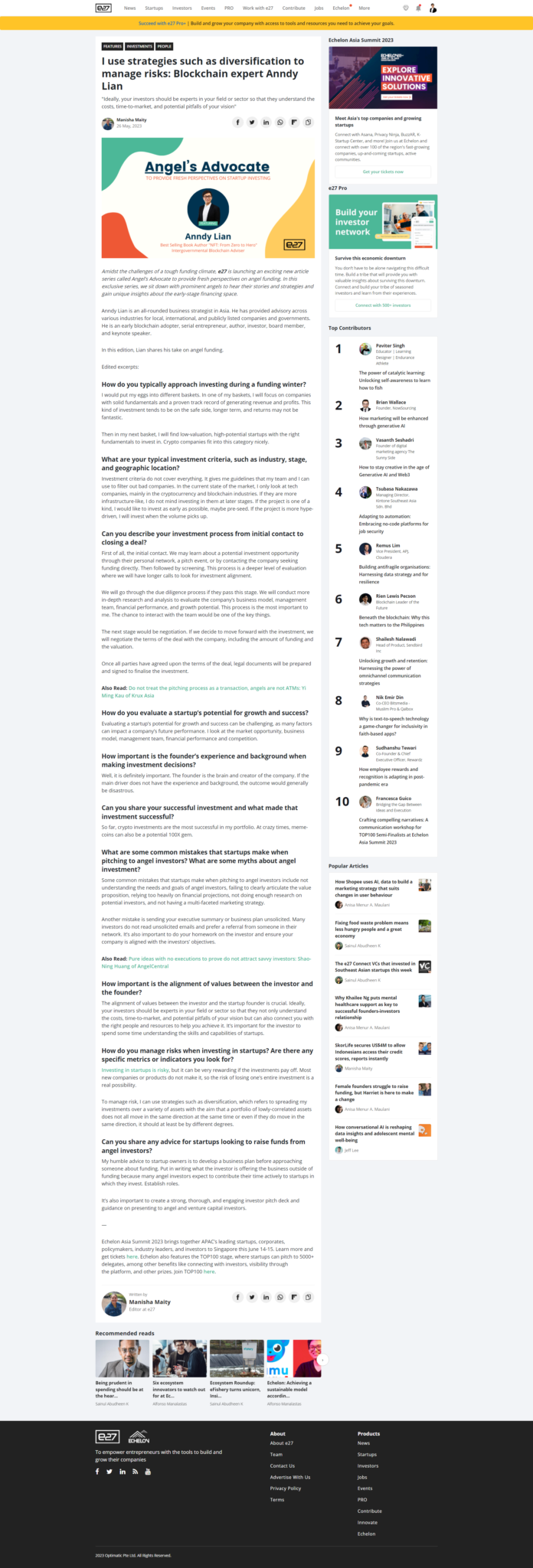
Anndy Lian is an early blockchain adopter and experienced serial entrepreneur who is known for his work in the government sector. He is a best selling book author- “NFT: From Zero to Hero” and “Blockchain Revolution 2030”.

Currently, he is appointed as the Chief Digital Advisor at Mongolia Productivity Organization, championing national digitization. Prior to his current appointments, he was the Chairman of BigONE Exchange, a global top 30 ranked crypto spot exchange and was also the Advisory Board Member for Hyundai DAC, the blockchain arm of South Korea’s largest car manufacturer Hyundai Motor Group. Lian played a pivotal role as the Blockchain Advisor for Asian Productivity Organisation (APO), an intergovernmental organization committed to improving productivity in the Asia-Pacific region.

An avid supporter of incubating start-ups, Anndy has also been a private investor for the past eight years. With a growth investment mindset, Anndy strategically demonstrates this in the companies he chooses to be involved with. He believes that what he is doing through blockchain technology currently will revolutionise and redefine traditional businesses. He also believes that the blockchain industry has to be “redecentralised”.

j j j

BLOCKCHAIN EXPERT SHARES HIS OPTIMISM AMID ONGOING ‘CRYPTO WINTER’

BLOCKCHAIN EXPERT SHARES HIS OPTIMISM AMID ONGOING ‘CRYPTO WINTER’

Anndy Lian is a blockchain executive and author who gave his insights this week regarding the current ‘crypto winter’ marked by the downturn in the virtual asset market.

This Singapore-based chairman of cryptocurrency trading platform BigONE Exchange expressed his upbeat stance despite the market drawdown investors worldwide feel across the board.

We want to share this report with our readers about Mr. Anndy Lian’s hopeful viewpoints despite the present ‘crypto winter.’ We believe we can mitigate their worries, especially if they are adversely affected investors.

Crypto winter is a period when virtual currencies’ trading prices sharply drop, and investors do not see any recovery in sight for more than one year. This time spurs paranoia that the notoriously volatile cryptocurrency industry is about to undergo another prolonged slump.

Additionally, crypto winter indicates a steep decline in virtual coin prices followed by a prolonged flat trading period. The most recent crypto winter took place around 2018.

During that period, Bitcoin rallied to approximately US$20,000 prior to an estimated two-year slide that witnessed it plummet to under US$5,000.

Lian, who wrote the best-selling reference, “Blockchain Revolution 2030,” published by South Korea’s largest bookstore chain, Kyobo, remarked that the Terra crash had doubled down on investors’ fear that the sharp meltdown in the virtual currency market could be longer-lasting and not transitory, much like the US inflation’s steep surge.

This virtual asset collapse drew in confident crypto-asset newcomers, making it quite astonishing. Lian added that the new investors felt enticed partly due to the high level of well-known venture capitalists pouring their investment funds into the cryptocurrency startup and its stablecoin offering.

The Mongolian Productivity Organization’s chief digital advisor mentioned that cryptocurrency commentators were already noting the first signals of crypto winter. These signs are led by Bitcoin’s fall from grace this year.

The flagship cryptocurrency, which trades at exactly US$29,273.97 at the time of writing per the information posted on Coinmarketcap.com, is down from its spectacular US$69,000-high in November 2021 to US$33,000 in January this year.

In Lian’s article posted on blockchain and cryptocurrency news source Forkast News, he remarked that the final nails in the coffin consist of the recession risk following the tapering off of trillions of US dollars injected into the United States’ economy and the US Federal Reserve System getting serious about raising interest rates.

He added the record-busting inflation rates in the world’s largest economy complement the implosion of UST and Terra’s LUNA in dragging down the already ailing crypto-asset market.

Nonetheless, Lian cited that he believes the cryptocurrency and blockchain space would likely become stronger from the present market downturn. He also said that these industries would eventually be more innovative and integrated with mainstream retail and financial ecosystems.

Lian mentioned investing’s fundamental tenets as well. He cited that retail investors should only invest what they can afford to lose, get involved in the cryptocurrency investment scene with a lucid plan, and be careful with crypto-assets’ inherent volatility.

He also said that investors should not invest too much as a component of their overall investment portfolios. We appreciate Mr. Lian’s views about the crypto winter.

We understand that many virtual currency investors feel perturbed these days. However, we hope they will take Mr. Lian’s perspectives and advice.

We are on the same page as this blockchain professional. We also believe the current crypto winter will not last, and better things are ahead for cryptocurrency investors.


Original Source: https://cryptofrontline.com/blockchain-expert-shares-his-optimism-amid-ongoing-crypto-winter/

Anndy Lian is an early blockchain adopter and experienced serial entrepreneur who is known for his work in the government sector. He is a best selling book author- “NFT: From Zero to Hero” and “Blockchain Revolution 2030”.

Currently, he is appointed as the Chief Digital Advisor at Mongolia Productivity Organization, championing national digitization. Prior to his current appointments, he was the Chairman of BigONE Exchange, a global top 30 ranked crypto spot exchange and was also the Advisory Board Member for Hyundai DAC, the blockchain arm of South Korea’s largest car manufacturer Hyundai Motor Group. Lian played a pivotal role as the Blockchain Advisor for Asian Productivity Organisation (APO), an intergovernmental organization committed to improving productivity in the Asia-Pacific region.

An avid supporter of incubating start-ups, Anndy has also been a private investor for the past eight years. With a growth investment mindset, Anndy strategically demonstrates this in the companies he chooses to be involved with. He believes that what he is doing through blockchain technology currently will revolutionise and redefine traditional businesses. He also believes that the blockchain industry has to be “redecentralised”.

j j j