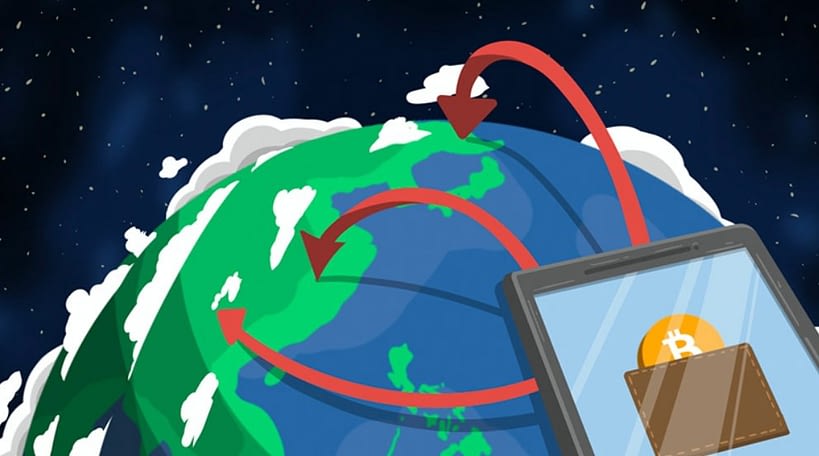
Nearly 40% of Banks Will Offer Crypto Services to Customers in Future

Nearly 40% of Banks Will Offer Crypto Services to Customers in Future

In December 2021 the magazine for top banking executives American Banker published its banking forecast for 2022. The forecast is based on a survey of 175 top banking executives, including global, regional, and departmental executives from community financial institutions. American Banker magazine has a high reputation in the industry focusing on innovation, technology, and regulation.

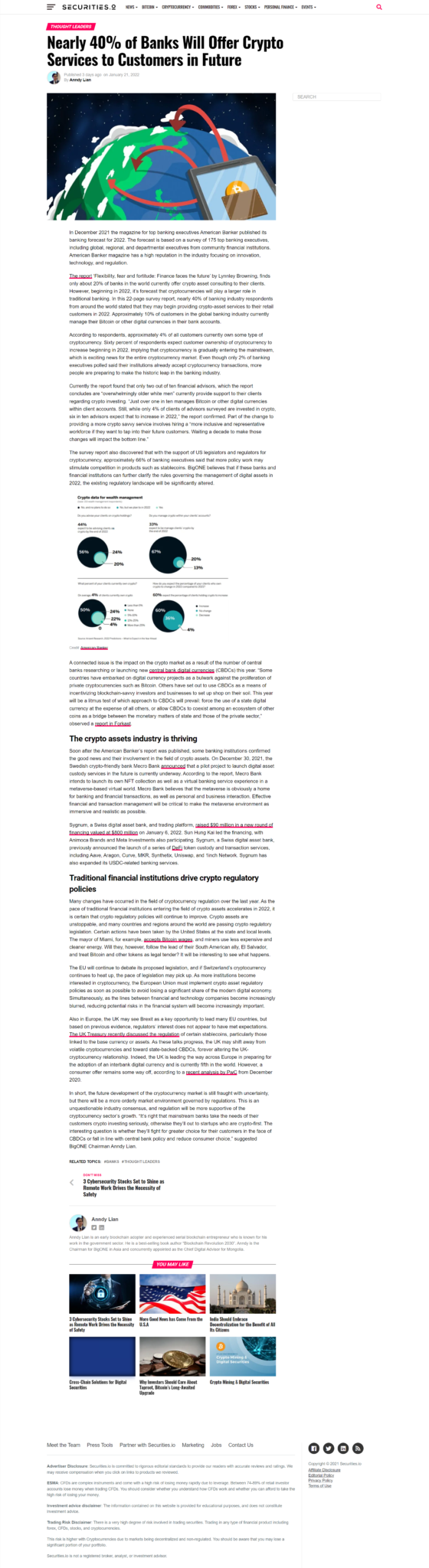
The report ‘Flexibility, fear and fortitude: Finance faces the future’ by Lynnley Browning, finds only about 20% of banks in the world currently offer crypto asset consulting to their clients. However, beginning in 2022, it’s forecast that cryptocurrencies will play a larger role in traditional banking. In this 22-page survey report, nearly 40% of banking industry respondents from around the world stated that they may begin providing crypto-asset services to their retail customers in 2022. Approximately 10% of customers in the global banking industry currently manage their Bitcoin or other digital currencies in their bank accounts.

According to respondents, approximately 4% of all customers currently own some type of cryptocurrency. Sixty percent of respondents expect customer ownership of cryptocurrency to increase beginning in 2022, implying that cryptocurrency is gradually entering the mainstream, which is exciting news for the entire cryptocurrency market. Even though only 2% of banking executives polled said their institutions already accept cryptocurrency transactions, more people are preparing to make the historic leap in the banking industry.

Currently the report found that only two out of ten financial advisors, which the report concludes are “overwhelmingly older white men” currently provide support to their clients regarding crypto investing. “Just over one in ten manages Bitcoin or other digital currencies within client accounts. Still, while only 4% of clients of advisors surveyed are invested in crypto, six in ten advisors expect that to increase in 2022,” the report confirmed. Part of the change to providing a more crypto savvy service involves hiring a “more inclusive and representative workforce if they want to tap into their future customers. Waiting a decade to make those changes will impact the bottom line.”

The survey report also discovered that with the support of US legislators and regulators for cryptocurrency, approximately 66% of banking executives said that more policy work may stimulate competition in products such as stablecoins. BigONE believes that if these banks and financial institutions can further clarify the rules governing the management of digital assets in 2022, the existing regulatory landscape will be significantly altered.

Credit: American Banker

A connected issue is the impact on the crypto market as a result of the number of central banks researching or launching new central bank digital currencies (CBDCs) this year. “Some countries have embarked on digital currency projects as a bulwark against the proliferation of private cryptocurrencies such as Bitcoin. Others have set out to use CBDCs as a means of incentivizing blockchain-savvy investors and businesses to set up shop on their soil. This year will be a litmus test of which approach to CBDCs will prevail: force the use of a state digital currency at the expense of all others, or allow CBDCs to coexist among an ecosystem of other coins as a bridge between the monetary matters of state and those of the private sector,” observed a report in Forkast.

The crypto assets industry is thriving

Soon after the American Banker’s report was published, some banking institutions confirmed the good news and their involvement in the field of crypto assets. On December 30, 2021, the Swedish crypto-friendly bank Mecro Bank announced that a pilot project to launch digital asset custody services in the future is currently underway. According to the report, Mecro Bank intends to launch its own NFT collection as well as a virtual banking service experience in a metaverse-based virtual world. Mecro Bank believes that the metaverse is obviously a home for banking and financial transactions, as well as personal and business interaction. Effective financial and transaction management will be critical to make the metaverse environment as immersive and realistic as possible.

Sygnum, a Swiss digital asset bank, and trading platform, raised $90 million in a new round of financing valued at $800 million on January 6, 2022. Sun Hung Kai led the financing, with Animoca Brands and Meta Investments also participating. Sygnum, a Swiss digital asset bank, previously announced the launch of a series of DeFi token custody and transaction services, including Aave, Aragon, Curve, MKR, Synthetix, Uniswap, and 1inch Network. Sygnum has also expanded its USDC-related banking services.

Traditional financial institutions drive crypto regulatory policies

Many changes have occurred in the field of cryptocurrency regulation over the last year. As the pace of traditional financial institutions entering the field of crypto assets accelerates in 2022, it is certain that crypto regulatory policies will continue to improve. Crypto assets are unstoppable, and many countries and regions around the world are passing crypto regulatory legislation. Certain actions have been taken by the United States at the state and local levels. The mayor of Miami, for example, accepts Bitcoin wages, and miners use less expensive and cleaner energy. Will they, however, follow the lead of their South American ally, El Salvador, and treat Bitcoin and other tokens as legal tender? It will be interesting to see what happens.

The EU will continue to debate its proposed legislation, and if Switzerland’s cryptocurrency continues to heat up, the pace of legislation may pick up. As more institutions become interested in cryptocurrency, the European Union must implement crypto asset regulatory policies as soon as possible to avoid losing a significant share of the modern digital economy. Simultaneously, as the lines between financial and technology companies become increasingly blurred, reducing potential risks in the financial system will become increasingly important.

Also in Europe, the UK may see Brexit as a key opportunity to lead many EU countries, but based on previous evidence, regulators’ interest does not appear to have met expectations. The UK Treasury recently discussed the regulation of certain stablecoins, particularly those linked to the base currency or assets. As these talks progress, the UK may shift away from volatile cryptocurrencies and toward state-backed CBDCs, forever altering the UK-cryptocurrency relationship. Indeed, the UK is leading the way across Europe in preparing for the adoption of an interbank digital currency and is currently fifth in the world. However, a consumer offer remains some way off, according to a recent analysis by PwC from December 2020.

In short, the future development of the cryptocurrency market is still fraught with uncertainty, but there will be a more orderly market environment governed by regulations. This is an unquestionable industry consensus, and regulation will be more supportive of the cryptocurrency sector’s growth. “It’s right that mainstream banks take the needs of their customers crypto investing seriously, otherwise they’ll out to startups who are crypto-first. The interesting question is whether they’ll fight for greater choice for their customers in the face of CBDCs or fall in line with central bank policy and reduce consumer choice,” suggested BigONE Chairman Anndy Lian.


Original Source: https://www.securities.io/nearly-40-of-banks-will-offer-crypto-services-to-customers-in-future/
Anndy Lian is an early blockchain adopter and experienced serial entrepreneur who is known for his work in the government sector. He is a best selling book author- “NFT: From Zero to Hero” and “Blockchain Revolution 2030”.

Currently, he is appointed as the Chief Digital Advisor at Mongolia Productivity Organization, championing national digitization. Prior to his current appointments, he was the Chairman of BigONE Exchange, a global top 30 ranked crypto spot exchange and was also the Advisory Board Member for Hyundai DAC, the blockchain arm of South Korea’s largest car manufacturer Hyundai Motor Group. Lian played a pivotal role as the Blockchain Advisor for Asian Productivity Organisation (APO), an intergovernmental organization committed to improving productivity in the Asia-Pacific region.

An avid supporter of incubating start-ups, Anndy has also been a private investor for the past eight years. With a growth investment mindset, Anndy strategically demonstrates this in the companies he chooses to be involved with. He believes that what he is doing through blockchain technology currently will revolutionise and redefine traditional businesses. He also believes that the blockchain industry has to be “redecentralised”.
j j j

NFTs and blockchain key to metaverse future, crypto boosters claim

NFTs and blockchain key to metaverse future, crypto boosters claim

Blockchain technology, used to power cryptocurrencies and other decentralized record-keeping systems, has been struggling to find practical use cases outside ransomware and speculative projects like Bitcoin and NFTs. There have been a number of pilot projects in a variety of industries, but they’ve rarely turned into anything with significant business impact because of issues related to security, scalability, efficiency, and cost.

Now crypto proponents are looking to the metaverse as an area where the blockchain can make an impact.

NFT proponents say it is a better way of personalizing art and content in the metaverse, and say that the blockchain is a technology that can decentralize and secure metaverse content.

However, NfT’s actual use as part of the core infrastructure of the metaverse will likely be limited given those same issues of privacy, security, and inefficiency, plus the lack of legal oversight.

The most successful implementation of blockchain is cryptocurrencies, which are mainly used for speculative purposes. Like cryptocurrency, most people will be using NFTs in the metaverse for speculation, said Anndy Lian, a founding member of Influxo and Asia chairman of BigONE, a top global digital asset exchange.

And the fact that there’s a lack of legal oversight could actually be a benefit for its adoption, he said.

“Indeed, away from the hype about NFTs as high priced art work, one of their chief attractions within the crypto space is that they’re not considered securities for regulatory purposes,” he told Hypergrid Business.

There are privacy concerns regarding the blockchain. Although cryptography is involved in the sense that each transaction that’s added to the blockchain is digitally signed, the actual content of the blockchain is in plain text, unencrypted, available for anyone to read. That means that the public can, for example, trace cryptocurrency payments from wallet to wallet.

However, because of the legal limbo that crypto is currently in, there are no “know your customer” requirements such as those in place for all other types of financial activity.

For this reason, proponents of blockchain say it can prevent the kind of user privacy violations that Facebook — now rebranded as “Meta” — has been criticized for.

And since the blockchain relies on decentralized storage — every participant has their copy of the entire blockchain — there is no central control.

Through tokenization of physical assets for sale in the metaverse platforms, blockchain and NFTs can unlock commerce because this way, they facilitate exchanging of goods digitally, that could not be digitally transacted before, he said. For instance, digital passports such as those promoted by ARCx, can help with credit scoring, collateralized lending, and decentralized commerce in the metaverse, he said.

NFTs are already being used in existing metaverses such as Decentraland, but there are a lot of forgeries and duplication.

Blockchain can assure authenticity

According to proponents, the blockchain’s digital signature mechanism and distributed nature can help creators prove that they are the actual owners of particular content, and help users demonstrate that they are legitimate users.

Using blockchain could reduce NFT forgeries in the metaverse because each node verifies the status and ownership of all assets on the network, hence preventing them from being duplicated or changed, said Cynthia Cao, creator of CC is Dreaming, who is a NFT personality and a leading figure in virtual reality in entertainment.

And it’s not just about digital goods, she added.“In the future, when people upload their consciousness into the metaverse, we cannot ensure that their memories are not tampered with or controlled by anyone without the verification and authentication that blockchain provides,” she told Hypergrid Business. 

Storing metaverse content, data, NFTs, images and other arts on the blockchain can ensure permanent storage of that data as it becomes immutable.

This can prevent illegal tampering of anything of value stored in the metaverse, said Luke Stokes managing director at Foundation for Interwallet Operability.

The FIO protocol is enabling artists to sign their work with an easily readable address that acts as a unique signature for their work, hence preventing NFT forgeries, he told Hypergrid Business.

But there are risks, he added.

“There is also the potential for user error, where people miscopy long complicated addresses or suffer man-in-the-middle attacks that could potentially result in millions of dollars being sent to the wrong address or stolen forever,” he said.

Many existing metaverses and virtual worlds succeed by gamifying social and business experiences.

Metaverse platforms that use blockchain have better digital-based rewarding mechanisms for such gamification, for instance through tokens and in-world digital currencies, said Dinis Guarda, who is author, founder, and non-executive chairman of LynKeyCitiesabc.com, and Openbusinesscouncil.org.

“The metaverse will empower peer-to-peer experiences that will offer jobs, financial empowerment, lending, and trading, he said. “The metaverse and NFTs certification solutions will take on the role of a virtual business-empowered financial system.”

This gamification will lead to further growth of art, fashion, collectives, history, cities, property in the metaverse, he said.

Cryptocurrencies are also being used to trade goods and services, for gaming rewards, betting, and for value speculation in metaverses. In Decentraland, for instance, users can buy NFTs with cryptocurrencies or platform token MANA.

Other examples include Citiesabc.com, a metaverse for cities, and LynKey, a virtual and augmented reality platform using crypto for trading NFTs in property and smart tourism.

Unlike fiat currencies like the US dollar or the Euro, crypto enables very cheap transactions in digital worlds, said Daniel Logvin, CEO at LedgerByte.

“We can actually use blockchain to manage in-metaverse currency,” he told Hypergrid Business. “This provides us with security and transaction verification for our purchases and trades, thus ensuring a solid and transparent economy.”

There have even been grids that used Bitcoin in OpenSim, such as YrGrid back in 2015, though none of these projects ever took off due to the high management and overhead costs of using the volatile Bitcoin currency for in-world payments.

Although gaming and art will continue to lead in adoption of metaverse and NFTs, remote working and virtual living — which increased due to COVID, will play a role in popularizing metaverse, NFTs because even the non-tech world is getting interested.

“I think we are entering a really exciting time for the mainstream adoption of NFTs,” said Influxo’s Lian. “Certainly the rise of NFTs for football fans around the world to capture unique moments and to follow their favorite players is a testament to the maturing of the NFT marketplace.

The dark side of the blockchain

Turning an image or another digital asset into an NFT does not actually create any value, said Maria Korolov, editor and publisher at Hypergrid Business. Since it’s stored on the open blockchain, there is no security for assets. In fact, there’s already an epidemic of people simply “right-clicking” on NFTs to save their own copies, with no repercussions, since the block chain no legal weight behind it. Plus, anyone can add anything to a blockchain, whether or not they are the legal owners of that content.

NFTs are thus nothing more than virtual Beanie Babies, she said.

“NFTs by themselves don’t protect intellectual property,” she said. “Anyone can claim to own IP and put it on the blockchain. And the blockchain itself is notoriously susceptible to being hacked.”

Crypto companies are high-profile targets for attackers. Hackers go after exchanges, virtual wallets, and even the blockchain itself. For example, one approach is the “50 percent hack.” The blockchain is decentralized, and if there’s a conflict between transactions the blockchain automatically opts for the transaction that’s supported by the majority of the participants. Hackers have hijacked blockchains repeatedly by using botnets to create participating nodes and then stealing millions of dollars worth of currency. This vulnerability is built into the fundamental design of the blockchain, and there is currently no known fix.

Hackers steal money from blockchains right, left and center, she said.

Finally, blockchains are inefficient compared to centralized data storage because the data is duplicated in multiple locations, and new transactions require progressively larger amount of computing power, resulting in adverse environmental impact.

“That’s why no major organization has replaced its databases with blockchains,” she said. “Blockchains are inefficient, insecure, and basically unmanageable,” she said. “A bunch of companies have done pilot projects. They issued press releases about the pilot projects. But then when they looked at how those pilot projects actually worked out, they quietly abandoned the whole thing and never mentioned it again and wrote off the money they wasted as a learning experience.”


Original Source: https://www.hypergridbusiness.com/2022/01/why-nfts-and-blockchain-are-critical-to-success-of-metaverse/

Anndy Lian is an early blockchain adopter and experienced serial entrepreneur who is known for his work in the government sector. He is a best selling book author- “NFT: From Zero to Hero” and “Blockchain Revolution 2030”.

Currently, he is appointed as the Chief Digital Advisor at Mongolia Productivity Organization, championing national digitization. Prior to his current appointments, he was the Chairman of BigONE Exchange, a global top 30 ranked crypto spot exchange and was also the Advisory Board Member for Hyundai DAC, the blockchain arm of South Korea’s largest car manufacturer Hyundai Motor Group. Lian played a pivotal role as the Blockchain Advisor for Asian Productivity Organisation (APO), an intergovernmental organization committed to improving productivity in the Asia-Pacific region.

An avid supporter of incubating start-ups, Anndy has also been a private investor for the past eight years. With a growth investment mindset, Anndy strategically demonstrates this in the companies he chooses to be involved with. He believes that what he is doing through blockchain technology currently will revolutionise and redefine traditional businesses. He also believes that the blockchain industry has to be “redecentralised”.

j j j

EXCLUSIVE INTERVIEWS: Seasonal Insights on NFTs Past, Present, and Future (Part 2)

EXCLUSIVE INTERVIEWS: Seasonal Insights on NFTs Past, Present, and Future (Part 2)

Interviews with Jordan Belfort, Brock Pierce, Nifty Gateway, SuperRare, VaynerNFT, and other leaders in the NFT space.

The whir of people and activity, bright lights and decoration, and general festive air that used to punctuate the holiday season in the now-archaic shopping malls across the U.S. now seem replaced with the hustle and bustle of more NFTs coming to market. Every week brings news surprises directly to our inbox, for those of us who are on the mailing lists for new projects.

Multi-platinum recording artist, Pia Mia, came back from her stint as one of the judges at Miami Art Week inspired to release Birth of D1AD3MA, an NFT collection on OneOf which included the early release of her new song “Whole Thing”.

Sarah McDaniel, Playboy cover girl in 2016, dropped a limited edition of NFTs last week, this time not leveraging her image as a model, and only five of the 82 pieces have been collected. The NFTs are based on a short animated film, Kerfuffle. The difference in reception between Kerfuffle and her NSFW.app drops has not escaped McDaniel who said in a statement:

Looking to profit off crypto trading? Crypto traders just like you are getting profitable trades from Benzinga’s crypto research team! Click Here to See the Next Trade.

“My first NFT drop sold out in seconds because it leveraged my image and notoriety in the modeling world,” McDaniels said of her NSFW.app collection on OpenSea. “But the Kerfuffle drop has artistic power. It spotlights the empty culture and false beauty standards that generate a darker side to our society.”

Perhaps McDaniel anticipated the difference in responses – if so she made a Kerfuffle with the contrast in the drops themselves.

VaynerNFT, beyond supporting the very successful VeeFriends series, seems determined to dominate the space through sheer volume and variety of drops. This week they partnered with Coach on the launch of its first collection of NFTs featuring eight Coach Holiday animals.

VaynerNFT also released the Pepsi Mic Drop genesis NFT collection about which Gary Vayernchuk was naturally very enthusiastic:

“I love that Pepsi is embracing one of the most significant technology shifts of our lifetime. NFTs will change the culture of value creation forever; this is an exciting moment for the brand to build loyalty & bring immense value to its community & fans,” Vaynerchuk said.

But in the hubbub of holiday shopping for the latest and shiniest new certificates of digital ownership, we return to our review of the leading minds in the NFT space and their view, with all respect to Charles Dickens, on the spirit of NFTs past, present, and future.

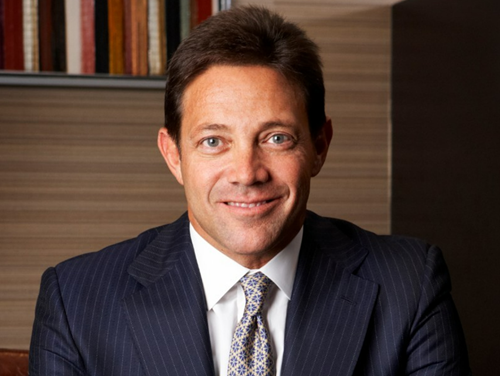
Jordan Belfort

Investor, Entrepreneur, Speaker, and Author

Past – What brought us here?

“I posted a tweet saying 2021 is the year of the NFT. And I got some pushback from people saying, no, this is just the beginningNext year is the year of the NFT. People are really passionate about this stuff.

I think it has to do more with what’s going on with web 3 and this push towards taking back power from centralized institutions. Web 2 is all about the big platforms like Amazon, Facebook, Google, Twitter, they organized what was this incredibly large, massive information that was web 1 and made it easy to use. But everyone that gave all the information lost power. Some people struck it rich, but most people didn’t make any money. They were the contributors and content creators, but they didn’t get compensated fairly for it.

So that I think what’s really underpinning this next movement where wealth is spread to the people who actually contribute to the creation of information. And what makes that possible is  NFTs. NFTs are like your authentication of ownership of any given asset or piece of information. They allow the individual to go out and create content, put it out into the world, and use smart contracts to get compensated for little bits of information over time…  it creates this landscape where the average person can start to get paid for creating content, and that’s what’s behind it.

I think it’s going to very quickly evolve… you’ll see many, many things tokenized – real estate, titles, and anything can really be tokenized, a great portion of the economy can be tokenized,” Belfort said.

See more: NFT Release Calendar

Present – What brought us here?

“I think that what you’re seeing right now is a hyper-growth phase. When you have this first wave of adoption there is a lot of FOMO (Fear Of Missing Out), and it’s speculative hot money… And we see that often happen early on and something gets hot.
And it’s because the hot money it’s a lot of speculative investments… Some projects are just looking for quick cash and those will probably fall by the wayside. But I think what you’re going to find is a lot of the better projects where there was something of value or some utility behind it, will continue to thrive over the long term…

I haven’t launched anything myself. I’ve been buying NFTs and I’ve been approached by everybody under the sun to launch NFTs, but I want the market to get a bit more mature. And also I’m looking to do something very special,” Belfort said.

Future

“At some point in the near future, the SEC is going to get involved in this space. They have to. I think what they’re going to be looking at is how many of these NFT projects are really about the future work of people who are essentially creating… value in a decentralized community. If they are not driving forward the value of a project, then that fails the Howey Test, which is what the SEC uses when they take action against someone.

So be very careful about getting involved in these projects that could really have the regulatory hammer come down on them in the next six months…  That doesn’t mean you shouldn’t do it, make your own decision, I think the NFT space is going to be massive in 2022. So there’s a lot of money to be made and a lot of fun to have there. Just be careful,” Belfort said.

Brock Pierce

BROCK PIERCE, Bitcoin Foundation Chairman

Past & Present

“NFT has been the theme of the year and Webster’s Dictionary acknowledged it as the 2021 ‘Word of the Year.’  It has taken a few years to get to this point – ownership of digital art as NFTs first began a few years ago – but the enthusiasm surrounding NFTs is expanding the horizons and driving innovation surrounding the ownership of unique digital assets,” Pierce said.

Future

“Looking ahead, the market does need to have some caution and there will likely be a correction next year, in many of the NFT projects that are ‘hype’ and without real communities behind them.

There will, however, be many new projects launched, some of which will capture the right balance of innovation, community, and utility, and will drive interaction with DAOs and metaverses,” Pierce said.

Griffin Cock Foster

Co-founder of Nifty Gateway

NFTs past: What brought us to this incredible point in NFTs in 2021?

“Looking back, the most remarkable part isn’t that NFTs grew the way they did – it’s that it took so long for something like this to come into fruition. At Nifty Gateway, we’ve seen and worked with hundreds of artists who had enormous followings, creativity, and devotion, but were denied meetings at traditional art galleries. In hindsight, it’s clear that there was tremendous demand from the public to collect their work and participate more deeply in the communities they created. Blockchain innovation was just the technological breakthrough that allowed it to happen,” Foster said.

NFTs Present – what should people be focused on right now?

“Right now, as always, it’s essential for NFT projects to focus on the long term. Those of us who have been in crypto for a while have seen many swings up and down, but as a five-year average, things look quite rosy indeed. This level of volatility is not uncommon for breakthrough new technologies. If we look back, we saw tremendous volatility when the Internet was first introduced for commercial use in the 1990s, and going back much further, we saw tremendous volatility when oil was first discovered and put to use in the Pennsylvania oil fields of the 1870s,” Foster said.

NFTs Future – is the growth sustainable?

“I predict in 2022, we will continue to see growth.  However, I will also stick to the mantra that prediction is hard, especially about the future. It’s unclear what trends will dominate in 2022, and it’s unclear what to expect, other than the unexpected.

I believe that 10 years from now, NFT collecting and trading will be at least 100x more popular than it is today. It’s captured the art world – and that is only the first inning. We couldn’t be more excited for the future,” Foster said.

Avery Akkineni

President of VaynerNFT

NFTs past: What brought us to this incredible point in NFTs in 2021?

“2021 was a watershed year for NFTs, with millions of new users flocking into the space, driven by key culture-makers and moments – particularly across art, sports, entertainment, and gaming. This year, NFTs truly entered mainstream consciousness,” Akkineni said.

NFTs Present – what should people be focused on right now?

“Successful NFT projects have a few things in common – a dedicated community, elements of utility, and unique use of NFT technology. While there is no set formula for what works, community buy-in is the most important variable to success,” Akkineni said.

NFTs Future – is the growth sustainable?

“We’re still in the very, very early days of NFTs, and 2022 will bring a plethora of new NFT use cases. However, in the long-term, NFTs are here to stay, and in the short-term, we’ll see an advancement of current technology, particularly as a larger number of users engage in the NFT space,” Akkineni said.

John Crain

CEO of SuperRare Labs

NFTs past: What brought us to this incredible point in NFTs in 2021?

“2021 has been an incredible year for the space and we’ve seen more than $200M in sales on SuperRare. I think this growth has been driven by the popularization of digital art and creatives who have been looking for new business models that work in a digital context. What makes NFTs so compelling is that they create an ownership layer for digital objects… When we started in 2018 it was very challenging to get folks to understand what we were doing. This year has been so validating in that the general public started to understand and embrace the implications and vast potential of this new market,” Crain said.

NFTs Present – what should people be focused on right now?

“2021 has been such an incredible boom year, there is sure to be a market correction and we’re prepared for that. Going forward, I think NFT projects need to focus on creating value and expanding the ecosystem… We’ve seen a lot of newcomers and we need new tooling and new use cases, not more of the same ideas and models being rehashed,” Crain said.

NFTs Future – is the growth sustainable?

“Overall, I don’t see things contracting in 2022…  I believe that 2022 will be a year of utility, with the goal being to create a more general user-friendly experience. I think we’re going to see better display technologies including analog and digital. We’re also looking to create an easier onboarding experience, which will open up new opportunities for users without a lot of crypto experience (so they don’t need to manage a wallet for example.)  We are also excited to see the technology continue to expand to new industries like fashion, film, and music, which really took off in 2021,” Crain said.

More Leading Voices in NFTs

There are so many use cases for NFTs, just within art and collectibles alone, that it’s hard to give the full picture with a single chorus of voices, even in a two-part article.

For example, Desiree “aka Dzikt”, artist and co-founder of Girlfrens NFT collection sees NFTs as a means to raising money and awareness for charity, specifically for those afflicted with cancer.

“Looking at this through the lens of a charity-focused NFT project, this community piece is something that is often overlooked by newcomers but becomes the key element that draws people in and keeps them engaged… Millions are being raised for charity through NFTs, it is a completely new avenue for causes to receive funds and more are being onboarded into crypto every day through platforms like the Giving Block,” Desiree said.

But while Desiree and other non-profit NFTs we have written about see a chance to raise funds for charity, other project leaders see NFTs as just a step toward the realization of a digitally verified and decentralized metaverse.

To Ori Levi, CEO of NFTTrade, 2021 might well be the year of the metaverse’s inception as much as the year of NFTs.

“2021 was the year of the metaverse, the first presence of digital life, and although we are still far from a mainstream metaverse, NFTs presented, for the first time, the ability to have status and be a member of an elite group of people online…  GameFi presents a new opportunity for the world, and the NFTs associated and usable in games and metaverses can go for significant value if they can present a fun and scalable game. ,” Levi said.

Dylan Katz, CEO of 2CrazyNFT platform, looks forward to a future more even market where digital ownership and encounters are just as valid as RL assets and experiences.

“In the future, we can hope to see NTFs in another more reasonable market that is available to the overall population, and simultaneously these NFTS will be Just authentic. Eventually, our virtual encounters will become compelling partners to certifiable encounters,” Katz said.

Anndy Lian, Chairman, Asia at BigONE Exchange concurs as to the importance of the Metaverse in the future of NFTs.

“I think NFT is the key and connector. NFT + Metaverse, NFT + Defi, NFT + SocialFI are some combinations that will do well in 2022. There are still many combinations to come. So, stay creative and innovative in 2022. I foresee 2022 as a year for stronger adoption,” Lian said.

In what very well may be a world first, Artentik, the marketplace for Santa Casa da Misericordia de Lisboa (SCML), Portugal’s 500-year-old organization that serves as keepers of the Museum and Church of Sao Roque in Lisbon will be dropping what is believed to be a Holy Thorn from Christ’s Crown of Thorns as an NFT on December 27th. I suppose it’s not too early to begin to think about Easter – if you have that kind of foresight for the bunny day.


Original Source: https://www.benzinga.com/markets/cryptocurrency/21/12/24668097/exclusive-interviews-seasonal-insights-on-nfts-past-present-and-future-part-2

Anndy Lian is an early blockchain adopter and experienced serial entrepreneur who is known for his work in the government sector. He is a best selling book author- “NFT: From Zero to Hero” and “Blockchain Revolution 2030”.

Currently, he is appointed as the Chief Digital Advisor at Mongolia Productivity Organization, championing national digitization. Prior to his current appointments, he was the Chairman of BigONE Exchange, a global top 30 ranked crypto spot exchange and was also the Advisory Board Member for Hyundai DAC, the blockchain arm of South Korea’s largest car manufacturer Hyundai Motor Group. Lian played a pivotal role as the Blockchain Advisor for Asian Productivity Organisation (APO), an intergovernmental organization committed to improving productivity in the Asia-Pacific region.

An avid supporter of incubating start-ups, Anndy has also been a private investor for the past eight years. With a growth investment mindset, Anndy strategically demonstrates this in the companies he chooses to be involved with. He believes that what he is doing through blockchain technology currently will revolutionise and redefine traditional businesses. He also believes that the blockchain industry has to be “redecentralised”.
j j j