Hong Kong’s Plans to Greenlight Spot Crypto ETFs

Hong Kong’s Plans to Greenlight Spot Crypto ETFs

Well, it seems that Hong Kong is seriously considering allowing spot crypto ETFs as it aims to establish itself as the hub for ‍crypto⁣ activities in Asia. This potential move by Hong​ Kong has caught the attention of financial news‍ outlet BNN Bloomberg, and they have delved into the subject. Let’s explore the ⁤discussions surrounding the authorization of‍ spot crypto ETFs and⁤ how it could position Hong Kong​ in the ever-evolving world of digital assets.

Hong Kong Poses Competitive ‌Threat To⁣ Asian Crypto Hubs

As the cryptocurrency market continues to expand and⁤ mature, the race ‍is on to establish dominant ‌hubs across Asia. Recently, Hong Kong ​has entered the race,⁢ exploring ways to authorize the trading ⁢of crypto-based Exchange Traded Funds (ETFs). These⁣ investment funds, traded on stock exchanges much ‍like traditional stocks, would offer a direct investment into the rapidly evolving world of cryptocurrencies. Richard ‍Douglas from ‍Saxo Markets has highlighted the potential benefits for local retail investors, who are keen to engage with this new asset class, but are often held back by the complexities and volatility inherent to the crypto market.

In the heart ‌of this ​potential shift is the idea of ‘Spot Crypto ETFs’.‍ A Spot ETF,‌ unlike regular ETFs, ‍would allow investors to directly hold actual cryptocurrencies rather⁤ than investing in a portfolio ‍of ⁤assets which track ⁤the underlying crypto. As of now, Hong Kong officials are assessing the feasibility and impacts of permitting‍ such investment vehicles. This initiative has‍ already seen some early‍ support ‍from financial services giant HSBC. In fact,‍ HSBC has begun offering trading of⁤ Crypto-linked ‍ETFs to ⁢their Hong⁢ Kong-based‍ customers, demonstrating an ​institutional acceptance of these novel financial ‌products.

But‌ what does this mean for‌ the broader Asian crypto landscape? By actively considering such progressive steps, Hong Kong is positioning ⁤itself as a major player in the‍ Asian cryptocurrency⁤ arena. This, in ⁤turn, could pose a competitive challenge to‌ other established or emerging crypto hubs across the region. However,⁤ the ultimate ⁣impact will depend ⁤on the delicate balance between innovation and regulation. While greater institutional acceptance and investor protections could make the crypto markets more accessible, ‍the‌ need for robust oversight and transparency remains ​paramount to ensure the⁢ continued growth and stability of these burgeoning digital assets.

The Potential of Spot Crypto ⁢Exchange-Traded Funds ​In Hong Kong

The move means an enormous‍ step forward considering⁢ that the Hong Kong Exchange (HKEX) pioneered the offering of crypto asset exposure through ETFs, further consolidating​ their footprint‍ in blockchain technology.

However, it’s essential‌ to note that while the city ⁤has shown openness to derivatives-based​ products offered‌ on exchanges specified ⁢by the Securities and Futures Commission (SFC), retail investors have faced roadblocks. To explain, a derivative-based⁢ product like a Bitcoin futures ETF, allows investors⁤ to gamble on the price of Bitcoin at ​a future date, instead of‌ buying the cryptocurrency in the present. Retail investors, mainly everyday individuals investing smaller amounts, have not yet had the opportunity to participate in these kinds of investments.

Leading technological ⁤conglomerates like Samsung ⁤Asset Management have already indicated ‍their interest in stepping into the arena, following their Bitcoin‌ futures ETF in Hong Kong. Such decisions will​ likely inspire other⁤ corporations to follow​ suit, escalating the demand and bringing spot crypto⁤ ETFs into​ regular ‌use. This success will lay a solid foundation for Hong Kong, ​paving the way to becoming a leading hub‌ for digital asset ⁤investment in Asia, and offering retail investors more opportunities to engage in the world ​of crypto assets., which cannot be understated, ⁢as their acceptance will fuel innovation, present ​diversified investment opportunities, and anchor a new era ⁣of financial ‍inclusion.

Unlocking ⁤Investment Opportunities ⁤With Hong Kong’s ETF Initiative

The news that​ Hong Kong regulators are considering allowing retail-oriented crypto Exchange Traded Funds ⁢(ETFs) comes as an‌ exciting development. As the city’s Securities ⁢and Futures Commission (SFC) proceeds with this plan, it ‍hints at the⁢ dawn of a new era in ​Hong Kong’s virtual assets sector. The move expands ‌the​ regulatory perimeter, opening ‍doors for fresh investment possibilities in the burgeoning field of crypto-assets.

At its core, an ⁤ETF is a type⁤ of security that tracks‍ an index, sector, commodity, or ​other asset, which can be purchased or sold on a stock exchange⁣ the same way a regular stock ⁣can. A crypto ETF, too, ⁢operates ⁣on the same principle but tracks one or more digital tokens. For the newcomers, this ⁢can be an ⁤attractive investment avenue as⁣ it​ provides ​them with⁢ a ‍relatively safe and regulated method to⁢ gain exposure to the often volatile crypto markets without owning the ‌underlying digital assets themselves.

This step indicates a major ⁢shift in‌ investment norms‍ and is ⁣a beacon for crypto firms and ⁢potential investors. Realizing the increasing interest and participation in ‌digital ⁤currencies,‌ Hong Kong aims to introduce new requirements for both spot-crypto and ETF investments. This initiative marks a significant stride in reinforcing its ‍position as a major fintech hub in Asia. Seizing this progression could be instrumental in promoting a wider acceptance and ‌understanding of blockchain⁣ technologies and cryptocurrencies, ⁤while ensuring investor protection in the thriving digital finance⁢ landscape.

Legislative Hurdles And Regulatory‌ Challenges In Crypto ETF ⁢Trade

Interest in these innovative financial products is soaring across the globe; they allow market ⁣participants to effectively‌ speculate​ on the potential future ​price movements of a given cryptocurrency without having ​to own it directly. But, as industry analyst ⁤Anndy Lian observed, the rise of crypto ETFs also poses significant legislative and regulatory challenges.

Among the complexities ‌to be addressed by regulators are custody issues.⁢ The SEC, the U.S. financial⁤ regulator, has been ⁣implementing new ⁣regulations surrounding the custody‌ of digital assets. Specifically, it is ‌concerned about how ownership is managed in the​ crypto universe since these assets are stored intangibly in distributed networks. To address this, the SEC​ has begun‍ to ​shift the grounds for denial of crypto ETFs from concerns about market manipulation to issues of rightful ownership and custody. This shift could potentially throw a legal wrench into Hong Kong’s plans.

Equally noteworthy are the challenges posed by cryptocurrencies themselves. Taking the cryptocurrency Ethereum as ⁢an example,‌ it ‌stands out for its ‍ability to ⁢enable smart contracts and decentralized applications. However, its intricacies also bring about certain difficulties. Since⁤ it is not solely a medium ‌of exchange like Bitcoin, but also ⁢a platform for building‍ applications, regulators ⁤might find it more challenging to categorize ​and formulate regulations around it. Nevertheless, ‍if‍ Hong Kong can successfully navigate these legislative hurdles and regulatory ‍challenges, it could cement its place as a leading crypto hub in Asia.

Efficient Ways To Capitalize On ⁢Hong Kong’s Potential Crypto Boom

However, the approval⁢ of these ETFs ⁤is yet⁢ to be confirmed, as regulators weigh⁢ the benefits and risks linked⁢ to this new asset class. Amid this backdrop of opportunity, individuals ‍keen on⁣ capitalizing on Hong‌ Kong’s potential crypto ​growth need to remain patient, stay informed, and possibly consider financial advice from‌ professionals in the crypto field. This strategic approach would offer the best chance of maximizing potential gains while minimizing possible losses. Cryptocurrency, while ⁢unpredictable, offers new avenues for technological innovation and investment growth.

In conclusion, the ‍proposed initiative by Hong⁢ Kong to allow spot crypto ETFs marks a significant step in its ambition to establish itself​ as​ the leading ⁣cryptocurrency hub in Asia. With its forward-thinking approach, the‍ city is positioning itself to ⁤attract investors and foster ⁢innovation in the ⁤rapidly evolving ‍crypto ‌market.


Source: https://techmalak.com/hong-kongs-plans-to-greenlight-spot-crypto-etfs/

Anndy Lian is an early blockchain adopter and experienced serial entrepreneur who is known for his work in the government sector. He is a best selling book author- “NFT: From Zero to Hero” and “Blockchain Revolution 2030”.

Currently, he is appointed as the Chief Digital Advisor at Mongolia Productivity Organization, championing national digitization. Prior to his current appointments, he was the Chairman of BigONE Exchange, a global top 30 ranked crypto spot exchange and was also the Advisory Board Member for Hyundai DAC, the blockchain arm of South Korea’s largest car manufacturer Hyundai Motor Group. Lian played a pivotal role as the Blockchain Advisor for Asian Productivity Organisation (APO), an intergovernmental organization committed to improving productivity in the Asia-Pacific region.

An avid supporter of incubating start-ups, Anndy has also been a private investor for the past eight years. With a growth investment mindset, Anndy strategically demonstrates this in the companies he chooses to be involved with. He believes that what he is doing through blockchain technology currently will revolutionise and redefine traditional businesses. He also believes that the blockchain industry has to be “redecentralised”.

j j j

Op-ed: JPEX – A crypto scandal that shakes Hong Kong’s reputation

Op-ed: JPEX – A crypto scandal that shakes Hong Kong’s reputation

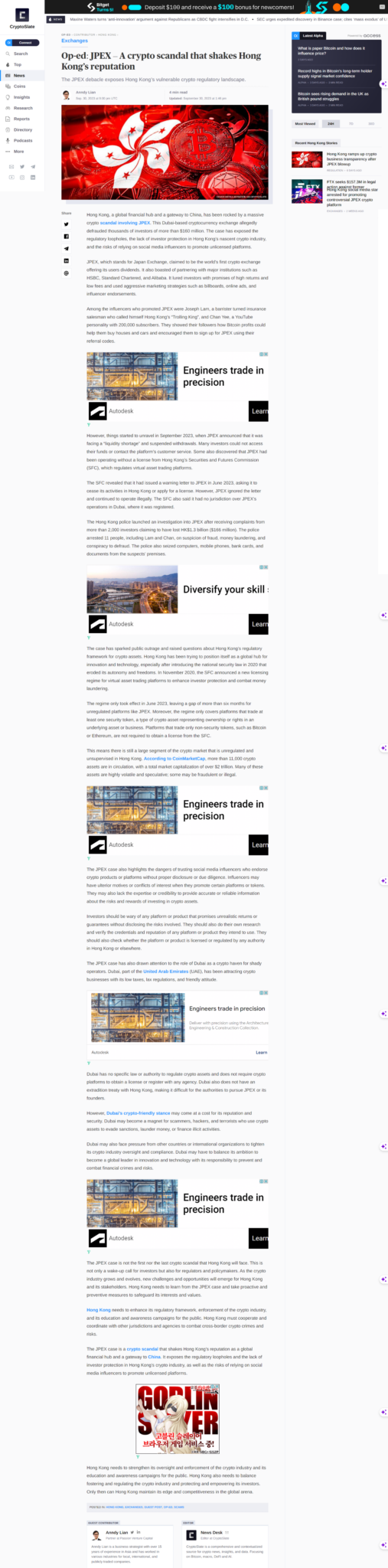
Hong Kong, a global financial hub and a gateway to China, has been rocked by a massive crypto scandal involving JPEX. This Dubai-based cryptocurrency exchange allegedly defrauded thousands of investors of more than $160 million. The case has exposed the regulatory loopholes, the lack of investor protection in Hong Kong’s nascent crypto industry, and the risks of relying on social media influencers to promote unlicensed platforms.

JPEX, which stands for Japan Exchange, claimed to be the world’s first crypto exchange offering its users dividends. It also boasted of partnering with major institutions such as HSBC, Standard Chartered, and Alibaba. It lured investors with promises of high returns and low fees and used aggressive marketing strategies such as billboards, online ads, and influencer endorsements.

Among the influencers who promoted JPEX were Joseph Lam, a barrister turned insurance salesman who called himself Hong Kong’s “Trolling King”, and Chan Yee, a YouTube personality with 200,000 subscribers. They showed their followers how Bitcoin profits could help them buy houses and cars and encouraged them to sign up for JPEX using their referral codes.

The SFC revealed that it had issued a warning letter to JPEX in June 2023, asking it to cease its activities in Hong Kong or apply for a license. However, JPEX ignored the letter and continued to operate illegally. The SFC also said it had no jurisdiction over JPEX’s operations in Dubai, where it was registered.

The Hong Kong police launched an investigation into JPEX after receiving complaints from more than 2,000 investors claiming to have lost HK$1.3 billion ($166 million). The police arrested 11 people, including Lam and Chan, on suspicion of fraud, money laundering, and conspiracy to defraud. The police also seized computers, mobile phones, bank cards, and documents from the suspects’ premises.

The case has sparked public outrage and raised questions about Hong Kong’s regulatory framework for crypto assets. Hong Kong has been trying to position itself as a global hub for innovation and technology, especially after introducing the national security law in 2020 that eroded its autonomy and freedoms. In November 2020, the SFC announced a new licensing regime for virtual asset trading platforms to enhance investor protection and combat money laundering.

The regime only took effect in June 2023, leaving a gap of more than six months for unregulated platforms like JPEX. Moreover, the regime only covers platforms that trade at least one security token, a type of crypto asset representing ownership or rights in an underlying asset or business. Platforms that trade only non-security tokens, such as Bitcoin or Ethereum, are not required to obtain a license from the SFC.

This means there is still a large segment of the crypto market that is unregulated and unsupervised in Hong Kong. According to CoinMarketCap, more than 11,000 crypto assets are in circulation, with a total market capitalization of over $2 trillion. Many of these assets are highly volatile and speculative; some may be fraudulent or illegal.

The JPEX case also highlights the dangers of trusting social media influencers who endorse crypto products or platforms without proper disclosure or due diligence. Influencers may have ulterior motives or conflicts of interest when they promote certain platforms or tokens. They may also lack the expertise or credibility to provide accurate or reliable information about the risks and rewards of investing in crypto assets.

Investors should be wary of any platform or product that promises unrealistic returns or guarantees without disclosing the risks involved. They should also do their own research and verify the credentials and reputation of any platform or product they intend to use. They should also check whether the platform or product is licensed or regulated by any authority in Hong Kong or elsewhere.

The JPEX case has also drawn attention to the role of Dubai as a crypto haven for shady operators. Dubai, part of the United Arab Emirates (UAE), has been attracting crypto businesses with its low taxes, lax regulations, and friendly attitude.

Dubai has no specific law or authority to regulate crypto assets and does not require crypto platforms to obtain a license or register with any agency. Dubai also does not have an extradition treaty with Hong Kong, making it difficult for the authorities to pursue JPEX or its founders.

However, Dubai’s crypto-friendly stance may come at a cost for its reputation and security. Dubai may become a magnet for scammers, hackers, and terrorists who use crypto assets to evade sanctions, launder money, or finance illicit activities.

Dubai may also face pressure from other countries or international organizations to tighten its crypto industry oversight and compliance. Dubai may have to balance its ambition to become a global leader in innovation and technology with its responsibility to prevent and combat financial crimes and risks.

The JPEX case is not the first nor the last crypto scandal that Hong Kong will face. This is not only a wake-up call for investors but also for regulators and policymakers. As the crypto industry grows and evolves, new challenges and opportunities will emerge for Hong Kong and its stakeholders. Hong Kong needs to learn from the JPEX case and take proactive and preventive measures to safeguard its interests and values.

Hong Kong needs to enhance its regulatory framework, enforcement of the crypto industry, and its education and awareness campaigns for the public. Hong Kong must cooperate and coordinate with other jurisdictions and agencies to combat cross-border crypto crimes and risks.

The JPEX case is a crypto scandal that shakes Hong Kong’s reputation as a global financial hub and a gateway to China. It exposes the regulatory loopholes and the lack of investor protection in Hong Kong’s crypto industry, as well as the risks of relying on social media influencers to promote unlicensed platforms.

Hong Kong needs to strengthen its oversight and enforcement of the crypto industry and its education and awareness campaigns for the public. Hong Kong also needs to balance fostering and regulating the crypto industry and protecting and empowering its investors. Only then can Hong Kong maintain its edge and competitiveness in the global arena.

Source: https://cryptoslate.com/op-ed-jpex-a-crypto-scandal-that-shakes-hong-kongs-reputation/

Anndy Lian is an early blockchain adopter and experienced serial entrepreneur who is known for his work in the government sector. He is a best selling book author- “NFT: From Zero to Hero” and “Blockchain Revolution 2030”.

Currently, he is appointed as the Chief Digital Advisor at Mongolia Productivity Organization, championing national digitization. Prior to his current appointments, he was the Chairman of BigONE Exchange, a global top 30 ranked crypto spot exchange and was also the Advisory Board Member for Hyundai DAC, the blockchain arm of South Korea’s largest car manufacturer Hyundai Motor Group. Lian played a pivotal role as the Blockchain Advisor for Asian Productivity Organisation (APO), an intergovernmental organization committed to improving productivity in the Asia-Pacific region.

An avid supporter of incubating start-ups, Anndy has also been a private investor for the past eight years. With a growth investment mindset, Anndy strategically demonstrates this in the companies he chooses to be involved with. He believes that what he is doing through blockchain technology currently will revolutionise and redefine traditional businesses. He also believes that the blockchain industry has to be “redecentralised”.

j j j

Is Hong Kong’s Reputation at the Mercy of Crypto Scammers?

Is Hong Kong’s Reputation at the Mercy of Crypto Scammers?

Anndy Lian weighs in on the recent collapse of JPEX, a cryptocurrency platform that allegedly defrauded thousands of investors of more than HK$1.4 billion (US$180 million).

The collapse of JPEX has exposed the dark side of Hong Kong’s crypto industry and raised serious questions about its regulatory framework.

JPEX, which claimed to be a licensed and regulated platform, lured investors with flashy advertisements, celebrity endorsements, and promises of high returns. It offered its own native token, JPC, which could only be traded on its platform, as well as other popular cryptocurrencies such as Bitcoin and Tether.

However, in September 2023, JPEX suddenly suspended its services and announced that it was under investigation by the Hong Kong police for suspected money laundering and fraud. The platform’s website and social media accounts were taken down, and its customer service hotline was disconnected. Many investors found themselves unable to access their funds or withdraw their assets.

The JPEX scandal is not an isolated incident. In fact, it is the latest in a series of crypto scams that have plagued Hong Kong in recent years. In 2022, another platform called Black Cell Technology was shut down by the Securities and Futures Commission (SFC) for conducting an illegal initial coin offering (ICO) that raised US$30 million from investors. In 2021, a platform called MyCoin disappeared with HK$3 billion (US$387 million) from more than 3,000 investors.

These cases highlight the risks and challenges that Hong Kong faces as it strives to become a global hub for crypto innovation and adoption. While the city has a vibrant and diverse crypto ecosystem, with over 100 platforms operating in the market, it also suffers from a lack of clear and consistent regulation that leaves investors vulnerable to fraud and manipulation.

Hong Kong’s current approach to crypto regulation is based on a principle of “same risk, same regulation”. This means that crypto activities that fall under the existing securities laws are subject to the SFC’s oversight and enforcement, while those that do not are largely unregulated.

For example, the SFC has issued guidelines for platforms that offer trading of security tokens, which are digital tokens that represent ownership or economic rights in an underlying asset or business. These platforms must apply for a license from the SFC and comply with various requirements on anti-money laundering, investor protection, cybersecurity, and auditing.

However, most platforms in Hong Kong do not deal with security tokens, but rather with exchange tokens (such as Bitcoin) or utility tokens (such as JPC). These tokens are not considered securities under Hong Kong law and are therefore outside the SFC’s regulatory scope. As a result, these platforms operate in a legal gray area, where they are not required to obtain a license or follow any specific rules.

This creates a loophole that allows unscrupulous platforms to exploit investors’ ignorance and greed. By claiming to be licensed or regulated, these platforms can create a false sense of security and legitimacy among investors who may not understand the difference between security tokens and other types of tokens. By offering high returns or incentives, these platforms can entice investors to invest in their native tokens or other obscure cryptocurrencies that have no intrinsic value or market liquidity. By using complex and opaque mechanisms, these platforms can manipulate the prices and volumes of their tokens or cryptocurrencies to create artificial demand or supply.

The JPEX scandal is a symptom of a deeper problem in Hong Kong’s pursuit of financial innovation. While the city has been supportive of crypto development and has launched various initiatives to foster fintech growth, such as regulatory sandboxes and cross-border collaborations, it has also been slow and reactive in addressing the emerging risks and challenges posed by crypto activities.

Hong Kong needs to adopt a more proactive and comprehensive approach to crypto regulation that balances innovation with protection. Instead of relying on existing securities laws that may not capture the full spectrum of crypto activities, Hong Kong should consider developing a new regulatory framework that covers all types of crypto assets and service providers.

Such a framework should aim to achieve four main objectives: first, to prevent money laundering and terrorist financing; second, to protect investors from fraud and manipulation; third, to ensure fair competition and market integrity; and fourth, to promote financial inclusion and education.

To achieve these objectives, Hong Kong should consider implementing some of the following measures:

  • Require all crypto platforms to register or obtain a license from the SFC or another designated authority before operating in Hong Kong or serving Hong Kong investors.
  • Impose minimum standards on crypto platforms regarding capital adequacy, risk management, governance, disclosure, auditing, and reporting.
  • Establish a mechanism for monitoring and supervising crypto platforms’ activities and transactions, including their use of stablecoins or other forms of digital currency.
  • Enforce strict rules on crypto advertising and marketing, especially on social media platforms where influencers may have significant influence over investors’ decisions.
  • Hold crypto platforms accountable for any losses or damages suffered by investors due to their negligence, misconduct, or breach of contract.
  • Hold influencers accountable for any false or misleading statements or representations they make about crypto platforms or products.
  • Educate investors about the risks and benefits of crypto investments, as well as their rights and responsibilities as consumers.
  • Encourage self-regulation and industry best practices among crypto platforms and service providers, such as adopting codes of conduct, standards of ethics, and dispute resolution mechanisms.

By adopting these measures, Hong Kong can enhance its reputation as a leading crypto hub that fosters innovation and adoption while ensuring protection and stability. Hong Kong can also position itself as a role model for other countries that are grappling with similar issues and challenges in the crypto space.

The JPEX scandal is a wake-up call for Hong Kong to take action and reform its crypto regulation. The city cannot afford to lose its competitive edge or its credibility in the global financial market. The time to act is now.


Source: https://www.blockhead.co/2023/09/29/is-hong-kongs-reputation-at-the-mercy-of-crypto-scammers-jpex/

Anndy Lian is an early blockchain adopter and experienced serial entrepreneur who is known for his work in the government sector. He is a best selling book author- “NFT: From Zero to Hero” and “Blockchain Revolution 2030”.

Currently, he is appointed as the Chief Digital Advisor at Mongolia Productivity Organization, championing national digitization. Prior to his current appointments, he was the Chairman of BigONE Exchange, a global top 30 ranked crypto spot exchange and was also the Advisory Board Member for Hyundai DAC, the blockchain arm of South Korea’s largest car manufacturer Hyundai Motor Group. Lian played a pivotal role as the Blockchain Advisor for Asian Productivity Organisation (APO), an intergovernmental organization committed to improving productivity in the Asia-Pacific region.

An avid supporter of incubating start-ups, Anndy has also been a private investor for the past eight years. With a growth investment mindset, Anndy strategically demonstrates this in the companies he chooses to be involved with. He believes that what he is doing through blockchain technology currently will revolutionise and redefine traditional businesses. He also believes that the blockchain industry has to be “redecentralised”.

j j j