Is There a Need for a Third Exchange License in Hong Kong?

Is There a Need for a Third Exchange License in Hong Kong?

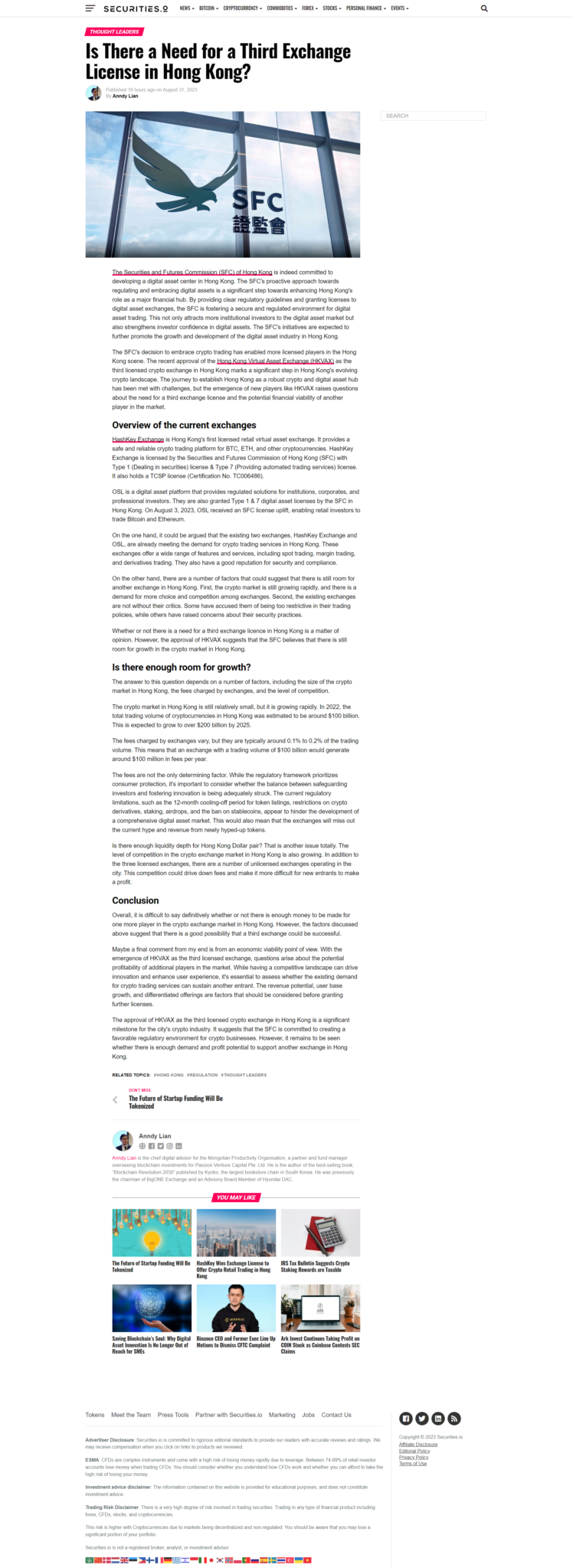
The Securities and Futures Commission (SFC) of Hong Kong is indeed committed to developing a digital asset center in Hong Kong. The SFC’s proactive approach towards regulating and embracing digital assets is a significant step towards enhancing Hong Kong’s role as a major financial hub. By providing clear regulatory guidelines and granting licenses to digital asset exchanges, the SFC is fostering a secure and regulated environment for digital asset trading. This not only attracts more institutional investors to the digital asset market but also strengthens investor confidence in digital assets. The SFC’s initiatives are expected to further promote the growth and development of the digital asset industry in Hong Kong.

The SFC’s decision to embrace crypto trading has enabled more licensed players in the Hong Kong scene. The recent approval of the Hong Kong Virtual Asset Exchange (HKVAX) as the third licensed crypto exchange in Hong Kong marks a significant step in Hong Kong’s evolving crypto landscape. The journey to establish Hong Kong as a robust crypto and digital asset hub has been met with challenges, but the emergence of new players like HKVAX raises questions about the need for a third exchange license and the potential financial viability of another player in the market.

Overview of the current exchanges

HashKey Exchange is Hong Kong’s first licensed retail virtual asset exchange. It provides a safe and reliable crypto trading platform for BTC, ETH, and other cryptocurrencies. HashKey Exchange is licensed by the Securities and Futures Commission of Hong Kong (SFC) with Type 1 (Dealing in securities) license & Type 7 (Providing automated trading services) license. It also holds a TCSP license (Certification No. TC006486).

OSL is a digital asset platform that provides regulated solutions for institutions, corporates, and professional investors. They are also granted Type 1 & 7 digital asset licenses by the SFC in Hong Kong. On August 3, 2023, OSL received an SFC license uplift, enabling retail investors to trade Bitcoin and Ethereum.

On the one hand, it could be argued that the existing two exchanges, HashKey Exchange and OSL, are already meeting the demand for crypto trading services in Hong Kong. These exchanges offer a wide range of features and services, including spot trading, margin trading, and derivatives trading. They also have a good reputation for security and compliance.

On the other hand, there are a number of factors that could suggest that there is still room for another exchange in Hong Kong. First, the crypto market is still growing rapidly, and there is a demand for more choice and competition among exchanges. Second, the existing exchanges are not without their critics. Some have accused them of being too restrictive in their trading policies, while others have raised concerns about their security practices.

Whether or not there is a need for a third exchange licence in Hong Kong is a matter of opinion. However, the approval of HKVAX suggests that the SFC believes that there is still room for growth in the crypto market in Hong Kong.

Is there enough room for growth?

The answer to this question depends on a number of factors, including the size of the crypto market in Hong Kong, the fees charged by exchanges, and the level of competition.

The crypto market in Hong Kong is still relatively small, but it is growing rapidly. In 2022, the total trading volume of cryptocurrencies in Hong Kong was estimated to be around $100 billion. This is expected to grow to over $200 billion by 2025.

The fees charged by exchanges vary, but they are typically around 0.1% to 0.2% of the trading volume. This means that an exchange with a trading volume of $100 billion would generate around $100 million in fees per year.

The fees are not the only determining factor. While the regulatory framework prioritizes consumer protection, it’s important to consider whether the balance between safeguarding investors and fostering innovation is being adequately struck. The current regulatory limitations, such as the 12-month cooling-off period for token listings, restrictions on crypto derivatives, staking, airdrops, and the ban on stablecoins, appear to hinder the development of a comprehensive digital asset market. This would also mean that the exchanges will miss out the current hype and revenue from newly hyped-up tokens.

Is there enough liquidity depth for Hong Kong Dollar pair? That is another issue totally. The level of competition in the crypto exchange market in Hong Kong is also growing. In addition to the three licensed exchanges, there are a number of unlicensed exchanges operating in the city. This competition could drive down fees and make it more difficult for new entrants to make a profit.

Conclusion

Overall, it is difficult to say definitively whether or not there is enough money to be made for one more player in the crypto exchange market in Hong Kong. However, the factors discussed above suggest that there is a good possibility that a third exchange could be successful.

Maybe a final comment from my end is from an economic viability point of view. With the emergence of HKVAX as the third licensed exchange, questions arise about the potential profitability of additional players in the market. While having a competitive landscape can drive innovation and enhance user experience, it’s essential to assess whether the existing demand for crypto trading services can sustain another entrant. The revenue potential, user base growth, and differentiated offerings are factors that should be considered before granting further licenses.

The approval of HKVAX as the third licensed crypto exchange in Hong Kong is a significant milestone for the city’s crypto industry. It suggests that the SFC is committed to creating a favorable regulatory environment for crypto businesses. However, it remains to be seen whether there is enough demand and profit potential to support another exchange in Hong Kong.


Source: https://www.securities.io/is-there-a-need-for-a-third-exchange-license-in-hong-kong/
Anndy Lian is an early blockchain adopter and experienced serial entrepreneur who is known for his work in the government sector. He is a best selling book author- “NFT: From Zero to Hero” and “Blockchain Revolution 2030”.

Currently, he is appointed as the Chief Digital Advisor at Mongolia Productivity Organization, championing national digitization. Prior to his current appointments, he was the Chairman of BigONE Exchange, a global top 30 ranked crypto spot exchange and was also the Advisory Board Member for Hyundai DAC, the blockchain arm of South Korea’s largest car manufacturer Hyundai Motor Group. Lian played a pivotal role as the Blockchain Advisor for Asian Productivity Organisation (APO), an intergovernmental organization committed to improving productivity in the Asia-Pacific region.

An avid supporter of incubating start-ups, Anndy has also been a private investor for the past eight years. With a growth investment mindset, Anndy strategically demonstrates this in the companies he chooses to be involved with. He believes that what he is doing through blockchain technology currently will revolutionise and redefine traditional businesses. He also believes that the blockchain industry has to be “redecentralised”.

j j j

Will Singapore, Hong Kong step up crypto scrutiny as US cracks down on Binance, Coinbase?

Will Singapore, Hong Kong step up crypto scrutiny as US cracks down on Binance, Coinbase?
  • The moves by the US SEC against Binance, Coinbase spooked investment sentiment just as Hong Kong seeks to establish itself as a trading hub along with Singapore
  • Unlike Singapore and Hong Kong, the US does not have comprehensive regulations for crypto and blockchain firms to operate without fear of regulatory action

US regulatory action against two major cryptocurrency exchanges, Coinbase and Binance, is likely to serve as a reference point for Hong Kong and Singapore as they seek to balance growth with investors’ safety, analysts have said.

The crackdown is the latest in a series of measures by the US Securities and Exchange Commission (SEC), which has levied fines and other penalties against crypto-lending firms, following the collapse of one of the most-reliable crypto exchanges FTX last November that sparked public outrage.

The SEC said Coinbase had acted as a broker, exchange and clearing agency for investments without proper registration. The complaint came a day after the regulator sued Binance, alleging it had tried to evade US regulation.

Binance said the enforcement action was unwarranted and alleged it was a regulatory “overreach” that damages the United States’ status as a global financial hub. Paul Grewal, Coinbase’s general counsel, said in a statement that the company would continue operating as usual and had “demonstrated commitment to compliance”, according to Reuters.

The development spooked investment sentiment just as Hong Kong is seeking to frame regulations to establish itself as a trading hub along with Singapore, which already has such a framework.

The two cities may look at the US action as a reference point, which could mean tighter scrutiny even in the Asian hubs, analysts say.

“There will be a fallout for sure. Hong Kong and Singapore are taking measures to regulate the cryptocurrency industry by proposing new licensing regimes for virtual asset trading platforms,” said Anndy Lian, Singapore-based author of the book “NFT: From Zero to Hero”.

Unlike Singapore and Hong Kong, the US has yet to come up with a comprehensive set of regulations that allows cryptocurrency and blockchain firms to operate transparently without fear of regulatory action.

“The war that the US is waging on cryptocurrencies shows no signs of abating, and it will only intensify as time wears on,” said Julian Hosp, the CEO and co-founder of Cake Group, a fast-growing Southeast Asia’s digital assets innovator.

The regulator’s action is part of a larger trend which is likely to continue into the 2024 presidential election, Hosp said.

Industry cautions on overkill

The Securities and Futures Commission (SFC) in Hong Kong has requested feedback on a proposal that would require virtual asset trading platform operators to obtain the same type of licences as securities traders, Lian said, adding that it had asked other firms who were not applying to prepare for an orderly closure.

Securities, as opposed to other financial assets, are strictly regulated and require detailed disclosures to inform investors of potential risks.

“These developments indicate that cryptocurrency exchanges seeking approval in Hong Kong and Singapore will have to adhere to new regulatory requirements and may be subject to increased scrutiny from regulators,” Lian said.

But new regulations could help establish the legitimacy of the cryptocurrency industry and potentially attract more investors and businesses at a time people are increasingly wary of the US market, analysts said.

“The SEC’s lawsuit primarily focuses on actions that have taken place in the United States and their impact on American citizens,” said Rajagopal Menon, vice-president of WazirX, India’s leading cryptocurrency exchange.

“As for regulators in Hong Kong, such as the Securities and Futures Commission, and Dubai’s Virtual Asset Regulatory Authority, the SEC’s lawsuit can serve as a point of reference or information. However, it does not automatically alter their regulatory stance or trigger immediate action,” he added.

At the two-day Crypto Expo Asia in Singapore, attendees were unbothered by news about Binance and Coinbase, with little to no mention about the developments.

Though the US action may not have a direct impact on other regions, Menon conceded that it could potentially have some indirect influence on their decision-making processes.

Nizam Ismail, founder of Singapore-based compliance consultancy Ethikom Consultancy, said crypto investors too were likely to be more cautious about risks and the need for due diligence on intermediaries.

“These products will be subject to prudential and consumer protection requirements. In the longer term, regulatory gaps will be addressed and consumer protection measures are likely to be introduced,” he added.

The development also exposed extreme price fluctuations in the digital assets which have made many traditional investors in assets like stocks and bonds cautious about investing in the digital asset.

After initially falling to a three-month low of US$25,750 following the Binance lawsuit, bitcoin has rebounded to around US$27,000 in afternoon trade in Asian hours.

Some investors – typically traditional investors, family offices and high net worth individuals – may have been deterred by the US regulator’s lawsuits, while “die-hards” long time investors “would not care”, said Hayden Hughes, the chief executive office and co-founder of Alpha Impact, a social trading platform.

A key takeaway from the incident for Asian hubs like Hong Kong is to have “regulatory clarity”, he said, adding that Hong Kong’s decision to open up to crypto and implement regulations had been a step in the right direction.

But it is unlikely that the event would deter crypto exchanges from seeking approval from Hong Kong and Singapore authorities, he said, highlighting that the two cities would gain from establishing clear rules and a licensing framework.

“Asian hubs can focus on their core mission of protecting the retail investors. There is absolutely no incentive for regulators to move fast and break things,” Hughes said.

Industry executives urged regulators to strike a balance with the fledgling industry.

Hong Kong and Singapore were unlikely to be impacted by the developments “if there is a will on both sides” and regulators are cautious “to not overkill the opportunity”, said Thomas Tallis, CEO of TVVIN, a firm that takes real-world assets and issues them on the blockchain.

Source: https://www.scmp.com/week-asia/economics/article/3223305/will-singapore-hong-kong-step-crypto-scrutiny-us-cracks-down-binance-coinbase

Anndy Lian is an early blockchain adopter and experienced serial entrepreneur who is known for his work in the government sector. He is a best selling book author- “NFT: From Zero to Hero” and “Blockchain Revolution 2030”.

Currently, he is appointed as the Chief Digital Advisor at Mongolia Productivity Organization, championing national digitization. Prior to his current appointments, he was the Chairman of BigONE Exchange, a global top 30 ranked crypto spot exchange and was also the Advisory Board Member for Hyundai DAC, the blockchain arm of South Korea’s largest car manufacturer Hyundai Motor Group. Lian played a pivotal role as the Blockchain Advisor for Asian Productivity Organisation (APO), an intergovernmental organization committed to improving productivity in the Asia-Pacific region.

An avid supporter of incubating start-ups, Anndy has also been a private investor for the past eight years. With a growth investment mindset, Anndy strategically demonstrates this in the companies he chooses to be involved with. He believes that what he is doing through blockchain technology currently will revolutionise and redefine traditional businesses. He also believes that the blockchain industry has to be “redecentralised”.

j j j

Hong Kong’s Virtual Asset Trading Regulations, Explained

Hong Kong’s Virtual Asset Trading Regulations, Explained

Hong Kong’s new licensing regime for centralised virtual asset trading platforms (VATPs) is a significant development in the global push for cryptocurrency regulations. The Anti-Money Laundering and Counter-Terrorist Financing Ordinance (AMLO) will have come into effect on June 1, requiring all VATPs operating in Hong Kong or targeting Hong Kong investors to obtain a license from the Securities and Futures Commission (SFC).

This new regime is a commendable step towards bringing virtual asset trading platforms under regulatory oversight. With the rapid growth of the cryptocurrency market, it is crucial to establish robust regulatory frameworks to protect investors and prevent money laundering. By requiring VATPs to be licensed, Hong Kong aims to ensure compliance with legal and regulatory requirements and promote the responsible operation of these platforms.

The transitional arrangements outlined in the circular provide a reasonable timeline for existing VATPs to apply for a license and review their systems and controls to meet SFC standards. VATPs that have been providing virtual asset services in Hong Kong before June 1, and can demonstrate a genuine business presence will be allowed to continue operating until May 31, 2024, without breaching licensing requirements. This transitional period allows these VATPs to adjust their operations and align with the regulatory framework while maintaining continuity for their existing clients.

The eligibility criteria for the transitional arrangements focus on factors such as incorporation in Hong Kong, physical office presence, central management and control, key personnel location, and genuine trading volume. These criteria ensure that VATPs with a significant and substantial presence in Hong Kong benefit from the transitional arrangements while preventing shell companies from exploiting the system.

Additionally, individuals performing regulated functions for pre-existing VATPs are also granted a transitional period unti 2024, without breaching licensing requirements. This allows individuals to continue their roles during the transition and ensure a smooth process for both the VATPs and their employees.

Importantly, VATPs that were not operating in Hong Kong before June 1, are not eligible for the transitional arrangements. This sends a clear message that operating without a license will be considered a criminal offense.

Eligibility for transitional arrangements

As mentioned above, to be eligible for the transitional arrangements, VATPs must have been providing a service in Hong Kong before June 1. The SFC will assess the following factors to determine if a VATP is operating a genuine business within Hong Kong: Incorporation; a physical presence; central management and control exercised by a physical staff; and a live operation with clients and a genuine trading volume.

Merely setting up a company or having “shell” operations in Hong Kong will not meet the eligibility criteria.

VATPs operating in Hong Kong before June 1

VATPs that have a meaningful and substantial presence in Hong Kong before June 1, known as pre-existing VATPs, can continue to provide a service in Hong Kong until 2024 without breaching the licensing requirements. This is possible through the non-contravention arrangement. However, pre-existing VATPs must apply for a license, comply with the SFC’s standards, and ensure their systems and controls meet the legal and regulatory requirements.

Individuals performing regulated functions for pre-existing VATPs

Individuals can perform regulated functions for pre-existing VATPs until 2024 without violating the licensing requirements. This is allowed under the non-contravention arrangement. However, it is essential for individuals to ensure they comply with the applicable regulations.

VATPs not operating in Hong Kong before June 1

VATPs that were not operating in Hong Kong before June 1 are not eligible for the transitional arrangements. These VATPs should refrain from engaging in any activities in Hong Kong or actively marketing their services to Hong Kong investors until they obtain a license from the SFC. Engaging in unlicensed activities is a criminal offense.

Individuals performing regulated functions for VATPs not operating in Hong Kong before June 1

Individuals who perform, or hold themselves out as performing, regulated functions for VATPs that were not operating in Hong Kong before June 1 are also not eligible for the non-contravention arrangement. Engaging in unlicensed activities in this scenario is a criminal offense.

It is crucial for all VATPs to understand that they must obtain a license from the SFC before commencing any business activities or marketing their services to Hong Kong investors.

Enforcement actions and licensing process

The SFC has the authority to take enforcement actions against VATPs that operate without a license or fail to comply with the licensing requirements. These actions may include criminal prosecution, fines, or other regulatory measures.

For VATPs that need to obtain a license, they must go through the licensing process outlined by the SFC. The process involves submitting an application, providing relevant documentation, and demonstrating compliance with the regulatory requirements. The SFC will assess each application on a case-by-case basis, considering factors such as the VATPs financial soundness, operational capabilities, and systems and controls for combating money laundering and terrorist financing.

Ongoing compliance obligations

Once licensed, VATPs are required to maintain ongoing compliance with the regulatory obligations set out by the SFC. These obligations include:

· Implementing robust systems and controls to detect and prevent money laundering and terrorist financing activities.
· Conducting customer due diligence, including KYC (know your customer) procedures, to verify their identities.
· Reporting suspicious transactions and maintaining proper record-keeping.
· Complying with relevant regulatory requirements, such as disclosure obligations, and licensing conditions.
· Cooperating with the SFC in inspections and providing necessary information and assistance.

VATPs should ensure that their compliance frameworks are adequate and up to date to meet these obligations.

Impact on the virtual asset trading industry

The introduction of the new licensing regime for VATPs in Hong Kong aims to enhance investor protection, safeguard the integrity of the market, and mitigate the risks associated with money laundering and terrorist financing. By establishing a robust regulatory framework, the SFC aims to foster the development of a healthy and sustainable virtual asset trading industry in Hong Kong.

VATPs operating in or targeting the Hong Kong market should carefully review the licensing requirements and ensure compliance with the new regime. It is advisable to seek legal and regulatory advice to navigate the licensing process effectively and maintain ongoing compliance with regulatory obligations.

Speaking to industry experts

I had an opportunity to speak to industry experts and how they look at the current framework.

Tony Tong, Chairman of the Hong Kong Blockchain Association, said: “I welcome the [new regulations] as this will create many new job opportunities for the regulated crypto industry in Hong Kong. The issuance system for [virtual asset trading platforms] in Hong Kong has opened for applications today. Hong Kong’s comprehensive regulatory framework for virtual assets follows the principle of ‘same business, same risks, same regulation,’ with the aim of providing adequate investor protection and managing major risks. This framework promotes sustainable development and supports innovation in the industry.”

Jay Hao, former Chief Executive Officer of OKX, holds a similar view. “Hong Kong has taken a giant leap towards taming the unruly world of virtual asset trading platforms by introducing a licensing regime. They have decided to bring law and order to the Wild West of cryptocurrency. This move is seen as a positive step towards regulation, which means we can all breathe a collective sigh of relief, or at least a regulated sigh. So, let’s raise our glasses to Hong Kong’s virtual asset licensing regime- a beacon of hope in a sea of crypto confusion. It’s a step towards a more regulated and secure future, where investors can trade virtual assets without constantly looking over their shoulders. It’s time to ride off into the sunset of virtual asset regulation, knowing that Hong Kong is paving the way towards a safer and more controlled cryptocurrency frontier.”

Bitverse’s founder Win is also positive and added that his solution would also help to increase trust among users. “We are extremely excited about Hong Kong’s positive stance towards cryptocurrencies and innovation.”

Bitverse is actively building the industry’s first web3 credit wallet, based on a high-security, highly scalable, and low Gas wallet core using MPC+AA technology, along with a web3 open credit protocol built on an AI+Oracle network. The web3 credit protocol, constructed on decentralized trusted network nodes, not only facilitates various project scenarios in acquiring customers quickly and at a low cost but also enhances product competitiveness through structured enhancements. Moreover, the mechanism of “credit mining” enables highly creditworthy users from the real world to earn greater profits, thereby genuinely attracting more B2B and B2C users to participate in the entire decentralized credit value network.

The deeming arrangement introduced under the AMLO offers an opportunity for pre-existing VATPs and proposed licensed individuals to be deemed licensed from June 1, if they meet specific conditions outlined by the SFC. This provision allows for a smooth transition and avoids disruption in the operation of VATPs and the roles of licensed individuals.

The implementation of the new licensing regime and the transitional arrangements demonstrates Hong Kong’s commitment to the virtual asset trading industry. By bringing VATPs under the oversight of the SFC, the government aims to protect investors, enhance market integrity, and mitigate the risks associated with virtual asset trading. The SFC’s supervisory and disciplinary powers, along with the adherence to regulatory requirements, will ensure a more transparent and accountable virtual asset trading environment.

While the new licensing regime is a significant step forward, ongoing monitoring and continuous adaptation of regulations will be essential. The cryptocurrency market is evolving rapidly, and regulatory frameworks must keep pace to address emerging risks and challenges effectively.

Overall, Hong Kong’s new licensing regime for VATPs is a positive development for the virtual asset trading industry. It sets a precedent for other jurisdictions to follow, fostering greater trust and confidence in the market. As the global cryptocurrency landscape continues to evolve, regulatory efforts like these will play. It will be interesting to observe how Hong Kong’s stance on cryptocurrencies unfolds in the coming months and how it affects the local economy and regulatory landscape.


Source: https://intpolicydigest.org/hong-kong-s-virtual-asset-trading-regulations-explained/

Anndy Lian is an early blockchain adopter and experienced serial entrepreneur who is known for his work in the government sector. He is a best selling book author- “NFT: From Zero to Hero” and “Blockchain Revolution 2030”.

Currently, he is appointed as the Chief Digital Advisor at Mongolia Productivity Organization, championing national digitization. Prior to his current appointments, he was the Chairman of BigONE Exchange, a global top 30 ranked crypto spot exchange and was also the Advisory Board Member for Hyundai DAC, the blockchain arm of South Korea’s largest car manufacturer Hyundai Motor Group. Lian played a pivotal role as the Blockchain Advisor for Asian Productivity Organisation (APO), an intergovernmental organization committed to improving productivity in the Asia-Pacific region.

An avid supporter of incubating start-ups, Anndy has also been a private investor for the past eight years. With a growth investment mindset, Anndy strategically demonstrates this in the companies he chooses to be involved with. He believes that what he is doing through blockchain technology currently will revolutionise and redefine traditional businesses. He also believes that the blockchain industry has to be “redecentralised”.

j j j