Synergy Unleashed: How AI and Web3.0 are reshaping the digital landscape

Synergy Unleashed: How AI and Web3.0 are reshaping the digital landscape

The digital landscape is constantly evolving, and at the forefront of this evolution are two groundbreaking technologies: Artificial Intelligence (AI) and Web3. These two pillars of innovation are set to reshape the way we interact with the digital world, offering unprecedented possibilities for decentralization, security, and personalization.

Unveiling the Vision of Web3

Web3 represents a radical departure from the current internet paradigm. It envisions a decentralized online ecosystem where users have control over their data, privacy, and finances. Built upon the robust foundation of blockchain technology, Web3 ensures secure and transparent data storage and transfer, revolutionizing the way we perceive the digital realm.

In the realm of Web3, users are emancipated from the clutches of centralized authorities. Instead, they wield the power to shape their online experiences and dictate the destiny of the internet. This liberation has the potential to usher in a new era of digital empowerment and self-sovereignty.

The Power of Artificial Intelligence

Artificial Intelligence, the technological marvel that has captivated human imagination, is a rapidly evolving field with the capacity to mimic human-like capabilities such as reasoning, learning, planning, and creativity. As AI continues its relentless march forward, it brings with it the promise of revolutionizing industries across the board.

Imagine a world where machines collaborate seamlessly with humans, amplifying our abilities and ushering in an era of unprecedented efficiency. This vision is not confined to science fiction; it’s a tangible reality that AI is gradually materializing.

A Symbiotic Relationship: AI Empowering Web3

The synergy between AI and Web3 is poised to be a game-changer, propelling both technologies to new heights of innovation. AI’s transformative potential can be harnessed to further empower the principles of Web3 in several profound ways:

1. Automating Tasks for Enhanced Efficiency

AI’s automation prowess can liberate Web3 users from mundane and time-consuming tasks. From managing digital wallets and trading cryptocurrencies to crafting Non-Fungible Tokens (NFTs), AI can seamlessly shoulder these responsibilities, allowing users to focus on more creative and productive endeavors.

2. Elevating Security to New Heights

The decentralized nature of Web3 provides an avenue for enhanced security, but AI can take it a step further. By analyzing blockchain data for anomalous patterns and preempting potential vulnerabilities, AI can fortify the Web3 ecosystem against fraud and cyberattacks, ensuring a safer digital landscape.

3. Personalizing Experiences for a Unique Web3 Journey

Imagine a digital world where every interaction is tailored to your preferences and interests. AI can make this a reality in Web3 by curating content, products, and services that resonate with each user. This level of personalization fosters deeper engagement and enriches the overall Web3 experience.

Blockchain: The Guardian of AI’s Ethical Evolution

While AI’s potential is awe-inspiring, it also raises concerns about ethical use and transparency. This is where blockchain steps in as a guardian of responsible AI deployment. Blockchain’s decentralized ledger can record, verify, and audit AI data, decisions, and actions, ensuring accountability and transparency in AI governance.

By leveraging blockchain, AI models can be imbued with an audit trail, tracking the data they utilize and the decisions they make. This addresses the challenge of explainable AI, instilling trust in the recommendations AI provides. Moreover, the marriage of blockchain and AI enhances data security, fostering a safer digital environment.

Bridging the Gap: AI, Blockchain, and Everyday Individuals

The fusion of AI and blockchain holds tangible benefits for individuals as well. Consider these scenarios:

  • Fraud Detection and Prevention: AI’s analytical prowess can identify fraudulent activities, and when integrated with blockchain, transactions and records can be verified for authenticity, minimizing the risk of fraud.
  • Copyright Protection: AI can monitor for copyright violations, and blockchain can create an immutable record of intellectual property ownership and usage rights, ensuring creators’ rights are respected.
  • Smart Contracts Revolution: The synergy between AI and blockchain can revolutionize sectors like finance, legal agreements, and supply chain management through self-executing smart contracts that enhance automation and efficiency.
  • Decentralized Power: The decentralized nature of both AI and blockchain mitigates central points of failure, fostering system resilience and reducing risks.

Envisioning the Future: AI + Web3 = Limitless Potential

The collaborative potential of AI and Web3 extends far beyond our current imagination. Here are a few glimpses of what the future may hold:

1. AI-Powered Trading

Integrating AI with Web3 can lead to innovative trading solutions, where AI algorithms analyze market data and provide bespoke insights to traders. This synergy creates a more informed and empowered trading experience.

2. Web4: Decentralization Amplified

Web4 is the logical evolution of Web3, aiming for an internet that is even more decentralized and user-controlled. This evolution would amplify user sovereignty and reshape the online landscape.

3. AI-Enhanced Relationships

AI algorithms can analyze user behavior to create more meaningful and personalized connections online, revolutionizing how we communicate and interact.

The Road Ahead: Trust in Math and Empowerment through AI

As we venture into this exciting era of AI and Web3 synergy, trust takes on a new dimension. Trust in these technologies lies not in human intermediaries but in the mathematical precision that underpins them. This trust in math offers a new paradigm of security and accountability, paving the way for a future where human potential is exponentially magnified.

In this landscape, AI becomes the driving force that empowers blockchain and Web3. The AI assistant becomes the bridge that lowers the entry barrier for Web3 participation, ushering in a new era of inclusivity and accessibility.

AI + Web3: A Journey Towards Zero Knowledge Proof

In the grand tapestry of innovation, blockchain stands as the decentralized brain that connects AI to the world. This interconnectedness forms the bedrock of a future where data privacy, personal empowerment, and security are no longer aspirations but fundamental realities.

As we embark on this journey, the intertwining of AI and Web3 is like a symphony of possibilities, where the harmony of innovation and human potential knows no bounds. Together, they illuminate a path towards a future that is decentralized, secure, and uniquely tailored to each individual’s aspirations and dreams.
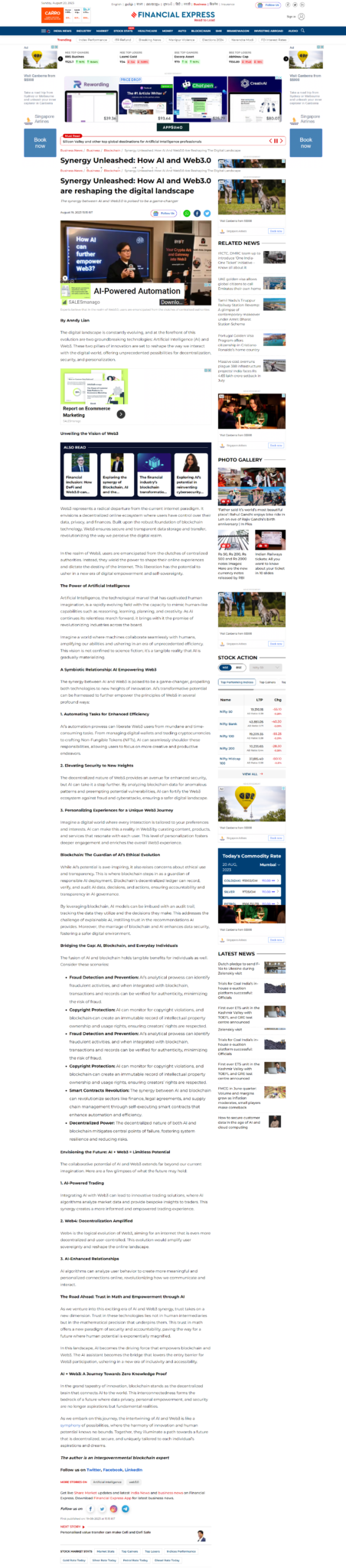
 

Source: https://www.financialexpress.com/business/blockchain-synergy-unleashed-how-ai-and-web3-0-are-reshaping-the-digital-landscape-3215163/

Anndy Lian is an early blockchain adopter and experienced serial entrepreneur who is known for his work in the government sector. He is a best selling book author- “NFT: From Zero to Hero” and “Blockchain Revolution 2030”.

Currently, he is appointed as the Chief Digital Advisor at Mongolia Productivity Organization, championing national digitization. Prior to his current appointments, he was the Chairman of BigONE Exchange, a global top 30 ranked crypto spot exchange and was also the Advisory Board Member for Hyundai DAC, the blockchain arm of South Korea’s largest car manufacturer Hyundai Motor Group. Lian played a pivotal role as the Blockchain Advisor for Asian Productivity Organisation (APO), an intergovernmental organization committed to improving productivity in the Asia-Pacific region.

An avid supporter of incubating start-ups, Anndy has also been a private investor for the past eight years. With a growth investment mindset, Anndy strategically demonstrates this in the companies he chooses to be involved with. He believes that what he is doing through blockchain technology currently will revolutionise and redefine traditional businesses. He also believes that the blockchain industry has to be “redecentralised”.

j j j

Crypto Philanthropy: How Digital Assets Are Driving Charitable Giving

Crypto Philanthropy: How Digital Assets Are Driving Charitable Giving

In 2021, crypto philanthropy saw a massive surge, with cryptocurrency donations rising by 16 times and reaching $500 million in the United States alone, the Web3 tech company that specializes in crypto philanthropy, Givepact, told Technopedia.

While platforms that specialize in crypto donations are yet to see another repeat of the 2021 bull run, the chief operating officer of Endaoment, Zach Bronstein, noted that crypto investors continue to drain their Donor Advisor Funds (DAFs) and give their remaining dollars to charities.

“Folks are excited to get the contributed dollars to the charitable recipients, and are using this slower period of blockchain activity to focus on making impactful and meaningful gifts.”

What is Crypto Philanthropy?

Crypto philanthropy is very similar to other forms of charitable giving, with the only major exception being the type of asset donated.

“The recipient has to understand all of the mechanics of holding a wallet, knowing how to transfer the token to and from an off-ramp or exchange, as well as keeping it secure and safe,” the co-founder of Bracket Labs, Pelli Wang, explained.

Givepact’s Maule added that in many instances, one of the most exciting parts of crypto donations is that, on average, crypto donors tend to give 82 times more money than “cash” donors, which could amount to $10,500 per donation.

In addition, crypto philanthropy is driven by one of the biggest names in the industry – Vitalik Buterin, the founder of ethereum (ETH), who, over the years, has donated vast amounts of crypto for a number of charitable causes.

“We have noticed a trend that schools, universities, and other research and higher learning institutions typically find themselves at the top of this list. I would argue that donors here are not just excited to give back to their college or university but rather are interested in supporting interesting and potentially greatly impactful research that’s being carried out. This is very much in line with the ethos of the Web3 space, to find funding opportunities that can translate not just to doing some good, but to being able to do some good that was previously unattainable,” Endaoment’s Bronstein said.

In 2022 alone, the company saw $22.8 million in crypto donations, with the average donation size being $43,000.

Crypto Philanthropy Pros and Cons

Crypto donations are processed at a much faster rate than traditional donations, the author of NFT: From Zero to Hero, Anndy Lian, told Technopedia, which could come in handy in times of emergencies.

In addition, the fact that crypto is borderless allows individuals to make crypto donations to charities worldwide, regardless of their location.

Lian said:

“The transaction costs for receiving crypto donations are lower than those for credit cards, debit cards, and wire transfers. This means that more of the donation goes directly to the cause.”

Bracket Labs’ Wang added that because cryptocurrency transactions are transparent, donors can openly see how much funds were collected for a certain cause.

On the other hand, cryptocurrencies remain a niche. Digital assets are highly volatile, which could also push many individuals against opting for crypto donations.

“The greatest challenges with crypto donations are fluctuations and regulations. The price of cryptocurrencies is highly volatile, which affects the value of donations. So, nonprofits need to be strategic about converting their bitcoin payments. When it comes to regulations, different regulations depend on the jurisdiction, which makes it complicated because the organizations need to navigate the procedures and comply with the laws,” a founder at Coin Data Flow, Alexandr Sharilov, told Technopedia.

What About Tax Implications?

One of the biggest advantages of crypto philanthropy is the tax breaks the donors get and the tax credit, Sharilov explained. This means that in many cases, donors are eligible to get a charitable contribution deduction when filing their tax returns at the full fair market value of the cryptocurrency that they donated at the time of the donation.

Wang noted that while tax deductions are one of the biggest reasons why many donors would opt for a crypto donation as opposed to cash, each county recognizes the value of cryptocurrencies differently.

In the US, for example, the Internal Revenue Service (IRS) treats digital assets as property for tax purposes meaning that donating digital assets is not a taxable event, and donors can claim a charitable deduction for the fair market value of their donation, Lian explained.

Companies specializing in crypto philanthropy are also keen to educate the public on how easy it is to contribute to charitable causes using digital assets.

“What is key here is explaining to folks that donations of crypto are treated just like donations or stock or property – if you have held the asset for over a year, you can deduct the current market value of the asset (if you have held less than one year, you can only deduct the cost basis of that asset). While of course, this is not tax advice, clearly donations of appreciated assets can create additional deductions for donors, and the non-profits reap the rewards of the appreciation by receiving additional funding!”

The Future of Crypto Philanthropy

Companies specializing in crypto philanthropy are bullish, betting that the field will continue to prosper in the years to come. Maule compared the current rate at which crypto adoption is growing to how the internet was in 1998.

“The interest in crypto is expanding, and we’re just at the beginning of seeing this take off. If $500 million in crypto was donated in 2021 with limited pathways to give, we are betting on a future that projects crypto donations will exceed $10 billion within a decade.”

Edaoment’s Bronstein added that even in the bear market currently faced by the cryptocurrency space, the company has seen over $52 million donated on its platform, with the metrics continuing to grow.

“Put this together with the fact that new folks are onboarding into web3 daily, and large organizations like Coinbase are working to tackle the crypto UX problem – we are sure to see many more folks join us in this space in the next few years, which will in turn lead to additional crypto donation activity, especially as folks learn how easy it can be, and the benefits that can be wrought.”

Making Crypto Philanthropy More Accessible

From UNICEF to the Rainforest Foundation, a number of charities have started to accept crypto donations showing just how easy it is for charities to “jump onto the trend”.

Lian and Sharilov both explained that organizations can start accepting crypto donations in two easy ways. Either through a hands-off approach by leveraging a crypto payment processor in the likes of Givepact or Endaoment to accept the donations on their behalf or through a hands-on approach by holding the crypto donations in a wallet controlled by the organization itself.

Bracket Labs’ Wang noted that before charities get involved in the Web3 space, they must make sure a member of their team is familiar with the crypto world.

“There are many benefits to tapping into the crypto/Web3 audience including higher average donations; younger, higher earning donors; potentially less fees to process. However, you need to make sure you have: a wallet provider or custodian; an off-ramp or exchange; tax/accountant; ID or KYC/AML provider and a security/compliance monitor.”


Source: https://www.techopedia.com/crypto-philanthropy-how-digital-assets-are-driving-charitable-giving

Anndy Lian is an early blockchain adopter and experienced serial entrepreneur who is known for his work in the government sector. He is a best selling book author- “NFT: From Zero to Hero” and “Blockchain Revolution 2030”.

Currently, he is appointed as the Chief Digital Advisor at Mongolia Productivity Organization, championing national digitization. Prior to his current appointments, he was the Chairman of BigONE Exchange, a global top 30 ranked crypto spot exchange and was also the Advisory Board Member for Hyundai DAC, the blockchain arm of South Korea’s largest car manufacturer Hyundai Motor Group. Lian played a pivotal role as the Blockchain Advisor for Asian Productivity Organisation (APO), an intergovernmental organization committed to improving productivity in the Asia-Pacific region.

An avid supporter of incubating start-ups, Anndy has also been a private investor for the past eight years. With a growth investment mindset, Anndy strategically demonstrates this in the companies he chooses to be involved with. He believes that what he is doing through blockchain technology currently will revolutionise and redefine traditional businesses. He also believes that the blockchain industry has to be “redecentralised”.

j j j

Panel Discussion: How will NFT empower the creator economy in the web3 era?

Panel Discussion: How will NFT empower the creator economy in the web3 era?

The rise of Non-Fungible Tokens (NFTs) has sparked a remarkable transformation in the cultural and creative economy, ushering in an era filled with new possibilities within the web3 ecosystem. NFTs offer creators unprecedented opportunities to monetize their work, establish ownership, and engage with their audience in exciting and innovative ways. This panel, organized by WikiEXPO explores the ways in which NFTs empower the creator economy and contribute to the development and prosperity of the cultural industry.

The panelists are Ganesh R, Co-founder, Firebond; Hanis Harmiles, Founder, Reinvent DAO; Tony Fu, Founder, NFT China; James Lee, CCO, Srarry Nift; Caesar Chen, Ethereum Developer & Anndy Lian, Intergovernmental Blockchain Advisor.

Direct Monetization and Increased Revenue:

NFTs provide creators with a distinct advantage: the ability to monetize their work directly, without the need for intermediaries. By minting and selling their digital creations as NFTs, artists can bypass traditional platforms and retain a larger portion of the revenue generated. This direct relationship between creators and collectors promotes a more equitable distribution of profits, ensuring that artists receive fair compensation for their contributions and fostering a sustainable economy.

Royalties and Secondary Sales:

A revolutionary aspect of NFTs is the inclusion of smart contracts. Creators can program these contracts to include royalties, guaranteeing them a percentage of future sales. This means that artists can benefit from the increasing value of their work over time or from subsequent sales on secondary markets. Such a system provides artists with a consistent revenue stream, incentivizing them to continue producing exceptional works and fueling the growth of the cultural industry.

Authenticity and Provenance:

Authenticity has long been a concern in the art world. However, NFTs tackle this issue by leveraging blockchain technology to establish transparent and immutable records of ownership and provenance. Each NFT is uniquely identified and linked to its creator, making it incredibly difficult to counterfeit or plagiarize digital assets. Collectors can now have confidence in the legitimacy and originality of the NFTs they acquire, building trust within the ecosystem and driving the demand for digital creations.

Tokenizing Intellectual Property:

NFTs extend beyond traditional visual artworks, encompassing a wide range of digital content such as music, videos, virtual real estate, and virtual goods. This ability to tokenize intellectual property opens up new avenues for creators in various fields to monetize their unique creations. Musicians, for instance, can release albums as NFTs, granting exclusive access to bonus tracks or backstage experiences. Filmmakers can tokenize movie memorabilia, offering collectors the opportunity to own iconic props or moments from their favorite films. This expansion of tokenization possibilities stimulates creativity and innovation, propelling the cultural industry forward.

Community Engagement and Collaboration:

NFTs foster direct interaction between creators and their audience, nurturing a sense of community and engagement. Artists can utilize platforms built around NFTs to communicate with collectors, offer exclusive perks, organize virtual events, and cultivate a dedicated fan base. This heightened connectivity enables creators to receive insights, feedback, and support from their community, resulting in more refined and impactful artistic creations. NFTs also facilitate collaboration between artists, encouraging the exchange of ideas, cross-disciplinary projects, and collective creativity.

Decentralized Marketplaces and Creative Freedom:

In the web3 era, NFTs are accompanied by decentralized marketplaces that empower creators with greater autonomy and creative freedom. These platforms eliminate the need for traditional gatekeepers, allowing artists to reach a global audience without geographical limitations. Moreover, creators have the flexibility to experiment with various pricing models, access real-time sales data, and maintain control over their artistic direction. By removing barriers and creating a more inclusive environment, NFTs unlock the full potential of the creator economy, fostering a thriving cultural industry.

Conclusion:

NFTs have emerged as a powerful force propelling the cultural and creative economy into uncharted territories. By empowering creators through direct monetization, royalties, authenticity, and community engagement, NFTs have revolutionized how artists interact with their audience and monetize their work. Through the tokenization of intellectual property and the freedom offered by decentralized marketplaces. As this technology continues to evolve, it promises to reshape the future of creativity, creating a more vibrant and inclusive ecosystem for artists and enthusiasts alike.


Anndy Lian is an early blockchain adopter and experienced serial entrepreneur who is known for his work in the government sector. He is a best selling book author- “NFT: From Zero to Hero” and “Blockchain Revolution 2030”.

Currently, he is appointed as the Chief Digital Advisor at Mongolia Productivity Organization, championing national digitization. Prior to his current appointments, he was the Chairman of BigONE Exchange, a global top 30 ranked crypto spot exchange and was also the Advisory Board Member for Hyundai DAC, the blockchain arm of South Korea’s largest car manufacturer Hyundai Motor Group. Lian played a pivotal role as the Blockchain Advisor for Asian Productivity Organisation (APO), an intergovernmental organization committed to improving productivity in the Asia-Pacific region.

An avid supporter of incubating start-ups, Anndy has also been a private investor for the past eight years. With a growth investment mindset, Anndy strategically demonstrates this in the companies he chooses to be involved with. He believes that what he is doing through blockchain technology currently will revolutionise and redefine traditional businesses. He also believes that the blockchain industry has to be “redecentralised”.

j j j