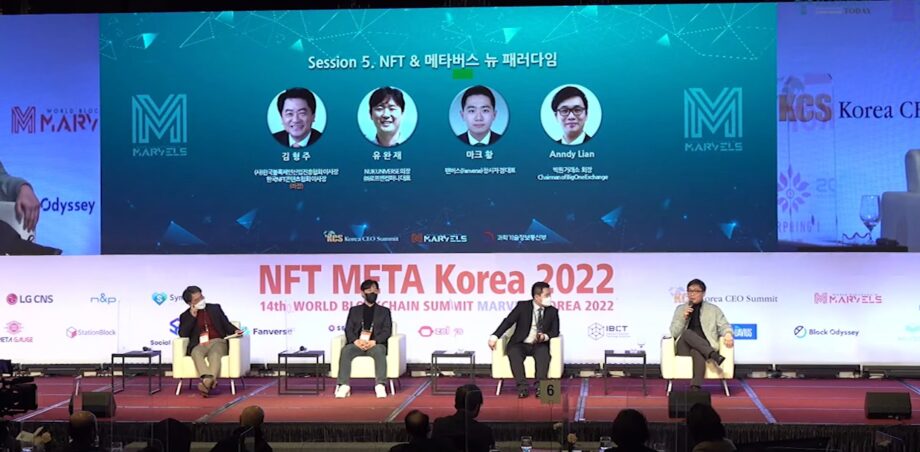
Anndy Lian Shares His Vision for Successful NFTs at NFT Meta Korea 2022

Anndy Lian Shares His Vision for Successful NFTs at NFT Meta Korea 2022

Speaking at the 14th World Blockchain Summit MARVELS, the Chairman of BigONE Exchange Anndy Lian said that key to success for NFT startups was a supportive community and a compelling user case. As a guest speaker at the event on February 22, under the theme of ‘NFT META Korea 2022’, Lian agreed that the global market for NFTs was very active currently but wanted to share his thoughts on how NFT projects can be successful in the longer run. One key factor that should be with a team from the outset is to ensure the NFT has utility, which is closely tied to the importance of community.


Lian illustrated the importance of getting this relationship between the NFT and its community, between creators and fans, with the example of starting a NFT around a well-known soccer player. While on paper the fans of a soccer player appear to be automatically part of the NFT community you are building, that isn’t necessarily the case. What was needed was a strong bond to be created between the fans and the soccer star and the platform for it to work. This was related to the importance of ensuring that when you see a new project in the NFT space you should as an investor consider whether it has utility. Lian added that for NFT creators it was important to be transparent about their offering to investors, not only to better convey its value, but also to ensure that when regulators start to enter the space in 2022 the quality of the NFT industry stands up to scrutiny.


With so much money, energy and creativity going to NFTs its clearly going to throw up some significant issues, and mistakes will be made. Just recently there was a legal battle over CryptoPunks, sparked by an issue with the original version of the code. The makers Larva labs attempted to ban the faulty V1 version, which had been replaced due to faulty programming code, and had the NFTs removed from OpenSea. While LooksRare, the rival to Opensea, was recently reported as experiencing significant wash trading.


But perhaps more worrying was the recent Wormhole bridge attack, when hackers managed to steal more than $320m from the bridge which connects the Ethereum blockchains. A ‘bridge’ is a protocol which allows crypto and NFT holders to move their assets across different blockchains. Wormhole’s bi-directional NFT highway provided a portal between Solana and Ethereum was only launched a few months ago, was designed to connect both communities and enable them to trade each other’s assets with ease. As reported in CNBC, analysis shows a hacker exploited a vulnerability on the Solana side of the bridge to create 120,000 so-called ‘wrapped’ Ethereum tokens for themselves. It appears that they then used these tokens to claim ETH that was held on the Ethereum side of the bridge.


This is indeed troubling on several fronts, not least because these bridge vulnerabilities have long been known about. Indeed, no less a figure in the crypto world than the inventor of Ethereum, Vitalik Buterin, posted early this year that so-called cross-chain devices such as bridges had “fundamental security limits”. The first reason is down to the fact that if a native blockchain suffers a 51% attack, which reverses a cross-bridge transaction (involving a transaction to another blockchain) then the asset could be left stranded in the non-native blockchain. Moreover, this vulnerability could potentially mean a successful 51% attack could threaten an entire crypto ecosystem. Clearly, the issue is as these handy bridges grow in volume, with the growth in DeFi and NFTs, that these issues will only increase. “Your data layer must be your security layer,” summarized Buterin in a tweet thread accompanying the Reddit post.


One neat solution to the threat posed by bridging hacks to NFT transactions was unveiled on February 18 by Ethereum-based platform Harmony, with a Bored Ape Yacht Club Passport. This allows users to import their NFT into play-to-earn game DeFi Kingdoms, which is also built on Harmony and boasts over 120,000 monthly active users. VP of Engineering at Harmony, Leo Chen, explained in a post in late 2021 that the wider importance of this new cross-chain bridge, as part of the Horizon bridge: “It is an important step of the cross-chain infrastructure provided by Harmony to enable a multi-chain ecosystem and one step closer to the upcoming metaverse. The multi-chain world and the metaverse require inter-connected blockchains, not just the fungible tokens, but also non-fungible tokens.” The advantage is that the bridge does not move assets, but rather establishes asset ownership. The second advantage is that it enables artists and creators, put off from participating due to high gas fees, to mint and collect NFTs as a result. A third benefit is that it allows creators to try out their art on Harmony first, and then when demand increase, to bridge to multiple blockchains.


Anndy Lian commented: “I welcome innovatory solutions to NFT cross-chain transactions such as that provided by Harmony, which not simply a safer solution, but which allows creators to get involved in the space without undue costs. It backs up my thesis that NFT projects need to be as transparent as possible when creating their offerings and grow a viable community as they progress.” The market in NFTs boomed in 2021, with total sales globally totaling $25 billion, up from just $94.9 million the year before, according to DappRadar. “Not surprisingly social media is awash with tales of get rich quick NFT success, from CryptoPunks to Bored Apes, and everything in between, but the fascination with digital art is going to change in 2022, with more use cases around utility. At its core of course NFTs are a great way for creators and artists to contact directly with their fans, with their community. And that’s probably the most compelling use case to date that’s going to sustain the growth of NFTs into the future,” Lian added.


Anndy Lian is an early blockchain adopter and experienced serial entrepreneur who is known for his work in the government sector. He is a best selling book author- “NFT: From Zero to Hero” and “Blockchain Revolution 2030”.

Currently, he is appointed as the Chief Digital Advisor at Mongolia Productivity Organization, championing national digitization. Prior to his current appointments, he was the Chairman of BigONE Exchange, a global top 30 ranked crypto spot exchange and was also the Advisory Board Member for Hyundai DAC, the blockchain arm of South Korea’s largest car manufacturer Hyundai Motor Group. Lian played a pivotal role as the Blockchain Advisor for Asian Productivity Organisation (APO), an intergovernmental organization committed to improving productivity in the Asia-Pacific region.

An avid supporter of incubating start-ups, Anndy has also been a private investor for the past eight years. With a growth investment mindset, Anndy strategically demonstrates this in the companies he chooses to be involved with. He believes that what he is doing through blockchain technology currently will revolutionise and redefine traditional businesses. He also believes that the blockchain industry has to be “redecentralised”.
j j j

NFTs and blockchain key to metaverse future, crypto boosters claim

NFTs and blockchain key to metaverse future, crypto boosters claim

Blockchain technology, used to power cryptocurrencies and other decentralized record-keeping systems, has been struggling to find practical use cases outside ransomware and speculative projects like Bitcoin and NFTs. There have been a number of pilot projects in a variety of industries, but they’ve rarely turned into anything with significant business impact because of issues related to security, scalability, efficiency, and cost.

Now crypto proponents are looking to the metaverse as an area where the blockchain can make an impact.

NFT proponents say it is a better way of personalizing art and content in the metaverse, and say that the blockchain is a technology that can decentralize and secure metaverse content.

However, NfT’s actual use as part of the core infrastructure of the metaverse will likely be limited given those same issues of privacy, security, and inefficiency, plus the lack of legal oversight.

The most successful implementation of blockchain is cryptocurrencies, which are mainly used for speculative purposes. Like cryptocurrency, most people will be using NFTs in the metaverse for speculation, said Anndy Lian, a founding member of Influxo and Asia chairman of BigONE, a top global digital asset exchange.

And the fact that there’s a lack of legal oversight could actually be a benefit for its adoption, he said.

“Indeed, away from the hype about NFTs as high priced art work, one of their chief attractions within the crypto space is that they’re not considered securities for regulatory purposes,” he told Hypergrid Business.

There are privacy concerns regarding the blockchain. Although cryptography is involved in the sense that each transaction that’s added to the blockchain is digitally signed, the actual content of the blockchain is in plain text, unencrypted, available for anyone to read. That means that the public can, for example, trace cryptocurrency payments from wallet to wallet.

However, because of the legal limbo that crypto is currently in, there are no “know your customer” requirements such as those in place for all other types of financial activity.

For this reason, proponents of blockchain say it can prevent the kind of user privacy violations that Facebook — now rebranded as “Meta” — has been criticized for.

And since the blockchain relies on decentralized storage — every participant has their copy of the entire blockchain — there is no central control.

Through tokenization of physical assets for sale in the metaverse platforms, blockchain and NFTs can unlock commerce because this way, they facilitate exchanging of goods digitally, that could not be digitally transacted before, he said. For instance, digital passports such as those promoted by ARCx, can help with credit scoring, collateralized lending, and decentralized commerce in the metaverse, he said.

NFTs are already being used in existing metaverses such as Decentraland, but there are a lot of forgeries and duplication.

Blockchain can assure authenticity

According to proponents, the blockchain’s digital signature mechanism and distributed nature can help creators prove that they are the actual owners of particular content, and help users demonstrate that they are legitimate users.

Using blockchain could reduce NFT forgeries in the metaverse because each node verifies the status and ownership of all assets on the network, hence preventing them from being duplicated or changed, said Cynthia Cao, creator of CC is Dreaming, who is a NFT personality and a leading figure in virtual reality in entertainment.

And it’s not just about digital goods, she added.“In the future, when people upload their consciousness into the metaverse, we cannot ensure that their memories are not tampered with or controlled by anyone without the verification and authentication that blockchain provides,” she told Hypergrid Business. 

Storing metaverse content, data, NFTs, images and other arts on the blockchain can ensure permanent storage of that data as it becomes immutable.

This can prevent illegal tampering of anything of value stored in the metaverse, said Luke Stokes managing director at Foundation for Interwallet Operability.

The FIO protocol is enabling artists to sign their work with an easily readable address that acts as a unique signature for their work, hence preventing NFT forgeries, he told Hypergrid Business.

But there are risks, he added.

“There is also the potential for user error, where people miscopy long complicated addresses or suffer man-in-the-middle attacks that could potentially result in millions of dollars being sent to the wrong address or stolen forever,” he said.

Many existing metaverses and virtual worlds succeed by gamifying social and business experiences.

Metaverse platforms that use blockchain have better digital-based rewarding mechanisms for such gamification, for instance through tokens and in-world digital currencies, said Dinis Guarda, who is author, founder, and non-executive chairman of LynKeyCitiesabc.com, and Openbusinesscouncil.org.

“The metaverse will empower peer-to-peer experiences that will offer jobs, financial empowerment, lending, and trading, he said. “The metaverse and NFTs certification solutions will take on the role of a virtual business-empowered financial system.”

This gamification will lead to further growth of art, fashion, collectives, history, cities, property in the metaverse, he said.

Cryptocurrencies are also being used to trade goods and services, for gaming rewards, betting, and for value speculation in metaverses. In Decentraland, for instance, users can buy NFTs with cryptocurrencies or platform token MANA.

Other examples include Citiesabc.com, a metaverse for cities, and LynKey, a virtual and augmented reality platform using crypto for trading NFTs in property and smart tourism.

Unlike fiat currencies like the US dollar or the Euro, crypto enables very cheap transactions in digital worlds, said Daniel Logvin, CEO at LedgerByte.

“We can actually use blockchain to manage in-metaverse currency,” he told Hypergrid Business. “This provides us with security and transaction verification for our purchases and trades, thus ensuring a solid and transparent economy.”

There have even been grids that used Bitcoin in OpenSim, such as YrGrid back in 2015, though none of these projects ever took off due to the high management and overhead costs of using the volatile Bitcoin currency for in-world payments.

Although gaming and art will continue to lead in adoption of metaverse and NFTs, remote working and virtual living — which increased due to COVID, will play a role in popularizing metaverse, NFTs because even the non-tech world is getting interested.

“I think we are entering a really exciting time for the mainstream adoption of NFTs,” said Influxo’s Lian. “Certainly the rise of NFTs for football fans around the world to capture unique moments and to follow their favorite players is a testament to the maturing of the NFT marketplace.

The dark side of the blockchain

Turning an image or another digital asset into an NFT does not actually create any value, said Maria Korolov, editor and publisher at Hypergrid Business. Since it’s stored on the open blockchain, there is no security for assets. In fact, there’s already an epidemic of people simply “right-clicking” on NFTs to save their own copies, with no repercussions, since the block chain no legal weight behind it. Plus, anyone can add anything to a blockchain, whether or not they are the legal owners of that content.

NFTs are thus nothing more than virtual Beanie Babies, she said.

“NFTs by themselves don’t protect intellectual property,” she said. “Anyone can claim to own IP and put it on the blockchain. And the blockchain itself is notoriously susceptible to being hacked.”

Crypto companies are high-profile targets for attackers. Hackers go after exchanges, virtual wallets, and even the blockchain itself. For example, one approach is the “50 percent hack.” The blockchain is decentralized, and if there’s a conflict between transactions the blockchain automatically opts for the transaction that’s supported by the majority of the participants. Hackers have hijacked blockchains repeatedly by using botnets to create participating nodes and then stealing millions of dollars worth of currency. This vulnerability is built into the fundamental design of the blockchain, and there is currently no known fix.

Hackers steal money from blockchains right, left and center, she said.

Finally, blockchains are inefficient compared to centralized data storage because the data is duplicated in multiple locations, and new transactions require progressively larger amount of computing power, resulting in adverse environmental impact.

“That’s why no major organization has replaced its databases with blockchains,” she said. “Blockchains are inefficient, insecure, and basically unmanageable,” she said. “A bunch of companies have done pilot projects. They issued press releases about the pilot projects. But then when they looked at how those pilot projects actually worked out, they quietly abandoned the whole thing and never mentioned it again and wrote off the money they wasted as a learning experience.”


Original Source: https://www.hypergridbusiness.com/2022/01/why-nfts-and-blockchain-are-critical-to-success-of-metaverse/

Anndy Lian is an early blockchain adopter and experienced serial entrepreneur who is known for his work in the government sector. He is a best selling book author- “NFT: From Zero to Hero” and “Blockchain Revolution 2030”.

Currently, he is appointed as the Chief Digital Advisor at Mongolia Productivity Organization, championing national digitization. Prior to his current appointments, he was the Chairman of BigONE Exchange, a global top 30 ranked crypto spot exchange and was also the Advisory Board Member for Hyundai DAC, the blockchain arm of South Korea’s largest car manufacturer Hyundai Motor Group. Lian played a pivotal role as the Blockchain Advisor for Asian Productivity Organisation (APO), an intergovernmental organization committed to improving productivity in the Asia-Pacific region.

An avid supporter of incubating start-ups, Anndy has also been a private investor for the past eight years. With a growth investment mindset, Anndy strategically demonstrates this in the companies he chooses to be involved with. He believes that what he is doing through blockchain technology currently will revolutionise and redefine traditional businesses. He also believes that the blockchain industry has to be “redecentralised”.

j j j

CNBC- NFTs: Revolutionising and democratising the film industry

CNBC- NFTs: Revolutionising and democratising the film industry
After making massive strides in revolutionising the art industry, Non-Fungible Tokens (NFTs) are set to overhaul how movies are being funded and decentralise it to enable NFT holders to partake in the process.
Unlike many other NFT projects that may have little real-world value, these Movie NFTs are a powerful reminder of the seemingly unlimited potential that NFTs have to offer and is proof of what can be achieved when crypto communities join forces to bring about positive change in how businesses function.
Arabian Camels, an NFT community that is creating a $50 million Hollywood movie “Antara” based on the life of ancient Arabian knight Antarah Ibn Shaddad, has announced its NFT drop on January 14, with the integration of cryptocurrency exchange MoonPay. The Antara Movie NFT is the first NFT that allows a buyer to digitally part-own rights of the Hollywood Movie, enabling holders to partake in the box office and streaming revenues.
“The impact that Arabian Camels will have on Hollywood is immense. This is an exciting and revolutionary move that will inject a whole new lease of life into the movie business,” said Josef Brandmaier, a Producer of ‘Antara’.
While the basic tenets of these Movie NFTs are like other NFTs, the marriage of both digital and real worlds is what sets these NFTs apart from the crowd. Not only do NFT holders enjoy part-ownership of the content being represented through the token or of the movie rights itself, but they can also stake these NFTs to earn yields while the movie is still in production.
This enhances the overall appeal as NFT holders can choose to remain invested throughout the movie’s journey while also employing their capital to earn market-beating returns on their digital tokens. Moreover, members of such NFT communities can even get roles in the movie being produced, be given credit as producers, and even join the production team for exclusive gatherings on the real movie set with the cast and crew.
Garrett Minks, CTO of RAIR TECH says there are two precedents required for the movie industry to transform into a web3 business model – DAOs (distributed autonomous organisations) for quick and scalable capital formation and NFTs (non-fungible tokens) as authentication credentials to unlock streaming video.
“Last year, the ConstitutionDAO proved how fast a community could be galvanised to fund an issue by raising over 47 million dollars in less than a week to purchase a copy of the US Constitution. More recently, the BlockbusterDAO formed around reviving the Blockbuster brand as a Web3 business. Combined with streaming infrastructure that can read the blockchain at scale using services like Moralis, there will be a revolution in creator-centric funding for movies where funds are distributed in a more equitable manner for all parties,” Minks said.
This kind of real-world utility has never been possible before due to the traditional ways of film financing and rigid ownership structures prevalent across the major film studios. Movie NFTs are sure to disrupt the global movie-making industry by granting the audience the ability to not only enjoy their favorite content but also empower the new breed of actors, writers, and directors with access to funds from the same movie aficionado community and bring their movie ideas to life.
Anndy Lian, Chairman, BigONE Exchange says currently, NFTs are only being looked at as a form of art or collectibles, but very soon, interactive movie scenes will be seen where viewers can hunt for NFT gifts on the big screen and live.
“Product placements on screen can also be interactive and accountable through the usage of blockchain technology and crypto. This will bring utility to the next level. This will bring movie funding to new heights too as they are able to monetise basically every minute,” Lian said.

Anndy Lian is an early blockchain adopter and experienced serial entrepreneur who is known for his work in the government sector. He is a best selling book author- “NFT: From Zero to Hero” and “Blockchain Revolution 2030”.

Currently, he is appointed as the Chief Digital Advisor at Mongolia Productivity Organization, championing national digitization. Prior to his current appointments, he was the Chairman of BigONE Exchange, a global top 30 ranked crypto spot exchange and was also the Advisory Board Member for Hyundai DAC, the blockchain arm of South Korea’s largest car manufacturer Hyundai Motor Group. Lian played a pivotal role as the Blockchain Advisor for Asian Productivity Organisation (APO), an intergovernmental organization committed to improving productivity in the Asia-Pacific region.

An avid supporter of incubating start-ups, Anndy has also been a private investor for the past eight years. With a growth investment mindset, Anndy strategically demonstrates this in the companies he chooses to be involved with. He believes that what he is doing through blockchain technology currently will revolutionise and redefine traditional businesses. He also believes that the blockchain industry has to be “redecentralised”.
j j j