The alarming reason crypto now moves like gold but falls like stocks

The alarming reason crypto now moves like gold but falls like stocks

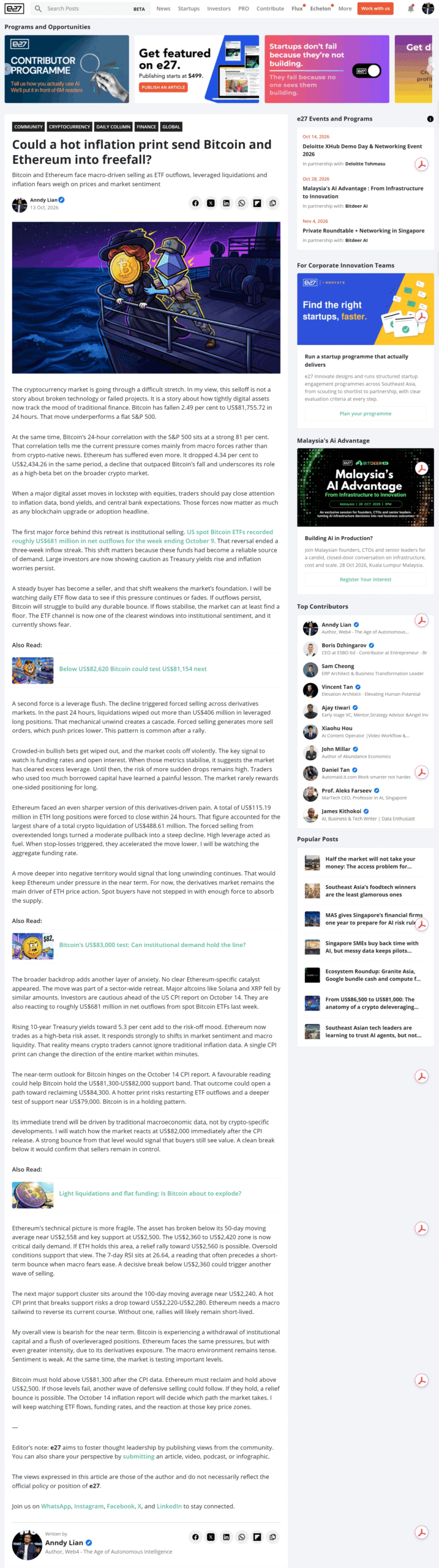
Financial markets worldwide faced significant pressure this week as escalating geopolitical tensions triggered a broad-based retreat from risk assets. The cryptocurrency market declined 1.17 per cent to reach US$2.42T over a 24-hour period, moving in lockstep with traditional equities and commodities in what analysts describe as a classic risk-off response to mounting global uncertainty. This synchronised movement reveals the extent to which digital assets have become integrated into the broader financial system, with crypto now showing a remarkable 94 per cent correlation with the S&P 500 and an 88 per cent correlation with gold.

The catalyst for this market-wide decline emerged from the collapse of US-Iran peace talks and the subsequent announcement of a US naval blockade of the Strait of Hormuz on April 12. This dramatic escalation sent oil prices surging nearly eight per cent to cross US$104 per barrel, reigniting fears of supply disruptions and asymmetric inflation shocks that could derail the global economic recovery. Traditional equity markets responded immediately to the heightened tensions.

The Dow Jones Industrial Average fell 269.23 points to close at 47,916.57, representing a decline of 0.56 per cent. The S&P 500 slipped 7.77 points to 6,816.89, down 0.11 per cent, while Asian markets bore the brunt of the selling pressure. The Nikkei 225 plummeted 477.85 points to 56,446.26, a drop of 0.84 per cent. Only the Nasdaq Composite managed to post gains, rising 80.48 points to 22,902.9 for a 0.35 per cent increase, while the FTSE 100 Index edged up 0.03 per cent to 10,600.53 despite falling 2.95 points in absolute terms.

What makes this particular sell-off noteworthy is the degree to which cryptocurrency has shed its reputation as an uncorrelated alternative asset class. The 94 per cent correlation with the S&P 500 indicates that digital assets now move almost in perfect tandem with traditional equities during periods of market stress. Even more telling is the 88 per cent correlation with gold, traditionally considered the ultimate safe haven during geopolitical crises. This suggests that investors are treating crypto as a risk asset rather than a hedge, liquidating positions across the board as they seek to reduce exposure to volatile markets. The implication is profound for those who believed cryptocurrency would serve as a portfolio diversifier during times of global instability.

Ethereum faced particular headwinds during this downturn, falling 3.65 per cent as asset-specific pressures compounded the broader market weakness. The cancellation of Ether Machine’s planned US$1.5B Nasdaq listing removed a significant vote of confidence in the institutional adoption of Ethereum-based ventures. Large treasury sales by entities like Trend Research added further selling pressure, suggesting that even sophisticated institutional players are reducing their exposure amid the uncertainty. Ethereum’s ability to hold the US$2,100 to US$2,200 support zone has become critical for the broader altcoin market, as a break below this level could trigger additional cascading liquidations across smaller cryptocurrencies.

The timing of this geopolitical crisis could not be worse for risk assets. Wall Street is shifting its focus to Q1 earnings season, with analysts projecting profit growth of roughly 12 per cent, marking the weakest performance since mid-2025. Goldman Sachs kicks off the major financial reporting cycle today, and investors will scrutinise every word for indications of how the banking sector is navigating the twin challenges of geopolitical instability and persistent inflation concerns. The IMF and World Bank Spring Meetings also begin this week, with IMF chief Kristalina Georgieva warning of potential downgrades to global growth forecasts due to the ongoing conflict. This confluence of negative catalysts creates a challenging environment for any sustained market recovery.

Looking ahead, the cryptocurrency market faces several critical inflexion points that will determine whether this decline represents a temporary setback or the beginning of a deeper correction. The SEC and CFTC roundtable on the CLARITY Act scheduled for April 16 could provide regulatory clarity that stabilises market sentiment, though investors should not expect transformative announcements from what is likely to be a preliminary discussion.

From a technical perspective, the market is currently testing the 50 per cent Fibonacci retracement level at US$2.42T. Holding above the US$2.39T level, which represents the 38.2 per cent retracement, is crucial for short-term stability. A break below US$2.34T would signal that deeper correction risks are materialising, potentially opening the door to further downside.

The path forward hinges on two primary factors: whether geopolitical tensions subside and whether regulatory developments provide reassurance to institutional investors. A de-escalation in the Middle East or renewed diplomatic efforts between the United States and Iran could trigger a relief rally across risk assets.

Analysts warn that supply disruptions in the energy market will persist even if a ceasefire holds, meaning inflation pressures may remain elevated for longer than markets currently anticipate. This creates a challenging environment where even positive geopolitical news may not be sufficient to drive a sustained recovery if macroeconomic fundamentals continue to deteriorate.

Investors should monitor several key indicators in the coming days. Price action around the US$2.42T pivot level will reveal whether buyers are willing to step in at current valuations. Any news flow from the April 16 regulatory event could provide short-term catalysts, though the market has become increasingly sceptical of regulatory promises. Ethereum’s performance relative to Bitcoin will indicate whether altcoin-specific pressures are abating or intensifying. The ability of traditional equity markets to stabilise despite ongoing geopolitical tensions will also influence crypto market sentiment, given the high correlation between these asset classes.

The current market environment demands caution and discipline from investors. The coordinated sell-off across cryptocurrencies, equities, and commodities demonstrates that no asset class exists in isolation during periods of systemic stress. Those who viewed cryptocurrency as a hedge against traditional market volatility have received a stark reminder that digital assets remain firmly embedded in the global financial system, subject to the same macroeconomic forces that drive traditional markets.

The coming weeks will test whether the crypto market can establish support at current levels or whether further downside awaits as geopolitical and regulatory uncertainties continue to unfold. Market participants must remain vigilant, focusing on concrete data rather than speculative narratives, as the intersection of geopolitics, regulation, and institutional behaviour continues to shape the trajectory of digital assets in an increasingly interconnected global economy.


Source: https://e27.co/the-alarming-reason-crypto-now-moves-like-gold-but-falls-like-stocks-20260413/

Anndy Lian is an early blockchain adopter and experienced serial entrepreneur who is known for his work in the government sector. He is a best selling book author- “NFT: From Zero to Hero” and “Blockchain Revolution 2030”.

Currently, he is appointed as the Chief Digital Advisor at Mongolia Productivity Organization, championing national digitization. Prior to his current appointments, he was the Chairman of BigONE Exchange, a global top 30 ranked crypto spot exchange and was also the Advisory Board Member for Hyundai DAC, the blockchain arm of South Korea’s largest car manufacturer Hyundai Motor Group. Lian played a pivotal role as the Blockchain Advisor for Asian Productivity Organisation (APO), an intergovernmental organization committed to improving productivity in the Asia-Pacific region.

An avid supporter of incubating start-ups, Anndy has also been a private investor for the past eight years. With a growth investment mindset, Anndy strategically demonstrates this in the companies he chooses to be involved with. He believes that what he is doing through blockchain technology currently will revolutionise and redefine traditional businesses. He also believes that the blockchain industry has to be “redecentralised”.

j j j

Binance cracks down on market makers: What traders need to know now

Binance cracks down on market makers: What traders need to know now

Binance just announced stricter rules for market makers and token issuers, and this move deserves careful attention from anyone watching how crypto markets mature. The exchange now requires projects to disclose their market maker identity, legal entity, and key contract terms covering inventory and fee handling. It explicitly bans profit-sharing and guaranteed-return arrangements between projects and market makers, as well as opaque token lending that permits broad, undefined use of borrowed tokens. These structures often hide incentives that drive manipulative behaviour.

They will also monitor market maker activity more closely, watching for selling that conflicts with vesting schedules, one-sided quote provision, or trading that artificially inflates volume. The platform reserves the right to blacklist firms that engage in these practices. Bloomberg separately notes a prohibition on any revenue-sharing models tied to market-making on Binance. This is not a minor policy tweak. It represents a fundamental shift toward transparency in a part of crypto markets that has long operated in the shadows.

Market makers play a vital role in healthy trading environments. They tighten spreads and provide depth, allowing traders to enter and exit positions without excessive slippage. But when market makers receive payments to pump volumes or support price levels at all costs, they create fake liquidity that misleads traders about real demand. The new Binance rules aim to separate genuine market making from arrangements designed to manufacture the appearance of activity. By forcing disclosure of who the market maker is and what they can do, and by banning profit-sharing and price-manipulation deals, Binance tries to reduce conflicts of interest and wash trading that drew criticism after past market meltdowns. Tokens that relied on aggressive, opaque market making to appear healthier than they truly were could see wider spreads or lower volumes in the near term. Projects with organic demand and clean arrangements may stand out more clearly once the noise fades. This short-term discomfort could actually help investors distinguish between substance and spectacle.

The real test of these new rules will be enforcement. Binance says it will take swift, decisive action against misconduct, including blacklisting market makers. But it remains unclear whether blacklisted entities will be publicly named or only handled internally. Transparency about enforcement would strengthen the credibility of this policy shift. Without public accountability, bad actors could simply migrate to less scrutinised venues while continuing similar practices. Watch how liquidity metrics change, especially for smaller or recently listed tokens. Persistent widening spreads or sharp drops in reported volume could signal that prior activity depended heavily on now-constrained arrangements.

Also, watch whether rival exchanges adopt similar policies or position themselves as more flexible alternatives. If Binance’s stricter stance becomes an industry norm, it could reduce room for aggressive market making across the entire ecosystem, not just on one venue. That would represent meaningful progress toward more honest price discovery.

These changes reflect a necessary evolution in how crypto markets operate. I have seen how opaque arrangements can undermine trust. When market makers and projects hide their relationships, they create information asymmetry that harms retail participants the most. Requiring disclosure does not eliminate all manipulation, but it raises the cost of deceptive behaviour and makes it easier for observers to spot red flags. Banning profit sharing between projects and their market makers removes a powerful incentive to coordinate trades that serve internal interests rather than genuine supply and demand. This aligns with a broader principle I hold: decentralised systems work best when incentives are transparent and aligned with long-term network health, not short-term price engineering.

That said, I approach these rules with measured optimism. Regulation and self-regulation in crypto must balance market integrity with innovation. Overly rigid constraints could push legitimate market-making activity offshore or into decentralised venues where oversight is minimal. The goal should not be to eliminate market making but to ensure it serves real liquidity needs rather than marketing narratives. Binance’s focus on specific harmful practices, such as front-running token release schedules or providing one-sided quotes, shows a nuanced understanding of where manipulation occurs. This targeted approach is more promising than blanket restrictions that might stifle useful activity. I also believe that traditional financial tests, such as the Howey test, often fail to capture the realities of decentralised systems. Similarly, market-making rules designed for traditional equities may not translate perfectly to crypto. Binance appears to be crafting rules specific to the dynamics of digital asset markets, which is the right direction.


Source: https://e27.co/binance-cracks-down-on-market-makers-what-traders-need-to-know-now-20260326/

Anndy Lian is an early blockchain adopter and experienced serial entrepreneur who is known for his work in the government sector. He is a best selling book author- “NFT: From Zero to Hero” and “Blockchain Revolution 2030”.

Currently, he is appointed as the Chief Digital Advisor at Mongolia Productivity Organization, championing national digitization. Prior to his current appointments, he was the Chairman of BigONE Exchange, a global top 30 ranked crypto spot exchange and was also the Advisory Board Member for Hyundai DAC, the blockchain arm of South Korea’s largest car manufacturer Hyundai Motor Group. Lian played a pivotal role as the Blockchain Advisor for Asian Productivity Organisation (APO), an intergovernmental organization committed to improving productivity in the Asia-Pacific region.

An avid supporter of incubating start-ups, Anndy has also been a private investor for the past eight years. With a growth investment mindset, Anndy strategically demonstrates this in the companies he chooses to be involved with. He believes that what he is doing through blockchain technology currently will revolutionise and redefine traditional businesses. He also believes that the blockchain industry has to be “redecentralised”.

j j j

Market crash or buying opportunity? What investors need to know now

Market crash or buying opportunity? What investors need to know now

United States indices closed Tuesday with modest losses, relinquishing early gains as crude prices resumed their ascent. The S&P 500 fell 0.37 per cent to 6,556.37, while the Nasdaq Composite dropped 0.84 per cent to 21,761.89, pressured by weakness in software names and the so-called Mag 7 technology leaders. The Dow Jones Industrial Average shed 84.41 points, or 0.18 per cent, to settle at 46,124.06. These movements reflect a market grappling with conflicting signals.

De-escalation narratives boost risk appetite while persistent inflation concerns keep the Federal Reserve on a hawkish footing. Technology stocks, which have led gains in prior months, now face scrutiny as higher-for-longer interest rate expectations compress valuation multiples. Investors who chased early Tuesday strength found themselves caught on the wrong side of a late-session reversal, a reminder that liquidity can vanish quickly when macro headlines dominate.

Asia-Pacific markets displayed sharper divergence. South Korea’s KOSPI surged 3.06 per cent at Wednesday’s open, fuelled by reports of a potential 15-point US-Iran de-escalation plan. This optimism contrasted with earlier heavy losses in Japan’s Nikkei and Hong Kong’s Hang Seng, both of which fell more than three per cent as energy prices spiked.

The regional split underscores how rapidly sentiment shifts when geopolitical headlines dominate, leaving traders to parse signal from noise in real time. Energy-dependent economies feel these swings most acutely, as oil price volatility directly impacts trade balances and corporate earnings forecasts. The KOSPI’s sharp rebound also highlights how local markets can decouple temporarily from global risk trends when catalyst-specific news emerges, creating both opportunity and whipsaw risk for cross-border capital.

The cryptocurrency market has stabilised after intense volatility, though it remains acutely sensitive to macroeconomic currents. Bitcoin trades around US$70,950, holding modest gains after rebounding from February lows. Ethereum hovers near US$2,130-US$2,160, recently underperforming Bitcoin amid heightened institutional selling pressure in ETH exchange-traded funds. Among altcoins, Solana holds steady near US$88-US$89, while XRP remains around US$1.42-US$1.45.

Market drivers remain anchored in geopolitical uncertainty. Recent liquidations of nearly US$550 million in short positions helped Bitcoin reclaim the US$71,000 threshold, demonstrating how leverage and sentiment can amplify moves in digital asset markets. This dynamic reveals a maturing yet still fragile ecosystem in which traditional finance flows increasingly intersect with decentralised protocols, creating new channels for volatility transmission.

Commodities reflect the same tug-of-war. Brent crude fell more than four per cent to drop below US$100 a barrel at Wednesday’s open on hopes of a de-escalation, after hitting highs near US$119 last week. The Federal Reserve held its benchmark rate at 3.5 per cent to 3.75 per cent this month and signalled only one rate cut for the remainder of 2026, while raising its inflation outlook to 2.7 per cent. Gold trades around US$4,550 per ounce, retaining some safe-haven appeal despite rising bond yields.

These moves highlight how traditional stores of value and inflation hedges respond to the same geopolitical and policy forces shaping equities and crypto. Oil’s sharp pullback from US$119 shows how quickly risk premiums can evaporate on diplomatic headlines, but the Fed’s cautious stance reminds markets that underlying inflation pressures have not disappeared.

This market environment reveals the intelligence gap that persists in Web3 and traditional finance alike. While institutional players react to Federal Reserve signals and Middle East headlines, decentralised networks continue processing transactions without pause. The US$550 million in short liquidations that propelled Bitcoin higher demonstrates how legacy market structures can create asymmetric opportunities for those who understand on-chain dynamics.

Ethereum’s underperformance relative to Bitcoin, driven by ETF selling pressure, reminds us that institutional adoption does not always align with network fundamentals. I see these moments not as noise but as data points in a larger transition toward more resilient, human-centric financial infrastructure. The current volatility underscores why true decentralisation matters. Systems that depend on single points of failure, whether geopolitical or institutional, remain vulnerable to sudden regime shifts.

The path forward demands more than reactive trading. It requires visionary architecture that anticipates the next cycle of innovation while respecting the lessons of past volatility. Markets will continue to oscillate between fear and hope, but the foundational shift toward open, programmable, and user-owned infrastructure represents a structural trend that transcends daily price action. Those who focus on building rather than merely speculating will define the next era of financial technology.


Source: https://e27.co/market-crash-or-buying-opportunity-what-investors-need-to-know-now-20260325/

Anndy Lian is an early blockchain adopter and experienced serial entrepreneur who is known for his work in the government sector. He is a best selling book author- “NFT: From Zero to Hero” and “Blockchain Revolution 2030”.

Currently, he is appointed as the Chief Digital Advisor at Mongolia Productivity Organization, championing national digitization. Prior to his current appointments, he was the Chairman of BigONE Exchange, a global top 30 ranked crypto spot exchange and was also the Advisory Board Member for Hyundai DAC, the blockchain arm of South Korea’s largest car manufacturer Hyundai Motor Group. Lian played a pivotal role as the Blockchain Advisor for Asian Productivity Organisation (APO), an intergovernmental organization committed to improving productivity in the Asia-Pacific region.

An avid supporter of incubating start-ups, Anndy has also been a private investor for the past eight years. With a growth investment mindset, Anndy strategically demonstrates this in the companies he chooses to be involved with. He believes that what he is doing through blockchain technology currently will revolutionise and redefine traditional businesses. He also believes that the blockchain industry has to be “redecentralised”.

j j j