Can Global Cooperation Achieve Consistent Stablecoin Regulation?

Can Global Cooperation Achieve Consistent Stablecoin Regulation?

In the ever-evolving landscape of digital finance, stablecoins have emerged as a pivotal bridge between traditional and cryptocurrency markets. As their influence grows, so does the imperative to establish a robust regulatory framework.

What are the ins of stablecoin regulation, and where could it be headed in the future?

FSB’s 10 Recommendations

In mid-July 2023, the Financial Stability Board (FSB) published its financial report on the regulation, supervision, and oversight of global stablecoin arrangements.

A total of 10 recommendations were endorsed by the member countries of G20. The FSB’s report reads: “The High-level Recommendations seek to promote consistent and effective regulation, supervision, and oversight of GSCs across jurisdictions to address the potential financial stability risks posed by GSCs, both at the domestic and international level, while supporting responsible innovation and providing sufficient flexibility for jurisdictions to implement domestic approaches.”

One of the key recommendations issued by the FSB is the requirement for stablecoin issuers to secure local licenses before operating in specific jurisdictions.

Explaining why it would be vital for governments to regulate stablecoins, Andrew Silverman, a tax analyst at Bloomberg Intelligence, said:

“Stablecoins, in my view, are not significantly different from derivatives, and governments have regulated derivatives for as long as they have existed. Allowing a financial instrument to go unregulated gives people and companies the ability to circumvent the rules simply by using a contract to stand in for an asset, and that opens up opportunities for abuse.”

Silverman added that the introduction of local licenses would allow governments to have broader control over which stablecoin issuers are operating in their jurisdiction. This could also allow governments to periodically obtain information from licensees, which could be the best “disinfectant” to avoid any regulatory or legal issues.

“Countries can also use licensing to keep the holders of licenses current on applicable laws and regulations, both in terms of maintaining current contact information with licensees and requiring acknowledgment of the current set of rules when a licensee renews their license,” Silverman noted.

Singapore, the First Country to Issue Stablecoin Regulation

On 15 August 2023, Singapore’s financial regulator was the first in the world to announce that it had finalized a set of rules on stablecoin regulation.

According to Anndy Lian, the author of NFT: From Zero to Hero, such a move has helped shape Singapore’s reputation as a “global hotspot for cryptocurrencies.” The introduced regulations highlight a number of requirements that include:

  • The reserves supporting stablecoins need to consist of low-risk and easily tradable assets, and their value must always be equal to or greater than the circulating value of the stablecoin.
  • In case of a redemption request, stablecoin issuers are required to reimburse holders with the nominal value of the digital currency within five business days.
  • Issuers are also obligated to furnish users with suitable information, which encompasses audit outcomes of reserves, among other details.

Lian explains, however, that even though introduced, the regulatory framework surrounding stablecoins “remains intricating and swiftly changing.”

“Different governing bodies, whether at the federal or state level, wield varying degrees of jurisdiction over transactions, contingent on the asset’s structure and the specific circumstances surrounding it. In light of this context, Singapore’s decision to finalize regulations for stablecoins holds tremendous significance.

“This step addresses the pertinent regulatory obstacles and boosts the advancement of stablecoins as a reputable medium of exchange within the digital asset ecosystem,” Linn added.

Stablecoin Regulation Going Global

The attempts of several major companies to launch their own stablecoins were previously met with some opposition from governing bodies. At the start of August 2023, PayPal announced the release of its own US-dollar pegged stablecoin – PayPal USD (PUSD). The stablecoin was launched in collaboration with Paxos Trust.

Since both companies are unregulated, meaning they are not examined by a federal banking agency which is why governing bodies are starting to turn towards regulating stablecoins.

But with cryptocurrencies being accessible on a global scale, how can stablecoin regulation be reached?

Bloomberg Intelligence’s Silverman noted that if governing bodies work together, they could communicate a single message. He added that the United States often holds major influence over other countries’ financial decisions, especially in the industry of decentralized finance (DeFi).

“Having an impact on US law-making indirectly influences other countries’ rule adoption. I would note, however, that consistent stablecoin regulation is not necessarily the ideal for all.  Companies and individuals that can arbitrage differences in countries’ stablecoin regulation could benefit from those distinctions.”

Lian added that Singapore’s stablecoin regulations could “potentially become a template for other nations grappling with their own regulatory frameworks.”

“Given Singapore’s standing as a meticulously overseen financial hub, its method of handling stablecoin regulations might emerge as a beacon for countries seeking to establish their own guidelines. Nevertheless, it is essential to acknowledge the swiftly evolving and intricate nature of the regulatory environment surrounding digital currencies.”

Can Stablecoin Regulation Prevent Another Market Meltdown?

Stablecoins are unique due to their ability to keep a 1:1 peg with the asset they are paired with, oftentimes the US dollar. However, on 9 May 2022, stablecoins made headlines when one of the biggest coins in the category – terra USD (UST), broke its peg from the US dollar.

UST’s collapse had led to major losses in the cryptocurrency industry, with many investors losing trust in stablecoins, fearing another collapse may be inevitable.

Silverman explained that by regulating stablecoins and essentially excluding speculative and volatile assets from supporting stablecoins, the assets could become “safer investments, or at least it will allow them to be viewed as safer investments.”

“I think the sentiment is good, but it could actually have the opposite effect. People viewed money market funds and collateralized debt obligations (CDOs) as entirely safe before the financial crisis when that didn’t turn out to actually be the case. Perhaps, speculative and volatile assets will, in fact, be successfully barred from being included in stablecoins. Perhaps not.”

He added: “A safe asset can always quickly become volatile under the right circumstances. Giving people the impression that a financial instrument is entirely safe when it’s almost certainly never possible to guarantee safety is not ideal from a policy perspective.”

Lian suggested that regulation ensuring that the reserves supporting stablecoins focus on low-risk and highly liquid assets could function as “a safeguard, tethering the stablecoin’s value to assets that are less prone to drastic value wings and can be readily transformed into cash when necessary.”

The Bottom Line

Stablecoins have represented a significant milestone in the cryptocurrency industry by attempting to offer stability and versatility in an otherwise volatile industry.

Silverman noted that all regulations are intended to offer protection without doing much harm to the assets being regulated, however, every regulation has the potential to weigh in favor of companies or individuals.

“The impact of regulations and their interpretation also changes over time, so what is beneficial to companies today could be better for individuals in the future. We will see how things shake out. If a regulation is truly harmful it tends to be struck down in court or over-written by statute. There are checks and balances. The downside, of course, is that everyone has to put up with a subpar regulation for some time until it is changed.”

Source: https://www.techopedia.com/can-global-cooperation-achieve-consistent-stablecoin-regulation

Anndy Lian is an early blockchain adopter and experienced serial entrepreneur who is known for his work in the government sector. He is a best selling book author- “NFT: From Zero to Hero” and “Blockchain Revolution 2030”.

Currently, he is appointed as the Chief Digital Advisor at Mongolia Productivity Organization, championing national digitization. Prior to his current appointments, he was the Chairman of BigONE Exchange, a global top 30 ranked crypto spot exchange and was also the Advisory Board Member for Hyundai DAC, the blockchain arm of South Korea’s largest car manufacturer Hyundai Motor Group. Lian played a pivotal role as the Blockchain Advisor for Asian Productivity Organisation (APO), an intergovernmental organization committed to improving productivity in the Asia-Pacific region.

An avid supporter of incubating start-ups, Anndy has also been a private investor for the past eight years. With a growth investment mindset, Anndy strategically demonstrates this in the companies he chooses to be involved with. He believes that what he is doing through blockchain technology currently will revolutionise and redefine traditional businesses. He also believes that the blockchain industry has to be “redecentralised”.
j j j

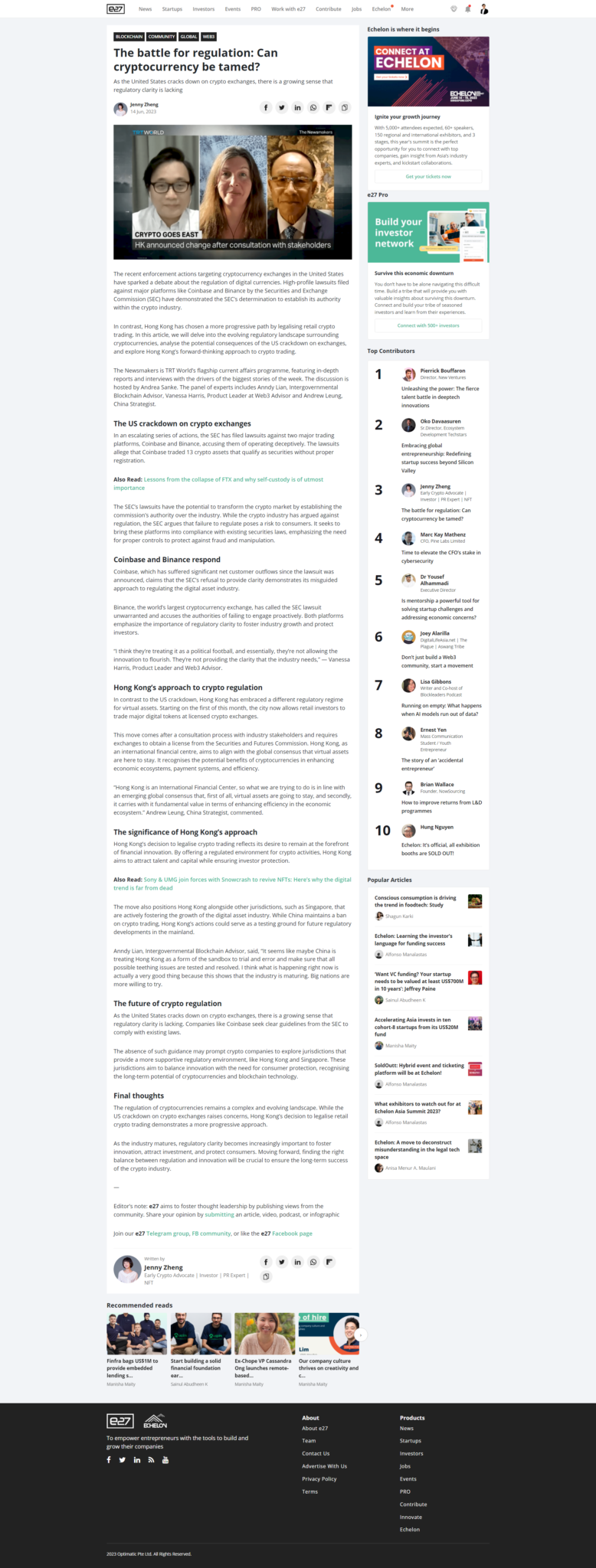
The battle for regulation: Can cryptocurrency be tamed?

The battle for regulation: Can cryptocurrency be tamed?

The recent enforcement actions targeting cryptocurrency exchanges in the United States have sparked a debate about the regulation of digital currencies. High-profile lawsuits filed against major platforms like Coinbase and Binance by the Securities and Exchange Commission (SEC) have demonstrated the SEC’s determination to establish its authority within the crypto industry.

In contrast, Hong Kong has chosen a more progressive path by legalising retail crypto trading. In this article, we will delve into the evolving regulatory landscape surrounding cryptocurrencies, analyse the potential consequences of the US crackdown on exchanges, and explore Hong Kong’s forward-thinking approach to crypto trading.

The Newsmakers is TRT World’s flagship current affairs programme, featuring in-depth reports and interviews with the drivers of the biggest stories of the week. The discussion is hosted by Andrea Sanke. The panel of experts includes Anndy Lian, Intergovernmental Blockchain Advisor, Vanessa Harris, Product Leader at Web3 Advisor and Andrew Leung, China Strategist.

The US crackdown on crypto exchanges

In an escalating series of actions, the SEC has filed lawsuits against two major trading platforms, Coinbase and Binance, accusing them of operating deceptively. The lawsuits allege that Coinbase traded 13 crypto assets that qualify as securities without proper registration.

The SEC’s lawsuits have the potential to transform the crypto market by establishing the commission’s authority over the industry. While the crypto industry has argued against regulation, the SEC argues that failure to regulate poses a risk to consumers. It seeks to bring these platforms into compliance with existing securities laws, emphasizing the need for proper controls to protect against fraud and manipulation.

Coinbase and Binance respond

Coinbase, which has suffered significant net customer outflows since the lawsuit was announced, claims that the SEC’s refusal to provide clarity demonstrates its misguided approach to regulating the digital asset industry.

Binance, the world’s largest cryptocurrency exchange, has called the SEC lawsuit unwarranted and accuses the authorities of failing to engage proactively. Both platforms emphasize the importance of regulatory clarity to foster industry growth and protect investors.

“I think they’re treating it as a political football, and essentially, they’re not allowing the innovation to flourish. They’re not providing the clarity that the industry needs,” — Vanessa Harris, Product Leader and Web3 Advisor.

Hong Kong’s approach to crypto regulation

In contrast to the US crackdown, Hong Kong has embraced a different regulatory regime for virtual assets. Starting on the first of this month, the city now allows retail investors to trade major digital tokens at licensed crypto exchanges.

This move comes after a consultation process with industry stakeholders and requires exchanges to obtain a license from the Securities and Futures Commission. Hong Kong, as an international financial centre, aims to align with the global consensus that virtual assets are here to stay. It recognises the potential benefits of cryptocurrencies in enhancing economic ecosystems, payment systems, and efficiency.

“Hong Kong is an International Financial Center, so what we are trying to do is in line with an emerging global consensus that, first of all, virtual assets are going to stay, and secondly, it carries with it fundamental value in terms of enhancing efficiency in the economic ecosystem.” Andrew Leung, China Strategist, commented.

The significance of Hong Kong’s approach

Hong Kong’s decision to legalise crypto trading reflects its desire to remain at the forefront of financial innovation. By offering a regulated environment for crypto activities, Hong Kong aims to attract talent and capital while ensuring investor protection.

The move also positions Hong Kong alongside other jurisdictions, such as Singapore, that are actively fostering the growth of the digital asset industry. While China maintains a ban on crypto trading, Hong Kong’s actions could serve as a testing ground for future regulatory developments in the mainland.

Anndy Lian, Intergovernmental Blockchain Advisor, said, “It seems like maybe China is treating Hong Kong as a form of the sandbox to trial and error and make sure that all possible teething issues are tested and resolved. I think what is happening right now is actually a very good thing because this shows that the industry is maturing. Big nations are more willing to try.

The future of crypto regulation

As the United States cracks down on crypto exchanges, there is a growing sense that regulatory clarity is lacking. Companies like Coinbase seek clear guidelines from the SEC to comply with existing laws.

The absence of such guidance may prompt crypto companies to explore jurisdictions that provide a more supportive regulatory environment, like Hong Kong and Singapore. These jurisdictions aim to balance innovation with the need for consumer protection, recognising the long-term potential of cryptocurrencies and blockchain technology.

Final thoughts

The regulation of cryptocurrencies remains a complex and evolving landscape. While the US crackdown on crypto exchanges raises concerns, Hong Kong’s decision to legalise retail crypto trading demonstrates a more progressive approach.

As the industry matures, regulatory clarity becomes increasingly important to foster innovation, attract investment, and protect consumers. Moving forward, finding the right balance between regulation and innovation will be crucial to ensure the long-term success of the crypto industry.

Source: https://e27.co/the-battle-for-regulation-can-cryptocurrency-be-tamed-20230612/

Anndy Lian is an early blockchain adopter and experienced serial entrepreneur who is known for his work in the government sector. He is a best selling book author- “NFT: From Zero to Hero” and “Blockchain Revolution 2030”.

Currently, he is appointed as the Chief Digital Advisor at Mongolia Productivity Organization, championing national digitization. Prior to his current appointments, he was the Chairman of BigONE Exchange, a global top 30 ranked crypto spot exchange and was also the Advisory Board Member for Hyundai DAC, the blockchain arm of South Korea’s largest car manufacturer Hyundai Motor Group. Lian played a pivotal role as the Blockchain Advisor for Asian Productivity Organisation (APO), an intergovernmental organization committed to improving productivity in the Asia-Pacific region.

An avid supporter of incubating start-ups, Anndy has also been a private investor for the past eight years. With a growth investment mindset, Anndy strategically demonstrates this in the companies he chooses to be involved with. He believes that what he is doing through blockchain technology currently will revolutionise and redefine traditional businesses. He also believes that the blockchain industry has to be “redecentralised”.

j j j

SEC removes digital assets from hedge fund rule: What does it mean for the future of digital asset regulation

SEC removes digital assets from hedge fund rule: What does it mean for the future of digital asset regulation

The U.S. Securities and Exchange Commission (SEC), which regulates the securities industry, has recently decided about digital assets. Digital assets are virtual or digital currencies that can be traded or exchanged. The SEC previously defined digital assets as securities in its hedge fund rule, subjecting them to additional regulations.

Hedge fund rule

The hedge fund rule, officially known as Rule 206(4)-8 under the Investment Advisers Act of 1940, is a rule created by the U.S. Securities and Exchange Commission (SEC) to prevent investment advisers from making false or misleading statements to investors in pooled investment vehicles such as hedge funds.

The rule imposes additional reporting and disclosure requirements on advisers to hedge funds and other private funds and requires them to implement specific compliance programs and risk management measures. The rule is designed to protect investors and maintain the integrity of the financial markets by ensuring that investment advisers act in their client’s best interests and provide accurate and complete information about their investment strategies and risks.

In the context of digital assets, the SEC included a definition of “digital assets” as securities in its hedge fund rule, subjecting them to additional regulations. However, the SEC recently removed this definition, indicating that it is still evaluating the term and has not yet decided whether digital assets should be classified as securities.

New asset class for “digital assets”?

Many people have been surprised by this move and have questioned the SEC’s approach to regulating digital assets. It’s worth noting that SEC Chair Gary Gensler gave a speech before the House Financial Services Committee on April 18, 2023, regarding the agency’s stance on digital assets. The hearing was not dedicated exclusively to the SEC’s crypto strategies, but the regulatory agency’s chairman faced criticism over perceived regulatory overreach and lack of clear crypto classification. During the hearing, Gensler refused to comment on whether Ether (ETH) was a security or a commodity, saying it depends on the facts and the law, despite being told he knows. It is worth noting that the U.S. House Financial Services Committee and House Agriculture Committee are set to put together legislation to oversee the crypto sector. The bill will be introduced within the next two months.

Having said so, I do see this in a more positive light. This suggests that the SEC is working on a regulatory framework for digital assets, and this decision may be part of a larger strategy. The SEC may have removed the definition of “digital assets” from the hedge fund rule to allow for further consideration and evaluation of the appropriate regulatory approach for this new asset class. The SEC could be taking a cautious approach to ensure that any regulatory framework it develops is appropriate for digital assets’ unique characteristics and addresses potential risks without hindering innovation.

Regulating digital assets is complex and contentious

Experts have commented on the SEC’s decision to remove its previous definition of digital assets as securities, which would have subjected them to additional regulations. Coinbase, a major player in the crypto industry, has publicly opposed the SEC’s stance on regulating digital assets. Some experts believe that the digital assets sector needs to focus more on risk management and operational due diligence, coupled with thoughtful regulation, to repair its reputation.

It’s essential to recognize that the SEC has had a changing stance on digital assets, and this recent decision isn’t the first time they’ve taken a position on their classification. Previously, the SEC confirmed that a 401(k) plan could be considered a single investor under section 3 (c) (1) and a qualified purchaser under section 3 (c) (7) if plan participants have investment discretion to allocate their accounts.

The question of how to regulate digital assets is complex and contentious. In addition to the points made, some argue that digital assets fundamentally differ from traditional securities and should be treated as a separate asset class. Because they operate on a decentralized network, digital assets aren’t subject to the same regulations and oversight as traditional securities. This lack of regulation has led to concerns about market manipulation, fraud, and other illicit activities.

Moreover, digital assets aren’t backed by physical assets or government guarantees, which makes them inherently risky. However, they also have the potential for high returns, which can entice investors who are willing to take on more risk in their investments. Due to these unique characteristics, some experts suggest that digital assets require a different approach to risk management, valuation, and investment strategies than traditional securities.

The evolving nature of the digital asset market may require clearer regulatory frameworks and standards as it matures. However, there is uncertainty surrounding how these assets will be classified and regulated and how this will affect the overall market. Digital assets have unique characteristics that differentiate them from traditional assets, including decentralization and the use of blockchain technology. This technology enables borderless transactions, smart contracts, and decentralized applications that offer new investment opportunities for retail and institutional investors.

Ending remarks

The growth of the digital asset market has attracted significant attention from regulators and investors, with some arguing that digital assets should be treated as securities to protect investors from fraud. The SEC’s decision to remove the definition of digital assets as securities from its hedge fund rule have fueled ongoing debate about the appropriate regulatory framework for this asset class. As the use of digital assets continues to expand, the SEC will likely continue to develop its regulatory approach.

In conclusion, the SEC’s recent decision is a significant development in regulating digital assets and raises questions about how these assets will be classified and regulated. As the digital asset market matures, there may be a need for clearer regulatory frameworks and standards to protect investors and prevent fraud while allowing for innovation and growth.


Source: https://www.financialexpress.com/business/blockchain-sec-removes-digital-assets-from-hedge-fund-rule-what-does-it-mean-for-the-future-of-digital-asset-regulation-3080830/

Anndy Lian is an early blockchain adopter and experienced serial entrepreneur who is known for his work in the government sector. He is a best selling book author- “NFT: From Zero to Hero” and “Blockchain Revolution 2030”.

Currently, he is appointed as the Chief Digital Advisor at Mongolia Productivity Organization, championing national digitization. Prior to his current appointments, he was the Chairman of BigONE Exchange, a global top 30 ranked crypto spot exchange and was also the Advisory Board Member for Hyundai DAC, the blockchain arm of South Korea’s largest car manufacturer Hyundai Motor Group. Lian played a pivotal role as the Blockchain Advisor for Asian Productivity Organisation (APO), an intergovernmental organization committed to improving productivity in the Asia-Pacific region.

An avid supporter of incubating start-ups, Anndy has also been a private investor for the past eight years. With a growth investment mindset, Anndy strategically demonstrates this in the companies he chooses to be involved with. He believes that what he is doing through blockchain technology currently will revolutionise and redefine traditional businesses. He also believes that the blockchain industry has to be “redecentralised”.

j j j