Hong Kong’s New Crypto Regulations – Opportunities, Risks, and China’s Backing

Hong Kong’s New Crypto Regulations – Opportunities, Risks, and China’s Backing

The recent launch of Hong Kong’s new crypto regulation has sparked interest among the crypto community. The city-state is looking to fully open its doors to crypto asset trading and investment, with a focus on establishing a licensing regime for crypto service providers. The move is expected to attract capital and talent to Asia, making it a hub for the crypto industry.

Opportunities

One of the significant opportunities presented by Hong Kong’s new crypto regulation is the potential for retail investors to participate in the crypto market. Previously, only institutional investors and high-net-worth individuals had access to this market. The new licensing regime is expected to provide a more level playing field for all investors, increasing market liquidity and improving price discovery.

Hong Kong’s reputation as a financial hub could make it an attractive destination for global crypto companies seeking to expand their presence in Asia. The city-state’s strong legal framework and supportive regulatory environment could encourage crypto companies to set up shop in Hong Kong, bringing job opportunities and economic growth to the region. Another potential opportunity presented by the new crypto regulation is the potential for Hong Kong to become a leader in green finance. The Hong Kong government has expressed interest in launching tokenized green bonds for institutional investors. This could attract investors interested in investing in environmentally sustainable projects, promoting responsible investing and reducing the carbon footprint.

Risks

While the new crypto regulation presents several opportunities, it also comes with its fair share of risks. The most significant risk is the potential for increased market volatility. The crypto market is notoriously volatile, and retail investors who lack experience and knowledge of the market may be at risk of significant losses.

There is the risk of crypto scams and fraudulent activities. The unregulated nature of the crypto market has made it a hotbed for scams and fraudulent activities. The new licensing regime is expected to address this issue, but it remains to be seen how effective it will be. Another significant risk is the potential for regulatory arbitrage. As Hong Kong establishes its licensing regime, crypto companies may look to set up shop in the city-state to avoid regulation in other jurisdictions. This could result in a race to the bottom, where jurisdictions offer increasingly lax regulations to attract crypto companies.

I must highlight this. On the surface, the new regulations appear to be a positive development for Hong Kong’s crypto industry, but are there any risks involved? One of the potential concerns is that the new regulations could stifle innovation by imposing too many restrictions on the industry . For example, the proposed regulations require all crypto exchanges to have a minimum capital of HK$5 million (US$644,000), and exchanges must maintain a 1:1 reserve ratio of fiat currency to digital assets. Such requirements could be difficult for some smaller players to meet, which could hurt the competitiveness of the industry.

China’s Backing

One question on the minds of many is whether China will back out of its support for Hong Kong’s crypto ambitions. China has historically been hostile to crypto, with a ban on cryptocurrency transactions in 2021. However, recent developments suggest that China may be softening its stance on crypto

Justin Sun’s crypto exchange, Huobi Global, has announced that it is applying for a crypto trading license in Hong Kong and launching a new trading venue there. This move suggests that China may be willing to support Hong Kong’s crypto ambitions, providing a boost to the city-state’s efforts to establish itself as a hub for the crypto industry.

On the flip side, many do see potential uncertainty surrounding China’s stance on cryptocurrencies too. If you remembered in 2021, China banned cryptocurrency transactions, which sent shockwaves throughout the global crypto industry. Although Hong Kong is technically part of China, it operates under a separate legal system and enjoys a high degree of autonomy. However, there are concerns that China could still exert its influence and try to clamp down on Hong Kong’s crypto industry if it sees it as a threat to its own regulatory goals

Conclusion

Hong Kong’s new crypto regulation, which is set to establish a licensing regime for crypto service providers, presents an opportunity for the city-state to become a hub for the crypto industry in Asia. This move is expected to attract capital and talent to the region, leading to improved market liquidity and increased price discovery.

However, the new regulation also poses some risks that need to be taken into consideration. One of the risks is the potential for increased market volatility as more players enter the market. Another risk is the possibility of scams and fraudulent activities as the industry expands and attracts more investors. To mitigate these risks, the Securities and Futures Commission is adopting a “regulate to protect” approach to digital assets.

As mentioned above, there is the risk of regulatory arbitrage, which could arise if other countries in the region adopt different regulatory frameworks for crypto service providers. To address this risk, the Hong Kong Monetary Authority (HKMA) has issued its conclusions on cryptoassets and stablecoins regulation, aiming to provide clarity and consistency across the industry.

My view is Hong Kong’s new crypto regulation presents both opportunities and risks for the city-state to establish itself as a hub for the crypto industry in Asia. While attracting capital and talent, improving market liquidity and increasing price discovery are some of the opportunities, market volatility, fraudulent activities, and regulatory arbitrage are some of the risks that need to be addressed to ensure the effectiveness of the new regulatory framework.


Source: https://www.securities.io/hong-kongs-new-crypto-regulations-opportunities-risks-and-chinas-backing/

Anndy Lian is an early blockchain adopter and experienced serial entrepreneur who is known for his work in the government sector. He is a best selling book author- “NFT: From Zero to Hero” and “Blockchain Revolution 2030”.

Currently, he is appointed as the Chief Digital Advisor at Mongolia Productivity Organization, championing national digitization. Prior to his current appointments, he was the Chairman of BigONE Exchange, a global top 30 ranked crypto spot exchange and was also the Advisory Board Member for Hyundai DAC, the blockchain arm of South Korea’s largest car manufacturer Hyundai Motor Group. Lian played a pivotal role as the Blockchain Advisor for Asian Productivity Organisation (APO), an intergovernmental organization committed to improving productivity in the Asia-Pacific region.

An avid supporter of incubating start-ups, Anndy has also been a private investor for the past eight years. With a growth investment mindset, Anndy strategically demonstrates this in the companies he chooses to be involved with. He believes that what he is doing through blockchain technology currently will revolutionise and redefine traditional businesses. He also believes that the blockchain industry has to be “redecentralised”.


j j j

India eyes global crypto regulations in G20: Are we ready for uniformity?

India eyes global crypto regulations in G20: Are we ready for uniformity?

India holds the G20 presidency this year and is a member of the G20 and the Financial Action Task Force (FATF). At the G20 and FATF meetings, India has been actively engaged in discussions on the issue of cryptocurrencies and their potential risks, particularly concerning money laundering and terrorist financing. I think that cryptocurrency regulation is likely to be one of the many things that will be talked about this year while the G20 is in charge.

In recent years, India has taken a cautious approach to cryptocurrencies and expressed concerns about their potential for illegal activities. In India, although trading in cryptocurrency assets is not prohibited, the introduction of a severe tax rate last year has significantly reduced such activity.

Additionally, offsetting losses from one cryptocurrency asset with gains from another has been prohibited. The Indian government has also discussed the possibility of implementing stricter regulations for cryptocurrencies, although it has not yet taken any concrete steps in this direction.

At the G20 and FATF meetings, India emphasized the need for international cooperation in addressing the risks posed by cryptocurrencies, including sharing information and best practices among countries. India has also supported the FATF’s efforts to develop global standards for regulating cryptocurrencies and has expressed its commitment to working with other countries to ensure the effective implementation of these standards.

What is the purpose of the proposed uniform regulations for cryptocurrency in India?

The purpose of the proposed uniform regulations for cryptocurrency in India is to provide a clear and consistent framework for using and managing cryptocurrencies. It is aimed to addressing the various risks associated with cryptocurrencies, such as financial stability, consumer protection, and illicit activities, while also promoting the development of the cryptocurrency industry in India.

The proposed laws are aimed at ensuring that the use of cryptocurrencies is in line with the overall goals of the Indian economy and that the risks associated with cryptocurrencies are effectively mitigated. The Indian government wants to make the cryptocurrency market fair for everyone and encourage people to use cryptocurrencies in a responsible and open way.

In addition to mitigating the risks posed by cryptocurrencies, it would also promote the growth and innovation of the cryptocurrency industry in India. By having clear and stable rules, the Indian government hopes to encourage investment, encourage innovation, and support the growth of the industry, which will help the Indian economy as a whole.

What are the key features of the proposed regulations?

The key features of the proposal may include provisions related to the licensing and registration of cryptocurrency exchanges, the reporting of suspicious transactions, and the implementation of anti-money laundering and countering the financing of terrorism (AML/CFT) measures. The rules may also include rules to protect consumers and keep their information private, as well as requirements to keep records and report to regulatory authorities.

It may outline the responsibilities of various stakeholders in the cryptocurrency ecosystem, such as exchanges, wallet providers, and users. They may set standards for their operation and conduct. They may also specify the types of cryptocurrencies that can be traded or held by individuals or businesses and establish rules for their safe storage and transfer.

The regulations may also address issues related to taxation and the treatment of cryptocurrency-related transactions for tax purposes. They may specify the tax implications of holding, buying, and selling cryptocurrencies and the tax treatment of income generated from cryptocurrency-related activities.

How will the introduction of these regulations impact the cryptocurrency industry in India?

Currently, the status of cryptocurrency regulations in India is somewhat uncertain. While the Indian government has expressed concerns about the potential risks posed by cryptocurrencies, it has not yet taken any concrete steps to regulate the industry. The Reserve Bank of India (RBI) has issued several warnings about using cryptocurrencies but has not yet implemented any specific regulations.

The introduction of these regulations may have a significant impact on the cryptocurrency industry in India. The regulations may create a more favorable environment for the industry’s growth by providing a clear and consistent framework for using cryptocurrencies. However, the regulations may impose additional costs and compliance requirements on cryptocurrency exchanges, which may impact their profitability. Additionally, the regulations may affect consumer behaviour as they may increase consumer confidence in the safety and security of cryptocurrencies.

In recent years, there has been growing interest in cryptocurrencies in India, and many cryptocurrency exchanges have emerged to meet this demand. But without clear and consistent rules, the use and management of cryptocurrencies in India are mostly uncontrolled.

How will it affect the wider Indian economy?

The proposed regulations for cryptocurrency in India may have a broader impact on the Indian economy. If the regulations effectively reduce the risks associated with cryptocurrencies, they may increase investor confidence and boost the industry’s growth. This, in turn, may positively impact employment and economic development.

But if the rules are too strict or hard to follow, they could slow down the growth of the industry and make it less likely to help the economy.

Are we ready for uniform crypto regulations?

This is a key question. Are we ready?

By introducing uniform regulations, the Indian government hopes to ensure that cryptocurrencies are used safely and securely while also protecting investors’ interests. From my point of view, the need for uniformity in the regulation of cryptocurrencies among G20 countries is a matter of debate. On the one hand, uniform regulations can help ensure a level playing field for businesses and prevent regulatory arbitrage, where companies flock to more lenient laws. This can also help to reduce the potential for cross-border risks to the financial system.

On the other hand, each country has unique economic, political, and cultural contexts and may have different needs and priorities regarding regulating cryptocurrencies. For example, some countries may put more emphasis on protecting consumers, while others may put more emphasis on fighting money laundering and terrorism financing.

Ultimately, the ideal approach to regulating cryptocurrencies is likely to be a balance between these two perspectives, where countries adopt a standard set of principles while still retaining the flexibility to tailor regulations to their specific circumstances. This approach can help make sure that cryptocurrencies are regulated in a way that encourages innovation, protects consumers, and reduces potential risks to the financial system while still respecting the sovereignty of each country.

I think it is too early to have uniform regulations across G20 countries on cryptocurrency. They did not perfect it in traditional finance; it will be a lot harder for cryptocurrency. Regulations should be localized if they want to move fast to catch up with the speed of changes in the cryptocurrency space.

The proposal for uniform regulation of cryptocurrencies among G20 countries could potentially delay regulation in individual countries, including India. Being an intergovernmental advisor on blockchain and cryptocurrency matters, I would propose that the Indian government do the same, rather than have uniform regulations across the entire country; they should be LocalizedThis approach can have several advantages, such as allowing for a more flexible and agile regulatory framework that can respond quickly to market changes and industry needs. LoLocalizedegulations can also take into account the specific needs and circumstances of different regions and jurisdictions and allow for the development of regulations tailored to the local context and priorities. This can be especially important in a country as diverse and complex as India, where there may be significant regional variations in the needs and challenges faced by the cryptocurrency industry.

To conclude

Indeed, the recent events in the crypto market have highlighted the need for some form of regulation in the crypto market. These events have demonstrated the potential risks associated with cryptocurrencies, including the volatility of prices, the lack of investor protection, and the potential for illegal activities.

The Indian Presidency provides an opportunity for India to showcase its leadership and to promote its views and interests on these and other issues of global significance. The timeline for introducing the regulations has not been officially announced yet. It is expected that the regulations will be presented in the near future following the G20 conference this month.

I hope something concrete and reasonable on cryptocurrency will come out of this meeting. Fingers-crossed.


Source: https://myvoice.opindia.com/2023/02/india-eyes-global-crypto-regulations-in-g20-are-we-ready-for-uniformity/

Anndy Lian is an early blockchain adopter and experienced serial entrepreneur who is known for his work in the government sector. He is a best selling book author- “NFT: From Zero to Hero” and “Blockchain Revolution 2030”.

Currently, he is appointed as the Chief Digital Advisor at Mongolia Productivity Organization, championing national digitization. Prior to his current appointments, he was the Chairman of BigONE Exchange, a global top 30 ranked crypto spot exchange and was also the Advisory Board Member for Hyundai DAC, the blockchain arm of South Korea’s largest car manufacturer Hyundai Motor Group. Lian played a pivotal role as the Blockchain Advisor for Asian Productivity Organisation (APO), an intergovernmental organization committed to improving productivity in the Asia-Pacific region.

An avid supporter of incubating start-ups, Anndy has also been a private investor for the past eight years. With a growth investment mindset, Anndy strategically demonstrates this in the companies he chooses to be involved with. He believes that what he is doing through blockchain technology currently will revolutionise and redefine traditional businesses. He also believes that the blockchain industry has to be “redecentralised”.

j j j

India to Push for Local and Global Crypto Regulations

India to Push for Local and Global Crypto Regulations

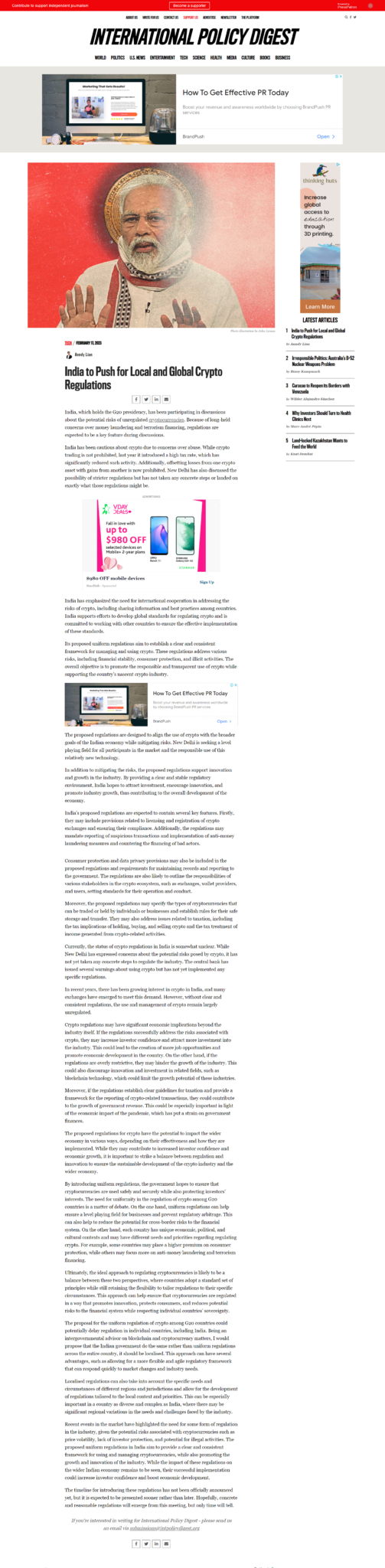
India, which holds the G20 presidency, has been participating in discussions about the potential risks of unregulated cryptocurrencies. Because of long-held concerns over money laundering and terrorism financing, regulations are expected to be a key feature during discussions.

India has been cautious about crypto due to concerns over abuse. While crypto trading is not prohibited, last year it introduced a high tax rate, which has significantly reduced such activity. Additionally, offsetting losses from one crypto asset with gains from another is now prohibited. New Delhi has also discussed the possibility of stricter regulations but has not taken any concrete steps or landed on exactly what those regulations might be.

India has emphasized the need for international cooperation in addressing the risks of crypto, including sharing information and best practices among countries. India supports efforts to develop global standards for regulating crypto and is committed to working with other countries to ensure the effective implementation of these standards.

Its proposed uniform regulations aim to establish a clear and consistent framework for managing and using crypto. These regulations address various risks, including financial stability, consumer protection, and illicit activities. The overall objective is to promote the responsible and transparent use of crypto while supporting the country’s nascent crypto industry.

The proposed regulations are designed to align the use of crypto with the broader goals of the Indian economy while mitigating risks. New Delhi is seeking a level playing field for all participants in the market and the responsible use of this relatively new technology.

In addition to mitigating the risks, the proposed regulations support innovation and growth in the industry. By providing a clear and stable regulatory environment, India hopes to attract investment, encourage innovation, and promote industry growth, thus contributing to the overall development of the economy.

India’s proposed regulations are expected to contain several key features. Firstly, they may include provisions related to licensing and registration of crypto exchanges and ensuring their compliance. Additionally, the regulations may mandate reporting of suspicious transactions and implementation of anti-money laundering measures and countering the financing of bad actors.

Consumer protection and data privacy provisions may also be included in the proposed regulations and requirements for maintaining records and reporting to the government. The regulations are also likely to outline the responsibilities of various stakeholders in the crypto ecosystem, such as exchanges, wallet providers, and users, setting standards for their operation and conduct.

Moreover, the proposed regulations may specify the types of cryptocurrencies that can be traded or held by individuals or businesses and establish rules for their safe storage and transfer. They may also address issues related to taxation, including the tax implications of holding, buying, and selling crypto and the tax treatment of income generated from crypto-related activities.

Currently, the status of crypto regulations in India is somewhat unclear. While New Delhi has expressed concerns about the potential risks posed by crypto, it has not yet taken any concrete steps to regulate the industry. The central bank has issued several warnings about using crypto but has not yet implemented any specific regulations.

In recent years, there has been growing interest in crypto in India, and many exchanges have emerged to meet this demand. However, without clear and consistent regulations, the use and management of crypto remain largely unregulated.

Crypto regulations may have significant economic implications beyond the industry itself. If the regulations successfully address the risks associated with crypto, they may increase investor confidence and attract more investment into the industry. This could lead to the creation of more job opportunities and promote economic development in the country. On the other hand, if the regulations are overly restrictive, they may hinder the growth of the industry. This could also discourage innovation and investment in related fields, such as blockchain technology, which could limit the growth potential of these industries.

Moreover, if the regulations establish clear guidelines for taxation and provide a framework for the reporting of crypto-related transactions, they could contribute to the growth of government revenue. This could be especially important in light of the economic impact of the pandemic, which has put a strain on government finances.

The proposed regulations for crypto have the potential to impact the wider economy in various ways, depending on their effectiveness and how they are implemented. While they may contribute to increased investor confidence and economic growth, it is important to strike a balance between regulation and innovation to ensure the sustainable development of the crypto industry and the wider economy.

By introducing uniform regulations, the government hopes to ensure that cryptocurrencies are used safely and securely while also protecting investors’ interests. The need for uniformity in the regulation of crypto among G20 countries is a matter of debate. On the one hand, uniform regulations can help ensure a level playing field for businesses and prevent regulatory arbitrage. This can also help to reduce the potential for cross-border risks to the financial system. On the other hand, each country has unique economic, political, and cultural contexts and may have different needs and priorities regarding regulating crypto. For example, some countries may place a higher premium on consumer protection, while others may focus more on anti-money laundering and terrorism financing.

Ultimately, the ideal approach to regulating cryptocurrencies is likely to be a balance between these two perspectives, where countries adopt a standard set of principles while still retaining the flexibility to tailor regulations to their specific circumstances. This approach can help ensure that cryptocurrencies are regulated in a way that promotes innovation, protects consumers, and reduces potential risks to the financial system while respecting individual countries’ sovereignty.

The proposal for the uniform regulation of crypto among G20 countries could potentially delay regulation in individual countries, including India. Being an intergovernmental advisor on blockchain and cryptocurrency matters, I would propose that the Indian government do the same rather than uniform regulations across the entire country, it should be localised. This approach can have several advantages, such as allowing for a more flexible and agile regulatory framework that can respond quickly to market changes and industry needs.

Localised regulations can also take into account the specific needs and circumstances of different regions and jurisdictions and allow for the development of regulations tailored to the local context and priorities. This can be especially important in a country as diverse and complex as India, where there may be significant regional variations in the needs and challenges faced by the industry.

Recent events in the market have highlighted the need for some form of regulation in the industry, given the potential risks associated with cryptocurrencies such as price volatility, lack of investor protection, and potential for illegal activities. The proposed uniform regulations in India aim to provide a clear and consistent framework for using and managing cryptocurrencies, while also promoting the growth and innovation of the industry. While the impact of these regulations on the wider Indian economy remains to be seen, their successful implementation could increase investor confidence and boost economic development.

The timeline for introducing these regulations has not been officially announced yet, but it is expected to be presented sooner rather than later. Hopefully, concrete and reasonable regulations will emerge from this meeting, but only time will tell.


Source: https://intpolicydigest.org/india-to-push-for-local-and-global-crypto-regulations/

Anndy Lian is an early blockchain adopter and experienced serial entrepreneur who is known for his work in the government sector. He is a best selling book author- “NFT: From Zero to Hero” and “Blockchain Revolution 2030”.

Currently, he is appointed as the Chief Digital Advisor at Mongolia Productivity Organization, championing national digitization. Prior to his current appointments, he was the Chairman of BigONE Exchange, a global top 30 ranked crypto spot exchange and was also the Advisory Board Member for Hyundai DAC, the blockchain arm of South Korea’s largest car manufacturer Hyundai Motor Group. Lian played a pivotal role as the Blockchain Advisor for Asian Productivity Organisation (APO), an intergovernmental organization committed to improving productivity in the Asia-Pacific region.

An avid supporter of incubating start-ups, Anndy has also been a private investor for the past eight years. With a growth investment mindset, Anndy strategically demonstrates this in the companies he chooses to be involved with. He believes that what he is doing through blockchain technology currently will revolutionise and redefine traditional businesses. He also believes that the blockchain industry has to be “redecentralised”.
j j j