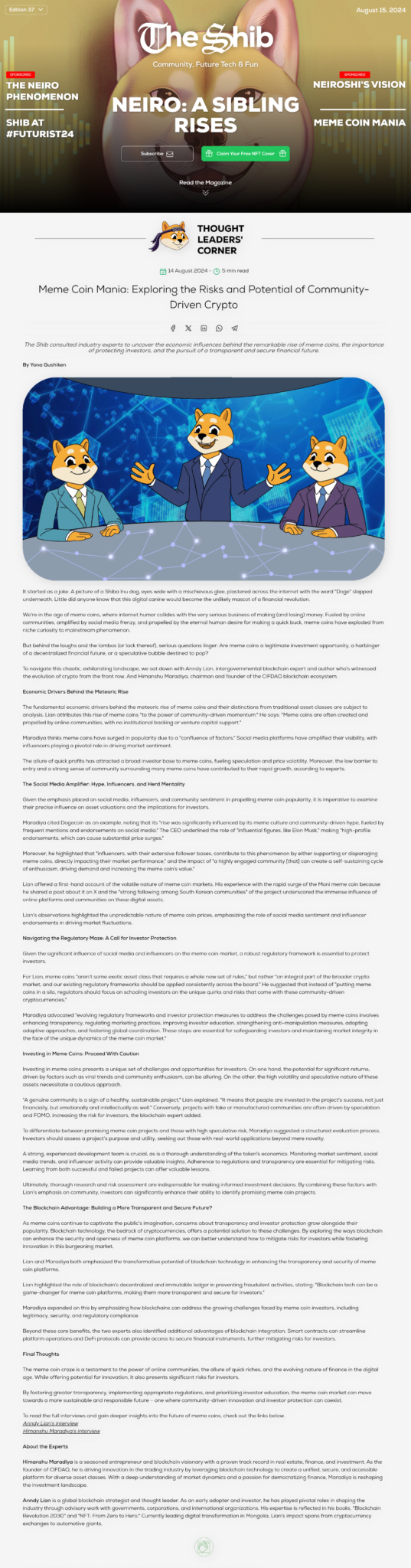
Meme Coin Mania: Exploring the Risks and Potential of Community-Driven Crypto

Meme Coin Mania: Exploring the Risks and Potential of Community-Driven Crypto

It started as a joke. A picture of a Shiba Inu dog, eyes wide with a mischievous glee, plastered across the internet with the word “Doge” slapped underneath. Little did anyone know that this digital canine would become the unlikely mascot of a financial revolution.

We’re in the age of meme coins, where internet humor collides with the very serious business of making (and losing) money. Fueled by online communities, amplified by social media frenzy, and propelled by the eternal human desire for making a quick buck, meme coins have exploded from niche curiosity to mainstream phenomenon.

But behind the laughs and the lambos (or lack thereof), serious questions linger: Are meme coins a legitimate investment opportunity, a harbinger of a decentralized financial future, or a speculative bubble destined to pop?

To navigate this chaotic, exhilarating landscape, we sat down with Anndy Lian, intergovernmental blockchain expert and author who’s witnessed the evolution of crypto from the front row. And Himanshu Maradiya, chairman and founder of the CIFDAQ blockchain ecosystem.

Economic Drivers Behind the Meteoric Rise

The fundamental economic drivers behind the meteoric rise of meme coins and their distinctions from traditional asset classes are subject to analysis. Lian attributes this rise of meme coins “to the power of community-driven momentum.” He says: “Meme coins are often created and propelled by online communities, with no institutional backing or venture capital support.”

Maradiya thinks meme coins have surged in popularity due to a “confluence of factors.” Social media platforms have amplified their visibility, with influencers playing a pivotal role in driving market sentiment.

The allure of quick profits has attracted a broad investor base to meme coins, fueling speculation and price volatility. Moreover, the low barrier to entry and a strong sense of community surrounding many meme coins have contributed to their rapid growth, according to experts.

The Social Media Amplifier: Hype, Influencers, and Herd Mentality

Given the emphasis placed on social media, influencers, and community sentiment in propelling meme coin popularity, it is imperative to examine their precise influence on asset valuations and the implications for investors.

Maradiya cited Dogecoin as an example, noting that its “rise was significantly influenced by its meme culture and community-driven hype, fueled by frequent mentions and endorsements on social media.” The CEO underlined the role of “influential figures, like Elon Musk,” making “high-profile endorsements, which can cause substantial price surges.”

Moreover, he highlighted that “influencers, with their extensive follower bases, contribute to this phenomenon by either supporting or disparaging meme coins, directly impacting their market performance,” and the impact of “a highly engaged community [that] can create a self-sustaining cycle of enthusiasm, driving demand and increasing the meme coin’s value.”

Lian offered a first-hand account of the volatile nature of meme coin markets. His experience with the rapid surge of the Moni meme coin because he shared a post about it on X and the “strong following among South Korean communities” of the project underscored the immense influence of online platforms and communities on these digital assets.

Lian’s observations highlighted the unpredictable nature of meme coin prices, emphasizing the role of social media sentiment and influencer endorsements in driving market fluctuations.

Navigating the Regulatory Maze: A Call for Investor Protection

Given the significant influence of social media and influencers on the meme coin market, a robust regulatory framework is essential to protect investors.

For Lian, meme coins “aren’t some exotic asset class that requires a whole new set of rules,” but rather “an integral part of the broader crypto market, and our existing regulatory frameworks should be applied consistently across the board.” He suggested that instead of “putting meme coins in a silo, regulators should focus on schooling investors on the unique quirks and risks that come with these community-driven cryptocurrencies.”

Maradiya advocated “evolving regulatory frameworks and investor protection measures to address the challenges posed by meme coins involves enhancing transparency, regulating marketing practices, improving investor education, strengthening anti-manipulation measures, adopting adaptive approaches, and fostering global coordination. These steps are essential for safeguarding investors and maintaining market integrity in the face of the unique dynamics of the meme coin market.”

Investing in Meme Coins: Proceed With Caution

Investing in meme coins presents a unique set of challenges and opportunities for investors. On one hand, the potential for significant returns, driven by factors such as viral trends and community enthusiasm, can be alluring. On the other, the high volatility and speculative nature of these assets necessitate a cautious approach.

“A genuine community is a sign of a healthy, sustainable project,” Lian explained. “It means that people are invested in the project’s success, not just financially, but emotionally and intellectually as well.” Conversely, projects with fake or manufactured communities are often driven by speculation and FOMO, increasing the risk for investors, the blockchain expert added.

To differentiate between promising meme coin projects and those with high speculative risk, Maradiya suggested a structured evaluation process. Investors should assess a project’s purpose and utility, seeking out those with real-world applications beyond mere novelty.

A strong, experienced development team is crucial, as is a thorough understanding of the token’s economics. Monitoring market sentiment, social media trends, and influencer activity can provide valuable insights. Adherence to regulations and transparency are essential for mitigating risks. Learning from both successful and failed projects can offer valuable lessons.

Ultimately, thorough research and risk assessment are indispensable for making informed investment decisions. By combining these factors with Lian’s emphasis on community, investors can significantly enhance their ability to identify promising meme coin projects.

The Blockchain Advantage: Building a More Transparent and Secure Future?

As meme coins continue to captivate the public’s imagination, concerns about transparency and investor protection grow alongside their popularity. Blockchain technology, the bedrock of cryptocurrencies, offers a potential solution to these challenges. By exploring the ways blockchain can enhance the security and openness of meme coin platforms, we can better understand how to mitigate risks for investors while fostering innovation in this burgeoning market.

Lian and Maradiya both emphasized the transformative potential of blockchain technology in enhancing the transparency and security of meme coin platforms.

Lian highlighted the role of blockchain’s decentralized and immutable ledger in preventing fraudulent activities, stating: “Blockchain tech can be a game-changer for meme coin platforms, making them more transparent and secure for investors.”

Maradiya expanded on this by emphasizing how blockchains can address the growing challenges faced by meme coin investors, including legitimacy, security, and regulatory compliance.

Beyond these core benefits, the two experts also identified additional advantages of blockchain integration. Smart contracts can streamline platform operations and DeFi protocols can provide access to secure financial instruments, further mitigating risks for investors.

Final Thoughts

The meme coin craze is a testament to the power of online communities, the allure of quick riches, and the evolving nature of finance in the digital age. While offering potential for innovation, it also presents significant risks for investors.

By fostering greater transparency, implementing appropriate regulations, and prioritizing investor education, the meme coin market can move towards a more sustainable and responsible future – one where community-driven innovation and investor protection can coexist.

To read the full interviews and gain deeper insights into the future of meme coins, check out the links below.
Anndy Lian’s interview
Himanshu Maradiya’s interview

About the Experts

Himanshu Maradiya is a seasoned entrepreneur and blockchain visionary with a proven track record in real estate, finance, and investment. As the founder of CIFDAQ, he is driving innovation in the trading industry by leveraging blockchain technology to create a unified, secure, and accessible platform for diverse asset classes. With a deep understanding of market dynamics and a passion for democratizing finance, Maradiya is reshaping the investment landscape.

Anndy Lian is a global blockchain strategist and thought leader. As an early adopter and investor, he has played pivotal roles in shaping the industry through advisory work with governments, corporations, and international organizations. His expertise is reflected in his books, “Blockchain Revolution 2030” and “NFT: From Zero to Hero.” Currently leading digital transformation in Mongolia, Lian’s impact spans from cryptocurrency exchanges to automotive giants.


Source: https://magazine.shib.io/article/66bcd2bde30f660001f07c59

Anndy Lian is an early blockchain adopter and experienced serial entrepreneur who is known for his work in the government sector. He is a best selling book author- “NFT: From Zero to Hero” and “Blockchain Revolution 2030”.

Currently, he is appointed as the Chief Digital Advisor at Mongolia Productivity Organization, championing national digitization. Prior to his current appointments, he was the Chairman of BigONE Exchange, a global top 30 ranked crypto spot exchange and was also the Advisory Board Member for Hyundai DAC, the blockchain arm of South Korea’s largest car manufacturer Hyundai Motor Group. Lian played a pivotal role as the Blockchain Advisor for Asian Productivity Organisation (APO), an intergovernmental organization committed to improving productivity in the Asia-Pacific region.

An avid supporter of incubating start-ups, Anndy has also been a private investor for the past eight years. With a growth investment mindset, Anndy strategically demonstrates this in the companies he chooses to be involved with. He believes that what he is doing through blockchain technology currently will revolutionise and redefine traditional businesses. He also believes that the blockchain industry has to be “redecentralised”.

j j j

Will UNI’s 70% Rally Last? Risks of Uniswap’s Fee Proposal

Will UNI’s 70% Rally Last? Risks of Uniswap’s Fee Proposal

Leading decentralized exchange (DEX) Uniswap’s UNI token received a massive boost in late February 2024 following a proposal to share platform fees with token holders who delegate and stake their tokens.

Following the announcement, UNI jumped over 70% to a near two-year high of $12.79 on February 24 on expectations of higher demand and lower UNI circulating supply from increased staking on the platform.

Will the latest news affect the long-term Uniswap (UNI) price prediction?

In this article, we analyze Uniswap’s fee-sharing proposal and highlight risks that could cut short the token’s rally.

Uniswap’s Fee Switch Upgrade to Reward UNI Holders

On February 23, 2024, the Uniswap Foundation proposed a network upgrade to implement a fee mechanism that rewards UNI token holders that have delegated and staked their tokens.

The Uniswap Foundation said that the proposed fee mechanism upgrade seeks to invigorate Uniswap’s governance system by incentivizing token delegation and staking.

“Less than 10% of circulating UNI is used to vote on a given proposal. Further, a large portion of existing delegation is ‘stale.’ As of February 1, 2024, 14 of the top 30 delegates by voting power had not voted over the last 10 proposals, and only 7 of these delegates have ever created a proposal,” said Uniswap Foundation.

How Will Uniswap’s Fee Switch Upgrade Work?

At the time of writing, Uniswap collects 0.3% fees on v2 and 0.05% to 1% fees on v3 for swapping tokens, which are paid to liquidity providers (LP).

If the new fee mechanism is approved, UNI stakers and delegators will receive a part of the LP fees.

The fee mechanism proposal is also known as the “fee switch” upgrade because the collection of protocol fees is actually built into the Uniswap protocol. However, the protocol fee collection was never turned on and was initially set to zero.

Here are key details of the proposed Uniswap fee switch upgrade:

  • The protocol fees that will be distributed will be expressed as a fraction of LP fees.
  • The protocol fees will be adjustable by governance and can be 0, 1/4, 1/5, 1/6, 1/7, 1/8, 1/9, or 1/10 of the LP fees.
  • Protocol fees can be set on a pool-by-pool basis.
  • Fees are accrued in both tokens that comprise the pool.

Two new smart contracts will be introduced with the new fee mechanism proposal:

1. V3FactoryOwner.sol

This contract will bring a programmatic, permissionless collection of protocol fees. It will also allow the conversion of those fees into a common ERC20 for distribution to stakers.

2. UniStaker.sol

This contract will manage delegation and fee distribution.

Risks to UNI Token Price From New Fee Mechanism Proposal

News of Uniswap’s proposed fee mechanism that rewards UNI stakers and delegators was cheered by the crypto market participants who pushed the UNI token price to its highest since April 2022.

In this section, we highlight events that could cut short Unswap’s explosive rally.

Protocol Fee-Sharing Approval Awaits

UNI token holders have to bear in mind that the proposed fee-sharing mechanism has not been approved as of February 27, 2024.

The Uniswap community will begin voting on the proposal on March 1, 2024. All Uniswap proposals are subject to a 7-day voting period during which UNI token holders can vote for, against, or abstain from voting.

Although it is widely expected that the proposal will get approved (as it benefits UNI holders who are voting), there are certain members of the Uniswap community for whom the new fee mechanism is unfavorable — Uniswap liquidity providers.

Anndy Lian, an intergovernmental blockchain expert, told Techopedia:

“If the proposal is approved, it would activate the protocol fee switch and distribute a portion of the fees collected by Uniswap to the token holders. This would increase the demand and value of UNI and incentivize more participation and delegation in the governance process.

“However, if the proposal is rejected, it could lead to a sell-off and a drop in the UNI price.”

Uniswap Trading Volume, TVL, and Liquidity Expected to Fall on Protocol Fee Sharing

According to a report by crypto analytics firm Gauntlet, the distribution of protocol fees to UNI stakers and delegators can reduce the profitability of LPs on Uniswap.

The reduced LP yield is expected to cause some of them to withdraw liquidity from Uniswap. The less liquidity in Uniswap’s trading pools might result in higher slippages for traders. The higher slippages might cause poor user experience and force traders to choose rival DEXs, which might ultimately result in decreased trade volume on Uniswap.

It should also be noted that lower trade volume might result in lower protocol fees distributed as the platform collects fees when token swaps occur.

Gauntlet warned that setting extremely high protocol fees would result in the DEX being “unable to retain any LPs.”

The research firm also added that core trading volumes from retail and institutional traders will be less affected than MEV volume, which accounts for 40% to 80% of volume on Uniswap and other DEXs, as MEV trades are more sensitive to market liquidity.

Gauntlet noted:

“At the extreme, a 100% protocol fee should result in a 100% loss of all volume, since such a DEX would be unable to retain any LPs. However, even for an extremely aggressive 80% protocol fee, the simulated DEX still retains substantial core volume. This once again highlights that liquidity is rarely a limiting factor for most of Uniswap’s core users.

“We note that for a viable 10-25% protocol fee, the revenue curves are fairly linear and far from the theoretical maximum. We conclude that a protocol fee in this range would be effective at generating revenue and is unlikely to suffer from diminishing returns due to core volume loss.”

Uniswap (UNI) Price Analysis: Is the Rally Short-Lived?

The rally in UNI token price has cooled since the crypto jumped as much as over 70% on February 23, 2024, following the fee switch upgrade proposal announcement. Token holders took the chance to book profit after UNI hit near two-year highs of $12.79.

Blockchain analytics firm Lookonchain reported that a “Uniswap Team/Investor/Advisor wallet” sold 90,000 UNI tokens from $1.03 million in USDC.


Tony Severino, a CMT candidate, technical analyst, and the author of the CoinChartist VIP newsletter, was bullish on the UNI token as he shared his technical analysis on the crypto:

“UNI’s over 50% single-week surge might only be the beginning of a sustained trend change. The clean breakout above the weekly and monthly upper Bollinger Band is a technical buy signal following a nearly two-year accumulation range.”

Elsewhere, CoinCodex data showed UNI token trading at an overbought zone as its 14-day relative strength index stood at 75 points on February 27, 2024. The token traded at $10.05 at the time of writing, above its 200-day simple moving average of $5.68.

The Bottom Line

Uniswap’s fee switch proposal is expected to have lasting consequences if approved.

Although the crypto market is currently focused on the direct benefits that UNI holders hope to enjoy, the resulting effects on Uniswap governance from an approved fee switch upgrade cannot be understated.

The upgrade is expected to incentivize “active, engaged, and thoughtful delegation,” which will ultimately make Uniswap more decentralized, resilient, and community-driven.


Source: https://www.techopedia.com/uniswap-uni-price-analysis

Anndy Lian is an early blockchain adopter and experienced serial entrepreneur who is known for his work in the government sector. He is a best selling book author- “NFT: From Zero to Hero” and “Blockchain Revolution 2030”.

Currently, he is appointed as the Chief Digital Advisor at Mongolia Productivity Organization, championing national digitization. Prior to his current appointments, he was the Chairman of BigONE Exchange, a global top 30 ranked crypto spot exchange and was also the Advisory Board Member for Hyundai DAC, the blockchain arm of South Korea’s largest car manufacturer Hyundai Motor Group. Lian played a pivotal role as the Blockchain Advisor for Asian Productivity Organisation (APO), an intergovernmental organization committed to improving productivity in the Asia-Pacific region.

An avid supporter of incubating start-ups, Anndy has also been a private investor for the past eight years. With a growth investment mindset, Anndy strategically demonstrates this in the companies he chooses to be involved with. He believes that what he is doing through blockchain technology currently will revolutionise and redefine traditional businesses. He also believes that the blockchain industry has to be “redecentralised”.

j j j

I use strategies such as diversification to manage risks: Blockchain expert Anndy Lian

I use strategies such as diversification to manage risks: Blockchain expert Anndy Lian

Amidst the challenges of a tough funding climate, e27 is launching an exciting new article series called Angel’s Advocate to provide fresh perspectives on angel funding. In this exclusive series, we sit down with prominent angels to hear their stories and strategies and gain unique insights about the early-stage financing space.

Anndy Lian is an all-rounded business strategist in Asia. He has provided advisory across various industries for local, international, and publicly listed companies and governments. He is an early blockchain adopter, serial entrepreneur, author, investor, board member, and keynote speaker.

In this edition, Lian shares his take on angel funding.

Edited excerpts:

How do you typically approach investing during a funding winter?

I would put my eggs into different baskets. In one of my baskets, I will focus on companies with solid fundamentals and a proven track record of generating revenue and profits. This kind of investment tends to be on the safe side, longer term, and returns may not be fantastic.

Then in my next basket, I will find low-valuation, high-potential startups with the right fundamentals to invest in. Crypto companies fit into this category nicely.

What are your typical investment criteria, such as industry, stage, and geographic location?

Investment criteria do not cover everything. It gives me guidelines that my team and I can use to filter out bad companies. In the current state of the market, I only look at tech companies, mainly in the cryptocurrency and blockchain industries. If they are more infrastructure-like, I do not mind investing in them at later stages. If the project is one of a kind, I would like to invest as early as possible, maybe pre-seed. If the project is more hype-driven, I will invest when the volume picks up.

Can you describe your investment process from initial contact to closing a deal?

First of all, the initial contact. We may learn about a potential investment opportunity through their personal network, a pitch event, or by contacting the company seeking funding directly. Then followed by screening. This process is a deeper level of evaluation where we will have longer calls to look for investment alignment.

We will go through the due diligence process if they pass this stage. We will conduct more in-depth research and analysis to evaluate the company’s business model, management team, financial performance, and growth potential. This process is the most important to me. The chance to interact with the team would be one of the key things.

The next stage would be negotiation. If we decide to move forward with the investment, we will negotiate the terms of the deal with the company, including the amount of funding and the valuation.

Once all parties have agreed upon the terms of the deal, legal documents will be prepared and signed to finalise the investment.

How do you evaluate a startup’s potential for growth and success?

Evaluating a startup’s potential for growth and success can be challenging, as many factors can impact a company’s future performance. I look at the market opportunity, business model, management team, financial performance and competition.

How important is the founder’s experience and background when making investment decisions?

Well, it is definitely important. The founder is the brain and creator of the company. If the main driver does not have the experience and background, the outcome would generally be disastrous.

Can you share your successful investment and what made that investment successful?

So far, crypto investments are the most successful in my portfolio. At crazy times, meme-coins can also be a potential 100X gem.

What are some common mistakes that startups make when pitching to angel investors? What are some myths about angel investment?

Some common mistakes that startups make when pitching to angel investors include not understanding the needs and goals of angel investors, failing to clearly articulate the value proposition, relying too heavily on financial projections, not doing enough research on potential investors, and not having a multi-faceted marketing strategy.

Another mistake is sending your executive summary or business plan unsolicited. Many investors do not read unsolicited emails and prefer a referral from someone in their network. It’s also important to do your homework on the investor and ensure your company is aligned with the investors’ objectives.

How important is the alignment of values between the investor and the founder?

The alignment of values between the investor and the startup founder is crucial. Ideally, your investors should be experts in your field or sector so that they not only understand the costs, time-to-market, and potential pitfalls of your vision but can also connect you with the right people and resources to help you achieve it. It’s important for the investor to spend some time understanding the skills and capabilities of startups.

How do you manage risks when investing in startups? Are there any specific metrics or indicators you look for?

Investing in startups is risky, but it can be very rewarding if the investments pay off. Most new companies or products do not make it, so the risk of losing one’s entire investment is a real possibility.

To manage risk, I can use strategies such as diversification, which refers to spreading my investments over a variety of assets with the aim that a portfolio of lowly-correlated assets does not all move in the same direction at the same time or even if they do move in the same direction, it should at least be by different degrees.

Can you share any advice for startups looking to raise funds from angel investors?

My humble advice to startup owners is to develop a business plan before approaching someone about funding. Put in writing what the investor is offering the business outside of funding because many angel investors expect to contribute their time actively to startups in which they invest. Establish roles.

It’s also important to create a strong, thorough, and engaging investor pitch deck and guidance on presenting to angel and venture capital investors.


Source: https://e27.co/i-use-strategies-such-as-diversification-to-manage-risks-blockchain-expert-invest-anndy-lian-20230524/

Anndy Lian is an early blockchain adopter and experienced serial entrepreneur who is known for his work in the government sector. He is a best selling book author- “NFT: From Zero to Hero” and “Blockchain Revolution 2030”.

Currently, he is appointed as the Chief Digital Advisor at Mongolia Productivity Organization, championing national digitization. Prior to his current appointments, he was the Chairman of BigONE Exchange, a global top 30 ranked crypto spot exchange and was also the Advisory Board Member for Hyundai DAC, the blockchain arm of South Korea’s largest car manufacturer Hyundai Motor Group. Lian played a pivotal role as the Blockchain Advisor for Asian Productivity Organisation (APO), an intergovernmental organization committed to improving productivity in the Asia-Pacific region.

An avid supporter of incubating start-ups, Anndy has also been a private investor for the past eight years. With a growth investment mindset, Anndy strategically demonstrates this in the companies he chooses to be involved with. He believes that what he is doing through blockchain technology currently will revolutionise and redefine traditional businesses. He also believes that the blockchain industry has to be “redecentralised”.

j j j