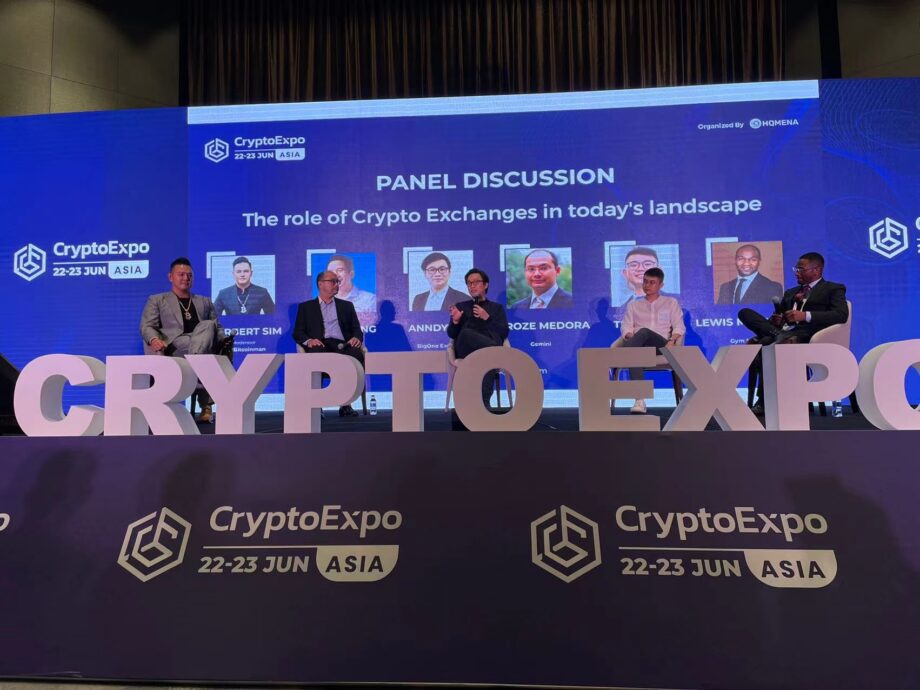
Crypto Expo Asia 2022 Singapore: The Role of Crypto Exchanges in Today’s Landscape

Crypto Expo Asia 2022 Singapore: The Role of Crypto Exchanges in Today’s Landscape

Crypto Expo Asia is the largest event in Asia for Investors and Crypto industry leaders to network and explore more business opportunities in the crypto space. They provide the market’s leading content & updates on the Crypto and Blockchain industry that will help you explore the investment opportunities available as smartly and securely.

A crypto exchange is a platform on which you can buy and sell cryptocurrency. You can use exchanges to trade one crypto for another — converting Bitcoin to Binance Coin, for example — or to buy crypto using regular currency, like the U.S. Dollar. Cryptocurrencies make it easier for people in different countries to pay each other, negating financial borders currently controlled by banks and governments. The panel comprises experts and practitioners from centralized exchanges. They will share insights on the role of Crypto Exchanges in today’s landscape.

The session is moderated by Herbert Sim, Bitcoin Man and with panelists Feroze Medora, Gemini; Anndy Lian, BigONE; Travis Teo, Tokenize and Lewis Mahlanga, Gym Network.

The following questions were addressed:

#1 The explosion of thus many crypto exchanges is the white-labelling phenomena, which allows for almost instant creation of an exchange. With all this proliferation, the nature of platforms continues to diversify. What is the current role of exchanges today, besides crypto trading?

Lewis Mahlanga: “We need to educate the market about cryptocurrencies.”

#2 Centralized Exchanges versus Decentralized Exchanges. What are your thoughts? Pros and cons?

Travis Teo: “As a new user, you might not know how the wallets work. You are also may not know where to obtain ETH or SOL. CEX will act as a bridge for these new users to guide them through the process.”

#3 To list out some more roles that a crypto exchange could play – Payment services (Remittance, Escrow Service, Micropayments, Merchant Services – Gateway processor, Mobile PoS card reader, Debit card; and more); Mobile wallet, ATM. What are the differentiating factors which sets apart each of the exchanges?

Herbert Sim: “Security of the exchange, how credible it is.”

#4 A big challenge for centralized crypto exchanges over the years is custodial. Users are required to perform mandatory tasks to sign up and verify their identity. Fees can be expensive because platform takes a percentage of initial investment, and off every trade. While there is high level of trust in the CEX from the users, the CEX actually holds the private keys to the tokens and the funds, which makes it subject to hacking. And we have all seen massive multi-million, even close to billion dollar hacks taken place, even in the present day. What are your thoughts about CEX’s custodial today?

#5 Possibly the toughest, most controversial question for crypto exchanges. What are your thoughts on wash-trading? And rankings on CoinMarketCap?

Feroze Medora: “Even though we are in a very new industry, I like the expression ‘Nothing is new under the sun’. Wash trading falls under the border category of market manipulation. Which are features of regular financial market for very time.”

#6 The question that is probably the biggest challenge for crypto exchanges. What are your thoughts on regulations by regulators across the world – from US SEC, to China’s PBoC, and here in Singapore Monetary Authority of Singapore (MAS)?

#7 Let’s talk about crypto trading specifically. Mobile Financial Trading, Derivatives Trading, Future Trading, Financial Trading. What’s next? What do you think is the future of trading?

Anndy Lian: “I think derivatives trading would be the strongest and will be one of the key crypto highlights. NFT trading and NFT marketplace would be the next to look at too. The current NFT market has not reached its fullest potential in terms of trading, because it has not hit a critical volume. We should look at this market seriously, build products on top of NFT, facilitate it with real utility and link back to spot/ derivatives trading to optimize its full potential.”

Crypto Expo Asia 2022 is held on 22 – 23 June 2022, at Raffles City Convention Centre, Singapore. The second day of the event will feature speakers from ConsenSys, UOB, OKX, Bybit, Fireblocks and many more. More information can be obtained at https://cryptoexpoasia.com/.

This article is produced by BLOCKCAST.CC.

Anndy Lian is an early blockchain adopter and experienced serial entrepreneur who is known for his work in the government sector. He is a best selling book author- “NFT: From Zero to Hero” and “Blockchain Revolution 2030”.

Currently, he is appointed as the Chief Digital Advisor at Mongolia Productivity Organization, championing national digitization. Prior to his current appointments, he was the Chairman of BigONE Exchange, a global top 30 ranked crypto spot exchange and was also the Advisory Board Member for Hyundai DAC, the blockchain arm of South Korea’s largest car manufacturer Hyundai Motor Group. Lian played a pivotal role as the Blockchain Advisor for Asian Productivity Organisation (APO), an intergovernmental organization committed to improving productivity in the Asia-Pacific region.

An avid supporter of incubating start-ups, Anndy has also been a private investor for the past eight years. With a growth investment mindset, Anndy strategically demonstrates this in the companies he chooses to be involved with. He believes that what he is doing through blockchain technology currently will revolutionise and redefine traditional businesses. He also believes that the blockchain industry has to be “redecentralised”.

j j j

Interview with Anndy Lian: Role of DAO and its Future

Interview with Anndy Lian: Role of DAO and its Future

– An Ukrainian DAO raised about 8 million dollar for the war effort? How do you see the role of DAO in international financing for economically ravaged/weaker countries?

There’s certainly potential in quickly and securely using DAOs (decentralized autonomous organizations) for financing for troubled parts of the world. The case of the Ukraine DAO shows that such a decentralized structure can be spun up quickly and cheaply and engage with a community around issues of concern to individuals around the world. You can also see from the growing use of crypto donations in the NGO and charity sector that DAOS could become a more formal means to channel funds and with less cost in terms of money transfer fees, and with less issues with government bureaucracy by directing funds straight into the pockets of those most in need. In addition, as a collectively owned and managed entity with a set of rules written in computer code, the DAO offers the potential couple with good governance, to avoid corruption that can damage already economically weakened countries.


– Russia has now been imposed multiple economic sanctions. How will DAO in particular play a role in Russian economy now that it will largely be cut off from the international financial system?

It may well be that civil society groups and civilian organizations faced with the impact of economic sanctions will use DAOs to bypass central government restrictions and appeal directly to people across the world for financial help. That will pose problems for the DAO as a model for co-operation as it raises pertinent questions about governance, how do you prove governance and how do you resist your funds being secured by state organizations. However, with the likely collapse of the Russian economy cryptocurrency gives ordinary Russians the opportunity to safeguard funds, as well as to use DAOs to pool resources to meet the needs for housing and heating to name two essential requirements for societal infrastructure to sustain the fabric of civil society in the face of the possible collapse of central government.


– Do you the ongoing Ukraine-Russia war as an inflection point in the mass adoption of DAO system? and how?

In fact, the rise of the DAO is closely tied to the emergence of cryptocurrency with the launch of Bitcoin back in 2008. It set the template, where typically the DAO founder has no workplace and no employees, but the project continues to run quietly because a group of people who believe in the project contribute to it.

More than a decade later, this DAO-based project has a market value of $1.3 trillion, making it one of the world’s top five company in terms of market value. Yes, Bitcoin is the most successful DAO right now, and its founder is the anonymous Satoshi Nakamoto. There is no boss or employees to manipulate, and all such organizations operate autonomously and anonymously. This is DAO’s core value.

More recently, the trend in using DAOs specifically to raise money for campaigns with a political theme have also emerged, in the lead up to the war in Ukraine. Notably ConstitutionDAO was founded on November 11, 2021, by a group of cryptocurrency enthusiasts. Its creators hoped to raise funds through the DAO method in order to purchase a copy of the US Constitution to realize the great dream of “putting the Constitution in the hands of the people,” and attracting over 17,000 donors. ConstitutionDAO took just nine days to raise approximately 11,000 ETH, which is worth more than $47 million.

While in December 2021 a DAO created to raise money for Ross Ulbricht, the jailed founder of Silk Road, announced that over 1,320 people raised over 2,800 ETH in to win the auction for Ross’s NFT. In short, the main reasons for FreeRossDAO’s popularity are its association with NFTs and people’s sympathy for the unfair treatment of Ross.

Taken in this context the mass adoption of DAOs to raise money to support the Ukrainian people is part of a growing trend, highlighted by the urgent need for resources to help refugees and civilian organizations. Indeed, the inspiration for the Ukraine DAO, the leading DAO which has raised over $13 million in crypto donations to date, came from a UK-based Ukrainian activist Alona Shevchenko who works with FreeRossDAO. Connecting to her network of friends led to the connection to Nadya Tolokonnikova of Pussy Riot, who launched the DAO on February 25 along with Trippy Labs and members of PleasrDAO, which was behind FreeRossDAO.

Therefore, the launch of the Ukraine DAO is in many ways simply a recognition of the already growing use of DAOs to raise funds for specific causes; the Russian invasion was the catalyst but whether it is a ‘tipping point’ remains to be seen. Some of the previous issues such as concerns about crypto scammers using the situation to fraudulently raise funds have emerged concerning published crypto addresses when queried by Ethereum’s founder Vitalik Butelin. Which is why the use of the DAO mechanism, which provides greater transparency has proved so popular as well as the means to organize collectively around it. As stated on the Ukraine DAO website, similar to a direct P2P crypto donation method using a DAO coupled with crypto as the funding mechanism means that: “Decentralized Autonomous Organizations are a model for the world to witness how people with a common purpose can join and work together quickly to distribute funds to present humanitarian causes.”

The speed and global reach of the Ukraine DAO, bypassing the problems caused by using conventional funding means whether through central funding institutions such as the banks or examples such as the Patreon startup, which returned money raised for the Ukrainian army, certainly shows their power for future fundraising in Ukraine. Whether this will mean that DAOs will work as a broader model for organizational structure is another question. DAOS have also caught the imagination of the startup community in the US for example, with VC money following suit. That entrepreneurial interest includes celebrity crypto owner Mark Cuban, who added a note of caution in highlighting the importance of good governance to provide long-term benefit to DAO members. “The future of corporations could be very different as DAOs take on legacy businesses,” he is quoted as saying. “Entrepreneurs that enable DAOs can make money. If the community excels at governance, everyone shares in the upside.”


– DAO, largely speaking, is legally still undefined. In the sense, there is a lot of gray area when it comes to DAO. Do you see DAO as a tool to channel the wealth of people who have been sanctioned?

It’s correct to say that DAOs can be used by any group of people with a collective purpose in mind, harnessing the power of cryptocurrency and guided by a set of principles embedded into the smart contracts that regulate the DAO’s operations. However, as recently outlined by the industry organisation CryptoUK, the converse is that by the nature of crypto its very possible to track any illegal funds coming out of Russia. For example, that are a lot of coin swap pools that are trackable, which can be monitored. So, when it comes to trying to evade sanctions it shows that the crypto industry has the capability to react and mobilize in real time to freeze or block funds and also to trace transactions to a single wallet where required. “Crypto transactions are not anonymous and untraceable. Through Public / Private sector collaboration we can quickly inform the criminal world (or those looking to circumvent sanctions) that this technology is exactly the opposite of what they are looking for in terms of anonymity and lack of traceability,” confirmed CryptoUK.


– How can DAO become more legally secured across the world, in order to make sure it is not misused by non-state actors?

While DAOs offer an alternative to organizing a corporation with decision making baked into the code, funding via the Dao’s token, and decisions decided by the whole community, in practice they currently lack the legal status of a corporate entity and a consistent regulatory framework. The token itself depending on the country’s regulations may be deemed as a security and come under tight legal regulations of its own, potentially opening up members of a DAO to liability. At least in the US as unincorporated entities, DAOs do not need to follow the legal formalities of incorporation such as registration, bylaws, and contracts. As a result, DAOs are treated as unincorporated partnerships. In a partnership, each individual has unlimited liability. Therefore, if the DAO is hacked or declares bankruptcy, each member is exposed to liability for the entire amount of funds. This key aspect of the legal status of DAOs for fund raising would need to be resolved to ensure they are not misused by non-state actors. It maybe that a lead would need to be taken at an international level, such as through the United Nations, as well as by individual nation states if the DAO is to prove sustainable from a regulatory standpoint, therefore.


Original Source: https://newslookout.com/feature/interview-with-anndy-lian-role-of-dao-and-its-future/

Anndy Lian is an early blockchain adopter and experienced serial entrepreneur who is known for his work in the government sector. He is a best selling book author- “NFT: From Zero to Hero” and “Blockchain Revolution 2030”.

Currently, he is appointed as the Chief Digital Advisor at Mongolia Productivity Organization, championing national digitization. Prior to his current appointments, he was the Chairman of BigONE Exchange, a global top 30 ranked crypto spot exchange and was also the Advisory Board Member for Hyundai DAC, the blockchain arm of South Korea’s largest car manufacturer Hyundai Motor Group. Lian played a pivotal role as the Blockchain Advisor for Asian Productivity Organisation (APO), an intergovernmental organization committed to improving productivity in the Asia-Pacific region.

An avid supporter of incubating start-ups, Anndy has also been a private investor for the past eight years. With a growth investment mindset, Anndy strategically demonstrates this in the companies he chooses to be involved with. He believes that what he is doing through blockchain technology currently will revolutionise and redefine traditional businesses. He also believes that the blockchain industry has to be “redecentralised”.

j j j

Analyzing the Role of Celebrities in NFTs Adoption and Popularization

Analyzing the Role of Celebrities in NFTs Adoption and Popularization

Amidst all events that happened this year in the cryptocurrency industry, without a doubt, the list would not be complete without making mention of Non-Fungible Tokens (NFTs). Asides from the Bull Run, Decentralized Finance (DeFi) frenzy on the Binance Smart Chain among others which was witnessed, NFTs rave was and is still very relevant.

However, celebrities had a role to play in the popularization and adoption of the technology. Just the way institutional investors that came into the Bitcoin and cryptocurrency markets played a huge role in wide adoption and likewise increase in the price of Bitcoin. Institutional investors popularized Bitcoin such that banks and individuals that once spoke against the technology have now embraced it with open arms. Celebrities have played a similar role in the adoption of NFTs by the creation and auction sales of NFTs.

What are NFTs?

NFT is an acronym for Non-Fungible Tokens which means the token is interchangeable with an equivalent. In other words, an NFT is a unique unit of data stored in a digital format with Blockchain technology and can therefore not be replicated or replaced. The irreplaceable nature of NFTs is what distinguishes them from the normal cryptos. NFTs are exclusive to an individual, unlike Bitcoin and Ethereum that can be held by a lot of people. They’re fungible tokens because 1 BTC is equivalent to 1 BTC and can be exchanged for each other.

An NFT may represent real-world objects like art, music, in-game items, and videos. They are bought and sold online, frequently with cryptocurrency, and they are generally encoded with the same underlying software as many cryptos.

Use-case of NFTs

The basic and most important use of non-fungible tokens is the storage of unique data on the blockchain. The process of storing a real asset on the Blockchain is called tokenization. Different categories of real assets can be tokenized; songs, albums, publication records, artworks, photos, and lots more.

These NFTs are tokenized with the aim of either keeping the digital format on the Blockchain or ultimately putting them up for sale. 2021 has seen the sale of different NFTs at whopping prices on NFT marketplaces such as OpenSea, Rarible, Influxo among others.

So why would anyone want to buy these NFTs?

Anyone can view the individual images—or even the entire collage of images online for free. So why are people willing to spend millions on something they could easily screenshot or download?

Because an NFT allows the buyer to own the original item. Not only that, it contains built-in authentication, which serves as proof of ownership. Much like the priceless nature of a Matisse or a Van Gogh, the original creation is worth more than the postcard you bought from the museum, and the same follows for NFTs and their copyrights.

Collectors value those “digital bragging rights” almost more than the item itself.

What Role Have Celebrities Played in NFTs?

NFTs have become a force to reckon with in the year 2021. The market capitalization of NFTs has exploded and witnessed parabolic growth in 2021 and celebrities have played a very important role in making that a reality. Several celebrities have tokenized their musical albums, artworks among others and auctioned them for sale, and have made good returns on these NFTs. This has in turn popularized NFTs and brought them mainstream.

Nevertheless, celebrities have also prompted other reputable companies to adopt the idea of NFTs and have set plans in motion to launch theirs. Fashion companies, media houses, and beverage drink companies among others have shown intention of creating NFTs this year. Apart from the fact that celebrities are making money from the NFTs rave, the adoption of unique digital storage is being popularized and widely adopted.

Ultimately, the popularization of NFTs by celebrities is in a way fostering the growth of blockchain technology and the cryptocurrency industry at large. An instance whereby a celebrity makes a sale on an NFT created, the news will spread far and wide and inquisitive people begin to ask questions. This could go a long way in bringing those individuals into the crypto industry.

There is a massive value and monetary potential in owning these ‘one of a kind’ NFTs, as with all art, inflation and rarity will drive its intrinsic value. Experts say that this phenomenon is ‘history in the making’ for the industry that only has one value at the point of sale when it comes to paying royalty to these masterpieces, only made possible by NFTs.

Legendary footballer, Ronaldinho who won the FIFA Player of the year award twice is said to have launched an NFT collection recently in July 2021 on NFT platform INFLUXO, which was developed by BigONE. The collection of NFTs will feature about seven NFTs and will be auctioned to fans of the legendary footballer. Taking a look at this scenario, football is one of the most popular games with a large fan base, and with the move of Ronaldinho, his fans will be interested in the auction as well as the technology behind the NFT idea which is, in turn, encouraging the growth of the industry.

What determines if a celebrity NFT is rare and significant?

The NFT has to tell a story that depicts the significance of the moment or the poetry of its being, just like Ronaldho’s Legendary footwork on the field, “Gathering everyone on the field to stop the genius, but they still can’t do it”. Owning the feeling or the genius-ness of Ronaldho is something that only a true fan can resonate with its intrinsic value. To many, this digital marketplace INFLUXO could be a way to communicate this specific feeling that couldn’t’ exist differently.

Celebrities and NFTs; making Our World a Metaverse

At the end of the NFTs wave with celebrities,  is the evolution of our world into a metaverse where the internet will become a virtual world. We’ve witnessed albums, artworks, songs, photos, and even real estate being tokenized and sold as NFTs. The NFTs auctioned and sold by celebrities are a way of connecting with their fans digitally with the sale of tokenized assets thereby making the world a metaverse.

In conclusion, the NFTs industry is still in its early stages and many innovations lie ahead for the industry. It is a very secure way of storage on the Blockchain that cannot be tampered with. The technology will soon be widely adopted and celebrities have taken the lead already.

Author:
Anndy Lian is an early blockchain adopter and experienced serial blockchain entrepreneur who is known for his work in the government sector. He is a best-selling book author “Blockchain Revolution 2030”. Anndy is the Chairman for BigONE in Asia and concurrently appointed as the Chief Digital Advisor for Mongolia.

Original Source:

https://www.securities.io/analyzing-the-role-of-celebrities-in-nfts-adoption-and-popularization/

Anndy Lian is an early blockchain adopter and experienced serial entrepreneur who is known for his work in the government sector. He is a best selling book author- “NFT: From Zero to Hero” and “Blockchain Revolution 2030”.

Currently, he is appointed as the Chief Digital Advisor at Mongolia Productivity Organization, championing national digitization. Prior to his current appointments, he was the Chairman of BigONE Exchange, a global top 30 ranked crypto spot exchange and was also the Advisory Board Member for Hyundai DAC, the blockchain arm of South Korea’s largest car manufacturer Hyundai Motor Group. Lian played a pivotal role as the Blockchain Advisor for Asian Productivity Organisation (APO), an intergovernmental organization committed to improving productivity in the Asia-Pacific region.

An avid supporter of incubating start-ups, Anndy has also been a private investor for the past eight years. With a growth investment mindset, Anndy strategically demonstrates this in the companies he chooses to be involved with. He believes that what he is doing through blockchain technology currently will revolutionise and redefine traditional businesses. He also believes that the blockchain industry has to be “redecentralised”.

j j j