Session 2: Singapore’s Model for Startup Ecosystem- Anndy Lian

Session 2: Singapore’s Model for Startup Ecosystem- Anndy Lian

On May 13, 2025, Anndy Lian, a best-selling book author, licensed fund manager, and seasoned venture capitalist, delivered an insightful speech at the “Policy Ecosystem Development for Startups” event in Mongolia. Organized by the Mongolian Ministry of Economy and Development, the Asian Productivity Organization, and the Mongolian Productivity Organization, the event brought together representatives from over ten countries to discuss strategies for fostering startup ecosystems.

In his session titled “Singapore’s Model for Startup Ecosystem,” Lian explored how Singapore has transformed from a colonial trading post into a global innovation hub, emphasizing its strategic policies, robust infrastructure, and international collaborations. This article distills the key points and highlights from Lian’s speech, offering a comprehensive look at Singapore’s startup success story.

Singapore’s Journey to a Global Innovation Hub

Lian began by tracing Singapore’s evolution from a 19th-century colonial trading port to one of the world’s leading startup hubs in the 21st century. This transformation, he noted, was not accidental but the result of deliberate government policies, a strategic location, and a forward-thinking approach to innovation. With a startup ecosystem valued at approximately SGD 1.44 billion, Singapore has leveraged its position in Asia, multilingual workforce, and robust financial sector to attract entrepreneurs and investors alike.

“Singapore’s strength lies in its location in Asia, a multilingual workforce, and a very robust financial sector,” Lian emphasized. The city-state hosts nearly all major global venture capital (VC) funds, either through Asian offices or dedicated subdivisions, making it a magnet for startups in sectors like fintech, healthcare, and deep tech. With over 4,500 tech startups, more than 400 VC firms, and 240 incubators and accelerators, Singapore has created a comprehensive ecosystem that supports startups at every stage of their journey.

Government Initiatives: The Backbone of Success

A cornerstone of Singapore’s startup ecosystem is its proactive government support, exemplified by initiatives like Startup SG and the Smart Nation vision. Lian highlighted how these programs have been instrumental in driving entrepreneurial growth and technological advancement. Startup SG, launched in 2017, provides mentorship, grants, and networking opportunities, fostering an environment where startups can thrive. “The networking opportunity is, in my opinion, the most important part,” Lian said, underscoring how connections facilitated by Startup SG have led to success stories in the VC space.

Since 2015, the Singapore government has invested over SGD 1 billion in startup programs, supporting more than 2,000 startups annually across sectors like fintech, healthcare, and sustainability. Programs like the Startup SG Founder Grant offer up to SGD 50,000 and mentorship to first-time entrepreneurs, while Startup SG Equity co-invests up to SGD 8 million with private VCs in high-growth startups. Lian cited Ninja Van, a logistics provider that scaled rapidly with support from SG Equity funding, as a prime example of how these initiatives translate into real-world success.

The Smart Nation initiative, another key pillar, integrates technology into areas like the Internet of Things (IoT) and artificial intelligence (AI). Lian noted that Singapore’s small size makes it an ideal testbed for innovative solutions, enabling rapid implementation and iteration. “Because we are small, it’s easy for us to implement a lot of different initiatives,” he said, pointing to Singapore’s ambition to lead in smart urban living.

Historical Milestones and Growth Phases

Lian provided a historical perspective to illustrate Singapore’s long-term commitment to innovation. In 1981, the National Computer Board (NCB) laid the groundwork for tech development, followed by companies like Creative Technology, which pioneered MP3 players and speakers. By 2000, the Economic Development Board (EDB) launched a bioscience initiative, attracting SGD 2 billion in startup investments. The National Research Foundation, established in 2006, further bolstered research and development (R&D) efforts, supporting companies like Hyflux, a water refinery innovator.

The period from 2010 to 2015 marked a significant growth phase, with startup funding rising from USD 80 million to USD 1 billion. Lian highlighted Lazada, founded in 2012, which leveraged Singapore’s logistical advantages to become a dominant e-commerce player in Southeast Asia. By 2017, the ecosystem had grown to USD 11 billion, driven by government support and global attention. Companies like Grab, initially a Malaysia-based startup, solidified their unicorn status in Singapore, expanding into markets like Cambodia, Malaysia, and Thailand while diversifying into financial tools and cryptocurrency payments.

Attracting Global Talent and Partnerships

Singapore’s ability to attract global talent and foster international partnerships was another key focus of Lian’s speech. With over 150,000 foreign professionals working in Singapore—29% of whom are in the tech sector—the city-state has become a hub for diverse expertise. Initiatives like the Tech.Pass, launched in 2021, and the EntrePass offer visas to top talent and entrepreneurs, with approval rates for tech roles reaching 90%. “The government views talent as one of the key pillars of economic growth,” Lian noted, highlighting the selective yet supportive nature of these programs.

International collaborations further enhance Singapore’s global competitiveness. Partnerships with institutions like MIT, Tsinghua University, and the Israel Innovation Authority have driven advancements in AI, cybersecurity, and deep tech. The Singapore-Israel Innovation Summit in 2022, for instance, facilitated cross-border exchanges, enabling Singaporean and Israeli companies to learn from each other. Collaborations with the World Bank, DBS, and the United Nations on fintech projects, as well as partnerships with France on autonomous systems, underscore Singapore’s commitment to global integration.

A Supportive Regulatory Environment

Singapore’s pro-business regulatory framework is a critical enabler of its startup ecosystem. Lian emphasized the ease of doing business, with company registration possible within one to two days. The city-state ranks highly for its strong legal framework and business-friendly policies, making it a preferred destination for crypto and fintech companies.

The Monetary Authority of Singapore (MAS) has established a fintech sandbox, which Lian described as “one of the best” he has seen, allowing startups to test innovative solutions with regulatory guidance. Compliance workshops and a trusted reputation further enhance Singapore’s appeal, ensuring accountability while fostering innovation.

Success Stories and Future Outlook

Lian shared inspiring success stories to illustrate Singapore’s impact. Carousell, a marketplace platform, grew from a valuation of a few million to unicorn status with support from Singaporean funds and government initiatives. Similarly, ShopBack’s cashback model and Grab’s expansion into financial services highlight the scalability of Singapore-based startups. Over 40% of Singapore’s unicorn founders have international backgrounds, reflecting the city-state’s ability to attract and nurture global talent.

Looking ahead, Lian identified fintech, healthcare, deep tech, AI, cryptocurrency, and green tech as key growth sectors. Singapore’s consistent VC funding—over USD 12 billion in recent years—and its ranking as the fifth-best startup ecosystem globally position it for continued leadership. “Those who dare to dream big are the architects of a better world,” Lian concluded, inviting entrepreneurs to explore Singapore’s supportive ecosystem. He extended a personal offer to connect with startups, emphasizing Singapore’s willingness to go the extra mile compared to other governments.

Bottom Line

Anndy Lian’s speech at the Mongolia event painted a vivid picture of Singapore’s startup ecosystem, driven by strategic government initiatives, a robust financial sector, and a commitment to global collaboration. From its historical roots to its current status as a top-five global startup hub, Singapore offers a model for fostering innovation through talent attraction, regulatory support, and international partnerships.

With success stories like Carousell, Grab, and Ninja Van, and a forward-looking focus on emerging technologies, Singapore continues to solidify its position as a launchpad for startups aiming to make a global impact. For entrepreneurs worldwide, Lian’s message was clear: Singapore is ready to help you turn bold dreams into reality.


Anndy Lian is an early blockchain adopter and experienced serial entrepreneur who is known for his work in the government sector. He is a best selling book author- “NFT: From Zero to Hero” and “Blockchain Revolution 2030”.

Currently, he is appointed as the Chief Digital Advisor at Mongolia Productivity Organization, championing national digitization. Prior to his current appointments, he was the Chairman of BigONE Exchange, a global top 30 ranked crypto spot exchange and was also the Advisory Board Member for Hyundai DAC, the blockchain arm of South Korea’s largest car manufacturer Hyundai Motor Group. Lian played a pivotal role as the Blockchain Advisor for Asian Productivity Organisation (APO), an intergovernmental organization committed to improving productivity in the Asia-Pacific region.

An avid supporter of incubating start-ups, Anndy has also been a private investor for the past eight years. With a growth investment mindset, Anndy strategically demonstrates this in the companies he chooses to be involved with. He believes that what he is doing through blockchain technology currently will revolutionise and redefine traditional businesses. He also believes that the blockchain industry has to be “redecentralised”.
j j j

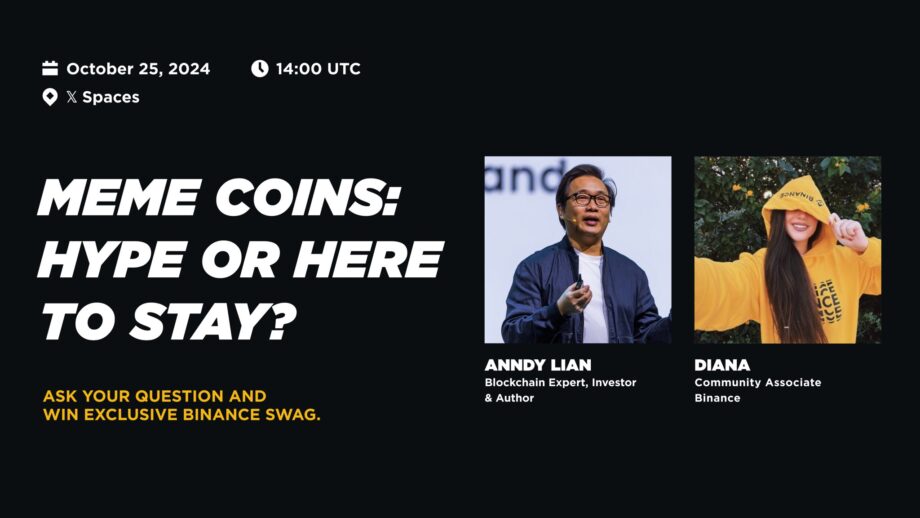
Meme Coins: Hype Or Here to Stay? -AMA Session With Anndy Lian

Meme Coins: Hype Or Here to Stay? -AMA Session With Anndy Lian

Meme coins have swiftly emerged as a distinctive segment within the cryptocurrency ecosystem, harmonizing humor, community engagement, and cutting-edge blockchain technology. In a recent Ask Me Anything (AMA) session titled “Memes to Millions,” hosted by Diana, a Binance Community Associate, on X (formerly Twitter), Anndy Lian—an accomplished book author, fund manager, and blockchain authority—delved into the multifaceted world of meme coins. The discussion illuminated the potential, inherent challenges, and strategic pathways toward mainstream adoption of meme coins, offering a comprehensive analysis grounded in profound industry expertise.

The Significance of Community in Meme Coin Success

A central theme of the AMA was the pivotal role of community in the proliferation and sustainability of meme coins. Anndy underscored that while technological advancements are crucial, it is the vibrancy and engagement of the community that truly distinguishes enduring meme coins from transient phenomena. “Meme coins are more about community than technology,” he emphasized, pointing out that the initial phases of a meme coin lifecycle are primarily propelled by the enthusiasm and active participation of its community members.

Drawing on examples like Dogecoin, Anndy illustrated how grassroots interactions, such as tipping and community-driven initiatives, form the bedrock for broader adoption. The inherent fun and inclusive nature of meme coins attract a diverse demographic, fostering a robust and dynamic community that sustains and drives the project forward. According to Anndy, the technological infrastructure can evolve in response to the community’s needs and aspirations, ensuring that the meme coin remains relevant and functional as the project matures.

Advancing Meme Coins: Utility and Strategic Partnerships

Looking towards the future, Anndy envisions meme coins transcending their playful origins to assume more substantive roles within the blockchain landscape. He advocates for the development of utility-driven meme coins that seamlessly integrate with decentralized finance (DeFi), gaming, and other innovative sectors. This evolution is driven by the strong community support that meme coins possess, which positions them to redefine the perception and utilization of digital assets.

Anndy highlighted various projects that exemplify this vision, particularly those built on advanced platforms like MemeCore—a multi-chain EVM layer 1 solution. They enable meme coins to stake and earn rewards directly from the layer 1 and further their Proof of Memes consensus model. Anndy encourages users to do that because it is a win-win model. MemeCore can secure their blockchain, while meme projects can get rewards that can be used for their marketing needs. The additional rewards work very well for the current CTO project, where they do not have much budget, and also the older memes from the previous bull run who have run out of budget to market.

Citing similar examples, he discussed the potential of AI-driven financial platforms like COPX, where users can leverage AI tools to enhance their trading strategies. The meme community can partner with COPX to trade their meme coins. In return, commissions from exchanges will be rewarded, along with COPX tokens. These additional rewards can be reinvested into the project’s growth and listing endeavors too.

Furthermore, NFTs are slated to play a significant role in the current bull market. Anndy pointed out that meme coin projects do not need to develop proprietary NFT marketplaces but can collaborate with established platforms like Seed.Photo, which recently partnered with Sandbox. This approach allows meme coins to focus on community-building while leveraging existing infrastructures to support their NFT initiatives.

For new users navigating the complexities of fiat on-ramps and off-ramps, Anndy recommended utilizing payfi protocols like AEON within the Ton ecosystem. Such solutions alleviate the burdens of high transaction fees and provide seamless integration for fiat conversions, enhancing user accessibility and experience. Again, there is no need to spend money on development.

All in all, Anndy’s focus is “Community first! Do not waste money on tech. Use existing tech. and always find ways to earn sustainable fees by partnering with good projects.”

Strategic Investments and Risk Mitigation in Meme Coins

Anndy provided critical guidance for investors considering meme coin investments, emphasizing the necessity of comprehensive due diligence and risk management. He reiterated that all cryptocurrencies carry inherent risks, with meme coins being particularly volatile. “All crypto coins are risky,” he stated, underscoring the importance of thorough research before allocating capital.

Investors are advised to clearly define their risk tolerance and investment objectives, whether seeking long-term stability or short-term gains. Evaluating the tokenomics—the economic framework of a cryptocurrency—is essential in assessing its growth potential and sustainability. Key factors include token distribution, utility, and market demand, which collectively influence the coin’s viability and investor confidence.

The Integral Role of Exchanges in Meme Coin Proliferation

During the AMA, Anndy explored the symbiotic relationship between meme coins and cryptocurrency exchanges. He posited that exchanges should adopt bespoke criteria for listing meme coins, acknowledging their unique characteristics compared to more established cryptocurrencies like Bitcoin or Ethereum. Meme coins, often propelled by community-driven hype rather than purely technological innovation, necessitate a distinct evaluation framework.

Anndy advocated for exchanges such as Binance and OKX to implement nuanced listing guidelines that account for community strength, engagement metrics, and real-world utility instead of expecting big communities. “CTO memes do not have money to create fake numbers.”

Additionally, he suggested that exchanges enhance user education and engagement by integrating tools and features that facilitate deeper understanding and interaction with meme coins. This proactive approach by exchanges can significantly contribute to the growth and mainstream acceptance of meme coins, positioning them for sustained success.

Emerging Trends: DeFi, AI, and Layer One Protocol Innovations

Anndy expressed optimism about several nascent trends within the cryptocurrency sector that hold transformative potential for meme coins. The integration of decentralized finance (DeFi) is a key area where meme coins can expand their utility and application. By leveraging DeFi platforms, meme coins can offer a variety of financial services, including staking, lending, and liquidity provision, thereby enhancing their functionality and appeal to a broader audience.

Moreover, the convergence of artificial intelligence (AI) and blockchain technology is anticipated to be a game-changer. Anndy foresees AI-driven projects within the meme coin ecosystem introducing sophisticated automation, predictive analytics, and personalized user experiences. These advancements can streamline operations, improve decision-making processes, and offer tailored services that increase user engagement and satisfaction.

Practical Strategies for Building and Sustaining Meme Coin Communities

For meme coin projects aiming to cultivate and maintain robust communities, Anndy offered several actionable strategies:

  1. Leveraging Established Platforms: Utilize well-known platforms like Twitter, Telegram, and Discord to facilitate community interactions, disseminate updates, and encourage discussions. Maintaining an active presence on these platforms is crucial for visibility and engagement.
  2. Forming Strategic Partnerships: Establish collaborations with other projects, influencers, and key stakeholders within the blockchain ecosystem. These partnerships can amplify reach, attract new members, and create synergistic opportunities for mutual growth.
  3. Ensuring Transparency and Open Communication: Maintain clear and open lines of communication with the community by providing regular updates, addressing concerns, and seeking feedback. Transparency builds trust and fosters a loyal and supportive community.
  4. Incentivizing Community Participation: Implement reward mechanisms such as airdrops, staking rewards, and community competitions to encourage active participation and contributions. Rewarding engagement fosters a sense of ownership and belonging among members.
  5. Conducting Educational Initiatives: Organize educational sessions, AMAs, and workshops to inform the community about the project’s vision, goals, and roadmap. An informed community is better equipped to advocate for and support the project’s development.

Enhancing Meme Coin Ecosystems through Collaboration and Innovation

Anndy emphasized the importance of creating a cohesive ecosystem where meme coins can collaborate, share resources, and develop collective utilities. By fostering partnerships and encouraging collaboration among various meme coin projects, a sustainable and scalable environment can be established, enabling meme coins to thrive and evolve in tandem with the broader blockchain ecosystem.

This ecosystem-centric approach involves leveraging shared technologies, pooling resources for marketing and development, and co-creating utilities that benefit the entire community. Such collaboration not only enhances individual project strengths but also fortifies the overall meme coin landscape, making it more resilient and adaptable to market dynamics.

The Future Outlook for Meme Coins

The future trajectory of meme coins appears promising, driven by continuous innovation and the unwavering support of dedicated communities. As meme coins integrate more deeply with DeFi, AI, and advanced layer one protocols, their utility and functionality are expected to expand, attracting a wider array of investors and users. This evolution positions meme coins not just as speculative assets but as integral components of the decentralized financial ecosystem.

The strategic role of exchanges in nurturing meme coin growth cannot be overstated. By adopting tailored listing criteria and enhancing user education, exchanges can facilitate the seamless integration of meme coins into mainstream financial systems, thereby accelerating their adoption and stability.

Furthermore, the convergence of AI and blockchain technology is set to revolutionize the meme coin space, introducing innovative solutions that enhance efficiency, security, and user experience. These technological advancements, coupled with strategic partnerships and robust community engagement, will likely drive the next wave of meme coin innovation and adoption.

Conclusion

Meme coins have undeniably carved out a unique and influential niche within the cryptocurrency landscape. The insights shared by Anndy Lian during the “Memes to Millions” AMA highlight the critical factors driving the success and sustainability of meme coins. From the paramount importance of community engagement to the strategic integration of utility and advanced technologies, the future of meme coins is poised for significant growth and mainstream acceptance.

As the cryptocurrency ecosystem continues to evolve, meme coins stand at the forefront of innovation, demonstrating that humor and community spirit can coexist with sophisticated blockchain technology. By embracing strategic partnerships, robust investment strategies, and emerging trends such as DeFi and AI, meme coins are well-positioned to transition from digital curiosities to essential pillars of the decentralized financial world.

For investors, developers, and enthusiasts alike, understanding the intricate dynamics of meme coins is essential for navigating this vibrant and rapidly evolving space. With expert guidance and a focus on sustainable growth, meme coins can achieve their potential, transforming from memes to millions and beyond.


Anndy Lian is an early blockchain adopter and experienced serial entrepreneur who is known for his work in the government sector. He is a best selling book author- “NFT: From Zero to Hero” and “Blockchain Revolution 2030”.

Currently, he is appointed as the Chief Digital Advisor at Mongolia Productivity Organization, championing national digitization. Prior to his current appointments, he was the Chairman of BigONE Exchange, a global top 30 ranked crypto spot exchange and was also the Advisory Board Member for Hyundai DAC, the blockchain arm of South Korea’s largest car manufacturer Hyundai Motor Group. Lian played a pivotal role as the Blockchain Advisor for Asian Productivity Organisation (APO), an intergovernmental organization committed to improving productivity in the Asia-Pacific region.

An avid supporter of incubating start-ups, Anndy has also been a private investor for the past eight years. With a growth investment mindset, Anndy strategically demonstrates this in the companies he chooses to be involved with. He believes that what he is doing through blockchain technology currently will revolutionise and redefine traditional businesses. He also believes that the blockchain industry has to be “redecentralised”.

j j j

Session 8: Preview of Cryptocurrency (Part 2) by Anndy Lian

Session 8: Preview of Cryptocurrency (Part 2) by Anndy Lian

Beyond Profile Pictures: Exploring the Expanding Utility of NFTs

While the initial wave of NFTs focused heavily on digital art and collectibles, the technology’s potential extends far beyond profile pictures and speculative trading. As the NFT space matures, we’re witnessing a surge in innovative applications across various sectors, from real estate and event ticketing to supply chain management and identity verification.

One of the key strengths of NFTs lies in their ability to represent unique, verifiable ownership of digital and physical assets. This has opened up exciting possibilities for industries like real estate, where NFTs can be used to tokenize property deeds, streamlining transactions and reducing the need for intermediaries. Imagine a future where real estate purchases are executed securely and transparently on a blockchain, with NFTs serving as digital representations of ownership.

The event ticketing industry is another sector ripe for disruption. NFTs can be used to create secure, tamper-proof tickets, combating counterfeiting and enabling new forms of fan engagement. Exclusive access to events, meet-and-greets with artists, and other unique experiences can be linked to NFTs, providing additional value to attendees.

Beyond these examples, NFTs are being explored for use cases such as:

– Supply Chain Management: Tracking the provenance and authenticity of products, from luxury goods to pharmaceuticals.
– Identity Verification: Providing secure and verifiable digital identities, potentially streamlining access to services and reducing fraud.
– Digital Rights Management: Protecting the intellectual property of creators by securely associating ownership and usage rights with digital content.

However, the widespread adoption of NFTs is not without its challenges. Concerns around security vulnerabilities, the environmental impact of certain blockchain networks, and the need for clear regulatory frameworks are actively being addressed by developers and policymakers.

One promising development is the emergence of encrypted NFTs, which add an extra layer of security and privacy to digital assets. By encrypting the underlying data, creators can better protect sensitive information and control access to their work. This is particularly relevant for applications involving personal data or high-value assets.

The rise of AI-generated art has also sparked debate within the NFT space. While some argue that AI-generated NFTs lack the artistic merit of human-created works, others see them as a natural evolution of creative expression. Platforms like OpenSea have opened their doors to AI artists, allowing them to showcase their work and connect with collectors.

Ultimately, the success of NFTs will depend on their ability to provide tangible value and solve real-world problems. As the technology continues to evolve and mature, we can expect to see even more innovative and impactful applications emerge, transforming industries and redefining our relationship with digital ownership.

The key takeaway is this: don’t dismiss NFTs as a passing fad or limit their potential to digital art. The true power of NFTs lies in their versatility and adaptability, offering a glimpse into a future where digital ownership is secure, transparent, and accessible to all.


Anndy Lian is an early blockchain adopter and experienced serial entrepreneur who is known for his work in the government sector. He is a best selling book author- “NFT: From Zero to Hero” and “Blockchain Revolution 2030”.

Currently, he is appointed as the Chief Digital Advisor at Mongolia Productivity Organization, championing national digitization. Prior to his current appointments, he was the Chairman of BigONE Exchange, a global top 30 ranked crypto spot exchange and was also the Advisory Board Member for Hyundai DAC, the blockchain arm of South Korea’s largest car manufacturer Hyundai Motor Group. Lian played a pivotal role as the Blockchain Advisor for Asian Productivity Organisation (APO), an intergovernmental organization committed to improving productivity in the Asia-Pacific region.

An avid supporter of incubating start-ups, Anndy has also been a private investor for the past eight years. With a growth investment mindset, Anndy strategically demonstrates this in the companies he chooses to be involved with. He believes that what he is doing through blockchain technology currently will revolutionise and redefine traditional businesses. He also believes that the blockchain industry has to be “redecentralised”.

j j j