US tariffs vs crypto wins: An economic shift

US tariffs vs crypto wins: An economic shift

I’ve been closely following the unfolding events surrounding President Trump’s announcement of a 25 per cent tariff on all autos manufactured outside the United States, set to take effect on April 2, 2025. This decision, coupled with the ripple effects across financial markets, commodities, and the cryptocurrency sector, paints a complex picture of risk, opportunity, and uncertainty.

My perspective on this topic is shaped by a careful analysis of the data, historical precedents, and the broader implications for both traditional and decentralised financial systems. What we’re witnessing is a pivotal moment where geopolitics, trade policy, and technological innovation are colliding, with far-reaching consequences for investors, industries, and everyday consumers.

Let’s start with the tariffs themselves. The announcement of a 25 per cent levy on imported autos and car parts is a bold move, one that harkens back to Trump’s earlier trade policies during his first term. The stated goal, presumably, is to bolster domestic manufacturing and protect American jobs—a narrative that resonates with his political base. However, the immediate market reaction suggests that investors are less convinced of its efficacy.

Major US indices retreated, with the S&P 500 dropping 1.1 per cent, the Dow Jones slipping 0.3 per cent, and the Nasdaq taking a steeper 2.0 per cent hit. The technology sector, already reeling from negative news in AI and data centre developments, bore the brunt of this decline. The VIX, often dubbed the “fear gauge,” spiked 7.1 per cent to 18.36, signalling heightened volatility and unease among traders. This isn’t surprising—tariffs introduce uncertainty, and markets despise uncertainty.

The impact on the auto industry is particularly stark. Countries like Japan, Germany, South Korea, Mexico, and Canada, which collectively account for a significant share of US auto imports, now face a steep cost increase. For example, Japan’s Toyota and Germany’s Volkswagen rely heavily on the US market, and a 25 per cent tariff could force them to either absorb the cost (cutting into profit margins) or pass it on to consumers (raising prices).

Domestic producers like General Motors and Ford aren’t immune either, as the tariff extends to car parts—many of which are sourced globally. This could disrupt supply chains and elevate production costs, potentially offsetting any competitive advantage the tariffs aim to create.

I see this as a double-edged sword: while it might encourage some manufacturers to relocate production to the US, the short-term pain of higher costs and disrupted logistics could outweigh those gains, especially in an industry already grappling with inflation and semiconductor shortages.

Turning to the bond market, US Treasuries yields climbed across the curve, with the 2-year yield rising 2.3 basis points to 4.017per cent and the 10-year yield advancing 3.9 basis points to 4.352 per cent. This uptick reflects a shift in investor sentiment—higher yields suggest expectations of stronger economic growth or, more likely, inflationary pressures stemming from the tariffs. The US Dollar Index, up 0.4 per cent to a three-week high, further underscores this flight to safety and confidence in the dollar amid global uncertainty.

Commodities offered a mixed picture: gold held steady, a sign that investors aren’t fully panicking yet, while Brent crude rose 1.1 per cent to US$74 per barrel, buoyed by reports of declining US inventories. In Asia, the MSCI Asia ex-Japan index edged up 0.2 per cent, with Indonesia’s Jakarta Composite surging 3.8 per cent on domestic dividend news, though early trading hinted at broader regional weakness. This divergence highlights how global risk sentiment is fracturing—some markets are finding local resilience, while others brace for a tariff-induced storm.

Now, let’s pivot to the cryptocurrency angle, which adds another layer of intrigue. On the same day as the tariff announcement, Congress struck down an IRS regulation that would have required decentralised digital asset platforms to report customer transactions starting in 2027. This move, which saves the crypto industry an estimated US$4 billion in taxes, is a significant win for the sector—and, notably, for President Trump’s own World Liberty Financial platform.

Decentralised exchanges like Uniswap had argued that the rule was impractical, given their lack of custody over user assets or access to personal data. I find this development fascinating because it juxtaposes Trump’s protectionist trade stance with a deregulatory push in the crypto space, potentially benefiting his personal financial interests. It’s a reminder that policy decisions often carry a personal dimension, and here, the optics are hard to ignore.

Meanwhile, GameStop’s pivot to Bitcoin adds a wild card to the mix. The retailer’s plan to sell US$1.3 billion in zero-coupon convertible bonds to fund Bitcoin purchases—following the playbook of Michael Saylor’s MicroStrategy—sent its stock soaring 12 per cent on March 26. This isn’t just a quirky corporate move; it reflects a growing trend of companies embracing cryptocurrency as a treasury reserve asset.

With Bitcoin’s price historically sensitive to macroeconomic shifts, the tariff-induced uncertainty could either amplify its appeal as a hedge or expose it to sharper volatility. Ethereum, too, is in the spotlight with its Pectra upgrade successfully launching on the Hoodi testnet, though its price dipped three per cent amid a bearish technical pattern. If Pectra hits the mainnet by April 25, as developers hope, it could bolster Ethereum’s long-term utility—yet the immediate market mood remains cautious.

The stablecoin front offers a counterpoint of stability. Custodia Bank and Vantage Bank’s launch of a US bank-backed stablecoin on Ethereum marks a milestone in bridging traditional finance and blockchain. This isn’t just a technical achievement; it’s a regulatory breakthrough, showing that US banks can tokenise assets within legal bounds.

Caitlin Long of Custodia has long championed this integration, and her optimism seems warranted—stablecoins could smooth out some of the volatility plaguing other cryptocurrencies, especially as tariff-related turbulence looms.

My take on this is that the tariffs are a gamble—potentially revitalising US manufacturing but risking higher costs, strained trade relations, and inflation that could squeeze consumers already stretched thin. The market’s initial retreat and the VIX’s jump suggest that investors share my skepticism about the short-term outlook, though the dollar’s strength hints at underlying resilience in the US economy.

In the crypto realm, deregulation and corporate adoption (GameStop, Trump’s platform) signal a maturing industry, yet one still tethered to broader risk sentiment. The stablecoin breakthrough offers a glimmer of hope for stability, but Ethereum’s wobble reminds us that volatility remains a constant.

I can’t help but think about the people behind these numbers—the autoworkers hoping for job security, the investors watching their portfolios, the crypto enthusiasts betting on a decentralised future. The tariffs might protect some livelihoods but raise car prices for millions. The crypto wins might empower innovation but also widen inequality if gains concentrate among the well-connected.

My role here is not to pick winners or losers. What’s clear is that we’re in for a bumpy ride—April 2, when the tariffs kick in, will be just the beginning. For now, I’ll keep watching the data, the markets, and the human stories, because that’s where the real truth lies.


Source: https://e27.co/us-tariffs-vs-crypto-wins-an-economic-shift-20250327/

Anndy Lian is an early blockchain adopter and experienced serial entrepreneur who is known for his work in the government sector. He is a best selling book author- “NFT: From Zero to Hero” and “Blockchain Revolution 2030”.

Currently, he is appointed as the Chief Digital Advisor at Mongolia Productivity Organization, championing national digitization. Prior to his current appointments, he was the Chairman of BigONE Exchange, a global top 30 ranked crypto spot exchange and was also the Advisory Board Member for Hyundai DAC, the blockchain arm of South Korea’s largest car manufacturer Hyundai Motor Group. Lian played a pivotal role as the Blockchain Advisor for Asian Productivity Organisation (APO), an intergovernmental organization committed to improving productivity in the Asia-Pacific region.

An avid supporter of incubating start-ups, Anndy has also been a private investor for the past eight years. With a growth investment mindset, Anndy strategically demonstrates this in the companies he chooses to be involved with. He believes that what he is doing through blockchain technology currently will revolutionise and redefine traditional businesses. He also believes that the blockchain industry has to be “redecentralised”.

j j j

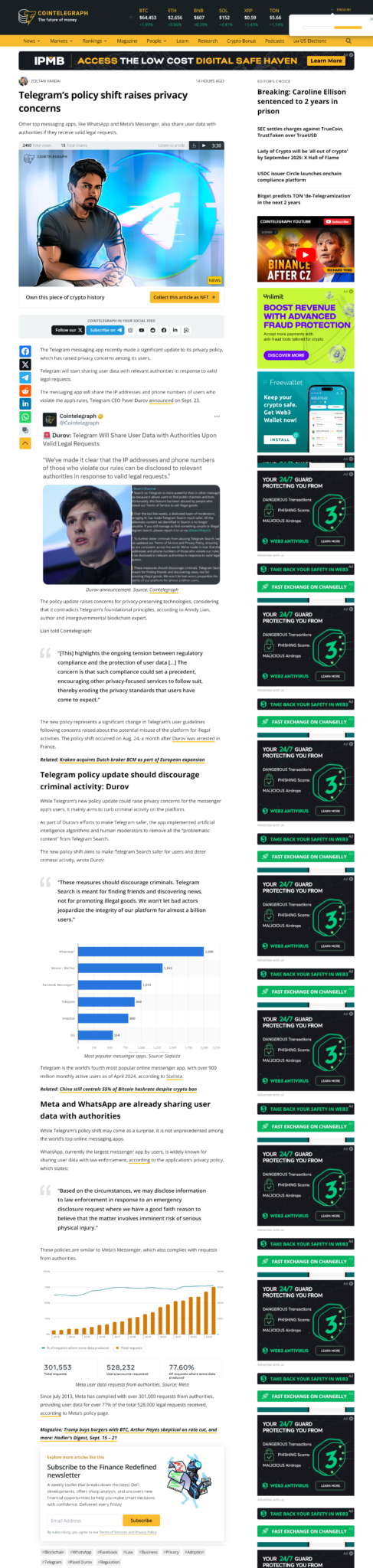
Telegram’s policy shift raises privacy concerns

Telegram’s policy shift raises privacy concerns

The Telegram messaging app recently made a significant update to its privacy policy, which has raised privacy concerns among its users.

Telegram will start sharing user data with relevant authorities in response to valid legal requests.

The messaging app will share the IP addresses and phone numbers of users who violate the app’s rules, Telegram CEO Pavel Durov announced on Sept. 23.

The policy update raises concerns for privacy-preserving technologies, considering that it contradicts Telegram’s foundational principles, according to Anndy Lian, author and intergovernmental blockchain expert.

Lian told Cointelegraph:

“[This] highlights the ongoing tension between regulatory compliance and the protection of user data […] The concern is that such compliance could set a precedent, encouraging other privacy-focused services to follow suit, thereby eroding the privacy standards that users have come to expect.”

The new policy represents a significant change in Telegram’s user guidelines following concerns raised about the potential misuse of the platform for illegal activities. The policy shift occurred on Aug. 24, a month after Durov was arrested in France.

Telegram policy update should discourage criminal activity: Durov

While Telegram’s new policy update could raise privacy concerns for the messenger app’s users, it mainly aims to curb criminal activity on the platform.

As part of Durov’s efforts to make Telegram safer, the app implemented artificial intelligence algorithms and human moderators to remove all the “problematic content” from Telegram Search.

The new policy shift aims to make Telegram Search safer for users and deter criminal activity, wrote Durov:

“These measures should discourage criminals. Telegram Search is meant for finding friends and discovering news, not for promoting illegal goods. We won’t let bad actors jeopardize the integrity of our platform for almost a billion users.”

Telegram is the world’s fourth most popular online messenger app, with over 900 million monthly active users as of April 2024, according to Statista.

Related: China still controls 55% of Bitcoin hashrate despite crypto ban

Meta and WhatsApp are already sharing user data with authorities

While Telegram’s policy shift may come as a surprise, it is not unprecedented among the world’s top online messaging apps.

WhatsApp, currently the largest messenger app by users, is widely known for sharing user data with law enforcement, according to the application’s privacy policy, which states:

“Based on the circumstances, we may disclose information to law enforcement in response to an emergency disclosure request where we have a good faith reason to believe that the matter involves imminent risk of serious physical injury.”

These policies are similar to Meta’s Messenger, which also complies with requests from authorities.

Since July 2013, Meta has complied with over 301,000 requests from authorities, providing user data for over 77% of the total 528,000 legal requests received, according to Meta’s policy page.


Source: https://cointelegraph.com/news/telegram-policy-shift-privacy-concerns


Anndy Lian is an early blockchain adopter and experienced serial entrepreneur who is known for his work in the government sector. He is a best selling book author- “NFT: From Zero to Hero” and “Blockchain Revolution 2030”.

Currently, he is appointed as the Chief Digital Advisor at Mongolia Productivity Organization, championing national digitization. Prior to his current appointments, he was the Chairman of BigONE Exchange, a global top 30 ranked crypto spot exchange and was also the Advisory Board Member for Hyundai DAC, the blockchain arm of South Korea’s largest car manufacturer Hyundai Motor Group. Lian played a pivotal role as the Blockchain Advisor for Asian Productivity Organisation (APO), an intergovernmental organization committed to improving productivity in the Asia-Pacific region.

An avid supporter of incubating start-ups, Anndy has also been a private investor for the past eight years. With a growth investment mindset, Anndy strategically demonstrates this in the companies he chooses to be involved with. He believes that what he is doing through blockchain technology currently will revolutionise and redefine traditional businesses. He also believes that the blockchain industry has to be “redecentralised”.

j j j

Interview/Anndy Lian – Ethereum’s Layer 2 Shift: The Future is Brimming with Potential

Interview/Anndy Lian – Ethereum’s Layer 2 Shift: The Future is Brimming with Potential

Ethereum’s infamous congestion is becoming a distant memory as Layer 2 solutions come online. The L2s are designed to unleash a new era of blockchain speed, affordability, and innovation, with the potential to reshape industries and revolutionize how we interact with digital assets.

We spoke with Anndy Lian, an influential blockchain expert, best-selling author, and dynamic business strategist,  for a deep dive into this transformative technology.

The Shib: Ethereum’s scalability challenges have been a major roadblock to mass adoption. How do you see Layer 2 solutions not only addressing these issues but also unlocking new possibilities for the blockchain industry as a whole?

Lian: Ethereum’s sluggish transactions act like a toll booth on the information highway, slowing everyone down. Layer 2 solutions bypass this by processing transactions on a faster track, reducing wait times and costs. This opens the door for more users, new applications, and a wave of innovation on the blockchain.  Beyond Ethereum, Layer 2 has the potential to connect different blockchains and fuel the growth of DeFi and NFTs by enabling faster and cheaper transactions.

Security and decentralization are still concerns with Layer 2, but the industry is actively working on preserving these core principles alongside scalability. This promising technology has the potential to unlock a new era of innovation and mass adoption for blockchain technology.

The Shib: Security and decentralization are often cited as concerns with Layer 2 solutions. How can we ensure that these scaling solutions maintain the core principles of blockchain technology while providing the benefits of speed and efficiency?

Lian: Layer 2 solutions address Ethereum’s scaling issues by offloading transactions, enabling faster speeds and lower fees. This paves the way for broader adoption and innovation in blockchain technology. However, concerns exist regarding security and decentralization. To address this, Layer 2 solutions inherit security from Layer 1 blockchains and utilize cryptographic techniques for verification. Decentralization is fostered through community governance and distributed validator networks. It’s a balancing act – some solutions prioritize speed with more centralized elements, while others aim for a more even spread. Understanding the specific security model of a Layer 2 solution is crucial. The future is bright. As Layer 2 technology matures, we can expect advancements in both security and decentralization, allowing them to unlock the true potential of blockchain technology.

The Shib: The Layer 2 landscape is rapidly evolving, with various technologies and projects vying for dominance. In your opinion, what are the key factors that will determine the success or failure of a Layer 2 solution, and which projects do you believe have the most potential to reshape the industry?

Lian: The Layer 2 race is heating up, with various technologies vying for dominance. Security, inherited from strong Layer 1s and proven verification methods, is paramount. But scalability is just as important – handling high transaction volume efficiently is crucial. Don’t forget decentralization – a distributed network with engaged community governance builds trust. User experience is king – if it’s complex, expensive, or slow, users won’t come. Finally, interoperability, the ability to connect with other blockchains, unlocks a world of possibilities.

Picking future winners is tough, but some contenders are making waves. Optimistic Rollups like Optimism and Arbitrum offer a good balance between security, scalability, and decentralization. ZK-Rollups like Loopring and Immutable X boast high scalability with strong security potential, but user experience and interoperability might need work. Validium chains like Polygon Hermez take scalability to the extreme, but their reliance on centralized validators raises decentralization concerns.

The winner will likely depend on the specific needs of the application and its users. We can expect further innovation and hybrid solutions that combine the strengths of different approaches as this exciting space matures.

The Shib: Beyond scalability, how do you envision Layer 2 solutions transforming the way we interact with blockchain technology? Can you provide specific examples of use cases or applications that you believe will be revolutionized by Layer 2?

Lian: Layer 2 solutions have the potential to revolutionize how we interact with blockchain technology beyond just speeding things up. Imagine buying your coffee with crypto without breaking the bank – Layer 2’s efficiency could make microtransactions a reality, paving the way for everyday blockchain use in areas like mobile payments and rewarding online creators. For gamers, clunky in-game economies plagued by slow transactions could be a thing of the past. Layer 2 could enable smooth purchases of virtual items and NFT trading within games, creating a more dynamic and immersive experience.

Decentralized social media platforms could leverage Layer 2 for efficient content creation, sharing, and data ownership. This could mean managing your online identity and data with greater ease and security. Even complex supply chains could benefit. Layer 2 solutions could facilitate transparent tracking of every step, from production to delivery, boosting trust and visibility for both businesses and consumers. These are just a glimpse of the possibilities. As Layer 2 matures, expect even more innovative applications to emerge, transforming how we interact with and utilize blockchain technology in our daily lives. The future is brimming with potential.

The Shib: What advice would you give to both investors and developers who are interested in exploring the Layer 2 space? What are the key considerations they should keep in mind when evaluating or building on these solutions?

Lian: Entering the Layer 2 arena is exciting, but caution is key for both investors and developers. Investors, diversify! Explore established players alongside promising newcomers. Security is king – understand how Layer 2 solutions inherit security and verify transactions. Look for scalability, smooth user experience, and low fees. Interoperability is a plus, opening future doors. Finally, a strong community and active development inspire confidence.

For developers, choose the right tool for the job. Align your project’s needs with a Layer 2 solution’s strengths in security, scalability, and function. Stay ahead of the curve – the Layer 2 landscape is dynamic. Security is paramount – prioritize robust measures to safeguard user funds and data. User experience is king – make interacting with your dApp seamless. Embrace interoperability to reach a wider audience and unlock future potential. Layer 2 is young, so do your research, be cautious, and adapt as the technology evolves. With careful consideration, both investors and developers can shape the future of this transformative space.

As Layer 2 solutions continue to evolve and mature, the future of blockchain technology is undeniably bright. Anndy Lian’s insights underscore the immense potential of Layer 2 solutions to break down barriers, democratize access, and unleash a wave of innovation that extends far beyond Ethereum.

As this transformative technology matures, we stand on the brink of a new era—one where blockchain seamlessly integrates into our daily lives, powering everything from microtransactions to decentralized social networks and beyond. The future is not just bright; it’s decentralized, scalable, and brimming with possibilities. Layer 2 isn’t just an evolution; it’s a revolution that promises to reshape the digital landscape and empower individuals in ways we’re only beginning to imagine.


Source: https://news.shib.io/2024/07/03/interview-anndy-lian-ethereums-layer-2-shift-the-future-is-brimming-with-potential/


Anndy Lian is an early blockchain adopter and experienced serial entrepreneur who is known for his work in the government sector. He is a best selling book author- “NFT: From Zero to Hero” and “Blockchain Revolution 2030”.

Currently, he is appointed as the Chief Digital Advisor at Mongolia Productivity Organization, championing national digitization. Prior to his current appointments, he was the Chairman of BigONE Exchange, a global top 30 ranked crypto spot exchange and was also the Advisory Board Member for Hyundai DAC, the blockchain arm of South Korea’s largest car manufacturer Hyundai Motor Group. Lian played a pivotal role as the Blockchain Advisor for Asian Productivity Organisation (APO), an intergovernmental organization committed to improving productivity in the Asia-Pacific region.

An avid supporter of incubating start-ups, Anndy has also been a private investor for the past eight years. With a growth investment mindset, Anndy strategically demonstrates this in the companies he chooses to be involved with. He believes that what he is doing through blockchain technology currently will revolutionise and redefine traditional businesses. He also believes that the blockchain industry has to be “redecentralised”.

j j j