
CZ Left Binance… Should You Also Leave for Coinbase, OKX, Etc?

CZ Left Binance… Should You Also Leave for Coinbase, OKX, Etc?

By now, you’ll be well aware that Changpeng Zhao (CZ) has resigned from the beast of an exchange that is Binance. Singaporean ex-MAS director Richard Teng has taken the reins as CEO, following in the few legal footprints left by CZ.

Over $1 billion has left the world’s largest crypto along with CZ as users withdrew their funds in response to the crypto titan pleading guilty to anti-money laundering violations in the US.

Binance was fined $4.3 billion whilst CZ himself agreed to pay a $50 million penalty.

These withdrawals are not necessarily a reflection of the confidence the market has in Teng but rather, the lack of confidence in Binance’s overall position.

As Blockhead contributor Anndy Lian explains, CZ’s supporters were disappointed in his resignation and “if not handled properly they may lose trust or interest in the exchange.”

“Moreover, CZ’s departure could also create a power vacuum or a leadership crisis within, as Teng may face resistance or opposition from some of the existing executives or employees who are loyal to CZ or who have different views or agendas,” Lian states.

Of course, the Binance fallout is serving as good news for its competitors. Crypto trading giant OKX saw its largest daily inflow of $152 million. Bybit enjoyed a $50.9 billion inflow and Bitstamp attracted $30.5 million.

“We anticipate that this will accelerate the outflow of projects, exchanges, founders and firms from direct U.S. regulatory purview,” crypto market maker Auros COO Jason Atkins told The Block. “Compliance will now be a non-negotiable so as to minimize lapses in the AML and KYC requirements in the U.S., irrespective of the country of incorporation.”

Coinbase has experienced a continuous rise in its stock price too, rising 12% over the past few days and more than 41% throughout the past month.

Reacting to Binance’s news, CEO Brian Armstrong took to Twitter to emphasise the importance of compliance.

“Since the founding of Coinbase back in 2012 we have taken a long-term view. I knew we needed to embrace compliance to become a generational company that stood the test of time,” he said. “This meant we couldn’t always move as quickly as others… Today’s news reinforces that doing it the hard way was the right decision.”

Other winners include degens who jumped onto meme coins aptly titled $CZ and $TENG, enjoying returns of up to 100,000% and 14,000% respectively.

4 Fingers, Big 4 Audit, FUD 4 Real

The image of CZ holding up four fingers has become a meme of its own. Stemming from an initial tweet he wrote earlier this year, the figure reflects CZ’s fourth item on his “Do’s and Dont’s” list: Ignore FUD.

With CZ finally exiting Binance, it’s now time to re-evaluate the FUD surrounding the exchange and whether we can apply his advice to his own firm.

As mentioned, Binance is set to pay a fine of $4.3 billion. A simple glance at Binance’s proof-of-reserves will indicate that the exchange backs customer assets one-to-one.

“People can withdraw 100% of the assets they have on Binance. We will not have an issue at any given day,” CZ reassuringly said in an interview. “In crypto, there’s no central bank printing money to bail out banks when there’s a liquidity crunch. Crypto businesses have to hold user assets one-to-one, and that’s what we do – it’s very simple.”

According to Binance, the exchange has $6.35 billion in total assets, which means it should be able to easily pay off the $4.3 billion fine without eating into customer funds.

However, Binance has refrained from disclosing its liabilities. When FTX collapsed, eyes predictably turned to Binance. At that time, CNBC’s Becky Quick pressed CZ on whether Binance could handle a $2.1 billion payment.

“Would you be able to handle it if somebody asked you for $2.1 billion back?” Quick asked him.

“We are financially OK,” CZ replied, failing to provide a direct answer.

When Quick pressed him on getting a Big 4 auditor to vet his firm, CZ claimed none wanted to work with him.

“A Big 4 auditor would reveal [problems],” Quick said. “If you’re saying that some of them don’t want to work with you, that raises questions too. They don’t want to work with you because you don’t have the files and the data that would make them feel comfortable to give their stamp of approval?”

In response, CZ pushed the blame onto the auditors. “Many of them don’t know how to audit crypto exchanges,” he said.

CNBC’s Andrew Ross Sorkin pointed out that Coinbase has a Big 4 auditor, to which a flummoxed CZ replied, “I don’t look at Coinbase.”

Star Trek or Fiction?

In CZ’s internal letter addressed to Binance staff, the now-former-CEO turned to Star Trek for words of wisdom. “I need everyone to continue performing admirably,” he said, lifting from the 2009 Star Trek film.

Binance users will now have to decide how much of what CZ told them is fiction, like his Star Trek quote. Last year, CZ was reluctant to answer whether Binance could cover a $2.1 billion fine. Its current $4.3 billion penalty is more than double that.

Whilst its proof-of-reserves points to a $6.35 billion asset stronghold, Binance’s reluctance to permit an audit means its liabilities could diminish this number substantially.

Perhaps Teng will straighten up Binance’s financials, in line with regulatory demands. But the truth could be painful to hear.


Source: https://www.blockhead.co/2023/11/23/cz-left-binance-should-you-also-leave-for-coinbase-okx-etc/

Anndy Lian is an early blockchain adopter and experienced serial entrepreneur who is known for his work in the government sector. He is a best selling book author- “NFT: From Zero to Hero” and “Blockchain Revolution 2030”.

Currently, he is appointed as the Chief Digital Advisor at Mongolia Productivity Organization, championing national digitization. Prior to his current appointments, he was the Chairman of BigONE Exchange, a global top 30 ranked crypto spot exchange and was also the Advisory Board Member for Hyundai DAC, the blockchain arm of South Korea’s largest car manufacturer Hyundai Motor Group. Lian played a pivotal role as the Blockchain Advisor for Asian Productivity Organisation (APO), an intergovernmental organization committed to improving productivity in the Asia-Pacific region.

An avid supporter of incubating start-ups, Anndy has also been a private investor for the past eight years. With a growth investment mindset, Anndy strategically demonstrates this in the companies he chooses to be involved with. He believes that what he is doing through blockchain technology currently will revolutionise and redefine traditional businesses. He also believes that the blockchain industry has to be “redecentralised”.

j j j

How Crypto Exchanges Should Be Regulated: Challenges And Scenarios For 2024 And Beyond

How Crypto Exchanges Should Be Regulated: Challenges And Scenarios For 2024 And Beyond

Crypto exchanges, the platforms that allow users to buy, sell, and trade cryptocurrencies and other digital assets, have been at the center of the crypto industry’s growth and innovation. However, they have also been the source of many controversies and risks, such as hacks, frauds, scams, market manipulation, money laundering, and tax evasion. As the crypto market matures and attracts more attention from regulators, investors, and the public, the question of how crypto exchanges should be regulated becomes more urgent and complex.

The Current State Of Crypto Exchange Regulation

The current state of crypto exchange regulation is fragmented, inconsistent, and uncertain. Different jurisdictions have different approaches and standards for crypto exchanges, ranging from outright bans to laissez-faire policies to comprehensive frameworks. Some of the key regulatory issues and challenges that crypto exchanges face include:

  • The legal status and classification of crypto assets: Crypto assets, such as Bitcoin, stablecoins, and tokens, have different features and functions, and may belong to different legal categories, such as securities, commodities, currencies, or something else. Depending on the category, crypto assets may have to follow different rules and regulations, such as registration, disclosure, reporting, taxation, and consumer protection. But there is no global agreement or clarity on how to define and classify crypto assets, and different regulators may have different views and opinions.
  • The jurisdiction and authority of regulators: These platforms operate globally and in a decentralized way, often serving customers across borders and countries. But regulators may have different scopes and powers to oversee and enforce them, depending on where they are, where they are registered, where they are incorporated, or where they operate. They may have to deal with conflicting or overlapping regulatory requirements or expectations from different regulators, or they may try to avoid or escape regulation by moving or hiding their operations or assets.
  • The applicability and interpretation of existing laws and regulations: These platforms may have to follow existing laws and regulations that apply to traditional financial institutions or intermediaries, such as anti-money laundering (AML), counter-terrorism financing (CTF), know-your-customer (KYC), investor protection, market integrity, and prudential standards. But these laws and regulations may not be fully suitable or relevant, as they may not capture the unique features and risks of crypto assets and activities, such as decentralization, anonymity, volatility, and innovation. Moreover, these laws and regulations may vary across countries and may be subject to different interpretations and implementations by regulators and courts.

The Future Scenarios Of Crypto Exchange Regulation

The future scenarios of crypto exchange regulation are uncertain and dynamic, as they depend on various factors, such as the evolution of the crypto market, the development of the regulatory frameworks, the actions and reactions of the regulators and the industry, and the emergence of new technologies and innovations. However, based on the current trends and signals, some of the possible scenarios that crypto exchanges may face in 2024 and beyond include:

  • Scenario 1: Global harmonization and standardization: In this scenario, global regulators and standard-setters, such as the Financial Action Task Force (FATF), the Financial Stability Board (FSB), the Basel Committee on Banking Supervision (BCBS), and the International Organization of Securities Commissions (IOSCO), work together to create and apply a consistent and coherent set of rules and guidelines for these platforms, based on common principles and best practices. They have to follow these rules and guidelines, no matter where they are or operate, and are subject to regular supervision and enforcement by competent authorities. They also benefit from regulatory clarity and certainty, as well as enhanced trust and legitimacy among investors and the public. But they also face increased compliance costs and risks, as well as reduced innovation and competition, as they have to stick to strict and uniform standards that may not fit their specific needs or preferences.
  • Scenario 2: Regional integration and differentiation: In this scenario, regional regulators and authorities, such as the European Union (EU), the Association of Southeast Asian Nations (ASEAN), and the African Union (AU), create and apply their own regional frameworks and initiatives for these platforms, based on their regional goals and priorities. They have to follow these regional frameworks and initiatives, depending on where they are or operate, and are subject to regional supervision and enforcement by regional bodies or agencies. These platforms benefit from regulatory alignment and cooperation, as well as tailored solutions and opportunities, within their respective regions. But also face regulatory fragmentation and confusion, as well as limited access and exposure, across different regions, as they have to deal with different and divergent standards that may create barriers or conflicts.
  • Scenario 3: Local adaptation and experimentation: In this scenario, local regulators and authorities, such as the US, China, India, and Switzerland, create and apply their own local policies and measures for these platforms, based on their local conditions and interests. They have to follow these local policies and measures, depending on where they are or operate, and are subject to local supervision and enforcement by local agencies or courts. These platforms benefit from regulatory flexibility and diversity, as well as customized support and incentives, within their respective jurisdictions. They also face regulatory uncertainty and volatility, as well as increased complexity and risk, across different jurisdictions, as they have to cope with different and changing standards that may create uncertainty or instability.

To Sum Up

Crypto exchanges are a vital and vibrant part of the crypto industry, but they also pose significant challenges and risks for regulators, investors, and the public. As the market evolves and matures, the question of how they should be regulated becomes more urgent and complex. The future scenarios of crypto exchange regulation are uncertain and dynamic, and may vary across different levels and dimensions, such as global, regional, and local. They may face different regulatory outcomes and implications, depending on the scenario that prevails or emerges. They may need to prepare and adapt for different regulatory scenarios, by enhancing their regulatory awareness and compliance, engaging and collaborating with regulators and stakeholders, and leveraging their innovation and differentiation.


Source: https://www.benzinga.com/23/11/35682896/how-crypto-exchanges-should-be-regulated-challenges-and-scenarios-for-2024-and-beyond

Anndy Lian is an early blockchain adopter and experienced serial entrepreneur who is known for his work in the government sector. He is a best selling book author- “NFT: From Zero to Hero” and “Blockchain Revolution 2030”.

Currently, he is appointed as the Chief Digital Advisor at Mongolia Productivity Organization, championing national digitization. Prior to his current appointments, he was the Chairman of BigONE Exchange, a global top 30 ranked crypto spot exchange and was also the Advisory Board Member for Hyundai DAC, the blockchain arm of South Korea’s largest car manufacturer Hyundai Motor Group. Lian played a pivotal role as the Blockchain Advisor for Asian Productivity Organisation (APO), an intergovernmental organization committed to improving productivity in the Asia-Pacific region.

An avid supporter of incubating start-ups, Anndy has also been a private investor for the past eight years. With a growth investment mindset, Anndy strategically demonstrates this in the companies he chooses to be involved with. He believes that what he is doing through blockchain technology currently will revolutionise and redefine traditional businesses. He also believes that the blockchain industry has to be “redecentralised”.
j j j

Bitcoin, Ether, Doge Skyrocket: Should You Be Buying At Current $30K Levels?

Bitcoin, Ether, Doge Skyrocket: Should You Be Buying At Current $30K Levels?

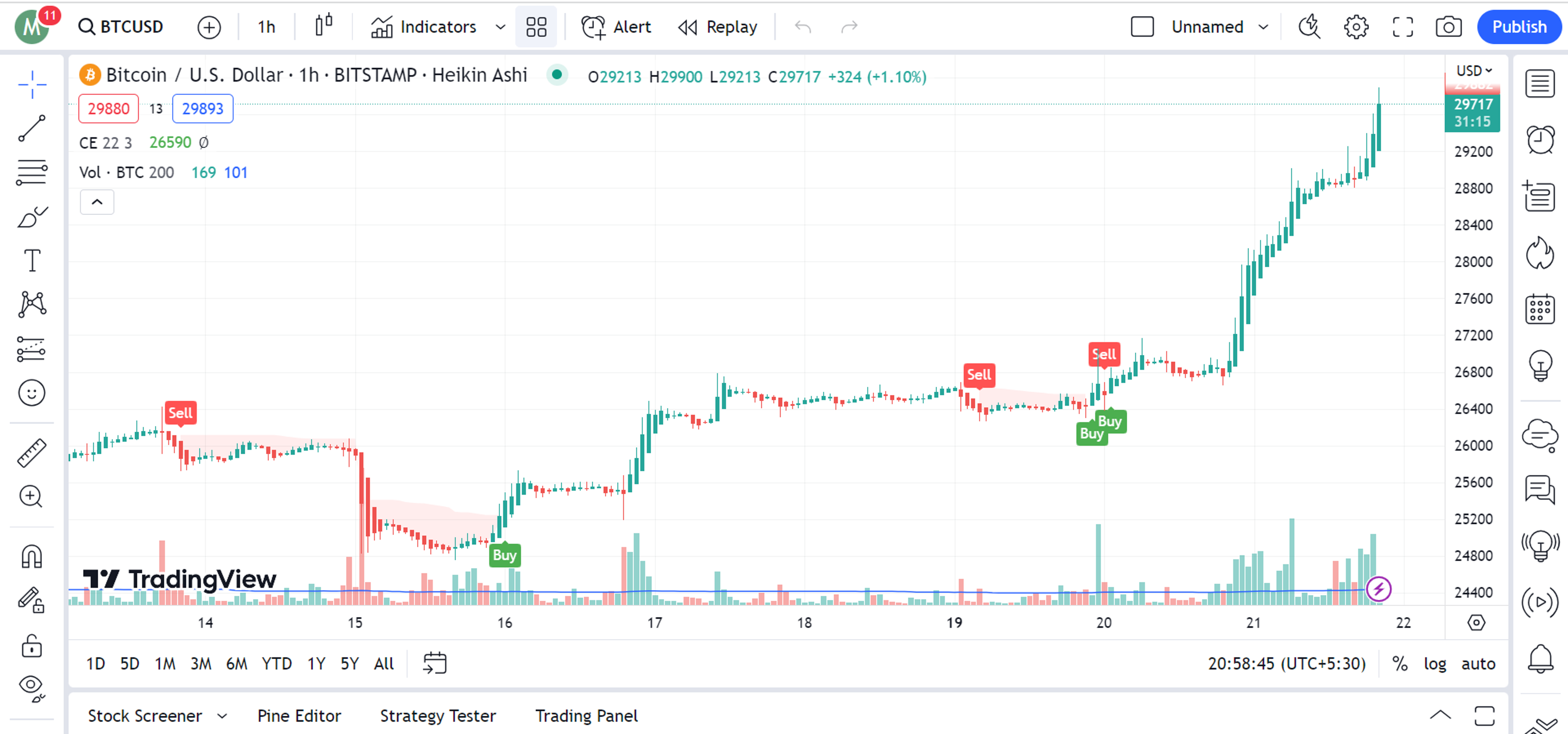
Major cryptocurrencies like Bitcoin Ether and Dogecoin are trading at a monthly high on Wednesday.

Bitcoin, the world’s largest digital currency, broke $26,500 for the first time in over a month to make a high of $29,883, up about 11% over the past 24 hours. It subsequently broke $30,000 — the first time in more than a year.

Ether was trading at $1849, up 7.5%, while Doge was trading up about 6%, according to data from TradingView.

Recently, BlackRock BLK, submitted an application last week for a Bitcoin exchange-traded fund (ETF) in the U.S.

Additionally, EDX Markets, a cryptocurrency exchange backed by prominent financial entities such as Charles Schwab, Citadel Securities, and Fidelity Digital Assets, has launched its trading services.

Industry experts have weighed in on the phenomenal rise, attributing it to several factors, including institutional interest and economic forecasts.

Bitcoin’s Future Performance

Greg Waisman, COO of payments platform Mercuryo, says Bitcoin’s renewed dominance, accounting for 50% of the market capitalization of the crypto ecosystem, has been spurred by the application for a spot Bitcoin ETF by BlackRock and followed by WisdomTreeInvesco, and Bitwise. “The renewed optimism about a BTC ETF from these financial giants is evidence that Bitcoin holds true potential that will boost its future performance,” Waisman states.

Waisman also emphasizes Bitcoin’s burgeoning momentum as a technology with innovative Layer-2 protocols such as the Lightning Network revolutionizing payments.

“The positive sentiment on its capabilities has contributed to the increasing inflow of funds into Bitcoin worth $3.6 billion over the past few months,” he said.

Macro-Economic Indicators

Raj Kapoor, the founder of the Blockchain Governance Council, highlights the role of the Federal Reserve’s decision to halt rate hikes and suggested that the weakening of the U.S. dollar could also be playing a significant role.

Kapoor opines, “The stronger the macroeconomic environment, the higher the Bitcoin price.”

He further mentions the impact of filings for a Bitcoin ETF by financial giants like BlackRock and Fidelity Investments.

Greg Magadini, Head of Derivatives at Amberdata, a crypto data analytics firm, shares insights into ETH call selling since the ETH Shanghai upgrade.

Magadini said, “This flow is some of the largest, persistent flow, ever seen in ETH options… suggesting this flow is institutional.”

Institutional Involvement As A Catalyst

“NFT: From Zero to Hero” author Anndy Lian attributes the surge in Bitcoin’s price to the growing interest among institutional investors, and specifically notes BlackRock’s launching of a Bitcoin ETF.

“This institutional involvement has sparked optimism among traders regarding Bitcoin’s price,” he said.

Lian also highlights the potential correlation between a declining US dollar index and a favorable macroeconomic climate as factors that may continue to positively impact Bitcoin’s price.

Serenity Shield CEO Venket Naga said increased mainstream adoption and acceptance of cryptocurrencies have attracted more investors and users and growing institutional interest, such as the entry of major financial institutions into the crypto market, has provided a sense of legitimacy and attracted more investors.

“The market’s long-term sustainability depends on continued adoption and addressing concerns like scalability and energy consumption. Continued innovation and practical application of blockchain technology, specifically tailored to address real-world requirements, will play pivotal roles in determining the market’s overall sustainability,” he added.


Source: https://www.benzinga.com/markets/cryptocurrency/23/06/32950439/bitcoin-ether-doge-skyrocket-should-you-be-buying-at-current-30k-levels

Anndy Lian is an early blockchain adopter and experienced serial entrepreneur who is known for his work in the government sector. He is a best selling book author- “NFT: From Zero to Hero” and “Blockchain Revolution 2030”.

Currently, he is appointed as the Chief Digital Advisor at Mongolia Productivity Organization, championing national digitization. Prior to his current appointments, he was the Chairman of BigONE Exchange, a global top 30 ranked crypto spot exchange and was also the Advisory Board Member for Hyundai DAC, the blockchain arm of South Korea’s largest car manufacturer Hyundai Motor Group. Lian played a pivotal role as the Blockchain Advisor for Asian Productivity Organisation (APO), an intergovernmental organization committed to improving productivity in the Asia-Pacific region.

An avid supporter of incubating start-ups, Anndy has also been a private investor for the past eight years. With a growth investment mindset, Anndy strategically demonstrates this in the companies he chooses to be involved with. He believes that what he is doing through blockchain technology currently will revolutionise and redefine traditional businesses. He also believes that the blockchain industry has to be “redecentralised”.
j j j