Highlights of DeCC Day at Token2049 Singapore

Highlights of DeCC Day at Token2049 Singapore

Lisa Loud, executive director of Secret Network Foundation, opened the day and spoke of two key conversations that were directly relevant to DeCC Day.

The first was a gathering at EthDenver in February where the DeCC Alliance first met, and first put together an overview and informal alliance of companies dedicated to promoting and delivering confidential computing. It is really important to note that the almost 30 companies under this umbrella use different technologies, and some are even directly competitive, but all have as a common goal confidential computing.

The second conversation germane to the DeCC Day was Lisa’s meetings with SEC Commissioner Hester Pierce. Lisa remarked to Hester that she really deserved the term CryptoMom for her hard work on behalf of crypto.

However, Hester replied she wasn’t a champion of crypto, she was a champion of people making their own decisions.

And to paraphrase the last line from Robert Frost’s poem ‘The Road not Taken’ that has made all the difference.

The DeCC Day carried on in style. The Silent Swap team were there in force and made a big announcement that their Beta was open. Supdoggie from the team gave a highly technical look at how SilentSwap is using TEE and FHE in its architecture.

Sodalabs, represented by Avishay Yanai, gave a talk on the tech behind Garbled Circuits, yet another technology added to the Alliance which already includes TEE, MPC, ZK and FHE.

The first panel, on the Importance of DePIN, was moderated by Crypto Megan. Her guests were Amar Bedi of Tashi, Alex Zaidelson of SCRT Labs and Anil Murty of Akash. The triple A guests were united in their comment that OpenAI is very closed – and that is why we need DePIN to democratize access to GPUs.

The Building Web3 Responsibly panel was moderated by Varuni Trivedi, editor of The Coin Republic and included LC of IBL Law, Joshua Maddox of COTI, Bruce Ahn of Partisia, and Zheng Leong Chua of Automata Network. Echoing shades of Games of Thrones, LC said ‘regulation is coming.’ Bruce said ‘Devs understand the rules.’ Zheng said ‘we love compliance,’ and Joshua said ‘we need to get dirty.’

Zoe McFox of Phala Network moderated the Power of DeCC panel. During this conversation, it was pointed out that in the military, there are armed guards securing databases with guns, and that we needed to find equally secure tech solutions. She was joined by Supdoggie, Yannick Schrade of Arcium and Kabal.

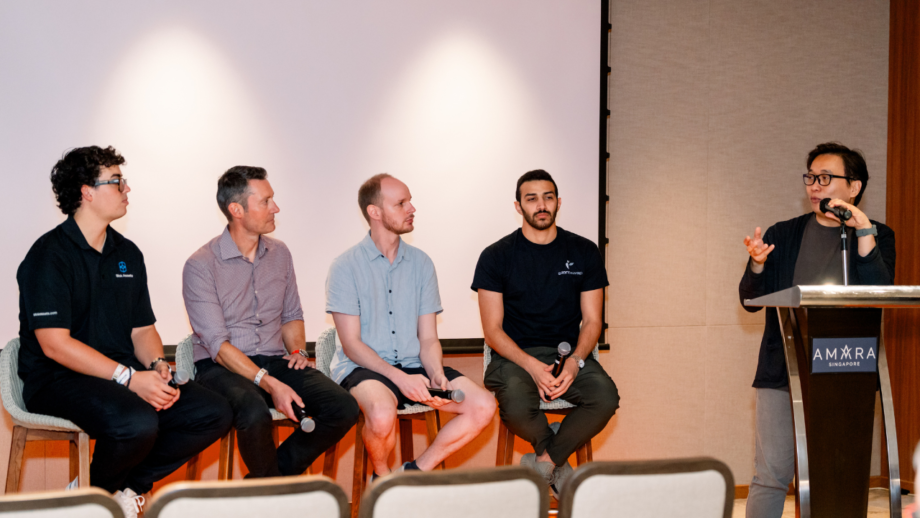
Finally, Anndy Lian, Governmental Blockchain Advisor, led the panel looking at commercial use cases. He was joined by Josh Wyant of Novapolis, Gavin Thomas of TEN, Cal of SquidGrow and Juan Mari of Blok Assets. During this panel it was observed that Vitalik’s lack of privacy is well documented with people tracking him through his publicly acknowledged wallets. But it’s the same for ordinary people who need protection also.

Throughout the presentations and discussions, the audience was engaged and every opportunity for questions to be asked was filled with participation and insightful answers.

The event ended with a powerful round of networking where relationships were built that will live on and keep the value of the event going for years to come.


Source: https://www.blockleaders.io/events/highlights-of-decc-day-at-token2049-singapore-

Anndy Lian is an early blockchain adopter and experienced serial entrepreneur who is known for his work in the government sector. He is a best selling book author- “NFT: From Zero to Hero” and “Blockchain Revolution 2030”.

Currently, he is appointed as the Chief Digital Advisor at Mongolia Productivity Organization, championing national digitization. Prior to his current appointments, he was the Chairman of BigONE Exchange, a global top 30 ranked crypto spot exchange and was also the Advisory Board Member for Hyundai DAC, the blockchain arm of South Korea’s largest car manufacturer Hyundai Motor Group. Lian played a pivotal role as the Blockchain Advisor for Asian Productivity Organisation (APO), an intergovernmental organization committed to improving productivity in the Asia-Pacific region.

An avid supporter of incubating start-ups, Anndy has also been a private investor for the past eight years. With a growth investment mindset, Anndy strategically demonstrates this in the companies he chooses to be involved with. He believes that what he is doing through blockchain technology currently will revolutionise and redefine traditional businesses. He also believes that the blockchain industry has to be “redecentralised”.

j j j

DeCC Day Token 2049 Singapore – Use Cases With Commercial Application

DeCC Day Token 2049 Singapore – Use Cases With Commercial Application

During the Token 2049 week in Singapore, the DeCC event hosted a panel discussion titled “Use Cases with Commercial Applications.” Moderated by Anndy Lian, a book author and governmental blockchain advisor, the panel featured prominent figures in the blockchain industry: Gavin Thomas, Co-Founder of TEN Protocol; Josh Wyant, Founder of Novapolis; Cal, Lead Developer at SquidGrow and SilentSwap; and Juan Mari, CEO of Blok Assets. The discussion delved into the practical applications of blockchain technology, focusing on privacy, regulatory challenges, and the potential for blockchain to revolutionize various industries.

The panel began with introductions, setting the stage for a deep dive into the commercial applications of blockchain. Juan Mari introduced Blok Assets, a firm based in Puerto Rico that builds legal structures within the SEC and FCA frameworks to tokenize assets. Gavin Thomas highlighted TEN Protocol’s work on an encrypted layer 2 for Ethereum, while Josh Wyant described Novapolis as a decentralized cloud platform with a community-centric approach. Cal, representing SilentSwap, explained their focus on privacy swaps powered by the Secret Network, enabling asset exchanges across multiple EVM chains.

The discussion quickly turned to privacy, a critical aspect of blockchain technology. The panelists shared various case studies illustrating the importance of privacy in commercial applications. Gavin Thomas cited the Italian banking system’s use of an enterprise-grade blockchain, which incorporates privacy into its design. He emphasized the potential benefits of moving to public blockchains with confidential computing, which could reduce vendor lock-in and foster competition, ultimately benefiting consumers.

Cal shared insights from SilentSwap’s journey, initially targeting consumer users but later attracting business clients who also required privacy. He highlighted the need for privacy in business transactions, where competitors should not have access to each other’s financial details. This need for privacy extends to various scenarios, such as venture capitalists being copy-traded or competitive traders being front-run by rivals. SilentSwap is now developing a business-to-business SDK to address these privacy concerns.

Juan Mari pointed out the lack of protocols for transfer agents in the tokenization of real-world assets. He stressed the need for a transfer agent with robust data privacy layers, especially when dealing with regulatory bodies like the SEC and FCA. The absence of such a solution presents a significant opportunity for innovation in the blockchain space.

The conversation then shifted to the role of confidential computing in governance and regulatory compliance. The panelists discussed how confidential computing could enable secure voting and other governance applications while maintaining privacy. They acknowledged the challenges governments face in balancing privacy with regulatory requirements, such as anti-money laundering (AML) and know-your-customer (KYC) processes. The panelists emphasized the importance of educating regulators about the benefits of blockchain technology and the potential for confidential computing to enhance security and privacy.

Anndy Lian raised the issue of privacy in the context of meme projects, questioning its importance in such communities. The panelists agreed that privacy remains crucial, even in meme projects, as it allows developers and traders to maintain anonymity and protect their identities. They shared anecdotes of individuals who have faced challenges due to a lack of privacy, underscoring the need for solutions that enable users to control their data and identities.

The panel also addressed the challenges of promoting and educating users about blockchain technology. They noted that many blockchain projects struggle to communicate their value propositions effectively, often using complex terminology that alienates potential users. The panelists suggested simplifying the user experience and abstracting away the complexity of blockchain to drive adoption. They emphasized the need for a “killer app” that showcases the benefits of blockchain without requiring users to understand the underlying technology.

In discussing the future of blockchain, the panelists expressed optimism about its potential to transform industries such as trade finance. They highlighted the inefficiencies in traditional trade finance processes, which involve extensive paperwork and reliance on third parties. Blockchain technology, with its ability to facilitate secure and transparent transactions, could streamline these processes and reduce friction. The panelists envisioned a future where blockchain underpins global trade finance, enabling more efficient and secure transactions.

The panel concluded with a discussion on emerging use cases for decentralized applications (dApps) that offer significant value for commercial adoption. They identified trade finance, real-world asset tokenization, and privacy-preserving advertising as areas ripe for innovation. The panelists also highlighted the potential for confidential computing to extend beyond web 3.0, enabling web 2.0 applications to incorporate privacy-preserving features.

Overall, the panel discussion at DeCC provided valuable insights into the commercial applications of blockchain technology. The panelists highlighted the importance of privacy, the challenges of regulatory compliance, and the potential for blockchain to revolutionize industries. As blockchain technology continues to evolve, it holds the promise of transforming how businesses operate, offering new opportunities for innovation and growth.

Anndy Lian is an early blockchain adopter and experienced serial entrepreneur who is known for his work in the government sector. He is a best selling book author- “NFT: From Zero to Hero” and “Blockchain Revolution 2030”.

Currently, he is appointed as the Chief Digital Advisor at Mongolia Productivity Organization, championing national digitization. Prior to his current appointments, he was the Chairman of BigONE Exchange, a global top 30 ranked crypto spot exchange and was also the Advisory Board Member for Hyundai DAC, the blockchain arm of South Korea’s largest car manufacturer Hyundai Motor Group. Lian played a pivotal role as the Blockchain Advisor for Asian Productivity Organisation (APO), an intergovernmental organization committed to improving productivity in the Asia-Pacific region.

An avid supporter of incubating start-ups, Anndy has also been a private investor for the past eight years. With a growth investment mindset, Anndy strategically demonstrates this in the companies he chooses to be involved with. He believes that what he is doing through blockchain technology currently will revolutionise and redefine traditional businesses. He also believes that the blockchain industry has to be “redecentralised”.
j j j

DOGS token sets memecoin record with 17M users on The Open Network

DOGS token sets memecoin record with 17M users on The Open Network

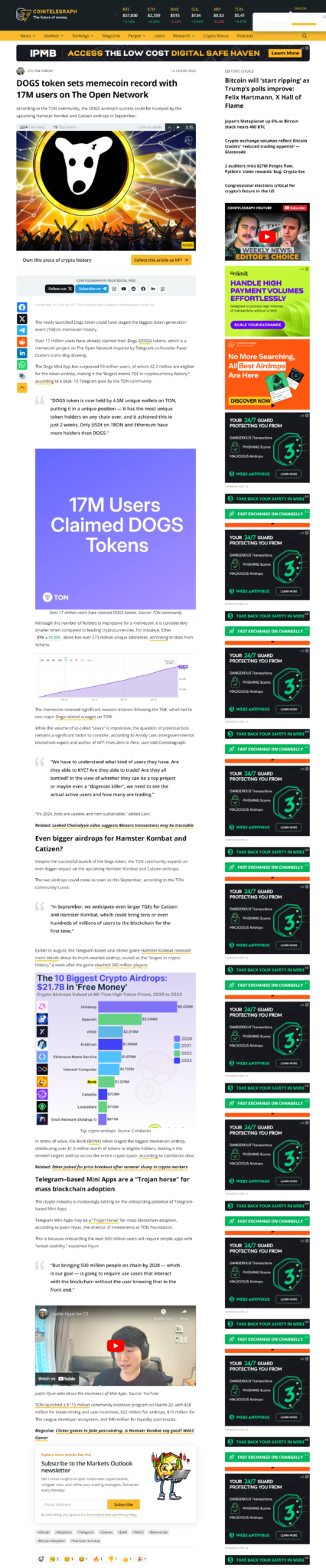
The newly launched Dogs token could have staged the biggest token generation event (TGE) in memecoin history.

Over 17 million users have already claimed their Dogs (DOGS) tokens, which is a memecoin project on The Open Network inspired by Telegram co-founder Pavel Durov’s iconic dog drawing.

The Dogs Mini App has surpassed 53 million users, of whom 42.2 million are eligible for the token airdrop, making it the “largest meme TGE in cryptocurrency history,” according to a Sept. 10 Telegram post by the TON community.

“DOGS token is now held by 4.5M unique wallets on TON, putting it in a unique position — it has the most unique token holders on any chain ever, and it achieved this in just 2 weeks. Only USDt on TRON and Ethereum have more holders than DOGS.”

Over 17 million users have claimed DOGS tokens. Source: TON community

Although this number of holders is impressive for a memecoin, it is considerably smaller when compared to leading cryptocurrencies. For instance, Ether alone has over 273 million unique addresses, according to data from Ycharts.

The memecoin received significant investor interest following the TGE, which led to two major Dogs-related outages on TON.

While the volume of so-called “users” is impressive, the question of potential bots remains a significant factor to consider, according to Anndy Lian, intergovernmental blockchain expert and author of NFT: From Zero to Hero. Lian told Cointelegraph:

“We have to understand what kind of users they have. Are they able to KYC? Are they able to trade? Are they all bottled? In the view of whether they can be a top project or maybe even a “dogecoin killer”, we need to see the actual active users and how many are trading.”

“It’s 2024, bots are useless and non-sustainable,” added Lian.

Even bigger airdrops for Hamster Kombat and Catizen?

Despite the successful launch of the Dogs token, the TON community expects an even bigger impact on the upcoming Hamster Kombat and Catizen airdrops.

The two airdrops could come as soon as this September, according to the TON community’s post:

“In September, we anticipate even larger TGEs for Catizen and Hamster Kombat, which could bring tens or even hundreds of millions of users to the blockchain for the first time.”

Earlier in August, the Telegram-based viral clicker game Hamster Kombat released more details about its much-awaited airdrop, touted as the “largest in crypto history,” a week after the game reached 300 million players.

In terms of value, the Bonk (BONK) token staged the biggest memecoin airdrop, distributing over $1.3 million worth of tokens to eligible holders, making it the seventh largest airdrop across the entire crypto space, according to CoinGecko data.

Telegram–based Mini Apps are a “Trojan horse” for mass blockchain adoption

The crypto industry is increasingly betting on the onboarding potential of Telegram-based Mini Apps.

Telegram Mini Apps may be a “Trojan horse” for mass blockchain adoption, according to Justin Hyun, the director of investments at TON Foundation.

This is because onboarding the next 500 million users will require simple apps with “actual usability,” explained Hyun:

“But bringing 500 million people on-chain by 2028 — which is our goal — is going to require use cases that interact with the blockchain without the user knowing that in the front end.”

Justin Hyun talks about the mechanics of Mini Apps. Source: YouTube

TON launched a $115 million community incentive program on March 20, with $38 million for token mining and user incentives, $22 million for airdrops, $15 million for The League developer ecosystem, and $40 million for liquidity pool boosts.


Source: https://cointelegraph.com/news/dogs-token-largest-memecoin-17m-users

Anndy Lian is an early blockchain adopter and experienced serial entrepreneur who is known for his work in the government sector. He is a best selling book author- “NFT: From Zero to Hero” and “Blockchain Revolution 2030”.

Currently, he is appointed as the Chief Digital Advisor at Mongolia Productivity Organization, championing national digitization. Prior to his current appointments, he was the Chairman of BigONE Exchange, a global top 30 ranked crypto spot exchange and was also the Advisory Board Member for Hyundai DAC, the blockchain arm of South Korea’s largest car manufacturer Hyundai Motor Group. Lian played a pivotal role as the Blockchain Advisor for Asian Productivity Organisation (APO), an intergovernmental organization committed to improving productivity in the Asia-Pacific region.

An avid supporter of incubating start-ups, Anndy has also been a private investor for the past eight years. With a growth investment mindset, Anndy strategically demonstrates this in the companies he chooses to be involved with. He believes that what he is doing through blockchain technology currently will revolutionise and redefine traditional businesses. He also believes that the blockchain industry has to be “redecentralised”.

j j j