The APAC Tech Revolution: Five trends shaping our future

The APAC Tech Revolution: Five trends shaping our future

The APAC region is a hub of technological innovation, with trends like artificial intelligence, blockchain, cryptocurrency, electric vehicles, and autonomous driving shaping the future. These technologies are not only transforming industries but also creating new opportunities and challenges.

The Asia-Pacific (APAC) region has become a significant player in the global tech landscape, setting trends that are transforming industries and societies worldwide. Having observed the tech industry closely over the years, it’s clear that APAC is not just keeping up with global developments; it is often at the forefront.

From artificial intelligence to autonomous driving, the region is a hub of innovation, with five key tech trends leading the way into a new era of technological progress.

Artificial Intelligence: The rise of Grok AI

Artificial intelligence has moved from being a futuristic idea to a transformative force reshaping our daily lives and work environments. In APAC, AI is being adopted with great enthusiasm, and one of the most intriguing projects is Grok AI, led by Elon Musk. Grok AI aims to expand the capabilities of AI, focusing on creating systems that can understand and interact with humans in more advanced ways.

Elon Musk has suggested that his AI can interpret medical data, stating, “This is still early stage, but it is already quite accurate and will become extremely good,” in a post on X. Dr. Laura Heacock, an associate professor and breast radiologist at NYU Imaging, tested xAI’s Grok AI against the same set of breast imaging scans she used for benchmarking GPT-4. Her findings, shared through a series of 12 social media posts, were not favourable. Despite Grok’s ability to recognise basic imaging types like mammograms and ultrasounds, it failed to diagnose correctly in any instance. Heacock also concluded that Grok did slightly better than GPT-4 but still missed all diagnoses. From my perspective, this is a promising start.

Countries like China, Japan, and South Korea are heavily investing in AI, recognising its potential to drive economic growth and improve quality of life. China, in particular, aims to become a global leader in AI by 2030, leveraging its vast data resources and government support. Companies like Baidu are leading the way, making significant advancements in areas like natural language processing and autonomous driving. The impact of AI in APAC is profound, revolutionising sectors such as healthcare and finance by enhancing diagnostics, patient care, fraud detection, and customer service.

Blockchain: The power of decentralisation

Blockchain technology, with its promise of decentralisation and transparency, is captivating innovators and investors across APAC. Solana, a high-performance blockchain platform, stands out for its ability to process thousands of transactions per second at a low cost, attracting more users than many traditional Web2 companies. However, some argue about its level of decentralisation, which is a topic for another day.

There is a noticeable surge in blockchain-based startups and initiatives globally. Singapore, for example, has established itself as a hub for blockchain innovation, offering a supportive regulatory environment and a vibrant ecosystem of startups and investors. South Korea is exploring blockchain for various government services to enhance transparency and efficiency. The decentralisation offered by blockchain is particularly appealing in regions seeking more inclusive and equitable systems. As blockchain technology continues to evolve, its impact on industries and societies in the region is expected to grow.

Cryptocurrency: From bitcoin to mainstream adoption

Cryptocurrency, closely linked to blockchain, has rapidly moved from the fringes to the mainstream, with Bitcoin leading the charge. The APAC region has been at the forefront of this trend, with countries like Japan and South Korea embracing cryptocurrencies and blockchain technology. Bitcoin, the first and most well-known cryptocurrency, has seen its value soar, capturing the attention of investors and governments alike. In APAC, Bitcoin is increasingly viewed as a legitimate asset class, with some countries even considering establishing Bitcoin reserve funds. This shift in perception is exemplified by former U.S. President Donald Trump’s surprising support for Bitcoin, adding further legitimacy to the cryptocurrency.

Japan recognises Bitcoin as a legal form of payment and has a robust regulatory framework for cryptocurrency exchanges. South Korea also has a vibrant cryptocurrency market, with high public interest and government support for blockchain technology. The rise of cryptocurrency in APAC is not without challenges, such as regulatory uncertainty and concerns about security and fraud. Nevertheless, the potential of cryptocurrency to revolutionise finance and create new economic opportunities is undeniable, and APAC is poised to play a leading role in this transformation.

Electric Vehicles: The revolution led by Elon Musk and China

The electric vehicle (EV) revolution is well underway, with APAC at the heart of this transformation. Elon Musk’s Tesla has been a major catalyst for the EV movement, demonstrating that electric cars can be both desirable and practical. Tesla’s success has inspired a wave of innovation and investment in this sector, particularly in China. China, the world’s largest automotive market, is rapidly becoming a leader in electric vehicles. The Chinese government has set ambitious targets for EV adoption, offering subsidies and incentives to manufacturers and consumers. As a result, Chinese companies like BYD and NIO are emerging as major players in the global EV market.

The impact of electric vehicles extends beyond environmental benefits. The shift to EVs is driving innovation in battery technology, charging infrastructure, and renewable energy integration. Moreover, the growth of the EV market is creating new economic opportunities, from manufacturing to services. APAC’s commitment to electric vehicles is a testament to its forward-thinking approach to sustainability and innovation. As the world moves towards a greener future, the region’s leadership in the EV sector will be crucial.

Autonomous Driving: The future of transportation

Autonomous driving technology is set to revolutionise transportation, with APAC leading the way. Self-driving cars promise to enhance safety, reduce congestion, and transform the way we travel. Companies like Baidu and Hyundai are at the forefront of autonomous driving research and development. Baidu’s Apollo project, for instance, is one of the most advanced autonomous driving platforms globally, with partnerships spanning multiple countries and industries.

The potential of autonomous driving extends beyond personal vehicles. In the future, services like Uber could become driverless, offering a new level of convenience and efficiency. Many countries are already exploring autonomous public transportation solutions, with pilot projects in cities like Singapore and Tokyo. The road to fully autonomous vehicles is not always smooth sailing, including regulatory hurdles, technological limitations, and public acceptance. The progress being made in APAC is promising, and the potential benefits of autonomous driving are too significant to ignore.

Bottom Line

The APAC region is a hub of technological innovation, with trends like artificial intelligence, blockchain, cryptocurrency, electric vehicles, and autonomous driving shaping the future. These technologies are not only transforming industries but also creating new opportunities and challenges.

As the region continues to lead the way in tech innovation, it is crucial to address the ethical, regulatory, and societal implications of these technologies. By doing so, it can ensure that the benefits of technological advancement are shared widely and equitably. In conclusion, the tech trends dominating APAC are a testament to the region’s dynamism and potential. As these technologies continue to evolve, they will undoubtedly play a pivotal role in shaping the future of the global economy and society.



Source: https://ciosea.economictimes.indiatimes.com/blog/the-apac-tech-revolution-five-trends-shaping-our-future/116125244


Anndy Lian is an early blockchain adopter and experienced serial entrepreneur who is known for his work in the government sector. He is a best selling book author- “NFT: From Zero to Hero” and “Blockchain Revolution 2030”.

Currently, he is appointed as the Chief Digital Advisor at Mongolia Productivity Organization, championing national digitization. Prior to his current appointments, he was the Chairman of BigONE Exchange, a global top 30 ranked crypto spot exchange and was also the Advisory Board Member for Hyundai DAC, the blockchain arm of South Korea’s largest car manufacturer Hyundai Motor Group. Lian played a pivotal role as the Blockchain Advisor for Asian Productivity Organisation (APO), an intergovernmental organization committed to improving productivity in the Asia-Pacific region.

An avid supporter of incubating start-ups, Anndy has also been a private investor for the past eight years. With a growth investment mindset, Anndy strategically demonstrates this in the companies he chooses to be involved with. He believes that what he is doing through blockchain technology currently will revolutionise and redefine traditional businesses. He also believes that the blockchain industry has to be “redecentralised”.

j j j

Memecoin Trends: Insights from the Memewonder Panel Discussion

Memecoin Trends: Insights from the Memewonder Panel Discussion

The Memewonder event, co-hosted by Binance Thailand and MemeCore, brought together industry leaders to discuss the evolving landscape of memecoins. This panel, part of the Thailand Blockchain Week 2024, featured insights from key figures in the blockchain and cryptocurrency space. The discussion, moderated by Anndy Lian, a best-selling author and Managing Director of LIFT Ecofund by MemeCore, delved into the trends, challenges, and future of memecoins, particularly focusing on Community Takeover (CTO) projects.

Key Themes and Insights

The Rise of Community Takeover (CTO) Projects

Anndy Lian started off by saying that CTO projects are gaining popularity due to their community-driven nature. Unlike traditional projects led by developers, CTOs empower communities to take charge, fostering a sense of ownership and engagement. This model aligns with the decentralized ethos of blockchain, where communities can drive projects forward without relying on centralized leadership.

Jordan Jefferson, CEO of MyDoge, provided insights from the Dogecoin community, the original CTO project. He highlighted the narrative appeal of CTOs, where communities take over projects from anonymous developers. Jefferson pointed out that while CTOs offer a compelling narrative, they face challenges such as funding and coordination. He emphasized the need for sustainable models and investable opportunities within the Dogecoin ecosystem, aiming to attract more developers and projects to build on Dogecoin.

Challenges and Risks of CTO Projects

Despite their appeal, CTO projects face significant challenges. Anndy Lian highlighted issues such as fragmented communities, lack of funding, and the need for strong leadership. Without adequate resources and coordination, CTO projects risk failing, leading to the demise of the project. The panelists stressed the importance of sustainable models and the need for communities to secure funding and liquidity to thrive.

Louis Bellet, CEO & Fonder, Yellow, replied to the comment by highlighting the role of Yellow in decentralizing finance. He emphasized the importance of community-driven projects, noting that developers often lack the skills to build strong communities. Bellet argued that memecoins should naturally transition to community leadership, where new leaders emerge from within the community to drive the project forward. He also mentioned Yellow’s market-making division, which has been approached by several CTO projects for token listings, underscoring the growing interest in community-led initiatives.

The Role of Memecoins in the Broader Blockchain Ecosystem

Memecoins, often seen as speculative assets, have the potential to drive innovation and engagement in the blockchain space. The panelists discussed the entertainment value of memecoins, likening them to cultural phenomena that capture public imagination. They also noted the potential for memecoins to integrate with real-world applications, such as mobile apps and merchandise, to enhance their utility and appeal.

Eddie Li, Co-founder, AEON, shared his perspective as a payment protocol provider, focusing on the consumer attraction of memecoins. He noted that memecoins, driven by community and financial incentives, are gaining traction where traditional projects struggle. Li emphasized the importance of facilitating payments across different chains to support memecoin adoption. He also expressed concerns about the sustainability of memecoins, cautioning against projects with weak narratives or visions.

Future Trends and Innovations

Looking ahead, the panelists identified several trends that could shape the future of memecoins. They anticipated more innovation in fair launches and community involvement, with projects exploring new ways to engage and reward their communities. The panelists also highlighted the potential for memecoins to collaborate with traditional businesses, leveraging their community-driven nature to create new opportunities and partnerships.

Allan Fang, Partner, Blockchain for Good Alliance and Head of Moledao added that education is important. He stressed the importance of community support and governance in building strong projects. Fang noted that memecoins offer a unique way to engage communities, likening them to totems that foster loyalty and engagement. He also highlighted the potential for memecoins to link with real-world brands, suggesting that they could serve as effective community management tools.

Conclusion

The Memewonder panel discussion provided valuable insights into the evolving landscape of memecoins. As the blockchain industry continues to grow, memecoins are poised to play a significant role in driving innovation and community engagement. However, their success will depend on the ability of communities to navigate the challenges of funding, leadership, and sustainability. By fostering strong communities and exploring new applications, memecoins can continue to thrive and contribute to the broader blockchain ecosystem.


Anndy Lian is an early blockchain adopter and experienced serial entrepreneur who is known for his work in the government sector. He is a best selling book author- “NFT: From Zero to Hero” and “Blockchain Revolution 2030”.

Currently, he is appointed as the Chief Digital Advisor at Mongolia Productivity Organization, championing national digitization. Prior to his current appointments, he was the Chairman of BigONE Exchange, a global top 30 ranked crypto spot exchange and was also the Advisory Board Member for Hyundai DAC, the blockchain arm of South Korea’s largest car manufacturer Hyundai Motor Group. Lian played a pivotal role as the Blockchain Advisor for Asian Productivity Organisation (APO), an intergovernmental organization committed to improving productivity in the Asia-Pacific region.

An avid supporter of incubating start-ups, Anndy has also been a private investor for the past eight years. With a growth investment mindset, Anndy strategically demonstrates this in the companies he chooses to be involved with. He believes that what he is doing through blockchain technology currently will revolutionise and redefine traditional businesses. He also believes that the blockchain industry has to be “redecentralised”.

j j j

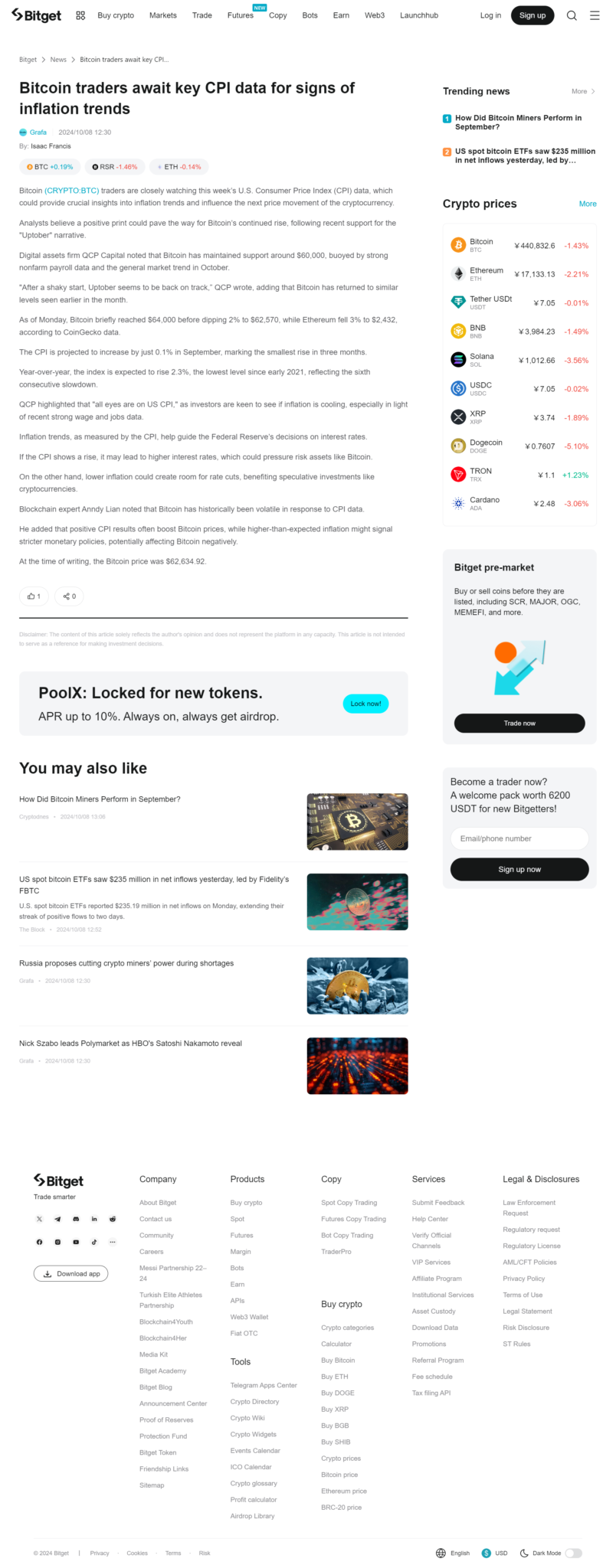
Bitcoin traders await key CPI data for signs of inflation trends

Bitcoin traders await key CPI data for signs of inflation trends

Bitcoin (CRYPTO:BTC) traders are closely watching this week’s U.S. Consumer Price Index (CPI) data, which could provide crucial insights into inflation trends and influence the next price movement of the cryptocurrency.

Analysts believe a positive print could pave the way for Bitcoin’s continued rise, following recent support for the “Uptober” narrative.

Digital assets firm QCP Capital noted that Bitcoin has maintained support around $60,000, buoyed by strong nonfarm payroll data and the general market trend in October.

“After a shaky start, Uptober seems to be back on track,” QCP wrote, adding that Bitcoin has returned to similar levels seen earlier in the month.

As of Monday, Bitcoin briefly reached $64,000 before dipping 2% to $62,570, while Ethereum fell 3% to $2,432, according to CoinGecko data.

The CPI is projected to increase by just 0.1% in September, marking the smallest rise in three months.

Year-over-year, the index is expected to rise 2.3%, the lowest level since early 2021, reflecting the sixth consecutive slowdown.

QCP highlighted that “all eyes are on US CPI,” as investors are keen to see if inflation is cooling, especially in light of recent strong wage and jobs data.

Inflation trends, as measured by the CPI, help guide the Federal Reserve’s decisions on interest rates.

If the CPI shows a rise, it may lead to higher interest rates, which could pressure risk assets like Bitcoin.

On the other hand, lower inflation could create room for rate cuts, benefiting speculative investments like cryptocurrencies.

Blockchain expert Anndy Lian noted that Bitcoin has historically been volatile in response to CPI data.

He added that positive CPI results often boost Bitcoin prices, while higher-than-expected inflation might signal stricter monetary policies, potentially affecting Bitcoin negatively.

At the time of writing, the Bitcoin price was $62,634.92.


Source: https://www.bitget.com/news/detail/12560604254521

Anndy Lian is an early blockchain adopter and experienced serial entrepreneur who is known for his work in the government sector. He is a best selling book author- “NFT: From Zero to Hero” and “Blockchain Revolution 2030”.

Currently, he is appointed as the Chief Digital Advisor at Mongolia Productivity Organization, championing national digitization. Prior to his current appointments, he was the Chairman of BigONE Exchange, a global top 30 ranked crypto spot exchange and was also the Advisory Board Member for Hyundai DAC, the blockchain arm of South Korea’s largest car manufacturer Hyundai Motor Group. Lian played a pivotal role as the Blockchain Advisor for Asian Productivity Organisation (APO), an intergovernmental organization committed to improving productivity in the Asia-Pacific region.

An avid supporter of incubating start-ups, Anndy has also been a private investor for the past eight years. With a growth investment mindset, Anndy strategically demonstrates this in the companies he chooses to be involved with. He believes that what he is doing through blockchain technology currently will revolutionise and redefine traditional businesses. He also believes that the blockchain industry has to be “redecentralised”.

j j j