This session captures a detailed discussion among several speakers about the current state and future of the cryptocurrency market. The conversation begins with introductions, where participants share their backgrounds and experiences in the crypto space. Speakers include @encryptedbae, @0xmugen, @anndylian, @cryptowendyo, @crypto_birb, @Crypto_Assessor , among others, who bring diverse perspectives from content creation, trading, and project development.
The discussion touches on various topics, including the current market sentiment, the role of meme coins, NFTs, and the impact of regulatory developments. Some participants express optimism about the market, despite recent downturns, emphasizing the cyclical nature of crypto and the importance of patience and risk management. They highlight that while Bitcoin is down from its all-time high, the overall market structure remains strong, and opportunities still exist, particularly in more volatile assets.
There is a discussion on the potential of meme coins and NFTs, noting that while many projects lack utility, some, like Doge and Shiba Inu, have built significant ecosystems. It is argued that meme coins are here to stay due to their strong community support and potential for future utility. The conversation also explores the idea of NFTs and meme coins as community tokens for brands and celebrities, suggesting that these digital assets could play a significant role in fan engagement and brand loyalty.
A comprehensive analysis of the market is provided, using historical data and technical indicators to predict future trends. The importance of following market trends rather than trying to predict exact peaks is emphasized, suggesting that the best strategy is to trail stop losses and let the market dictate actions. The potential impact of regulatory developments in the US and Europe is highlighted, noting that clearer regulations could drive more retail and institutional investment into the market.
The speakers agree that the market is currently in a consolidation phase, with significant growth expected in the fourth quarter of 2024 and the first quarter of 2025. They discuss the potential catalysts for the next big bull run, including regulatory clarity, the adoption of Bitcoin ETFs, and the entry of institutional investors. The conversation concludes with a consensus that while the market may experience short-term volatility, the long-term outlook for cryptocurrencies remains bullish, driven by increasing adoption and technological advancements.
Full recording of X Spaces can be found here:
https://x.com/Cointelegraph/status/1804126280050167938
Anndy Lian is an early blockchain adopter and experienced serial entrepreneur who is known for his work in the government sector. He is a best selling book author. The latest book is Web4: The Age of Autonomous Intelligence.
The decentralized finance (DeFi) space is leaving the bear winter behind and entering a bull summer as industry interest continues to pick up and the market moves into incentive-driven growth that focuses on real utility and technological innovations.
Or at least, that is what experts in the DeFi space are saying.
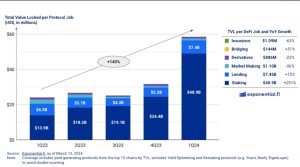
A recent report published by Exponential found that the “latest indicators signal not just growth but a transformative shift” within the DeFi space with significant growth in interest in DeFi yields.
The total value locked (TVL) in yield-generating DeFi protocols has steadily increased from $26.5 billion in the third quarter of 2023 to $59.7 billion in the first quarter of 2024, according to the report.
Total Value Locked per Protocol Job. Source: Exponential.fi
This growth signifies a return of confidence and liquidity to the DeFi markets.
We spoke to experts to find out the latest DeFi trends for 2024.
Key Takeaways
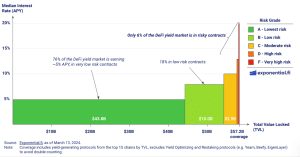
The DeFi industry continues to evolve with $43 billion already locked in low-risk yield contracts, indicating a shift towards more stable and reliable investment avenues.
The merging of traditional financial systems with DeFi is a significant trend, with financial institutions expected to use DeFi innovations such as smart contracts and decentralized lending to improve their services.
The DeFi space faces potential regulatory hurdles, exemplified by the SEC’s actions against Uniswap.
The development of Layer-2 scaling solutions and crypto bridges are pivotal in enhancing transaction speeds and reducing costs, thus supporting the broader adoption of DeFi.
Increased international regulatory cooperation is likely to result in a unified global framework for digital assets, balancing innovation with financial stability and opening up new opportunities for the DeFi sector.
DeFi Industry Is Maturing
As central banks signal towards more rate cuts, the DeFi yields space is gaining significant popularity as an attractive investment form with DeFi markets maturing, Anndy Lian, an inter-governmental blockchain advisor, told Techopedia.
This was also backed by the Exponential report, which noted that over $43 billion were locked into very low-risk DeFi yield contracts.
75% of DeFi total value locked (TVL) is currently in pools offering 0-5% of annual percentage yield (APY).
Total Value Locked in DeFi Yield Markets. Source: Exponential.fi
Additionally, new trends in the market are pointing towards more mainstream adoption, with DeFi projects continuing to grow and integrate more and more with traditional finance.
Lian said:
“The focus [of the DeFi space in 2024] seems to be on sustainable growth, improved security, and real-world applications that could lead to wider acceptance and use of DeFi platforms.”
Igor Telyatnikov, CEO and co-founder of AlphaPoint, a digital asset and cryptocurrency trading and investing platform, added that with over $90 billion locked in DeFi protocols, the DeFi market could very much reach and even surpass previous heights of $150 billion locked as previously seen in 2021. He said:
“Despite the challenges faced, DeFi has continued to attract both developers and users, showcasing its ability to innovate and adapt. We are seeing a maturing ecosystem with more robust infrastructure, improved user experiences, and increasing collaboration among projects.”
Decentralized Finance Trends 2024
Over the last year, DeFi applications have undergone significant changes, with a number of new trends starting to show up in the industry, stemming from crypto bridges to a number of Layer-2 (L2) scaling solutions.
Here are some of the biggest DeFi trends experts are paying attention to in the second half of 2024.
1. Traditional Finance Integration
The traditional finance market entering the DeFi space is perhaps the biggest trend in the current DeFi landscape.
Lian noted that the integration of traditional markets into the DeFi space could become a “significant step towards a more inclusive and efficient financial ecosystem,” with traditional financial institutions expected to collaborate more closely with the DeFi space, utilizing features like smart contracts, tokenization, and decentralized lending to enhance their products and services.
Lian said:
“A growing number of financial institutions are projected to adopt DeFi solutions, with significant investments to streamline operations and offer innovative services. The 24/7 operational model of DeFi breaks down traditional barriers of time and geography, offering constant accessibility and borderless transaction capabilities.”
Telyatnikov added that as regulatory clarity improves, the DeFi space could see a lot of exploration of new use cases in collaboration with more traditional institutions.
“Furthermore, the lines between DeFi and centralized finance will blur, leading to hybrid solutions that combine the best of both worlds.”
2. Layer-2 Scaling Solutions
Layer-2 scaling solutions are a prominent tech DeFi example that is expected to play a crucial role in the second half of 2024, AlphaPoint’s Telyatnikov noted. These solutions will enable faster and cheaper transactions while also maintaining the security of the underlying blockchain.
Lian added that the ability of L2 solutions to enhance the scalability and efficiency of blockchain networks is also vital for the growth of DeFi technology.
3. Crypto Bridges
However, major DeFi platforms have seen other emerging trends in the past year, including the development of crypto bridges and Know Your Customer (KYC’d) DeFi, according to Lian. He said:
“The emergence of crypto bridges has facilitated asset transitions to faster layer 2 networks like Arbitrum and Polygon, enhancing ERC-20 token trading while maintaining exposure to Ethereum.”
4. Regulation
AlphaPoint’s Telyatnikov added that over the past year, one of the most significant changes in the DeFi landscape was the heightened regulatory scrutiny.
“The recent Wells notice issued to Uniswap, the largest decentralized exchange by volume, and the ongoing Tornado Cash case have sent shockwaves and warning signals through the DeFi community, particularly in the US. Uniswap, being a significant utility in the DeFi ecosystem, is now facing a direct attack from regulators, creating uncertainty that may take a long time to resolve, similar to the Coinbase lawsuit.”
5. KYC’d DeFi
Such lawsuit cases bring direct challenges to the legal status of DeFi products, their tokens and use cases, which is why there could also be a potential rise of KYC’d DeFi. Know Your Customer procedures are known to align with regulatory standards and reduce illegal activities, which could serve as a limelight for a number of DeFi platforms.
For example, Singularity, a startup developing a protocol to provide institutions with confidential access to DeFi, attracted $2.2 million to develop a KYC-compliant DeFi platform for institutions.
Miko Matsumura, the managing partner at Gumi Cryptos Capital, said in a press release on February 22, 2024:
“Singularity addresses a crucial need in the market, providing institutional users with both the compliance and the commercial confidentiality necessary to participate in DeFi.”
Additionally, the SEC’s new regulatory definitions have the potential to bring decentralized exchanges (DEXs) within the scope of regulations for US broker-dealers, affecting their operations, which could also play a significant impact on the future of the DeFi space in the coming year.
However, global regulatory cooperation and the balance between innovation and safeguarding against financial stability risks will be crucial for further development of the DeFi space.
“The [current] focus seems to be on creating a regulatory environment that supports innovation while ensuring the security and integrity of the financial system,” Lian said.
The Bottom Line
As DeFi transitions from its speculative phase into a more mature and stable environment, the integration with traditional finance and the adoption of advanced technologies like Layer-2 solutions signify a robust future.
Despite facing regulatory challenges, the sector’s innovative response showcases its resilience and potential for sustained growth.
The growing acceptance and implementation of KYC procedures in DeFi could further enhance its legitimacy and foster broader adoption.
Overall, the future of DeFi looks promising, poised to redefine financial landscapes globally as it bridges the gap between traditional and decentralized finance while navigating regulatory challenges.
Anndy Lian is an early blockchain adopter and experienced serial entrepreneur who is known for his work in the government sector. He is a best selling book author. The latest book is Web4: The Age of Autonomous Intelligence.
For all the fun in trading images — and trading on the value of images — that happens, there are plenty of compelling use cases that are likely to enter the wider world.
Techopedia spoke to governmental advisor and author Anndy Lian about his take on the trajectory of NFTs and their impact across various industries, informed by his address this month at NFT NYC 2024.
NFT.NYC is a conference that brings together the global NFT community and web3 professionals in New York City.
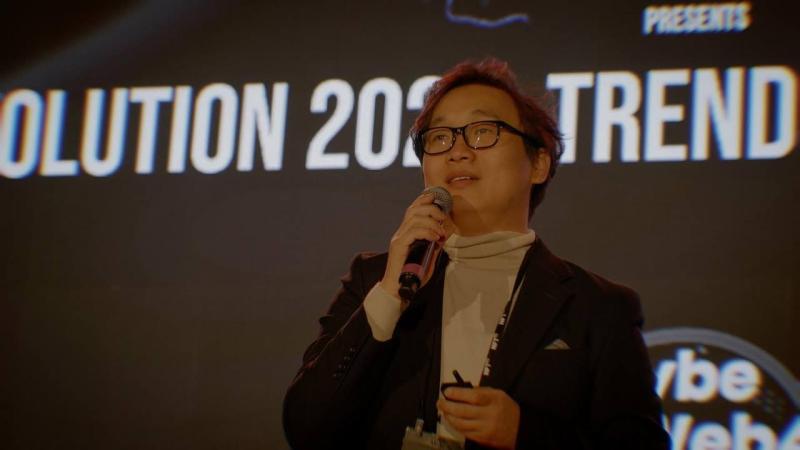
Anndy’s session was on April 4, 2024, at the main stage. His topic was titled “NFT Revolution 2024: Trends & Future Predictions” and followed his speech last year called ‘Think Bigger.’
Following his speech, Lian, who is also the author of NFT: From Zero to Hero, outlined his thoughts to Techopedia, focussing on trends, use cases, and the future shape of the market.
Key Takeaways
In a conversation with Anndy Lian at NFT NYC 2024, the trajectory of NFTs and their broad impact across industries was discussed.
Key trends to watch this year include RWA NFTs, NFT ETFs, AI NFTs, the rise of memes and collections by renowned artists, and ‘photographs as NFTs’.
The ERC 404 Hybrid token standard will blend fungible and non-fungible token features.
Solana and Binance Smart Chain are pivotal in the NFT boom, with mature infrastructure and community support
6 Key NFT Trends in 2024
RWA NFTs: Digitizing the Physical World
Real-World Asset (RWA) NFTs allow tangible assets like real estate, intellectual property, and fine art to be tokenized into liquid digital formats.
This trend is not just about tokenization but about improving accessibility and creating new markets and liquidity opportunities
For instance, Nexum.ai is leveraging NFTs to revolutionize supply chain financing, showcasing the technology’s practical benefits in traditional industries.
NFT ETFs: Diversification and Institutional Involvement
NFT Exchange-Traded Funds (ETFs) are emerging as opportunities for investors. By offering a diversified portfolio of NFTs, these ETFs provide a level of exposure similar to institutional-grade assets. Backed by credible entities, NFT ETFs could democratize access to the NFT market, allowing for broader participation and investment.
AI NFTs
AI NFTs represent a fusion of artificial intelligence with the NFT ecosystem. Platforms like copx.ai are at the forefront, wrapping NFTs around AI trading tools. This integration makes NFTs more accessible and functional, providing users with exclusive market insights and trades, thus adding a layer of intelligence to the NFT experience.
Meme with a Twist
The Squid Bros, a collection of 10,000 PFPs by SquidGrow created by renowned artist Mike S. Miller, known for his work with Marvel, DC, and Game of Thrones, exemplifies the power of community and intellectual property.
This project demonstrates how strong community backing and robust IP can elevate a meme-inspired NFT collection to new heights, creating value and engagement.
Photographs as NFTs: Capturing Authenticity
Seed.Photo’s selective process has led to a unique collection of photographs minted as NFTs. This approach appeals to major brands seeking authenticity and artistic value.
By curating real photographs as NFTs, Seed.Photo is setting a new standard for quality and exclusivity in the NFT marketplace.
The ERC 404 Hybrid Token Standard
ERC 404 marks a significant innovation in the blockchain world, blending the versatility of fungible tokens with the uniqueness of non-fungible tokens, and offering unique investor opportunities.
This hybrid approach could potentially unlock new functionalities and use cases for digital assets, making them more adaptable and valuable across various applications.
Solana & BNB: The Blockchain Networks Fueling the NFT Boom
Lian emphasized the role of blockchain networks such as Solana and Binance Smart Chain in the current NFT boom, which offer the necessary infrastructure and community support for the development and trade of NFTs.
He praised the chains for these features:
Solana
Lian said:
“It has a high throughput and low fees for NFTs, making it an ideal environment for NFT creation and trade.
“It supports a fully decentralized on-chain experience for artists and collectors, with features like auctions and perpetual royalties coded directly into the NFTs.
“Solana’s NFT standard and minting program offer extreme customizability, backed by a suite of tools which empower creators to launch their NFT storefronts and engage with their audience directly.”
BNB Chain
Lian said:
“BNB Chain offers Ethereum Virtual Machine (EVM) compatibility, which allows for the utilization of Ethereum’s well-established standards and tools.
This compatibility has positioned them as a competitive alternative for NFT creators, especially those seeking lower fees and a supportive community.
“Their marketplace provides a high liquidity platform for users to launch and trade NFTs, further bolstered by multi-chain support for seamless transfers between BSC and other networks.”
Lian added that a synergistic ecosystem for NFTs is important but that “Solana and BNB Chain have each carved out a niche, offering distinct advantages that cater to the diverse needs of the NFT community.”
The Bottom Line
Anndy Lian’s insights at NFT NYC and Techopedia reflect the power within NFTs to redefine ownership and artistic expression in the digital realm.
The speculators come first, but as technology and adoption continue, real purposes evolve, and 2024 will likely be no exception.
Anndy Lian is an early blockchain adopter and experienced serial entrepreneur who is known for his work in the government sector. He is a best selling book author. The latest book is Web4: The Age of Autonomous Intelligence.