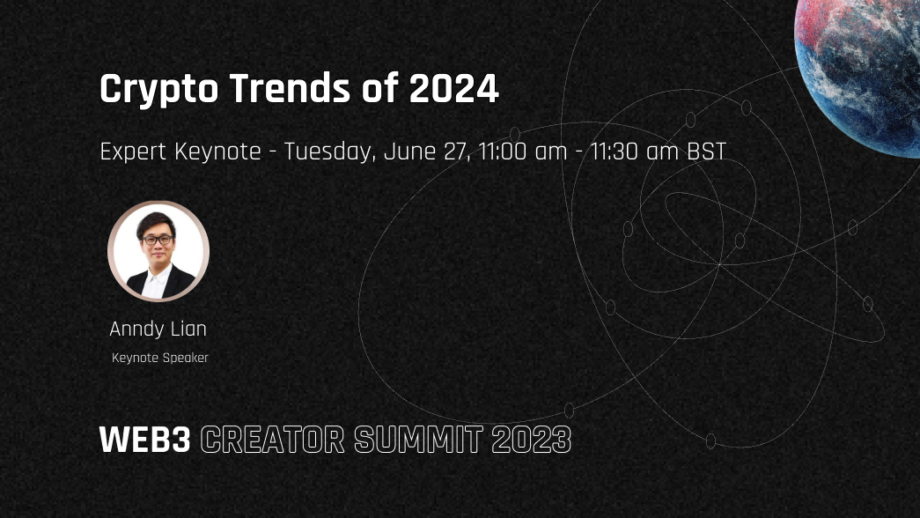
Web3 Creator Summit Expert Keynote: Crypto Trends of 2024 by Anndy Lian

Web3 Creator Summit Expert Keynote: Crypto Trends of 2024 by Anndy Lian

As we look into the future of the crypto industry, it’s essential to anticipate the trends and developments that will shape the landscape in 2024. I discussed the transformative power of artificial intelligence (AI), the significance of Central Bank Digital Currency (CBDC), the advancement of the crypto travel rule, and the shift towards decentralized governance, among other topics. Let’s explore these predictions further:

Artificial Intelligence: Transforming Everyday Life

I believe that AI will continue to disrupt various sectors and seamlessly integrate into our daily lives. Its impact is expected to be profound, reshaping industries and revolutionizing the way we interact and conduct business.

CBDC: A Game-Changer for the Crypto Industry

I place great emphasis on the significance of Central Bank Digital Currency (CBDC) as a pivotal element in tracking, tracing, and taxing financial transactions. The introduction of CBDCs holds the potential to drive the widespread adoption of digital assets and revolutionize the crypto industry as a whole. The enhanced transparency and accountability provided by CBDCs have the capacity to reshape our perception of and engagement with cryptocurrencies.

Crypto Travel Rule: Advancing Traceability and Taxation

The imminent advancement of the crypto travel rule aims to elevate traceability and taxation within the crypto space. By implementing stricter regulations, authorities can ensure that transactions are closely monitored, leading to a more secure and transparent ecosystem for all participants.

Layer 2: The Growing Influence of Bitcoin and Ethereum

I highlight the continued growth of Bitcoin and Ethereum, the two leading cryptocurrencies. Additionally, the rise of BRC20 tokens and the development of zero-knowledge proofs (ZK) are expected to contribute to the expansion of Layer 2 solutions. These advancements promise to enhance scalability, security, and efficiency within blockchain networks, fostering an environment conducive to widespread adoption.

Next Level NFT: Adoption and Brand Recognition

Non-Fungible Tokens (NFTs) have experienced increased adoption, thanks to the support and endorsement of major brands. Although the sales volume of NFTs has not seen significant growth, their relevance and influence continue to expand. NFTs provide unique digital assets that hold intrinsic value and can be securely traded on blockchain platforms, revolutionizing the concept of ownership and collectibles.

Web4: A Decentralized and Autonomous Web

The emergence of Web4 signifies a paradigm shift towards a more decentralized and autonomous web. Internet natives are actively participating in building decentralized narratives and fostering a more inclusive online environment. This transition aims to empower individuals and ensure that digital spaces remain democratic and accessible to all, free from the control of centralized entities.

Security Tokens: Advancing Crypto’s Potential

Security tokens play a vital role in unlocking the full potential of the crypto market. By tokenizing traditional financial assets such as stocks and bonds, the adoption of security tokens has the potential to revolutionize traditional markets and attract a broader investor base to the world of crypto. This democratization of access to financial assets promises to reshape the investment landscape.

Commodity Trading with Crypto: Expanding Possibilities

The integration of cryptocurrencies into commodity trading markets opens up exciting new possibilities for investors. From oil to gold, crypto enables individuals to seamlessly trade popular commodities, providing greater flexibility and choice while reducing traditional barriers to entry.

Mainstream Adoption: Defi and Financial Institutions

Decentralized finance (Defi) is gaining traction among mainstream financial companies. Banks, their clients, and family offices are increasingly allocating a significant portion of their assets to crypto. This mainstream acceptance further solidifies the legitimacy and potential of Defi as an integral part of the financial ecosystem, encouraging wider adoption and collaboration.

In conclusion, these predictions offer valuable insights into the future of various industries. Embracing the disruptions brought about by artificial intelligence, CBDCs, decentralized governance, and other emerging trends will be essential for individuals and businesses to thrive in an ever-changing world. By leveraging these transformative forces, we can unlock new opportunities, reshape traditional models, and shape a future that is both innovative and inclusive.


Anndy Lian is an early blockchain adopter and experienced serial entrepreneur who is known for his work in the government sector. He is a best selling book author- “NFT: From Zero to Hero” and “Blockchain Revolution 2030”.

Currently, he is appointed as the Chief Digital Advisor at Mongolia Productivity Organization, championing national digitization. Prior to his current appointments, he was the Chairman of BigONE Exchange, a global top 30 ranked crypto spot exchange and was also the Advisory Board Member for Hyundai DAC, the blockchain arm of South Korea’s largest car manufacturer Hyundai Motor Group. Lian played a pivotal role as the Blockchain Advisor for Asian Productivity Organisation (APO), an intergovernmental organization committed to improving productivity in the Asia-Pacific region.

An avid supporter of incubating start-ups, Anndy has also been a private investor for the past eight years. With a growth investment mindset, Anndy strategically demonstrates this in the companies he chooses to be involved with. He believes that what he is doing through blockchain technology currently will revolutionise and redefine traditional businesses. He also believes that the blockchain industry has to be “redecentralised”.

j j j

Founders Club Interviews Anndy Lian- Crypto Trends of 2023 (Part 1)

Founders Club Interviews Anndy Lian- Crypto Trends of 2023 (Part 1)

Founders Club brings founders from all walks of life together. Sergey Kochnev interviewed Anndy Lian, an intergovernmental blockchain advisor, investor and book author at Dubai, Blue Waters Island.

Current state of crypto

Anndy was also asked about the current state of the crypto market and Bitcoin’s future. He believes that the overall sentiments are not bad, and there is still hope for the market. The market has had a good run, and even though the projection towards a $30,000 run is around the corner, it’s just a matter of perspective.

He also believes that investing in crypto is a long-term game rather than a short-term one. It’s similar to investing in the stock market, where there are fluctuations, and people should expect them. He mentioned that during the 2016-2019 ICO era, people were having 10x and 100x gains within six or three months, which is not the case anymore.

Regarding the main trends in crypto, He stated that institutions are looking to create products using a basket of cryptocurrencies. They are not only interested in buying Bitcoin, but they also want to invest in other crypto assets.

Another trend is the rise of NFTs. They can represent anything from digital art and music to in-game items and virtual real estate. NFTs have become increasingly popular in recent years, with some pieces selling for millions of dollars. But with the rise in popularity of NFTs comes the risk of scams and bad actors in the space. By arming themselves with knowledge, people can avoid falling prey to bad actors and ensure they’re investing in legitimate NFTs. This is the gist of Anndy’s new book, NFT: From Zero to Hero.

The problem with NFTs and Web3 is that some people are simply jumping on the hype train without truly understanding the technology. It’s important for people to understand the utility of NFTs and how they can be used in real-life businesses and games.

While some may argue that NFTs are simply a web2 experience, it’s important to remember that technology takes time to adapt and for adoption to take place. It’s similar to the dot-com bubble of the early 2000s, where it took a decade for companies to become trillion-dollar businesses. But with the cycles of innovation becoming faster, it’s likely that the adoption of NFTs and Web3 will happen more quickly.

How to gain crypto knowledge

Sergey asked about how one can gain practical knowledge in the cryptocurrency market? When it comes to cryptocurrency investment, many people focus on the potential gains and forget about the possibility of losses. It is important to understand that the experience of losing is just as much a part of the journey as winning. Therefore, it is essential to have practical knowledge before investing in this market. The first step towards gaining practical knowledge is research. Do not just read articles, try it out for yourself. You cannot claim to be an expert in something you have not experienced. Some people claim to work in exchanges or on projects without even owning an NFT or understanding how dynamic the market can be. Practical knowledge is key. Educate yourself about the market before investing. Knowledge is power and this applies to any investment, whether it’s real estate, stocks, or cryptocurrency.

You cannot just jump into the market, hoping to get lucky and make a profit. Many people bought Bitcoin when it was at its peak, only to lose out when the market crashed.

It is also important to remember that hodling or holding on to a coin is not always the best option. You need to make your own decisions based on your understanding of the market. Do not blindly follow the advice of others without considering your own interests.

Looking ahead

Looking ahead to the end of 2023, it’s difficult to predict where the market will go. However, it’s clear that true decentralization and self-custody will continue to be important factors in the development of Web3 technologies. As the industry evolves, it will be important to stay focused on what is truly decentralized, and to avoid being convinced or confused by marketing hype.

Q3 and Q4 of this year will be a more promising time for the gaming industry. It’s also expected that bigger brands in the US will find a way to keep themselves in the game, while maintaining a good reputation. This is a significant advantage for the industry, as it will drive more positive vibes and traction. Web3 is expected to remain a good muscle within the US ecosystem, even without cryptocurrency. The industry is hopeful that this new technology will usher in a new era of gaming that is more secure, transparent, and accessible to all.

Anndy ended his interview by emphasizing that gaining practical knowledge in the cryptocurrency market is essential before investing. It is not enough to rely on theoretical knowledge or the advice of others. Research, try things out, and make your own decisions based on your understanding of the market. Remember, knowledge is power.


Anndy Lian is an early blockchain adopter and experienced serial entrepreneur who is known for his work in the government sector. He is a best selling book author- “NFT: From Zero to Hero” and “Blockchain Revolution 2030”.

Currently, he is appointed as the Chief Digital Advisor at Mongolia Productivity Organization, championing national digitization. Prior to his current appointments, he was the Chairman of BigONE Exchange, a global top 30 ranked crypto spot exchange and was also the Advisory Board Member for Hyundai DAC, the blockchain arm of South Korea’s largest car manufacturer Hyundai Motor Group. Lian played a pivotal role as the Blockchain Advisor for Asian Productivity Organisation (APO), an intergovernmental organization committed to improving productivity in the Asia-Pacific region.

An avid supporter of incubating start-ups, Anndy has also been a private investor for the past eight years. With a growth investment mindset, Anndy strategically demonstrates this in the companies he chooses to be involved with. He believes that what he is doing through blockchain technology currently will revolutionise and redefine traditional businesses. He also believes that the blockchain industry has to be “redecentralised”.

j j j

Exploring The Investment Trends Of Crypto Venture Capitalists In Today’s “Bullish” Market

Exploring The Investment Trends Of Crypto Venture Capitalists In Today’s “Bullish” Market

The value of a cryptocurrency can be influenced by various factors, including news about the cryptocurrency and its underlying technology, government regulations, and overall market conditions. The market can also be influenced by investor sentiment, which can be affected by a wide range of events. Just a month ago, everyone is still saying its a bear market. As of this week, everyone is cheering for the current bull run. Bitcoin reached its highest price since mid-August by breaking through the price ceiling of US$24,000. This was largely attributed to investors liquidating almost US$70 million of predominantly short-position bets.

There are many different types of investments in the cryptocurrency space, and the popular specific investments can vary over time.

More Popular Types Of Cryptocurrency Investments

Buying And Holding: This is the most straightforward and common investment strategy. Investors buy a cryptocurrency like Bitcoin or Ethereum and hold onto it for the long term, with the expectation that its value will increase over time.

Mining: Mining involves using computer hardware to solve complex mathematical problems and verify transactions on a blockchain network. Miners are rewarded with newly minted cryptocurrency as an incentive for their work.

Staking: Staking involves holding a certain amount of a cryptocurrency in a wallet and locking it up to support the network’s security and transaction processing. In exchange, stakers receive rewards in the form of newly minted coins.

Initial Coin Offerings (ICOs) and Initial Exchange Offerings (IEOs): ICOs and IEOs are ways for companies to raise funds by selling newly created cryptocurrencies to investors. This strategy can be risky as some ICOs and IEOs have turned out to be scams.

Cryptocurrencies have several investment theses. Some investors believe that they have the potential to replace traditional fiat currencies, while others see them mainly as a store of value or a means of exchange. In addition, some investors see the underlying blockchain technology as having the potential to revolutionize a variety of industries, from supply chain management to identity verification.

Some Specific Investment Theses For Cryptocurrencies

The use of cryptocurrency as a means of exchange: Some people believe that cryptocurrencies will eventually be used as a primary means of exchange, replacing traditional fiat currencies.

The store of value thesis: Some people believe that cryptocurrencies will eventually be used as a store of value, similar to gold.

The blockchain revolution thesis: Some people believe that the underlying blockchain technology has the potential to revolutionize a wide range of industries and that investing in cryptocurrencies is a way to get in on the ground floor of this technological revolution.

The “greater fool” theory: Some people believe that the price of a cryptocurrency will continue to go up as long as someone is willing to buy it at a higher price, even if there is no intrinsic value to the cryptocurrency. This is sometimes referred to as the “greater fool” theory of investing.

Venture capitalists (VCs) are individuals or firms who provide funding to early-stage companies in exchange for an equity stake. In the cryptocurrency space, VCs have traditionally invested directly in cryptocurrencies or blockchain-based startups, but recently there has been a shift in focus towards investments in blockchain infrastructure and applications.

The fall of FTX and other crypto exchanges has led VCs to become more cautious about investing in cryptocurrencies directly. Instead, they are looking to invest in companies that are building out the underlying technology and infrastructure of the blockchain. This includes companies that are developing blockchain-based platforms, building decentralized applications, or working on other blockchain-related projects.

The reason for this shift is that many VCs see a long-term potential for blockchain technology to disrupt various industries and believe that investing in the underlying infrastructure will yield better returns than investing directly in cryptocurrencies, which are known for their volatility. Another reason for this shift is that the regulatory landscape for cryptocurrencies is still uncertain and can create risks for investors. By investing in blockchain infrastructure and applications, VCs can mitigate some of these risks and potentially realize greater returns in the long run.

Some Specific Areas Of Interest For VCs In The Cryptocurrency Space.

Blockchain infrastructure: VCs are increasingly supporting startups working towards building a robust blockchain infrastructure. These companies focus on developing innovative solutions that can potentially revolutionize the blockchain ecosystem. One key area of interest for VCs is the development of new consensus algorithms. These algorithms enable network participants to agree on a shared state of the blockchain without relying on a centralized authority. Some companies are working on proof-of-stake (PoS) algorithms that reduce the energy consumption associated with proof-of-work (PoW) algorithms, which are used by Bitcoin and other cryptocurrencies.

They are also investing in layer1 companies, which are startups that focus on building the foundational infrastructure layer of the blockchain. These companies are working on creating new and innovative technologies that can potentially improve the scalability, security, and performance of the blockchain. Former team members from traditional finance giant Jump Trading have established a tech startup called Monad Labs, which has raised $19 million in seed funding. The company intends to create a new blockchain that addresses the shortcomings of existing layer 1 protocols. According to a statement, the Monad blockchain will be introduced on a testnet in the coming months, with plans for mainnet deployment later this year. The blockchain will use the proof-of-stake consensus mechanism and be compatible with the Ethereum Virtual Machine (EVM), allowing projects on Monad to interact with the EVM software platform. This interoperability will enable developers from other blockchain projects to construct decentralized applications that can work together on the Ethereum network.

Web3 solutions: Web3, also known as Web 3.0, is the next iteration of the World Wide Web, and it is built on blockchain technology. It is designed to be more decentralized, secure, and open than the current Web. VCs are looking for projects that align with the core principles of Web3 and have the potential to drive its adoption and growth. This is another rising trend. Just last week alone, I noted more than $20 million were raised in the Web3 space.

  • Caldera, a provider of Web3 application infrastructure, has secured a total of $9 million in funding from two investment rounds. The funding was spearheaded by established financial powerhouse Sequoia Capital and digital currency-focused firm Dragonfly.
  • UK-based startup Nefta, which focuses on Web3 in the gaming and entertainment industry, has disclosed raising $5 million in a seed funding round led by the Future Fund of venture firm Play Ventures.
  • In a seed funding round co-led by Insignia Venture Partners, MindWorks Capital, and Signum Capital, Sending Labs has raised $12.5 million. The company’s objective is to offer a more accessible approach for developers and users to construct and engage with decentralized communication-based applications (dapps).

I noted amongst the VCs in my network they are also looking at blockchain applications. VCs have also invested in companies that are using the blockchain to build new applications, such as supply chain management platforms, decentralized finance (DeFi) platforms, and decentralized identity solutions. Interoperability and cross-chain solutions, for example, aim to enable different blockchain networks to communicate and interact with each other and are also one of the top investment choices.

In my opinion, investing in blockchain infrastructure and applications is likely to promote the expansion and maturation of the cryptocurrency ecosystem, and potentially generate more sustainable returns for investors over the long term. However, it’s important to recognize that VC investment is just one aspect of the broader cryptocurrency ecosystem. Other investors, such as hedge funds, family offices, and individual investors, may have differing investment theses and strategies, which can also impact the market. It’s crucial to stay informed about the various factors that can influence the cryptocurrency space and adapt investment strategies accordingly. As a licensed fund manager and a VC myself for over a decade, this is my humble note to all.

“To achieve the best returns in the crypto space, it’s important to believe in the underlying technology, focus on community growth, and capitalize on market trends. By understanding the technology behind a particular cryptocurrency and its potential for solving real-world problems, investors can make informed investment decisions that align with their long-term goals.”- Anndy Lian


Source: https://www.benzinga.com/23/02/31015303/exploring-the-investment-trends-of-crypto-venture-capitalists-in-todays-bullish-market
Anndy Lian is an early blockchain adopter and experienced serial entrepreneur who is known for his work in the government sector. He is a best selling book author- “NFT: From Zero to Hero” and “Blockchain Revolution 2030”.

Currently, he is appointed as the Chief Digital Advisor at Mongolia Productivity Organization, championing national digitization. Prior to his current appointments, he was the Chairman of BigONE Exchange, a global top 30 ranked crypto spot exchange and was also the Advisory Board Member for Hyundai DAC, the blockchain arm of South Korea’s largest car manufacturer Hyundai Motor Group. Lian played a pivotal role as the Blockchain Advisor for Asian Productivity Organisation (APO), an intergovernmental organization committed to improving productivity in the Asia-Pacific region.

An avid supporter of incubating start-ups, Anndy has also been a private investor for the past eight years. With a growth investment mindset, Anndy strategically demonstrates this in the companies he chooses to be involved with. He believes that what he is doing through blockchain technology currently will revolutionise and redefine traditional businesses. He also believes that the blockchain industry has to be “redecentralised”.

j j j