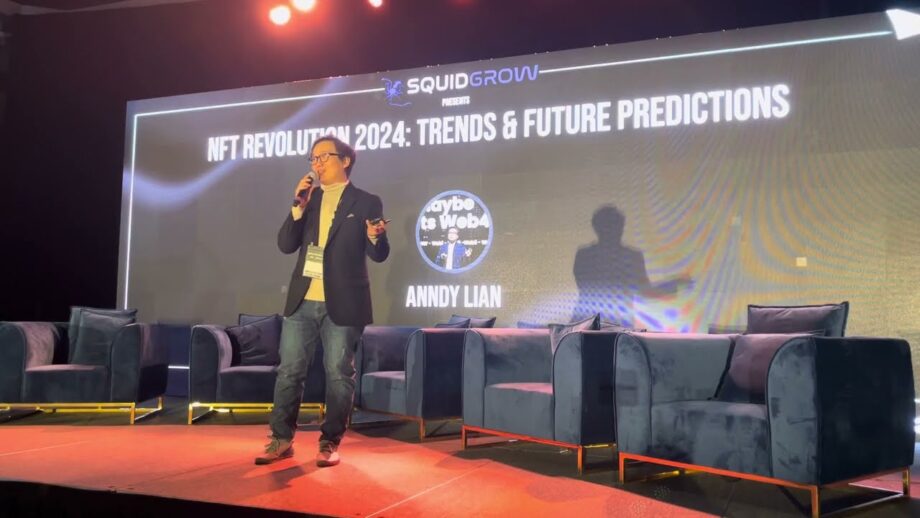
NFT.NYC 2024/ Main Stage/ 4 April – NFT Revolution 2024: Trends & Future Predictions by Anndy Lian

NFT.NYC 2024/ Main Stage/ 4 April – NFT Revolution 2024: Trends & Future Predictions by Anndy Lian

Anndy Lian took the stage at NFT.NYC to share his insights on the evolving landscape of non-fungible tokens (NFTs). His speech, a blend of personal anecdotes and industry analysis, provided a compelling look at the future of NFTs.

The Journey from Skepticism to Mainstream

Lian reminisced about the early days of NFTs, when his predictions were met with skepticism. Yet, he stood firm, and today, the diverse utilities of NFTs vindicate his foresight. His books, “Blockchain Revolution 2030” and “NFT: From Zero to Hero,” have not only topped sales charts but also demystified NFTs for the masses.

NFT Revolution 2024: The Trends Shaping the Future

Lian highlighted several key trends poised to shape the NFT space:

1) Hybrid Protocols such as ERC404: The convergence of fungible tokens (FTs) and NFTs creates new possibilities for asset management and ownership.
2) Real-World Asset NFTs (RWA NFTs): NFTs are transcending digital art, impacting sectors like real estate and supply chain management, making transactions more transparent and efficient. Nexum.ai is another example he gave on how they use supply chain financing with NFTs.
3) Institution-Backed NFTs: Major institutions are exploring NFTs, wrapping products within them, and providing a layer of credibility and security to the digital assets.
4) AI-Enhanced NFTs: Beyond generative art, AI is being leveraged to offer membership access and training products, signaling a move towards more practical applications. Copx.ai was the platform he quoted.
5) Meme-Inspired NFTs with a Twist: Projects like SquidGrow demonstrate the power of community and intellectual property (IP) in driving the value and utility of NFTs.
5) Photography NFT Marketplaces: Real photographs as NFTs offer a unique taste and authenticity that could attract big brands and create new opportunities for photographers. The example he shared about Seed.Photo is good sample.

Final Thoughts: The Road Ahead

Concluding his speech, Lian stressed the need for security measures to foster consumer adoption. The goal is to integrate mainstream buyers into the NFT ecosystem, ensuring robust communities and sustainable revenue streams.

Anndy Lian’s speech at NFT.NYC was more than just a presentation; it was a clarion call for the industry to embrace the NFT revolution with open arms and a cautious mind. As we look towards the future, it’s clear that NFTs are not just a fleeting trend but a transformative force reshaping the digital economy.

This article aims to encapsulate the essence of Anndy Lian’s speech, offering readers a glimpse into the potential trajectories of NFTs. For those looking to go deeper into the subject, Lian’s books and social media channels are good references in the realm of digital assets.


Anndy Lian is an early blockchain adopter and experienced serial entrepreneur who is known for his work in the government sector. He is a best selling book author- “NFT: From Zero to Hero” and “Blockchain Revolution 2030”.

Currently, he is appointed as the Chief Digital Advisor at Mongolia Productivity Organization, championing national digitization. Prior to his current appointments, he was the Chairman of BigONE Exchange, a global top 30 ranked crypto spot exchange and was also the Advisory Board Member for Hyundai DAC, the blockchain arm of South Korea’s largest car manufacturer Hyundai Motor Group. Lian played a pivotal role as the Blockchain Advisor for Asian Productivity Organisation (APO), an intergovernmental organization committed to improving productivity in the Asia-Pacific region.

An avid supporter of incubating start-ups, Anndy has also been a private investor for the past eight years. With a growth investment mindset, Anndy strategically demonstrates this in the companies he chooses to be involved with. He believes that what he is doing through blockchain technology currently will revolutionise and redefine traditional businesses. He also believes that the blockchain industry has to be “redecentralised”.

j j j

The Future of Crypto: What are the next big trends? By Anndy Lian | JCI Startup

The Future of Crypto: What are the next big trends? By Anndy Lian | JCI Startup

Anndy Lian, an intergovernmental blockchain expert shared his vision with JCI Startup. It’s clear that several key shifts are poised to reshape the crypto world:

Artificial Intelligence (AI) and Crypto Synergy
Artificial intelligence has long been an enabler of innovation, and its integration with the crypto space is no exception. AI-powered trading applications are gaining traction, offering both newcomers and seasoned traders insights and predictions about market behavior. By leveraging AI algorithms and advanced data analytics, platforms like Bybit’s Tools GPT provide real-time trading advice based on aggregated statistics and historical patterns.

Furthermore, AI’s influence extends beyond trading. AI-driven relationship projects are becoming prevalent, with users interacting with AI personas and companions. This symbiotic relationship between users and AI fosters engagement and community building. As AI becomes more integral, creators will likely monetize their AI’s capabilities, ultimately shaping new economic models within the crypto ecosystem.

Central Bank Digital Currencies (CBDCs) Revolutionize Finance
The advent of Central Bank Digital Currencies (CBDCs) marks a significant shift in financial paradigms. CBDCs hold the potential to revolutionize transactions by offering traceability, accountability, and tax compliance. This enhanced transparency could lead to a seismic change in the cryptocurrency landscape, bridging the gap between traditional finance and digital assets.

CBDCs’ ability to track and verify transactions could provide a comprehensive understanding of financial flows. This heightened oversight could redefine how cryptocurrencies are viewed and integrated into global economies, potentially driving mainstream adoption.

Decentralization and the Quest for Privacy
Decentralization has long been a foundational principle of cryptocurrencies. However, the rise of decentralized applications (DApps) and peer-to-peer networks heralds a new era of heightened monitoring and governance. These systems are increasingly being developed with built-in mechanisms to strike a balance between privacy and security, aligning with regulatory frameworks.

As decentralized governance gains prominence, organizations will collaborate on decisions, ensuring a more inclusive and diverse representation of stakeholders. The ongoing evolution of decentralized technologies, combined with AI’s role in regulating these networks, is shaping a more automated and structured crypto environment.

NFTs and Beyond: The Next Phase of Digital Collectibles
Non-fungible tokens (NFTs) have surged into prominence, redefining digital ownership and creativity. While NFT sales volume has experienced fluctuations, their adoption has steadily grown thanks to collaborations with established brands. Examples such as Oracle Red Bull Racing’s Velocity Series highlight the potential of combining NFTs with well-known entities to engage audiences and create new communities.

The evolution of NFTs extends beyond art and collectibles. The integration of NFTs in titles deeds, medical records, and property ownership could revolutionize industries reliant on trust and provenance.

Security Tokens (STOs) and Commodities on the Blockchain
Security tokens (STOs) are redefining how financial assets are represented on the blockchain. As traditional securities transition to tokenized formats, the bridge between traditional finance and blockchain strengthens. STOs empower investors with fractional ownership and enhance liquidity, ultimately broadening access to previously exclusive investment opportunities.

Commodities trading is also witnessing a transformation through blockchain technology. Tokenizing commodities enables fractional ownership, making these assets accessible to a broader range of investors. This innovation could democratize trading and investing in commodities, creating a more inclusive financial landscape.

Regulatory Clarity and Institutional Adoption
Regulatory clarity is emerging as a catalyst for institutional adoption of cryptocurrencies. Major financial institutions, including private banks and family offices, are exploring allocations in the crypto space. These institutions are recognizing the potential for diversification and growth that cryptocurrencies offer.

As regulations become more defined, institutional involvement is likely to increase, leading to a maturation of the crypto market. This trend could reshape the dynamics of the financial industry and contribute to the broader adoption of cryptocurrencies as legitimate investment vehicles.

In Conclusion

The future of cryptocurrency holds a myriad of possibilities, driven by the convergence of AI, regulatory developments, and innovative applications of blockchain technology. As trends continue to evolve, the crypto landscape is poised for transformation, reshaping traditional finance and pushing the boundaries of what’s possible in the digital realm.


Anndy Lian is an early blockchain adopter and experienced serial entrepreneur who is known for his work in the government sector. He is a best selling book author- “NFT: From Zero to Hero” and “Blockchain Revolution 2030”.

Currently, he is appointed as the Chief Digital Advisor at Mongolia Productivity Organization, championing national digitization. Prior to his current appointments, he was the Chairman of BigONE Exchange, a global top 30 ranked crypto spot exchange and was also the Advisory Board Member for Hyundai DAC, the blockchain arm of South Korea’s largest car manufacturer Hyundai Motor Group. Lian played a pivotal role as the Blockchain Advisor for Asian Productivity Organisation (APO), an intergovernmental organization committed to improving productivity in the Asia-Pacific region.

An avid supporter of incubating start-ups, Anndy has also been a private investor for the past eight years. With a growth investment mindset, Anndy strategically demonstrates this in the companies he chooses to be involved with. He believes that what he is doing through blockchain technology currently will revolutionise and redefine traditional businesses. He also believes that the blockchain industry has to be “redecentralised”.

j j j

Crypto trends of 2024: My predictions and disruptions

Crypto trends of 2024: My predictions and disruptions

As we turn our gaze to the future of the cryptocurrency industry, it is vital to anticipate the trends and developments that will shape the landscape in 2024. Let’s delve deeper into each of the discussed predictions:

Artificial Intelligence: Transforming everyday life

AI is expected to have a significant impact across various sectors, seamlessly integrating into our daily lives. Its influence will be profound, reshaping industries and revolutionising how we interact and conduct business.

AI has the potential to optimise processes, enhance decision-making, and unlock new possibilities in areas like healthcare, finance, and transportation. As AI technology advances, it will transform our everyday experiences and pave the way for a more efficient and interconnected world.

CBDC: A game-changer for the crypto industry

Central Bank Digital Currency (CBDC) holds immense significance in tracking, tracing, and taxing financial transactions. The introduction of CBDCs has the potential to drive widespread adoption of digital assets and revolutionise the entire crypto industry.

CBDCs offer enhanced transparency and accountability, reshaping the way we perceive and engage with cryptocurrencies. With the support and endorsement of central banks, CBDCs can bridge the gap between traditional finance and the crypto ecosystem, fostering greater trust and regulatory clarity.

Crypto travel rule: Advancing traceability and taxation

The imminent advancement of the crypto travel rule is set to elevate traceability and taxation within the crypto space. By implementing stricter regulations, authorities can closely monitor transactions, creating a more secure and transparent ecosystem for all participants.

This increased oversight will enhance the industry’s integrity, reduce the risk of illicit activities, and foster greater trust among users. As the crypto market matures, regulatory measures like the travel rule will become crucial for its sustainable growth and widespread adoption.

Layer 2: The growing influence of Bitcoin and Ethereum

Bitcoin and Ethereum, as the leading cryptocurrencies, will continue their upward trajectory in 2024. The emergence of BRC20 tokens and the development of zero-knowledge proofs (ZK) will contribute to the expansion of Layer 2 solutions.

These advancements promise to enhance scalability, security, and efficiency within blockchain networks, addressing some of the limitations that hinder mass adoption. Layer 2 solutions will enable faster and more cost-effective transactions, making cryptocurrencies more viable for everyday use and driving their integration into various industries.

Next level NFT: Adoption and brand recognition

NFTs have gained significant adoption thanks to the support and endorsement of major brands. While sales volumes may not have seen exponential growth, the relevance and influence of NFTs continue to expand.

NFTs provide unique digital assets with inherent value, securely traded on blockchain platforms. This revolutionises the concept of ownership and collectibles, opening up new avenues for artists, creators, and collectors. In 2024, we can expect NFTs to permeate further various industries, including gaming, virtual real estate, and intellectual property rights management.

Web4: A decentralised and autonomous web

The emergence of Web4 signifies a shift toward a more decentralised and autonomous web. Internet natives actively participate in building decentralised narratives, fostering inclusivity, and empowering individuals in digital spaces.

This transition aims to ensure a democratic and accessible online environment free from centralised control. Web4 envisions a future where individuals have more control over their data, privacy, and online experiences. It promotes collaboration, transparency, and user-centricity as foundational principles, enabling a more equitable and empowering digital landscape.

Security tokens: Advancing crypto’s potential

Security tokens play a crucial role in unlocking the full potential of the crypto market. By tokenising traditional financial assets such as stocks and bonds, security tokens have the potential to revolutionise traditional markets.

This democratisation of access to financial assets reshapes the investment landscape, allowing a broader investor base to participate in the crypto space. Security tokens provide fractional ownership, increased liquidity, and programmable functionality, enhancing the efficiency and accessibility of traditional financial instruments.

Commodity trading with crypto: Expanding possibilities

The integration of cryptocurrencies into commodity trading markets introduces exciting new possibilities for investors. From oil to gold, crypto enables individuals to seamlessly trade popular commodities, providing greater flexibility and choice while reducing traditional barriers to entry.

By leveraging blockchain technology, commodity trading becomes more transparent, efficient, and accessible to a wider range of participants. This integration paves the way for a more inclusive and globalised commodity market, with cryptocurrencies acting as a bridge between traditional and digital assets.

Mainstream adoption: Defi and financial institutions

Decentralised finance (Defi) is gaining traction among mainstream financial companies. Banks, their clients, and family offices are increasingly allocating a significant portion of their assets to crypto. This mainstream acceptance solidifies the legitimacy and potential of Defi as an integral part of the financial ecosystem.

The integration of Defi into traditional finance offers opportunities for greater financial inclusivity, transparency, and efficiency. Collaboration between traditional financial institutions and Defi protocols will drive the development of innovative financial products and services, catering to the evolving needs of investors.

Final thoughts

In conclusion, embracing the disruptions brought about by artificial intelligence, CBDCs, decentralised governance, and other emerging trends will be essential for individuals and businesses to thrive in an ever-changing world.

By leveraging these transformative forces, we can unlock new opportunities, reshape traditional models, and shape a future that is both innovative and inclusive. The crypto industry is poised for continued growth and evolution, and those who adapt and embrace these trends will be at the forefront of this transformative journey.

The article highlights the insightful keynote speech I delivered at the Web3 Creator Summit, focusing on the crypto trends expected to shape the year 2024.


Source: https://e27.co/crypto-trends-of-2024-my-predictions-and-disruptions-20230706/

Anndy Lian is an early blockchain adopter and experienced serial entrepreneur who is known for his work in the government sector. He is a best selling book author- “NFT: From Zero to Hero” and “Blockchain Revolution 2030”.

Currently, he is appointed as the Chief Digital Advisor at Mongolia Productivity Organization, championing national digitization. Prior to his current appointments, he was the Chairman of BigONE Exchange, a global top 30 ranked crypto spot exchange and was also the Advisory Board Member for Hyundai DAC, the blockchain arm of South Korea’s largest car manufacturer Hyundai Motor Group. Lian played a pivotal role as the Blockchain Advisor for Asian Productivity Organisation (APO), an intergovernmental organization committed to improving productivity in the Asia-Pacific region.

An avid supporter of incubating start-ups, Anndy has also been a private investor for the past eight years. With a growth investment mindset, Anndy strategically demonstrates this in the companies he chooses to be involved with. He believes that what he is doing through blockchain technology currently will revolutionise and redefine traditional businesses. He also believes that the blockchain industry has to be “redecentralised”.

j j j