ADA/BTC prediction: Will Vasil hardfork turn around Cardano’s downward trend?

ADA/BTC prediction: Will Vasil hardfork turn around Cardano’s downward trend?

Bitcoin (BTC), the first cryptocurrency and the most valuable coin, is losing steam in 2022 amid a wider shift in market sentiment. Meanwhile, Cardano’s (ADA) long-awaited Vasil hard fork failed to trigger bullishness.

What does it mean for the ADA/BTC forecast? Here we take a look at the Cardano (ADA) to Bitcoin (BTC) cryptocurrency pair and factors shaping the ADA/BTC exchange rate.


What is ADA/BTC?

ADA/BTC represents the exchange rate between ADA, the native cryptocurrency of the Cardano blockchain, and BTC, the native coin on the Bitcoin Network.

Maxim Shilo, digital assets analyst at CoinLoan, explained that to determine the ADA/BTC rate, the coins’ prices are calculated separately, then added together, noting:

“If BTC rises 4.5%, and ADA rises 2.5% at the same time, then ADA/BTC price is down 2% respectively…There might be some differences, which are for market makers to spread on.”

Bitcoin was created in 2009 as a digital alternative to cash. Since its launch, the cryptocurrency has started to act as a store of value. It’s been compared to gold as a hedge against inflation.

Bitcoin’s key feature is mining. This is done through a blockchain that connects all public BTC transactions together. The blockchain uses a Proof-of-Work (PoW) consensus mechanism through which miners compete to solve mathematical equations and confirm the legitimacy of transactions. Miners are rewarded in BTC.

BTC tokens also undergo halving events roughly every four years. This is when the number of the BTC coins in circulation is reduced by half, making the token scarcer and raising its price.

Cardano was launched in 2017 as a third-generation crypto platform that uses the Proof-of-Stake (PoS) consensus mechanism. The blockchain prides itself in being the first ever crypto platform “to be founded on peer-reviewed research and developed through evidence-based methods”.

Cardano’s key focus is on being sustainable. In September 2021 the platform introduced smart contract capability, which means that the blockchain can now also support the creation of decentralised apps (dApps), new tokens, decentralised finance (DeFi) games, non-fungible tokens (NFTs) and more – one of the key factors that makes it stand out compared to BTC.

The platform was developed in “eras”, each named after a prominent historical figure in the fields of literature and computer science, such as Byron, Shelley, Goguen, Basho and Voltaire.

As of 30 September, the blockchain’s era is Basho, which introduced more scaling and optimisation to Cardano. Voltaire will be the last era in the blockchain’s development, which will bring governance to the system.

ADA/BTC historical rate chart

The ADA/BTC exchange rate surged 1,373.4% in the four months after the launch of the ADA token, trading at 0.00007103BTC in January 2018. At the same time the ADA price in USD jumped more than 4,800% to $1.0797. This was when ADA reached its all-time high against BTC.

Between 2018 and 2020 the exchange rate moved sideways, peaking at 0.00001811BTC and 0.00001495BTC in April 2019 and July 2020, respectively. In 2021, ADA regained its momentum against bitcoin.
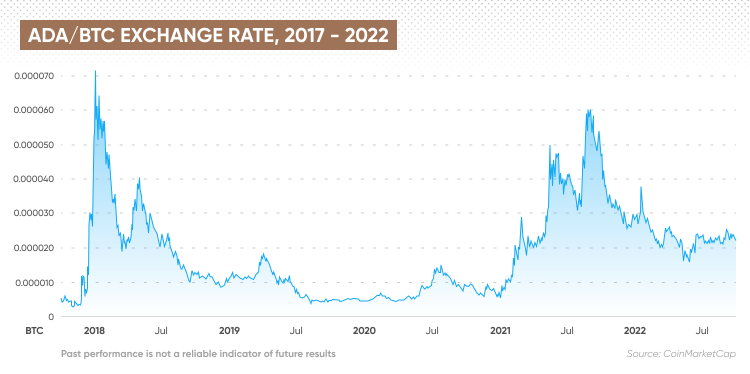
ADA/BTC EXCHANGE RATE, 2017-2022

Between January and September 2021, the ADA/USD rate surged over 800%, with ADA enjoying the peak of 0.00006008BTC. The jump was mostly driven by bullish sentiment for Cardano, with ADA trading at a record high of $2.9682 in September 2021.

But, wider sentiment in the cryptocurrency markets shifted. ADA/USD swinged lower, losing over 20% year-to-date. Separately, ADA and BTC have lost 68% and 58% of their value in 2022, respectively (as of 30 September).

Is the Vasil fork driving ADA/BTC?

Cardano’s long-awaited Vasil mainnet upgrade, which aims to improve the blockchain’s scalability and increase the network’s capacity, was launched on 22 September after several delays. The Cardano Foundation said on Twitter.

Full Vasil capability became available on 27 September. In addition to that, the Cardano blockchain activated the Plutus V2 cost model, which delivered lower transaction costs for smart contracts.

This update was expected to boost ADA’s value, but failed to do so. According to Anndy Lian, chief digital advisor at the Mongolian Productivity Organisation and author of NFT: From Zero to Hero, “this is mainly due to the financial uncertainty globally.”

“Marco risks led by a very hawkish US Fed have also weighed down ADA’s price movement after Vasil’s launch,” he told Capital.com.

The ADA/BTC exchange rate dropped by 5.5 % between 22 and 29 September, during the hype in the run-up to the fork’s launch.

Shilo agreed that this phenomenon was linked to wider macro-economic factors stemming from a troubled global economy and a wider bear market. “Macro doesn’t really care about the updates or future promises,” he said.

Shilo added that Cardano was not the only token affected by macroeconomics on the brink of a big upgrade, using Ethereum’s Merge as an example.

Lian noted that although ADA failed to jump after the Vasil fork, their voting power has increased by 53%, noting:

“This means that more ADA was being used across proposals in Project Catalyst with 11% of all the circulating ADA being used in Catalyst Fund9, which is a community-driven initiative that allows users to vote and determines the future direction of the ecosystem.”

According to Lian “more utility and support from the community means better potential for the development of the token”.

In other news, the Cardano Foundation is preparing for an events season, which will kick off in October 2022. The Foundation is due to participate in a number of key crypto events that could affect an ADA/BTC forecast.

In November, Cardano will hold the Cardano Summit 2022 in Switzerland, which will focus on presentations and updates from developers of Cardano’s decentralised applications (dApps).

ADA/BTC forecast for 2022 and beyond

Based on the analysis of ADA’s past price performance, as of 30 September, the algorithm-based forecasting service WalletInvestor predicted that ADA/USD could fall to $0.0423 in 2023. The platform did not provide a price prediction for 2027.

In terms of its bitcoin prediction, the site saw BTC/USD trade at $30,274.06 in 2023 and reach $74,480.14 by 2027.

While WalletInvestor did not provide a direct Cardano/Bitcoin forecast, data suggested that the exchange rate could be 0.000000567BTC in 2023.

DigitalCoinPrice predicted that ADA/USD could rise to $0.46 by the end of 2022, $0.99 in 2023 and $1.76 in 2025. Its long-term prediction saw the coin reaching $6.04 in 2030.

The site also gave an upbeat BTC/USD forecast, expecting the coin to average at $20,403 in 2022, $44,579 in 2023, $79,430 in 2025 and surpass $273,000 in 2030.

DigitalCoinPrice’s ADA/BTC forecast for 2022 expected the pair to reach 0.00002255BTC. In 2023, the ADA/BTC prediction saw the exchange rate falling to 0.00002221BTC. The site’s ADA/BTC forecast for 2025 stood at 0.00002216BTC. Its long-term ADA/BTC forecast for 2030 was 0.00002212BTC.

Shilo stressed that bitcoin has relative strength to altcoins and added that in his opinion the ADA/BTC forecast is pointing downwards:

“It’s unlikely that [ADA] will outperform BTC. I can’t see it happening in the near term. Only very few selected coins have done so in the long term, and historically the chances are very slim. Given that the price is trading in the range and is in no man’s land against BTC, it’s clearly pointing toward a downward trend.”

Note that analysts’ and algorithm-based forecasts can be wrong and shouldn’t be used as a substitute for your own research. Always conduct your own due diligence before trading, and never trade money you cannot afford to lose.


Source: https://capital.com/ada-btc-prediction-cardano-bitcoin-vasil-hardfork

Anndy Lian is an early blockchain adopter and experienced serial entrepreneur who is known for his work in the government sector. He is a best selling book author- “NFT: From Zero to Hero” and “Blockchain Revolution 2030”.

Currently, he is appointed as the Chief Digital Advisor at Mongolia Productivity Organization, championing national digitization. Prior to his current appointments, he was the Chairman of BigONE Exchange, a global top 30 ranked crypto spot exchange and was also the Advisory Board Member for Hyundai DAC, the blockchain arm of South Korea’s largest car manufacturer Hyundai Motor Group. Lian played a pivotal role as the Blockchain Advisor for Asian Productivity Organisation (APO), an intergovernmental organization committed to improving productivity in the Asia-Pacific region.

An avid supporter of incubating start-ups, Anndy has also been a private investor for the past eight years. With a growth investment mindset, Anndy strategically demonstrates this in the companies he chooses to be involved with. He believes that what he is doing through blockchain technology currently will revolutionise and redefine traditional businesses. He also believes that the blockchain industry has to be “redecentralised”.

j j j

This Is How South Korea’s Incoming President Aims to Turn the Country Into Crypto Hub

This Is How South Korea’s Incoming President Aims to Turn the Country Into Crypto Hub

Yoon Suk-yeol – South Korea’s new president – promised he will allow initial coin offerings (ICOs) and impose friendly crypto taxation rules.

South Korea’s newly elected president – Yoon Suk-yeol – displayed a pro-crypto stance during his campaign. Among his ideas is increasing the minimum threshold for paying capital gains tax on profits from digital asset investments.

Crypto Community Welcomes the New President

Last week’s presidential election in South Korea was the most contested in the East Asian country’s history. The candidate of the Conservative party – Yoon Suk-yeol – collected only 263,000 votes more than his opponent – the Democratic Party’s Lee Jae-myung. The winner, who will officially step into office in May, labeled his win a “victory of the great South Korean people.”

During his campaign, Yoon showed he is a keen supporter of the cryptocurrency industry numerous times. Initially, he promised to allow initial coin offerings (ICOs). In another appearance, the former prosecutor said that those who generate profits of less than $40,000 per year from crypto trading will be exempt from paying taxes. Currently, such taxes are imposed on profits generated above $2,000 per annum.

Korea Blockchain Association – a lobby group for digital asset exchanges – predicted that the new president will positively impact the local cryptocurrency ecosystem. Speaking on the matter was Secretary-General Yoon Seong-han:

“We definitely welcome his stance as he is confident about boosting the industry. As ICOs are banned now, we have no choice but to issue coins in Singapore and other countries. Ventures and startups will be able to raise money easily from investors [if the ban is lifted].”

Anndy Lian – Chairman of BigONE Exchange – welcomed Yoon’s viewpoint, too: “He understands the importance of crypto. He understands the future, and it is unstoppable.”

It is worth noting that private digital assets are highly popular among South Koreans, as the most enthusiastic demographic group are those in their 30s. A recent study revealed that around 15% of local crypto holders had allocated more than $8,000 each in the asset class.

It Is Time for South Korea to Embrace Crypto

Not long ago, Sohn Byung-doo – CEO of Korea Exchange (KRX) – argued that the country needs to study and explore ways to embrace the cryptocurrency sector.

The exec outlined there are around five million local investors, while the daily market trading volume is about $12 billion. If the nation does not engage further with the asset class, it could fall behind other countries that have already opened their arms to it:

“Now is the time for exchanges to compete directly with overseas exchanges.”

Featured Image Courtesy of NPR


Original Source: https://cryptopotato.com/this-is-how-south-koreas-incoming-president-aims-to-turn-the-country-into-crypto-hub/


Anndy Lian is an early blockchain adopter and experienced serial entrepreneur who is known for his work in the government sector. He is a best selling book author- “NFT: From Zero to Hero” and “Blockchain Revolution 2030”.

Currently, he is appointed as the Chief Digital Advisor at Mongolia Productivity Organization, championing national digitization. Prior to his current appointments, he was the Chairman of BigONE Exchange, a global top 30 ranked crypto spot exchange and was also the Advisory Board Member for Hyundai DAC, the blockchain arm of South Korea’s largest car manufacturer Hyundai Motor Group. Lian played a pivotal role as the Blockchain Advisor for Asian Productivity Organisation (APO), an intergovernmental organization committed to improving productivity in the Asia-Pacific region.

An avid supporter of incubating start-ups, Anndy has also been a private investor for the past eight years. With a growth investment mindset, Anndy strategically demonstrates this in the companies he chooses to be involved with. He believes that what he is doing through blockchain technology currently will revolutionise and redefine traditional businesses. He also believes that the blockchain industry has to be “redecentralised”.

j j j

Anndy Lian Commented on “Banking Giants Laundering Billions Might Turn Against Bitcoin Too” at CryptoNews

Anndy Lian Commented on “Banking Giants Laundering Billions Might Turn Against Bitcoin Too” at CryptoNews

Banking Giants Laundering Billions Might Turn Against Bitcoin Too

Documents uncovered by an investigation conducted by 110 news organizations appear to show global banking giants moving trillions of dollars for clients allegedly involved in fraud, embezzlement, money laundering, and more, as the banks defend themselves against the allegations. Meanwhile, the crypto community appears to be divided as to whether it spells good news for crypto in general, and bitcoin (BTC) in particular. (Updated at 17:45 UTC: updates in bold.)

The evidence was uncovered by the International Consortium of Investigative Journalists (ICIJ) in a new report. The consortium said that it, together with BuzzFeed News and 108 other media organization, conducted a 16-month, cross-border investigation, and revealed the leaked documents, now known as the FinCenFiles.

The consortium wrote that “secret United States government documents reveal” that global banks “have defied money laundering crackdowns by moving staggering sums of illicit cash for shadowy characters and criminal networks.” The five named banks are JPMorganHSBCStandard Chartered BankDeutsche Bank and Bank of New York Mellon.

Furthermore, the leaked documents allegedly “show banks blindly moving cash through their accounts for people they can’t identify, failing to report transactions with all the hallmarks of money laundering until years after the fact, even doing business with clients enmeshed in financial frauds and public corruption scandals.”

These files, the authors said, include more than 2,100 suspicious activity reports (SARs) filed by banks and other financial firms with the United States Department of Treasury’s Financial Crimes Enforcement Network, also known as FinCEN.

ICIJ said:

“[The] documents identify more than [USD] 2 trillion in transactions between 1999 and 2017 that were flagged by financial institutions’ internal compliance officers as possible money laundering or other criminal activity — including [USD] 514 billion at JPMorgan and [USD] 1.3 trillion at Deutsche Bank. […] The FinCEN Files represent less than 0.02% of the more than 12 million suspicious activity reports that financial institutions filed with FinCEN between 2011 and 2017.”

ICIJ added that United States agencies responsible for enforcing money-laundering laws rarely prosecute megabanks that break the law, “and the actions authorities do take barely ripple the flood of plundered money that washes through the international financial system.”

Per the authors, the data shows that Deutsche Bank is leading by some distance, with JPMorgan in second place.

“Mobsters pushed billions through Deutsche Bank in one of the biggest dirty money scams ever,” tweeted BuzzFeed News, adding that “small businesses were crushed” in the process.

The news outlet further claimed that the bank’s executives “had direct knowledge for years of serious failings that left the bank vulnerable to money launderers.” After a USD 10 billion mirror trading scandal was exposed, “Deutsche Bank blamed it on a few middle-level staffers in its Moscow office, paid a fine, and got back to business,” reported BuzzFeed News.

Crypto as a systemic threat

News of the traditional banking system’s alleged wrongdoings came as little surprise to the crypto community.

And the irony of the situation was not lost on many commentators: While regulators ramp up the pressure on the crypto industry, particularly in the field of anti-money laundering (AML) measures, the banking sector appears to be running roughshod over the very same AML rules.

Commenting on a report on HSBC’s drop to a 25-year low today in the stock market, the CEO of crypto exchange Binance, Changpeng Zhao, tweeted that it “might be a good time for their treasury to buy bitcoin?”

However, Anndy Lian, investor and blockchain adviser, didn’t agree that this was a good idea, writing: “On the contrary, I hope HSBC to stay away from bitcoin. Early stages mess the soup.”

Others, like the Chief Legal Officer of crypto exchange Kraken, Marco Santori, also claimed that this will not help Bitcoin’s cause at all.

“If you think this is good for bitcoin, man you are going to be so disappointed,” he said. “I wonder if this will compel FinCEN to publish more information about the efficacy of its enforcement activity. It would serve to quell many complaints to the tune of “Why do we send all this info to FinCEN – what good has it done?”

Others, like GetLevvel CEO Chris Hart, also chimed in saying that there is a risk that “the answer to a perception of poor enforcement is more enforcement, and ‘more’ isn’t limited to fiat-based transactions.”

Bitcoin educator, author, and entrepreneur Andreas Antonopoulos also stressed that this leak will be used against cryptocurrencies. According to him, the correct analysis of this news is that AML/CTF (counter terrorism financing) and KYC (know your customer) don’t work and the report will be used to increase the use of controls and surveillance.


“That makes crypto-currency a systemic threat, not to the economic nature of national money, but to the control and surveillance system of geopolitical money. Math money doesn’t play politics, which makes it automatically “rogue” money,” he said, estimating that “the war on cash and the war on “illicit” money becomes an all out war on the only money that still works.”

According to him, “the solution is to stop trying to use money (a tool) to fight crime (human nature).”

“But if you think the hypocrites will back down and adopt sensible systems and laws that enable human trade and economic inclusion, you are wrong,” Antonopoulos said.


Banks respond

“BNY Mellon takes its role in protecting the integrity of the global financial system seriously, including filing Suspicious Activity Reports (SARs),” told Cryptonews.com Associate Director for Corporate Communications Sorrel Beynon, adding that they “fully comply with all applicable laws and regulations, and assist authorities in the important work they do.” The bank cannot by law, they claim, “comment on any alleged SAR we may have filed or that may have been illegally disclosed by third parties to the media.”

Deutsche Bank’s Head of UK Media Relations, Charlie Olivier, told Cryptonews.com that the fight against financial crime, money laundering and capital flight has been a priority for both investigating authorities and financial institutions, the latter of which, Deutsche Bank included, have invested “billions of dollars” to more support authorities in this effort. “Naturally, this leads to increased detection levels.”

Olivier stated that “the ICIJ has reported on a number of historic issues,” claiming that “those relating to Deutsche Bank are well known to our regulators.”

“The issues have already been investigated and led to regulatory resolutions in which the bank’s cooperation and remediation was publicly recognized. Where necessary and appropriate, consequence management was applied. To the extent that information referenced by the ICIJ is derived from SARs, it should be noted that this is information that is pro-actively identified and submitted by banks to governments pursuant to the law. SARs are alerts of potential issues, not proven facts,” he said.

Per the statement provided by Standard Chartered Group Media Relations Director, Josephine Wong, to Cryptonews.com, SARs are filed by the banks “when circumstances warrant and that means our screening and monitoring systems are working as intended.” A SAR filing does not mean there has been criminal activity, but that the bank has identified “something suspicious or irregular in a transaction that meets the filing requirements in the local market,” which is then reported to law enforcement “so they can investigate and, if they see fit, take further action.”

“The reality is that there will always be attempts to launder money and evade sanctions; the responsibility of banks is to build effective screening and monitoring programs to protect the global financial system,” said Wong, adding that in 2019 Standard Chartered “monitored more than 1.2 billion transactions for potential suspicious activity and screened more than 157 million for sanctions compliance.”

JPMorgan declined to comment. We contacted HSBC as well, and will update should they reply.


Source: https://cryptonews.com/news/leak-alleges-banking-giants-moving-staggering-sums-of-illici-7768.htm


Anndy Lian is an early blockchain adopter and experienced serial entrepreneur who is known for his work in the government sector. He is a best selling book author- “NFT: From Zero to Hero” and “Blockchain Revolution 2030”.

Currently, he is appointed as the Chief Digital Advisor at Mongolia Productivity Organization, championing national digitization. Prior to his current appointments, he was the Chairman of BigONE Exchange, a global top 30 ranked crypto spot exchange and was also the Advisory Board Member for Hyundai DAC, the blockchain arm of South Korea’s largest car manufacturer Hyundai Motor Group. Lian played a pivotal role as the Blockchain Advisor for Asian Productivity Organisation (APO), an intergovernmental organization committed to improving productivity in the Asia-Pacific region.

An avid supporter of incubating start-ups, Anndy has also been a private investor for the past eight years. With a growth investment mindset, Anndy strategically demonstrates this in the companies he chooses to be involved with. He believes that what he is doing through blockchain technology currently will revolutionise and redefine traditional businesses. He also believes that the blockchain industry has to be “redecentralised”.

j j j

