Positive Crypto Signs from U.K. and Hong Kong: Who is the New Crypto Hub?

Positive Crypto Signs from U.K. and Hong Kong: Who is the New Crypto Hub?

U.K. has a new pro-crypto PM and a new name for stablecoins

At the point of the news on the vote to recognize Crypto as regulated financial instruments, Bitcoin just spiked to $21,170. This aligns with the new crypto developments in the U.K. market. As part of the Financial Services and Markets Bill, the U.K. House of Commons, the lower house of Parliament, agreed on Tuesday to regulate cryptocurrency assets as financial instruments. The House of Lords, the upper house, will vote on the bill before it becomes law. This occurs as Rishi Sunak, who on Monday was appointed as the nation’s next prime minister, has a history of endorsing cryptocurrencies.

The local cryptocurrency sector, which recently celebrated Rishi Sunak’s election as the nation’s new prime minister, will likely applaud moves to grant legal legitimacy to digital assets. When Sunak served as the Boris Johnson administration’s finance minister, he presented the markets bill, which indirectly led to the stablecoin regulations.

The bill expands upon current stablecoin regulating provisions and uses the term “Digital Settlement Assets” (DSA) in place of “crypto assets,” moving away from the use of the phrase “crypto assets.” Stablecoins with a focus on payments that are cryptocurrencies tethered to the value of other assets like the U.S. dollar or gold were already covered by elements in the draft bill that would have extended existing restrictions to them.

According to Griffith, the financial services and city minister, the crypto provision “clarifies that crypto assets could be brought within the scope of the existing provisions” of the Financial Services and Markets Act 2000 relating to regulated financial activities. The crypto provision depends on the definition of “crypto asset” inserted by a new clause 14. The regulations might control cryptocurrency advertising and ban businesses that aren’t allowed to operate nationwide.

“The Treasury will consult on its approach with industry and stakeholders ahead of using the powers to ensure the framework reflects the unique benefits and risks posed by crypto activities,” Griffith said. He added: “The Treasury will consult on its approach with industry and stakeholders ahead of using the powers to ensure the framework reflects the unique benefits and risks posed by crypto activities,”

The Crypto and Digital Assets All Party Parliamentary Group (APPG) provides a forum for parliamentarians, regulators and the U.K government to discuss challenges and opportunities relating to the crypto sector. This group, chaired by Scottish National Party member of Parliament (MP) Lisa Cameron, has issued a written statement to the media seeking regulatory clarity and business certainty. “U.K. crypto and digital asset firms desperately need clarity over the U.K.’s approach to crypto policy and for the government to deliver on its vision for the U.K. crypto sector,” Cameron said in the statement.

The legalization of cryptocurrencies and digital assets as financial instruments is still pending. Important requirements that must be met for the Bill include: Before the Bill receives final royal sanction from the next king, King Charles III, the House of Lords will need to accept or change it.

The U.K. government can assure financial stability and strong regulatory standards by recognizing the promise of this technology and regulating it at this time, allowing these new technologies to be employed in the future reliably and safely.

Hong Kong wants to be positioned as crypto hub, while Singapore pivots

A few years back, Hong Kong was on the right track to becoming a crypto hub. Then Hong Kong’s regulator, the Securities Futures Commission (SFC) knocked on doors. Exchanges were questioned about listing tokens that seemed like securities and also issued warnings about high leverages.

Fast forward to 2022, October 31, the Hong Kong government is exploring legalizing retail crypto trades. Financial Secretary Paul Chan announced in a keynote speech at the Hong Kong Fintech Week conference that authorities would begin a consultation process on providing retail investors with “a suitable degree of access” to virtual assets. “We want to make our policy stance clear to the global market, to demonstrate our determination to explore fintech with the global virtual asset community,” he added.

In contrast, Singapore is significantly restricting access to cryptocurrencies for individual investors after last year’s market collapse brought down several digital asset companies with ties to the Southeast Asian country and caused much greater losses throughout the industry. If you remember, many of the huger crypto companies moved from Singapore to Dubai, and now the same thing is happening again. Hong Kong appears to be the next hotspot for digital-asset enterprises, entrepreneurs, and investment.

Even the head of the central bank, Ravi Menon, admitted in a Bloomberg Television interview that some crypto enterprises with a retail concentration would leave the city-state, stating plainly, “We wish them good luck.”

Cryptocurrencies “play a supporting role in the broader digital asset ecosystem, and it would not be feasible to ban them,” the Monetary Authority of Singapore (MAS) stated in a media statement. Singapore’s stand is very firm and has made it clear that they are not banning cryptocurrencies and is working towards reducing risks.

Positive signs

I see all these are positive signs. Singapore is planning ahead. Hong Kong is leaving some room going forward. U.K.’s plan is ambitious. Hong Kong seems like walking on a different path than China which has banned cryptocurrencies completely. People on the ground are now speculating that Hong Kong could be the outflow channel for the Chinese to start trading cryptocurrencies again.

The recognition of cryptocurrencies under proper regulations would go very far. I am optimistic about the outcomes. #anndylian

 

Source: https://www.benzinga.com/22/11/29572049/positive-crypto-signs-from-u-k-and-hong-kong-who-is-the-new-crypto-hub

Anndy Lian is an early blockchain adopter and experienced serial entrepreneur who is known for his work in the government sector. He is a best selling book author- “NFT: From Zero to Hero” and “Blockchain Revolution 2030”.

Currently, he is appointed as the Chief Digital Advisor at Mongolia Productivity Organization, championing national digitization. Prior to his current appointments, he was the Chairman of BigONE Exchange, a global top 30 ranked crypto spot exchange and was also the Advisory Board Member for Hyundai DAC, the blockchain arm of South Korea’s largest car manufacturer Hyundai Motor Group. Lian played a pivotal role as the Blockchain Advisor for Asian Productivity Organisation (APO), an intergovernmental organization committed to improving productivity in the Asia-Pacific region.

An avid supporter of incubating start-ups, Anndy has also been a private investor for the past eight years. With a growth investment mindset, Anndy strategically demonstrates this in the companies he chooses to be involved with. He believes that what he is doing through blockchain technology currently will revolutionise and redefine traditional businesses. He also believes that the blockchain industry has to be “redecentralised”.

j j j

Who owns the most voyager crypto? VGX tokens are also distributed among troubled platform’s customers

Who owns the most voyager crypto? VGX tokens are also distributed among troubled platform’s customers

Voyager Digital has been making headlines ever since the crypto platform filed for Chapter 11 bankruptcy protection in July 2021. The company is engaged in ongoing court proceedings.

Here we take a look at the voyager (VGX) tokens circulating supply and analyse who owns the most VGX.

Voyager Digital: Origins & token history

Voyager Digital is a US-based cryptocurrency platform that was founded in 2017 by a team of finance and technology industry veterans, including the firm’s CEO Stephen Ehrlich, chairman Philip Eytan and Gaspard de Dreuzy, a serial entrepreneur.

In addition to being a crypto company, Voyager Digital is a publicly traded company listed on the Toronto Stock Exchange (TSX) since 2021 under the ticker VOYG.

As of September 2022, the company hosts over 100 different digital assets through its mobile application and allows clients to earn rewards of up to 12% annually on more than 40 cryptocurrencies.

The Voyager token (VGX) is the platform’s native cryptocurrency. It’s designed to reward customers for their loyalty. It was based on the Ethos Token. In 2019, Voyager acquired Ethos.io and incorporated the team, technology and native token into its ecosystem.

Until 2020, Voyager operated with a multi-token functionality. After 2020, the company integrated its native tokens into a new single token model known as VGX 2.0. Today, VGX maintains a presence on the Ethereum blockchain as an ERC20 cryptocurrency.

According to the project’s whitepaper, Voyager utilises the VGX 2.0 token to boost the platform’s adoption and functionality. Holding VGX allowed users to earn 7% staking rewards and raise their earnings by joining the Voyager Loyalty Program.

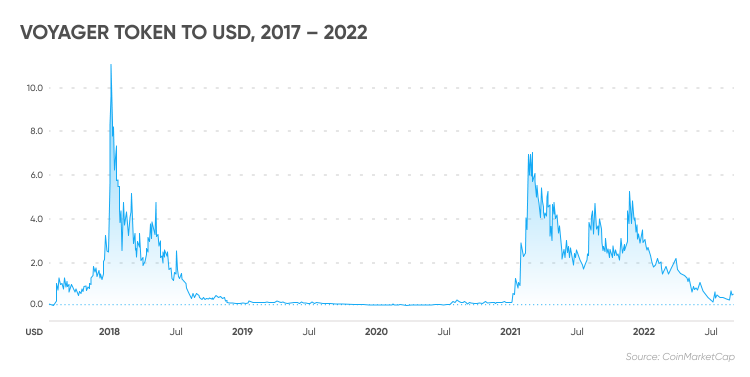
The VGX token was met with enthusiasm. The price rose to an all-time high of $11.02 just six months after the token launched in 2017. The bullish run was short-lived, and the price fell by 96.7% to $0.3678 by August 2018.

Voyager token to USD, 2017 – 2022

The next big jump took place between January and February 2021, when VGX surged 3,267% to $6.9023, from levels as low as $0.2. Around this time, the Uniswap (UNI) token became available on the Voyager platform.

On 22 November 2021, VGX surged to $5 amid a positive general crypto market sentiment, however, this was the token’s last peak as it embarked on a bearish run. But since its November high, the VGX has lost more than 75% of its value, sliding down to $0.9188.

Latest voyager crypto news

In July 2021 Voyager filed for Chapter 11 bankruptcy protection, as it was heavily affected by the global crypto crash. Since then, the company has been in and out of court proceedings.

As Voyager moves through the Chapter 11 bankruptcy process, latest filings revealed on 8 September that the company will auction off the remainder of its assets on 13 September. The results of the auction will become final during a court hearing approving them on 29 September.

In the latest voyager token news, potential buyers remained unnamed. However, bids previously made by the crypto trading platform FTX were made public. FTX said in a press release on 22 July that it would buy Voyager’s assets and loans at cash value and open accounts for Voyager customers on FTX. This proposal, however, was branded a “low-ball” bid by Voyager’s lawyers.

In a second-day hearing presentation on 4 August, the company stated that it had received “higher and better” buyout offers. As of 12 September, Voyager said that it was contacted by 88 potentially interested buyers and was in “active discussions” with 20.

Who owns the most Voyager crypto?

So, who owns the most Voyager crypto and how is the token distributed?

When Voyager decided to integrate its tokens (VGX and LGO (the native token of a company Voyager acquired) into one, VGX was exchanged for VGX 2.0 (now known as VGX) at a 1:1 rate. LGO’s exchange rate to VGX 2.0 was 6.5356340619:1.

The circulating supply of VGX tokens stood at 222 million. The circulating supply of LGO was over 33 million. Following the token swap, Voyager chose to mint a growth pool of tones on an annual basis to power Voyager Loyalty Program rewards, as well as fund promotional campaigns for new and existing customers.

Hence, 40 million new tokens were minted in the first year since the integration, 20 million will be minted in the second year and 10 million between the third and eight years.

According to data provided by CoinMarketCap, the total and circulating supply of VGX, as of 12 September, surpassed 278 million tokens. The maximum supply stood at 297 million.

Voyager also introduced a new initiative called the Voyager Loyalty Program, which Voyager customers can qualify for by maintaining a number of VGX tokens in their accounts. The programme has three tiers:

  • Adventurer – customers holding over 500 VGX
  • Explorer – customers holding over 5,000 VGX
  • Navigator – customers holding over 20,000 VGX

The more VGX customers stake, the higher they move up these tier categories and the more rewards they earn with each tier.

So, who owns the most Voyager crypto?

Over the last few months, VGX whales have gradually reduced their holdings. However, data revealed by etherscan.io showed that the top 100 VGX token holders, as of 12 September, collectively owned 97.62% of the total supply in circulation.

The website noted that the top account holding the most voyager tokens owned 93.9% of the circulating supply, which amounted to 208 million VGX tokens worth $191m, as of 12 September. According to the website, the account’s address is 0x933bb73de8fcfb74415fbc99561623c593bf3b61.

The second biggest VGX whale owned 1.9% of the total circulating supply, amounting to four million VGX tokens.

The third biggest VGX holder was an account under the address ‘Binance 8’ that held around 0.18% of the total circulating supply, amounting to around 395,757 tokens.

The fourth and fifth biggest voyager coin whales owned around 0.14% of the total circulating supply.

Final thoughts

While knowing who owns voyager crypto may be useful for the coin’s enthusiasts, it shouldn’t be used as a sole reason to trade. Nearly all of the maximum VGX supply is in circulation, as of the time of writing (12 September), which could lead to the possibility of greater volatility. Investors are warned to exercise caution.

According to Invezz’s analyst Crisous Nyaga, “uncertainty about the Voyager collapse and low volume trading could lead to market manipulation.

“The coin’s future is uncertain and it will depend on the outcome of the bankruptcy proceedings. If the firm moves completely out of business, there is a possibility that the VGX token will not survive. On the other hand, if it is acquired, there is a possibility that the coin will continue doing well.”

Anndy Lian, chief digital advisor at the Mongolian Productivity Organisation and the author of NFT: From Zero to Hero, told Capital.com that retail investors are buying VGX based on rumours that the company will be acquired by either Binance or FTX.

“I noted that the current investors are still working very hard promoting in different channels with the hope of making the VGX a more viable choice for new investors and perhaps drawing more attention so that the buyout can complete faster. These are positive signs from the community members who want the token to do well and resume their staking and cashback rewards,” he stressed.

Note that analysts’ predictions and opinions can be wrong. Always conduct your own due diligence before trading. And never invest or trade money you cannot afford to lose.


Source: https://capital.com/voyager-who-owns-most-vgx-crypto-tokens

Anndy Lian is an early blockchain adopter and experienced serial entrepreneur who is known for his work in the government sector. He is a best selling book author- “NFT: From Zero to Hero” and “Blockchain Revolution 2030”.

Currently, he is appointed as the Chief Digital Advisor at Mongolia Productivity Organization, championing national digitization. Prior to his current appointments, he was the Chairman of BigONE Exchange, a global top 30 ranked crypto spot exchange and was also the Advisory Board Member for Hyundai DAC, the blockchain arm of South Korea’s largest car manufacturer Hyundai Motor Group. Lian played a pivotal role as the Blockchain Advisor for Asian Productivity Organisation (APO), an intergovernmental organization committed to improving productivity in the Asia-Pacific region.

An avid supporter of incubating start-ups, Anndy has also been a private investor for the past eight years. With a growth investment mindset, Anndy strategically demonstrates this in the companies he chooses to be involved with. He believes that what he is doing through blockchain technology currently will revolutionise and redefine traditional businesses. He also believes that the blockchain industry has to be “redecentralised”.

j j j

Who owns the most dogecoins? Biggest whales revealed

Who owns the most dogecoins? Biggest whales revealed

Dogecoin (DOGE) is a meme coin pioneer. So,  who owns the most dogecoins?

Here we take a look at the meme token’s circulating supply and dogecoin’s biggest holders.

What is dogecoin?

Dogecoin (DOGE) was created in 2013 by software engineers Billy Markus and Jackson Palmer, neither of whom are still affiliated with the project. The coin was inspired by the popular 2010 meme of a Shiba Inu dog called Doge, and was originally started as a joke. It was the first memecoin, and has inspired the creation of hundreds of others.

Dogecoin is an open-source, decentralised, peer-to-peer cryptocurrency, which “sets itself apart from other digital currencies with an amazing, vibrant community made up of friendly folks”.

According to its website: “Dogecoin is many things to many different people. At its heart, Dogecoin is the accidental crypto movement that makes people smile!

“It is also an open-source peer-to-peer cryptocurrency that utilises blockchain technology, a highly secure decentralised system of storing information as a public ledger that is maintained by a network of computers called nodes.”

The currency’s unofficial tagline is ‘Do Only Good Everyday’.  Its community cares about supporting each other, being kind, teaching people about cryptocurrency, fundraising, having fun, making memes and being absurd.

The coin’s protocol was based on the now-defunct Luckycoin, a spinoff of Litecoin (LTC) – an early altcoin. According to Palmer, this protocol was used as means to turn the potential miners away from the project with the aim of making it fail. However, that did not go as planned and Luckycoin was removed from DOGE’s protocol since it was causing a number of problems.

In 2014, the Dogecoin Foundation was established by the project’s creators. It aims to provide support, advocacy, trademark protection and governance for the DOGE cryptocurrency project.

Although started as a joke, the coin soon found utility as its low value  made it popular for small online transactions, such as tipping strangers anonymously on the internet.

Recently, Markus had even asked Twitter to add dogecoin to the Twitter tip jar, as “it just makes too much sense – the OG tipping cryptocurrency on the internet belongs there”.

As the token surged in popularity, it was spotted by Tesla (TSLA) founder Elon Musk, who tapped into the social media hype around DOGE, calling it “the people’s crypto” on Twitter.

Dogecoin supply

According to data provided by CoinMarketCap, DOGE does not have a maximum supply. This makes the digital asset an “inflationary coin”, while cryptocurrencies such as bitcoin are deflationary because they have a limit on how many tokens can be mined.

Every four years the number of bitcoin tokens released into circulation is halved.

“As with all commodities, cutting the supply in half will create a supply shock and a price spike — and that’s essentially what the halving cycle does,” Morgan Stanley’s Investing in Cryptocurrency report noted.

Up until 2014, dogecoin was also halved. The final dogecoin halving event took place in April 2014, when the payout was reduced from 250,000 to 125,000 coins a block. Later on, however, the cryptocurrency’s protocol was changed to provide an unlimited supply so the halving events were no longer necessary.

Dogecoin itself noted that the fact that it does not have a maximum supply does not make its total supply unlimited.

“Dogecoin’s supply is not unlimited, because it has an absolute limit of issuance per block, per day, per year – just like other coins do,” the project’s team said on dogecoin’s website.

“The only difference is that Dogecoin’s issuance does not have an end date. Therefore, Dogecoin is only “infinite” over ‘infinite time’. Over finite time, its issuance is, in fact, finite.”

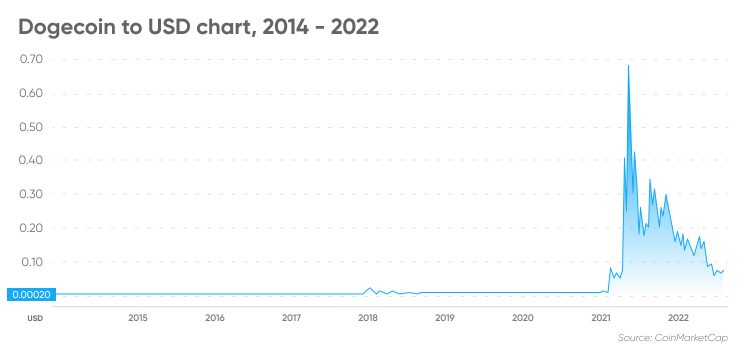
Dogecoin to USD chart, 2014 - 2022

As of 29 July, the total supply of dogecoins mined amounted to more than 132 billion. All tokens mined were in circulation.  The cryptocurrency had a market capitalisation surpassing $8bn and was ranked  the 10th biggest cryptocurrency, surpassing “dogecoin killer” Shiba Inu and “Ethereum killer” Polkadot.

Who owns the most dogecoins?

Over the years, there has been a lot of speculation about who has the most dogecoins or who are the biggest dogecoin whales. A crypto whale is an entity – be it an institution, individual or exchange – that owns a significant amount of a digital asset and therefore can influence the price.

What is your sentiment on DOGE/USD?

In 2021, news reports started referencing a “mysterious dogecoin whale” who owned $22bn of the asset at the time. Some alleged that that person was Elon Musk, as his support for the cryptocurrency was documented online in a series of twitter posts and during an appearance in an episode of Saturday Night Live (SNL). But there is no evidence to support the claim  that  it was him.

Other guesses included the US-based trading platform Robinhood (HOOD), however, the company’s CEO Vlad Tenev denied the rumours.

According to data provided by intotheblock, there are seven top holders of dogecoin, as of 29 July. The wallets are anonymous due to the decentralised nature of cryptocurrencies. Intotheblock noted that the biggest DOGE whale owns 30.16% of the total circulating supply of the cryptocurrency.

The top holder’s account’s balance surpassed 40.84 bn DOGE coins which amounted to $2.55bn at the time of writing. According to blockchair, the account’s address is DPDLBAe3RGQ2GiPxDzhgjcmpZCZD8cSBgZ.

The second biggest dogecoin whale owned just 5.35% of the total circulating supply of the cryptocurrency which amounted to 7.25bn DOGE tokens ($452.1m, as of the time of writing).

“You would be surprised at how many crypto currency token supplies that are owned by a handful of people. It is concerning but it is telling that crypto is no different than the financial industry in terms of  whales,” Mark Basa, the director at HOKK Finance, told Capital.com.

Anndy Lian, chairman of BigONE Exchange and the author of Blockchain Revolution 2030, told Capital.com that dogecoin concentration may be a real issue.

“The whales can single-handedly bring Dogecoin and its ecosystem down. This is a big flaw in the design and the similar outcomes can actually happen in many other top coins too. Personally, I think influencers like Elon Musk and Mark Cuban saw this issue and are the earliest to step in to instil confidence to avoid possible mass panic sell by regular holders,” he told Capital.com.

Lian also referenced the speculations that the biggest dogecoin holders were either Musk or Cuban but noted that who the owner is, is not as important.

“It is the behaviour and intention that matters most. If the top holder believes in the coin and is willing to build the ecosystem, I respect that. If they just want to sell their investment off, I hope they can offload it in batches. Offloading is also a good thing as the coin can become more decentralised.”

Dogecoin reveals the biggest whale wallet

Dogecoin has also addressed the speculations and rumours surrounding who the biggest dogecoin holders are.

Dogecoin said that “many of the top Dogecoin wallets are cold wallets or hot wallets controlled by exchanges and brokers, and they thus represent Dogecoin held in custody for thousands – or hundreds of thousands, even – of people.”

The meme coin’s team noted that many of the biggest holder wallets appear to be managed by trading platforms, as they exhibit patterns of activity and volume that are typical of crypto exchanges or brokerage services holding large amounts of collateral.

“In particular, the Dogecoin community has identified the exchanges and brokerage platforms behind some of the largest wallets, including the infamous ‘whale’ holding 30% of the supply… As it turned out, that infamous whale wallet, which was split across several addresses in October/November 2021, contains the holdings of hundreds of thousands of retail holders,” Dogecoin noted.

What does ownership concentration mean for the token?

CoinLoan’s digital assets analyst, Maxim Shilo, noted that knowing who owns the most dogecoins is as important as knowing how many shares Apple investors have.

“If you are already an investor or want to become one, then it is certainly necessary to understand what can become catalysts for growth or decline. Knowing who owns the most Dogecoin can give you an advantage in the marketplace,” he told Capital.com.

HOKK Finance’s Basa added that knowing who the top dogecoin holders are could expose their motives.

“Let’s say that an old rumour I read on the Doge reddit is true: that a foreign nation, or foreign investor, owned a huge supply of Doge and was using it to drain funds from the common retail investor.
“If so, Doge has a serious enemy and the world should know. If exposed, then there could be a huge sell-off, or a massive withdraw of Doge from centralised exchanges where investors would store their Doge on cold wallets in order to come together and show the community’s strength, similar to the Gamestop scenario, where the power of the community liquidated some serious hedge fund shorting the company’s stock.”

CoiLoan’s Shilo added that DOGE can be a great investment for novice traders since it is known for its “massive pumps,” however, highlighted that “owning it comes with risks… as it has a structure, in which most of the tokens are found in 1-2 wallets.

“This negatively affects the characteristics of the token. When there is such a concentration of coins, there is a chance that at any moment these wallets may be hacked, or the owner could be tempted to arrange dump and pump schemes.”

Note that analysts’ predictions and opinions can be wrong. Knowing and following the biggest cryptocurrency whales shouldn’t be used as a substitute for your own research. Always conduct your own due diligence before trading. And never invest or trade money you cannot afford to lose.


Original Source: https://capital.com/who-owns-the-most-dogecoins

Anndy Lian is an early blockchain adopter and experienced serial entrepreneur who is known for his work in the government sector. He is a best selling book author- “NFT: From Zero to Hero” and “Blockchain Revolution 2030”.

Currently, he is appointed as the Chief Digital Advisor at Mongolia Productivity Organization, championing national digitization. Prior to his current appointments, he was the Chairman of BigONE Exchange, a global top 30 ranked crypto spot exchange and was also the Advisory Board Member for Hyundai DAC, the blockchain arm of South Korea’s largest car manufacturer Hyundai Motor Group. Lian played a pivotal role as the Blockchain Advisor for Asian Productivity Organisation (APO), an intergovernmental organization committed to improving productivity in the Asia-Pacific region.

An avid supporter of incubating start-ups, Anndy has also been a private investor for the past eight years. With a growth investment mindset, Anndy strategically demonstrates this in the companies he chooses to be involved with. He believes that what he is doing through blockchain technology currently will revolutionise and redefine traditional businesses. He also believes that the blockchain industry has to be “redecentralised”.

j j j