Who owns the most ethereum? Biggest ETH holders

Who owns the most ethereum? Biggest ETH holders

Ethereum’s long-awaited upgrade to a proof-of-stake (PoS) consensus mechanism is set to begin in the third or fourth quarter of 2022. The event is expected to increase scalability and adoption rate for the second-largest cryptocurrency by market capitalisation, ether (ETH).

What are the major ether use cases? Will ETH supply change after migrating to PoS? Who owns the most ethereum (ETH) coins? In this article, we discuss the project in detail and find out more about ethereum holders.

What is ethereum?

Ethereum is the world’s leading smart contracts blockchain. Its native cryptocurrency, ether (ETH), is the second largest after bitcoin (BTC), with a market capitalisation of more than $200.71bn at the time of writing (28 July).

Founded by Russia-born, Canadian programmer Vitalik Buterin and a host of co-founders, including Gavin Wood, Charles Hoskin, Joseph Lubin and Anthonio di Lorio, Ethereum debuted in 2015, preceded by a whitepaper published by Buterin in 2014.

In its whitepaper, Ethereum described a cryptographic ledger that allowed users to encode smart contracts and build decentralised applications (Dapps) within its blockchain.

Built on Bitcoin’s innovation, Ethereum has several differences with Bitcoin which was launched in 2009.

The role of Ethereum in the blockchain industry differs from that of bitcoin. The former is a platform for developing and deploying decentralised applications (Dapps) on its network, whereas the latter focuses on facilitating peer-to-peer decentralised payments.

In short, Ethereum could be compared to a market place of blockchain-based financial services, games, social networks, and other Dapps. According to State of the Dapps, as of 28 July 2022, out of 4,073 decentralised applications, 2,970 were built on the Ethereum blockchain.

Tokenomics is another distinction between the two leading blockchains. Unlike bitcoin, ether has no hard cap.

The Ethereum network is gradually expanding, as the total number of addresses continues trending up. According to Glassnode, it increased from around 10,000 addresses in 2015 to more than 155 million addresses in June 2022.
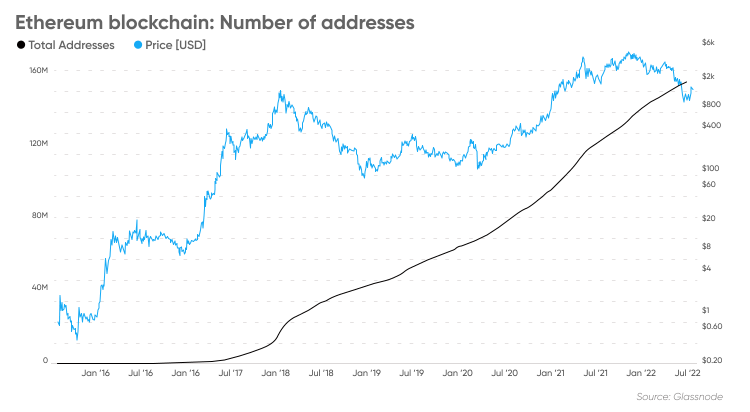
Ethereum blockchain: Number of addresses

Ethereum use cases

Ethereum smart-contracts helped the platform to become widely used in various sectors, from decentralised finance (DeFI), to gaming and non-fungible tokens (NFT) space.

Top 20 Ethereum-based tokens, as of 28 July, included: stablecoins, like Tether (USDT) and USD Coin (USDC); DeFi cryptocurrencies, like Uniswap (UNI) and Chainlink (LINK); and gaming cryptocurrencies, like ApeCoin (APE), Decentraland (MANA), The Sandbox (SAND) and Axie Infinity (AXS).

According to Ark Invest’s Big Ideas 2022 report: “After a turbulent 2018-2019, Ethereum emerged in 2021 as the predominant smart contracting platform for decentralized finance and non-fungible tokens (NFTs).
“Ether (ETH) is both the preferred collateral in DeFi and the unit of account in NFT marketplaces, suggesting that it is likely to capture a portion of the $123 trillion global money supply.”

However, the dominance of DeFi applications on Ethereum blockchain has decreased lately, while NFT transactions have been growing. According to Glassnode’s data as of 25 July 2022, consumption of gas by NFT projects surged 6.2%, since November 2021, while DeFi application’s gas usage plunged from 27.5% to 15.1%.

Ethereum supply: How many ether (ETH) coins are there?

The Ethereum network began with 72 million Ether coins in circulation. A crowd sale conducted in July and August 2014 to fund the project’s development sold about 83% of its initial supply or 60 million.

In exchange for an ETH wallet address, the crowd sale participants sent a total of 31,000 bitcoin to a designated Bitcoin address. The participants were promised to receive the ETH that they bought when the network was launched.

The initial ETH price for the crowd sale was set at 2,000 ETH per BTC, and it was intended to progressively decrease to a final price of 1,337 ETH per BTC in the 42-day public sale that ended on 2 September 2014.

The crowd sale raised 31,529 BTC (approximately $18m at the time) in exchange for 60 million ETH, according to blockchain research firm Messari.

The total number of ethereum coins in circulation today differs from the early days. Following the launch of the Ethereum Mainnet in 2015, each block minted a new ETH. Block rewards, which were initially set at 5 ETH per block, have now been reduced to 2 ETH per block.

Ethereum does not have a fixed supply. As of 28 July 2022, circulating ETH supply totals 121.73m, according to CoinMarketCap.
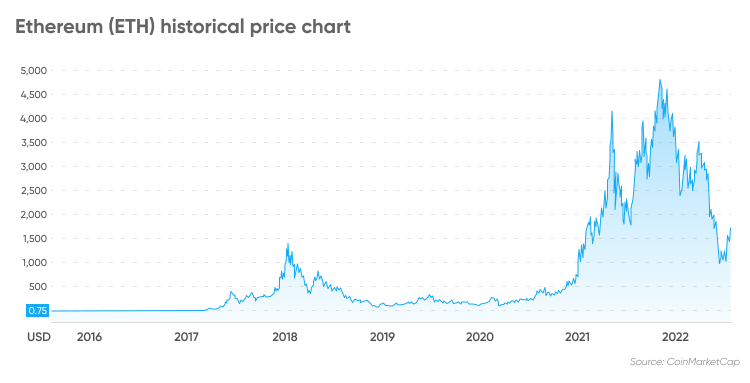
Ethereum (ETH) historical price chart

ETH supply after PoS migrating

Ethereum is in the process of migrating to proof-of stake (PoS) consensus which will see ETH ditching its proof-of-work (PoW) miners. It will instead reward newly-issued ETH tokens to validators who have staked ETH tokens on the network.

The upgrade to PoS or known as ‘The Merge’ and ‘Ethereum 2.0’ is touted as the biggest event on the cryptocurrency markets. Validators depositing ETH through staking will reduce the circulating supply of ETH in the future.

What is your sentiment on ETH/USD?

The network said only 1,600 ETH a day will remain after the Merge, dropping the total issuance by 90%.

As of 28 July 2022, over 13.8 million ETH had been staked in anticipation of The Merge, removing approximately 11.5% of the coin’s current supply from circulation.

According to Glassnode’s data as of 9 July, Lido, a project offering a staking solution for Ethereum, accounted for 4.137 million ETH staked (31.8%), while the combined stake of three crypto exchanges Coinbase, Kraken and Binance accounted for 3.505 million ETH (27% of the total amount staked).

The Merge is expected to happen later in 2022, which Ethereum said will reduce the energy required to secure Ethereum by about 99.95%.

Who has the most ethereum?

There were 201.76 million ethereum holders as of 28 July, up from 199.58 million a month earlier on 29 June, according to CoinCarp.

Who are the biggest ethereum holders? The largest ETH-holding address was an ETH2 deposit smart contract which held over 13.1 million coins or close to 11% of ETH’s circulating as of 28 July, according to Ethereum data on-chain Etherscan and Coincarp.

The second largest ETH-holding  address was a Wrapped Ether smart contract with 4.28 million ETH (3.58% of circulating supply), as of 28 July.

The third and fourth highest amounts of ETH were deposited in wallet addresses identified as belonging to crypto exchanges Kraken and Binance.

Based on data from Etherscan, two unidentified wallet addresses in fifth and sixth places are top holders of ethereum outside those deposited in the smart contracts and crypto exchanges.

The two unidentified wallets had about 1.95 million and 1.49 million ETH tokens in them, respectively, representing 1.6% and 1.2% of the total ETH supply, as of 28 July 2022.

The two wallets mentioned above were the only two unidentified addresses among the top 10 ether holders. The remaining protocols were identified as smart contracts, cryptocurrency exchanges, and decentralised finance (DeFi) protocols.

It is unknown how much ETH holdings do early contributors and ethereum insiders currently have. In October 2018, Buterin disclosed his wallet address on Twitter. He added that he “never personally held more than ~0.9% of all ETH, and my net worth never came close to $1b.”

What do analysts view of Ethereum?

According to Ark Invest, Ethereum could displace many traditional financial services and ether (ETH) could compete as global money.

“As financial services move on-chain, decentralized networks are likely to take share from existing financial intermediaries. The beneficiaries of this shift include Ethereum, the base protocol, and DeFi, the decentralized applications built on top of Ethereum,” the company said.

Anndy Lian, intergovernmental blockchain advisor, said Ethereum’s upgrade from PoW to PoS is a big move for the cryptocurrency market.

“This is like the launch of Windows 95 where all good things will follow,” said Lian who is also the author of Blockchain Revolution 2030.
“Ethereum’s transition to PoS will bring many benefits, including improved efficiency, scalability, security and reduced centralization. I am looking forward to more surprises,” he said, adding that there will be more upgrades after The Merge.

Cryptocurrency prices are highly volatile, including for ethereum (ETH) and bitcoin (BTC). It is important to do your own research on a coin or token to determine if it is a good fit for your portfolio. Whether ethereum (ETH) is a suitable asset for you will depend on your risk tolerance and how much you intend to trade.

When looking for ethereum projections, bear in mind that analysts’ and algorithm-based ETH crypto price predictions can be wrong. Their expectations are based on fundamental and technical studies of the cryptocurrency’s past performance, which offers no guarantee of future results. And never trade money that you cannot afford to lose.


Original Source: https://capital.com/who-owns-the-most-ethereum

Anndy Lian is an early blockchain adopter and experienced serial entrepreneur who is known for his work in the government sector. He is a best selling book author- “NFT: From Zero to Hero” and “Blockchain Revolution 2030”.

Currently, he is appointed as the Chief Digital Advisor at Mongolia Productivity Organization, championing national digitization. Prior to his current appointments, he was the Chairman of BigONE Exchange, a global top 30 ranked crypto spot exchange and was also the Advisory Board Member for Hyundai DAC, the blockchain arm of South Korea’s largest car manufacturer Hyundai Motor Group. Lian played a pivotal role as the Blockchain Advisor for Asian Productivity Organisation (APO), an intergovernmental organization committed to improving productivity in the Asia-Pacific region.

An avid supporter of incubating start-ups, Anndy has also been a private investor for the past eight years. With a growth investment mindset, Anndy strategically demonstrates this in the companies he chooses to be involved with. He believes that what he is doing through blockchain technology currently will revolutionise and redefine traditional businesses. He also believes that the blockchain industry has to be “redecentralised”.
j j j

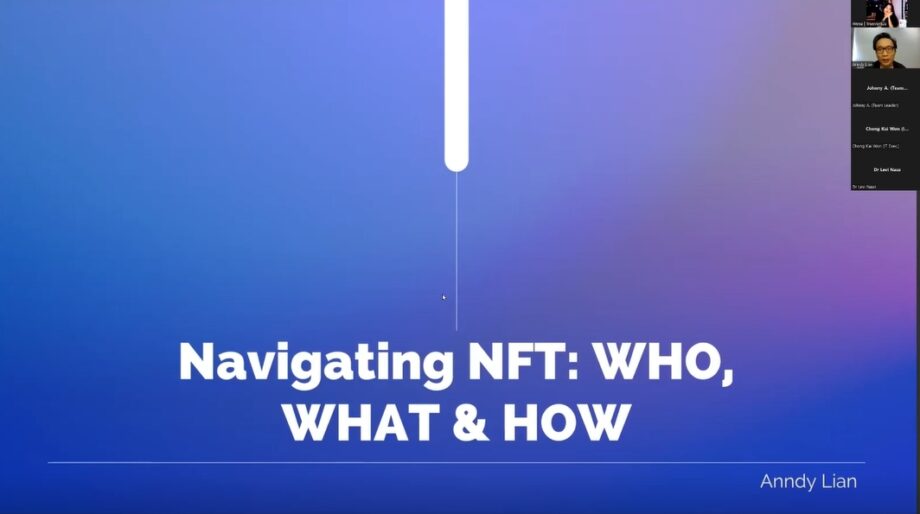
Anndy Lian’s Speech at Asia Crypto Summit, 18 July 2022- Navigating NFT: Who, What & How

Anndy Lian’s Speech at Asia Crypto Summit, 18 July 2022- Navigating NFT: Who, What & How

Anndy Lian, an all-rounded business strategist in Asia. He has provided advisory across a variety of industries for local, international, public listed companies and governments. He is an early blockchain adopter and experienced serial entrepreneur, book author, investor, board member, and keynote speaker.

Currently, he is appointed as the Chief Digital Advisor at Mongolia Productivity Organization, championing national digitization.

Prior to his current appointments, he was the Chairman of BigONE Exchange, a global top 30 ranked crypto spot exchange, and was also the Advisory Board Member for Hyundai DAC, the blockchain arm of South Korea’s largest car manufacturer Hyundai Motor Group where he looks after the governance and compliance aspects of the business.

He also played a pivotal role as the Blockchain Advisor for Asian Productivity Organisation (APO), an intergovernmental organization committed to improving productivity in the Asia-Pacific region.

His second book, titled NFT: From Zero to Hero, tells you all that you need to know about NFT. His book will available very soon.

NFT stands for “non-fungible token.” NFTs can really be anything digital。 In simple words, these cryptographic assets are based on blockchain technology. They cannot be exchanged or traded equivalently like other cryptographic assets. Like Bitcoin or Ethereum.

NFT allows the buyer to own the original item. Not only that, it contains built-in authentication, which serves as proof of ownership. Collectors value those “digital bragging rights” almost more than the item itself.

The following topics were addressed:

– Why NFT is important
– Overview of the current NFT industry
– Who are the current participants in the NFT market?
– Introduction of CEX and DEX NFT marketplace
– What are the different types of NFTs?
– What are the necessary tools if I want to gain an in-depth understanding of the NFT market?
– What is a successful NFT project?
– Quick Overview on NFT Regulations
– Quick Overview of NFT and Traditional Business
– What to look out for during the bearish times?
– What’s next for the future?

NFTs have the potential to be infinitely useful in many industries by increasing security and processing costs for transactions and providing a new platform for the gig economy to work through.

NFTs are revolutionizing digital asset ownership and laying the foundations for crypto, play-to-earn games, metaverses, and more.

Anndy Lian is an early blockchain adopter and experienced serial entrepreneur who is known for his work in the government sector. He is a best selling book author- “NFT: From Zero to Hero” and “Blockchain Revolution 2030”.

Currently, he is appointed as the Chief Digital Advisor at Mongolia Productivity Organization, championing national digitization. Prior to his current appointments, he was the Chairman of BigONE Exchange, a global top 30 ranked crypto spot exchange and was also the Advisory Board Member for Hyundai DAC, the blockchain arm of South Korea’s largest car manufacturer Hyundai Motor Group. Lian played a pivotal role as the Blockchain Advisor for Asian Productivity Organisation (APO), an intergovernmental organization committed to improving productivity in the Asia-Pacific region.

An avid supporter of incubating start-ups, Anndy has also been a private investor for the past eight years. With a growth investment mindset, Anndy strategically demonstrates this in the companies he chooses to be involved with. He believes that what he is doing through blockchain technology currently will revolutionise and redefine traditional businesses. He also believes that the blockchain industry has to be “redecentralised”.

j j j

Three Arrows, Voyager failures raise questions of who is next in crypto fall from grace

Three Arrows, Voyager failures raise questions of who is next in crypto fall from grace

The crypto winter is killing off companies that took on big risks when markets were booming. So is this the shakeout all financial markets go through?

Hedge fund Three Arrows Capital (3AC) looks like the biggest casualty of the crypto price collapse so far after filing for bankruptcy in the U.S., but according to blockchain business advisor Anndy Lian, the worst may be yet to come.

“It will have a snowball effect,” said Lian, who is a fund manager for blockchain investments at Passion Venture Capital Pte. in Singapore and advises Mongolia’s government on the industry.“[The impact] will not just be on 3AC, it will be on 3AC’s involvement as an investor or as a fund manager, then it will snowball down,” Lian said in an interview with Forkast.

That snowball has already hit crypto lending platform Voyager Digital Ltd., which filed for Chapter 11 bankruptcy on Wednesday in New York. Yet as more companies get swamped, some in the industry are calling it a necessary shakeout after the excesses of last year’s record-setting crypto price surge.

Voyager Digital had earlier halted or limited customer withdrawals, a move adopted by other lenders such as BlockFi. Crypto exchange Celsius was one of the first lending and staking platforms to halt withdrawals in early June, citing the common refrain “extreme market conditions.”

The collapse of Terra, which some argue helped trigger the bankruptcies now being filed, saw its Luna token fall from the ranks of a top 10 cryptocurrency with a market capitalization of almost US$30 billion to effectively zero in a matter of days.

Broken arrow

Any firm with significant exposure to the Terra project was hit hard by the collapse, including 3AC, which had a US$200 million investment in Luna Foundation Guard, the organization behind the Terra stablecoin, effectively wiped out when the project went south.

As 3AC sank into funding trouble, Voyager got hit after disclosing it had loaned over US$650 million in the USDC stablecoin and Bitcoin to 3AC, which it might not be getting back. BlockFi was among the lenders that foreclosed on roughly US$400 million in loans to 3AC.

Chapter 11 generally allows for a company to come up with a plan to pay off creditors and rebuild the business.

In the crypto boom times, many of these companies with lending and staking platforms were venturing into ever more risky areas for profits, Igneus Terrenus, head of communications at crypto exchange Bybit, said in an interview with Forkast.

“It’s almost a repeat or like a rhyming [with] what happened with the subprime mortgage crisis (which led to the Global Financial Crisis of 2008),” he said. “These firms just have to go further and deeper into more risky area because there is so much appetite.”

One of the world’s largest investment banks, Goldman Sachs is said to be looking to raise US$2 billion to buy distressed assets from Celsius, though Goldman hasn’t commented on the speculation.

Smaller pond

Companies native to the crypto industry are also looking for opportunities, with Bahamas-based crypto exchange FTX providing a US$400 million loan to BlockFi that includes an option to buy the troubled crypto lender.

Buying these firms out is a “smart move” Terrenus said, not only as a business opportunity, but in the case of FTX it creates a positive impression of a “savior” within the industry and grants confidence back to those firms and the market in general.

While the so-called contagion spreads in the crypto industry, it hasn’t reached broader traditional markets — this time around.

In its recent Financial Stability Report, the Bank of England highlighted how vulnerabilities in the crypto market, such as over-leveraging and breakdown of confidence in stablecoins, have contributed to the crypto crash.

The BoE recommended increased regulation of the industry to minimize the risk to broader markets as crypto adoption grows and become further entwined within traditional finance.

“It happens to everybody,” he said. “The fact that it’s happening to crypto now I don’t think should come as a surprise to people. The really important thing is what the crypto industry does now that it’s happened.”

Some of these firms will have to look at strengthening their balance sheets and internal controls, Sullivan added.

Many of these firms that are in trouble at the moment are not true DeFi (decentralized finance), but traditional centralized businesses just focused on cryptocurrency, he said.

Total value locked in these protocols has decreased in the past few months, but there have not been the collapses as has been seen in more centralized firms.

“Decentralized protocols actually performed exactly how they intended to and avoided the perils that the likes of BlockFi, Celsius and Voyager are experiencing,” Sullivan said.

Original Source: https://forkast.news/three-arrows-voyager-failure-crypto-fall-from-grace/

Anndy Lian is an early blockchain adopter and experienced serial entrepreneur who is known for his work in the government sector. He is a best selling book author- “NFT: From Zero to Hero” and “Blockchain Revolution 2030”.

Currently, he is appointed as the Chief Digital Advisor at Mongolia Productivity Organization, championing national digitization. Prior to his current appointments, he was the Chairman of BigONE Exchange, a global top 30 ranked crypto spot exchange and was also the Advisory Board Member for Hyundai DAC, the blockchain arm of South Korea’s largest car manufacturer Hyundai Motor Group. Lian played a pivotal role as the Blockchain Advisor for Asian Productivity Organisation (APO), an intergovernmental organization committed to improving productivity in the Asia-Pacific region.

An avid supporter of incubating start-ups, Anndy has also been a private investor for the past eight years. With a growth investment mindset, Anndy strategically demonstrates this in the companies he chooses to be involved with. He believes that what he is doing through blockchain technology currently will revolutionise and redefine traditional businesses. He also believes that the blockchain industry has to be “redecentralised”.

j j j