Why You Should Consider Investing in These Three Cryptocurrencies

Why You Should Consider Investing in These Three Cryptocurrencies

Key points

  • Given the unique attributes of Dogecoin, Toncoin, and Shiba Inu, each offers distinct investment opportunities.
  • However, due to the high volatility of the cryptocurrency market, investors are advised to diversify their portfolios and conduct thorough research before making any decision.

Cryptocurrency investors are constantly on the lookout for the next big opportunity. While Bitcoin and Ethereum often dominate the headlines, other digital assets have garnered significant attention and support. Among these are Dogecoin, Toncoin, and Shiba Inu. Each of these cryptocurrencies has unique attributes and backing that make them intriguing options for investors.

I will share the reasons why one might consider adding these three coins to their portfolio in the current market environment. Not financial advice, of course.

Dogecoin: The Power of Community and Celebrity Endorsement

Dogecoin, originally created as a joke, has evolved into a serious player in the cryptocurrency market. Launched in December 2013 by Billy Markus and Jackson Palmer, Dogecoin was inspired by the popular “Doge” meme featuring a Shiba Inu dog. Despite its humorous beginnings, Dogecoin has built a robust community and has seen substantial growth over the years.

One of the most compelling reasons to consider investing in Dogecoin is its strong community support. The Dogecoin community is known for its charitable efforts and positive spirit. For instance, in 2014, the community raised $50,000 to help send the Jamaican bobsled team to the Winter Olympics. This sense of community and goodwill has helped Dogecoin maintain a loyal following.

Another significant factor contributing to Dogecoin’s appeal is the endorsement of high-profile individuals, most notably Elon Musk. The CEO of Tesla and SpaceX has frequently tweeted about Dogecoin, often causing its price to surge. Musk’s influence cannot be understated; his tweets have the power to move markets, and his support for Dogecoin has brought it into the mainstream spotlight.

In May 2021, Musk referred to Dogecoin as “the people’s crypto,” further solidifying its status as a legitimate investment option.

From a financial perspective, Dogecoin has shown impressive growth. As of 6 June 2024, Dogecoin’s market capitalization stands at approximately $15.8 billion, making it one of the top 10 cryptocurrencies by market cap. While its price is highly volatile, the potential for significant returns is evident. For example, in early 2021, Dogecoin’s price surged by over 12,000%, reaching an all-time high of $0.73 in May of that year.

I am waiting for Elon Musk’s plan for $DOGE. And I know he will do something to it.

Toncoin: The Telegram Connection and Growing Ecosystem

Toncoin, the native cryptocurrency of the TON (Telegram Open Network) blockchain, is another digital asset worth considering. Originally developed by the team behind the popular messaging app Telegram, TON aims to provide a fast, secure, and scalable blockchain platform. Although Telegram officially withdrew from the project in 2020 due to regulatory issues, the TON community has continued to develop and expand the network.

One of the primary reasons to invest in Toncoin is its strong user base. Telegram boasts over 700 million monthly active users as of 2023, and the integration of TON into the messaging app has the potential to drive significant adoption. The seamless integration of cryptocurrency transactions within a widely used messaging platform could revolutionize the way people send and receive money, making Toncoin a valuable asset.

The TON ecosystem is rapidly growing, with numerous projects being built on the platform. One notable example is Hamster Kombat, a decentralized game that leverages the TON blockchain for in-game transactions and rewards. The success of such projects highlights the versatility and potential of the TON network.

Many new projects are building on TON. For example, in just three months, 239 million users subscribed to the Hamster Kombat app.

Pavel Durov, the founder of Telegram, pointed out that four to five million new users join the game daily, making it the fastest-growing digital service in the world. “It took Hamster only 73 days to reach 100 million monthly users. Each day, 4-5 million new users join Hamster Kombat, making it the fastest-growing digital service in the world.”

From a technical standpoint, TON offers several advantages over other blockchain platforms. It utilizes a unique consensus mechanism called “Byzantine Fault Tolerant” (BFT) proof-of-stake, which enhances security and scalability. Additionally, TON’s multi-chain architecture allows for parallel transaction processing, significantly increasing throughput. These technical innovations position TON as a formidable competitor in the blockchain space.

Financially, Toncoin has shown promising growth. As of the point of writing, Toncoin’s market capitalization is around $38.5 billion, reflecting its increasing adoption and potential for future growth. While it may not yet be as well-known as some other cryptocurrencies, its strong fundamentals and growing ecosystem make it a compelling investment option.

Shiba Inu: The Power of Community and Strategic Partnerships

Shiba Inu, often referred to as the “Dogecoin killer,” is another cryptocurrency that has captured the attention of investors. Launched in August 2020 by an anonymous developer known as “Ryoshi,” Shiba Inu was created as an experiment in decentralized community building. Despite its relatively short history, Shiba Inu has quickly gained a massive following and has become one of the most talked-about cryptocurrencies.

One of the key reasons to consider investing in Shiba Inu is its strong and passionate community. The Shiba Inu community, known as the “Shib Army,” is highly active on social media and has played a crucial role in promoting the coin. This grassroots support has helped Shiba Inu achieve significant milestones, such as being listed on major cryptocurrency exchanges like Binance and Coinbase.

Another factor contributing to Shiba Inu’s appeal is its strategic partnerships and endorsements. Notably, Ethereum co-founder Vitalik Buterin has been associated with Shiba Inu. In May 2021, Buterin donated 50 trillion SHIB tokens (worth approximately $1 billion at the time) to the India COVID-Crypto Relief Fund, bringing significant attention to the project.

Additionally, Shiba Inu has formed partnerships with various companies and platforms, further enhancing its credibility and adoption.

From a financial perspective, Shiba Inu has demonstrated remarkable growth. Its market capitalization is approximately $9.3 billion, making it one of the top 20 cryptocurrencies by market cap. The coin’s price has the potential for high returns. For instance, in 2021, Shiba Inu’s price surged by over 1,000% in just one month, reaching an all-time high.

Furthermore, Shiba Inu’s ecosystem is expanding with the development of various projects and initiatives. One notable example is ShibaSwap, a decentralized exchange (DEX) that allows users to trade, stake, and earn rewards with SHIB tokens. The success of ShibaSwap and other projects within the Shiba Inu ecosystem highlights the coin’s potential for long-term growth and utility.

More recently, I see Shytoshi Kusama making his first public appearance in Kyoto to meet the Shiba Inu community. This means they are working hard on the ground. I hope to see more price action soon.

Conclusion: A Diversified Approach to Cryptocurrency Investment

In conclusion, Dogecoin, Toncoin, and Shiba Inu each offer unique attributes and potential benefits for investors. Dogecoin’s strong community support and celebrity endorsements, Toncoin’s integration with Telegram and growing ecosystem, and Shiba Inu’s passionate community and strategic partnerships make them compelling options in the current market.

However, it is essential to approach cryptocurrency investment with caution. The market is highly volatile, and prices can fluctuate dramatically. Diversifying one’s portfolio and conducting thorough research are crucial steps to mitigate risks and maximize potential returns.

Ultimately, the decision to invest in Dogecoin, Toncoin, or Shiba Inu should be based on a careful assessment of one’s risk tolerance, investment goals, and market conditions. By staying informed and making strategic decisions, investors can navigate the dynamic world of cryptocurrency and potentially reap significant rewards.


 

Source: https://www.financemagnates.com/cryptocurrency/why-you-should-consider-investing-in-these-three-cryptocurrencies/

Anndy Lian is an early blockchain adopter and experienced serial entrepreneur who is known for his work in the government sector. He is a best selling book author- “NFT: From Zero to Hero” and “Blockchain Revolution 2030”.

Currently, he is appointed as the Chief Digital Advisor at Mongolia Productivity Organization, championing national digitization. Prior to his current appointments, he was the Chairman of BigONE Exchange, a global top 30 ranked crypto spot exchange and was also the Advisory Board Member for Hyundai DAC, the blockchain arm of South Korea’s largest car manufacturer Hyundai Motor Group. Lian played a pivotal role as the Blockchain Advisor for Asian Productivity Organisation (APO), an intergovernmental organization committed to improving productivity in the Asia-Pacific region.

An avid supporter of incubating start-ups, Anndy has also been a private investor for the past eight years. With a growth investment mindset, Anndy strategically demonstrates this in the companies he chooses to be involved with. He believes that what he is doing through blockchain technology currently will revolutionise and redefine traditional businesses. He also believes that the blockchain industry has to be “redecentralised”.

j j j

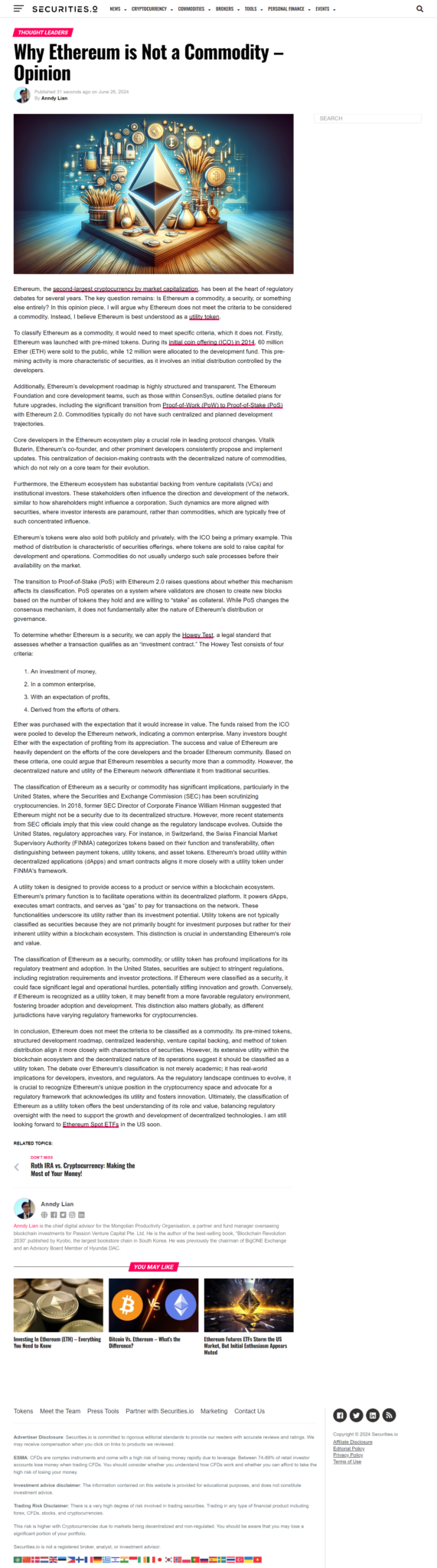
Why Ethereum is Not a Commodity – Opinion

Why Ethereum is Not a Commodity – Opinion

Ethereum, the second-largest cryptocurrency by market capitalization, has been at the heart of regulatory debates for several years. The key question remains: Is Ethereum a commodity, a security, or something else entirely? In this opinion piece, I will argue why Ethereum does not meet the criteria to be considered a commodity. Instead, I believe Ethereum is best understood as a utility token.

To classify Ethereum as a commodity, it would need to meet specific criteria, which it does not. Firstly, Ethereum was launched with pre-mined tokens. During its initial coin offering (ICO) in 2014, 60 million Ether (ETH) were sold to the public, while 12 million were allocated to the development fund. This pre-mining activity is more characteristic of securities, as it involves an initial distribution controlled by the developers.

Additionally, Ethereum’s development roadmap is highly structured and transparent. The Ethereum Foundation and core development teams, such as those within ConsenSys, outline detailed plans for future upgrades, including the significant transition from Proof-of-Work (PoW) to Proof-of-Stake (PoS) with Ethereum 2.0. Commodities typically do not have such centralized and planned development trajectories.

Core developers in the Ethereum ecosystem play a crucial role in leading protocol changes. Vitalik Buterin, Ethereum’s co-founder, and other prominent developers consistently propose and implement updates. This centralization of decision-making contrasts with the decentralized nature of commodities, which do not rely on a core team for their evolution.

Furthermore, the Ethereum ecosystem has substantial backing from venture capitalists (VCs) and institutional investors. These stakeholders often influence the direction and development of the network, similar to how shareholders might influence a corporation. Such dynamics are more aligned with securities, where investor interests are paramount, rather than commodities, which are typically free of such concentrated influence.

Ethereum’s tokens were also sold both publicly and privately, with the ICO being a primary example. This method of distribution is characteristic of securities offerings, where tokens are sold to raise capital for development and operations. Commodities do not usually undergo such sale processes before their availability on the market.

The transition to Proof-of-Stake (PoS) with Ethereum 2.0 raises questions about whether this mechanism affects its classification. PoS operates on a system where validators are chosen to create new blocks based on the number of tokens they hold and are willing to “stake” as collateral. While PoS changes the consensus mechanism, it does not fundamentally alter the nature of Ethereum’s distribution or governance.

To determine whether Ethereum is a security, we can apply the Howey Test, a legal standard that assesses whether a transaction qualifies as an “investment contract.” The Howey Test consists of four criteria:

  1. An investment of money,
  2. In a common enterprise,
  3. With an expectation of profits,
  4. Derived from the efforts of others.

Ether was purchased with the expectation that it would increase in value. The funds raised from the ICO were pooled to develop the Ethereum network, indicating a common enterprise. Many investors bought Ether with the expectation of profiting from its appreciation. The success and value of Ethereum are heavily dependent on the efforts of the core developers and the broader Ethereum community. Based on these criteria, one could argue that Ethereum resembles a security more than a commodity. However, the decentralized nature and utility of the Ethereum network differentiate it from traditional securities.

The classification of Ethereum as a security or commodity has significant implications, particularly in the United States, where the Securities and Exchange Commission (SEC) has been scrutinizing cryptocurrencies. In 2018, former SEC Director of Corporate Finance William Hinman suggested that Ethereum might not be a security due to its decentralized structure. However, more recent statements from SEC officials imply that this view could change as the regulatory landscape evolves. Outside the United States, regulatory approaches vary. For instance, in Switzerland, the Swiss Financial Market Supervisory Authority (FINMA) categorizes tokens based on their function and transferability, often distinguishing between payment tokens, utility tokens, and asset tokens. Ethereum’s broad utility within decentralized applications (dApps) and smart contracts aligns it more closely with a utility token under FINMA’s framework.

A utility token is designed to provide access to a product or service within a blockchain ecosystem. Ethereum’s primary function is to facilitate operations within its decentralized platform. It powers dApps, executes smart contracts, and serves as “gas” to pay for transactions on the network. These functionalities underscore its utility rather than its investment potential. Utility tokens are not typically classified as securities because they are not primarily bought for investment purposes but rather for their inherent utility within a blockchain ecosystem. This distinction is crucial in understanding Ethereum’s role and value.

The classification of Ethereum as a security, commodity, or utility token has profound implications for its regulatory treatment and adoption. In the United States, securities are subject to stringent regulations, including registration requirements and investor protections. If Ethereum were classified as a security, it could face significant legal and operational hurdles, potentially stifling innovation and growth. Conversely, if Ethereum is recognized as a utility token, it may benefit from a more favorable regulatory environment, fostering broader adoption and development. This distinction also matters globally, as different jurisdictions have varying regulatory frameworks for cryptocurrencies.

In conclusion, Ethereum does not meet the criteria to be classified as a commodity. Its pre-mined tokens, structured development roadmap, centralized leadership, venture capital backing, and method of token distribution align it more closely with characteristics of securities. However, its extensive utility within the blockchain ecosystem and the decentralized nature of its operations suggest it should be classified as a utility token. The debate over Ethereum’s classification is not merely academic; it has real-world implications for developers, investors, and regulators. As the regulatory landscape continues to evolve, it is crucial to recognize Ethereum’s unique position in the cryptocurrency space and advocate for a regulatory framework that acknowledges its utility and fosters innovation. Ultimately, the classification of Ethereum as a utility token offers the best understanding of its role and value, balancing regulatory oversight with the need to support the growth and development of decentralized technologies. I am still looking forward to Ethereum Spot ETFs in the US soon.


Source: https://www.securities.io/why-ethereum-is-not-a-commodity-opinion/

Anndy Lian is an early blockchain adopter and experienced serial entrepreneur who is known for his work in the government sector. He is a best selling book author- “NFT: From Zero to Hero” and “Blockchain Revolution 2030”.

Currently, he is appointed as the Chief Digital Advisor at Mongolia Productivity Organization, championing national digitization. Prior to his current appointments, he was the Chairman of BigONE Exchange, a global top 30 ranked crypto spot exchange and was also the Advisory Board Member for Hyundai DAC, the blockchain arm of South Korea’s largest car manufacturer Hyundai Motor Group. Lian played a pivotal role as the Blockchain Advisor for Asian Productivity Organisation (APO), an intergovernmental organization committed to improving productivity in the Asia-Pacific region.

An avid supporter of incubating start-ups, Anndy has also been a private investor for the past eight years. With a growth investment mindset, Anndy strategically demonstrates this in the companies he chooses to be involved with. He believes that what he is doing through blockchain technology currently will revolutionise and redefine traditional businesses. He also believes that the blockchain industry has to be “redecentralised”.

j j j

Why is Bitcoin stagnated despite $2B in spot ETF inflows?

Why is Bitcoin stagnated despite $2B in spot ETF inflows?

Bitcoin has experienced a 6.7% drop after almost reaching $72,000 on May 21, settling at $67,100. This decline does not necessarily signal a bearish trend, as Bitcoin is still only 8.7% below its all-time high. However, investors are puzzled why the recent inflows into Bitcoin spot exchange-traded funds (ETFs) haven’t sparked more bullish sentiment.

Distribution of assets by the failed Mt. Gox exchange estate

Data from Farside Investors reveals $1.96 billion in net inflows into U.S. spot Bitcoin ETFs since May 15, equivalent to 64 days of BTC issuance from miners. Notably, the U.S. spot Bitcoin ETF market has now exceeded $50 billion in assets under management. In comparison, U.S. gold ETFs hold about $118.5 billion, according to the World Gold Council.

Moreover, inflows into spot Bitcoin ETFs typically prompt the withdrawal of Bitcoins from exchanges, which has dropped to its lowest level since March 2018—2.3 million BTC, as per Glassnode data.

Aggregate Bitcoin balances on exchanges, BTC. Source: Glassnode

Although there’s no certainty these coins will be sold in the near term, their transfer to cold storage and custodians outside of exchanges usually reduces market liquidity. This issue becomes more pronounced in bull markets, where thinner order books at higher price levels can amplify price movements due to aggressive buying.

Consequently, if institutional investors continue to acquire Bitcoin through ETFs yet the price keeps falling, it’s likely that selling pressure originates from the regular spot markets. It’s suggested that the movement of 141,686 BTC by the bankrupt Japanese exchange Mt. Gox on May 28 indicates an imminent asset distribution to its creditors, ahead of the scheduled deadline on October 31.

Over $9.4 billion worth of Bitcoin is owed to about 127,000 creditors of Mt. Gox, who have been waiting for over a decade since the exchange’s collapse in 2014 due to multiple hacks. Despite the short-term negative impact on Bitcoin’s price, Anndy Lian, an intergovernmental blockchain expert, believes that repaying this debt will resolve a longstanding issue and permanently remove the associated uncertainty.

Regulatory uncertainty and the anti-crypto lobby

Among the reasons prompting Bitcoin holders to cash out above $67,000 is the regulatory uncertainty in the United States. The U.S. Securities and Exchange Commission (SEC) and the Commodity Futures Trading Commission have taken legal actions against leading exchanges and intermediaries, including Binance, Coinbase, Kraken, KuCoin, and Robinhood.

Additionally, the U.S. Department of Justice has levied charges against the co-founders of Tornado Cash and the developers of Samourai Wallet for money laundering, as well as against Roger “Bitcoin Jesus” Ver for allegations of tax evasion and fraud dating back seven years. Although these events do not directly affect Bitcoin, they tarnish the industry’s image, making it less appealing to institutional investors.

This issue extends beyond the U.S. For instance, Hong Kong’s Securities and Futures Commission has issued an ultimatum to cryptocurrency exchanges that have not yet registered to operate in the area. As of May 31, only 18 exchanges have applied for a license, with major players such as OKX, Huobi, and Gate opting out due to the stringent regulatory requirements imposed by Hong Kong.

In addition to ongoing legal challenges and Wells notices, there’s a persistent political backlash against cryptocurrencies. On May 29, U.S. Senators Elizabeth Warren and William Cassidy addressed a letter to the Drug Enforcement Administration, claiming that cryptocurrencies have “played an increasingly prominent role” in the fentanyl trade. Senator Warren has previously faced criticism for using unreliable data in discussions about terrorism.

These factors, together with the potential impact on cryptocurrency intermediaries and the possible selling pressure from the distribution of Mt. Gox coins do not set a definitive upper limit for Bitcoin at $70,000 or similar levels. It remains to be seen whether spot ETF investors will maintain their positions as the U.S. debt continues to escalate. For now, the market appears to be under bearish control in the short term.


Source: https://cointelegraph.com/news/why-is-bitcoin-stagnated-despite-2b-in-spot-etf-inflows

Anndy Lian is an early blockchain adopter and experienced serial entrepreneur who is known for his work in the government sector. He is a best selling book author- “NFT: From Zero to Hero” and “Blockchain Revolution 2030”.

Currently, he is appointed as the Chief Digital Advisor at Mongolia Productivity Organization, championing national digitization. Prior to his current appointments, he was the Chairman of BigONE Exchange, a global top 30 ranked crypto spot exchange and was also the Advisory Board Member for Hyundai DAC, the blockchain arm of South Korea’s largest car manufacturer Hyundai Motor Group. Lian played a pivotal role as the Blockchain Advisor for Asian Productivity Organisation (APO), an intergovernmental organization committed to improving productivity in the Asia-Pacific region.

An avid supporter of incubating start-ups, Anndy has also been a private investor for the past eight years. With a growth investment mindset, Anndy strategically demonstrates this in the companies he chooses to be involved with. He believes that what he is doing through blockchain technology currently will revolutionise and redefine traditional businesses. He also believes that the blockchain industry has to be “redecentralised”.

j j j