Anndy Lian: “DeFi will be too profitable to simply kill off with regulation”

Anndy Lian: “DeFi will be too profitable to simply kill off with regulation”

Decentralized finance (DeFi) poses both opportunities and challenges for governments and regulators coming out of the pandemic. Take the case of the USA where tricky new regulations around crypto have been tacked on the key infrastructure bill, lead by Senator Elizabeth Warren, including her urging Treasury Secretary Janet Yellen to identify and remedy risks posed by cryptocurrencies.

At the same time, you have countries like Kazakhstan, Canada, U.S.A. is benefiting from the migration of crypto miners following China’s crackdown, now allowing bitcoin to be used by their banks. The task for the DeFi sector is to carry on educating Governments and regulators on the benefits of DeFi especially in parts of the world where banking is hard to access, and in promoting crypto entrepreneurship for the future. Nevertheless, governments are trying to know more to get themselves fitted with the new DeFi trends.

DeFi is here to stay, that’s worth saying first and foremost. What shape it takes, and how much it will be a benefit to everyone rather than a select few, depends on all stakeholders working together. DeFi startups that take a proactive attitude, following best practices, and in dialogue with their regulators, will be in the best position to advance not just their business but also the interests of their customers. Obviously, recent examples such as Binance reigning in the amount of leverage they are offering for futures contracts show that it’s prudent to take account of the regulatory landscape.

As a pro-government crypto advisor myself, I emphasise the value of working with regulators and the public to explain the risks involved in different products are vital.


————————————–

Regulators are Coming for the DeFi Goose and Its Golden Eggs

  • There are two big sources of ambiguity: one is conceptual and linguistic, and the other relates to international consistency.
  • DeFi’s survival is “guaranteed” by the fact that it’s much too lucrative for governments to completely hobble it.

Regulation is becoming a very hot topic in the crypto industry as governments try to understand how they should respond to this still relatively new phenomenon. With United States-based crypto companies now fighting the infrastructure bill battle in the House after a defeat in the Senate, the industry could potentially look very different in a few years, after recently proposed rule changes have been implemented.

Various sub-sectors within crypto will likely be affected in different ways by incoming regulation, but one area that may be affected more than most is decentralized finance (DeFi). This is largely because, due to its arguably decentralized nature, it would potentially be very hard to carry out know-your-customer (KYC) and anti-money laundering (AML) checks on users if it becomes truly decentralized.

According to industry figures who spoke to Cryptonews.com, DeFi is currently dogged by vagueness, ambiguity and inconsistency in the application of existing rules, as well as proposed new laws. However, while most observers agree that DeFi will likely suffer from ongoing regulatory uncertainty in the short-to-medium term, they also say that regulators will ultimately choose to adopt guidelines that nurture – rather than nuke – the fledgling sector.

Ambiguity…and more ambiguity

The aforementioned infrastructure bill provides a good example of the kind of minefield that current and incoming regulations present to the DeFi world.

The original draft of the bill included decentralized exchanges and peer-to-peer marketplaces in its definition of “broker,” thereby encompassing much of DeFi with its proposal to subject all “brokers” to the requirement to report large transactions to the Internal Revenue Service (IRS).

Coin Center executive director Jerry Brito celebrated an amendment that sought to remove both decentralized exchanges and peer-to-peer marketplaces from the scope of the bill. However, a subsequent proposed amendment proposed altering the language yet again, so that only proof-of-work mining appeared to be excluded by the new definition of “broker.”

This isolated example illustrates just how tricky it will be for DeFi players to navigate future regulations.

But there are plenty more examples of this kind of lack of clarity and certainty. It’s a common feature of pretty much all laws and regulations that will affect the DeFi sector, from the European Commission’s recent anti-money laundering proposals to the Financial Action Task Force (FATF)’s soon-to-be-revised guidelines.

There are two big sources of ambiguity: One is conceptual and linguistic, and the other relates to international consistency.

Anndy Lian, the Chairman of the crypto exchange BigONE and the Chief Digital Advisor to the Mongolian Productivity Organization, said,

“At the FATF recent Plenary meeting in June this year, a key takeaway was the concern around the apparent lack of consensus across different jurisdictions and between industry players regarding the best way to comply with the Travel Rule. And while the private sector has led the way in developing solutions to enable implementation of the Travel Rule, ‘a majority of jurisdictions have not yet implemented the FATF’s requirements.’”

For Lian, the real issue and challenge for the DeFi sector is the uneven compliance with the Travel Rule across jurisdictions, which “poses real headaches for both DeFi businesses and their customers.”

But in terms of incoming and future regulation, there’s also a big problem related to semantics and conceptual clarity. According to the MakerDAO (MKR) community member PaperImperium, technical terms aren’t used consistently by regulators and the crypto industry, making it unclear as to what exactly policymakers want.

PaperImperium told Cryptonews.com:

“A great example of this is the debate around stablecoins. As the Gorton-Zhang paper from a few weeks ago makes clear, later confirmed by private discussions, even a term as simple as ‘stablecoin’ has a different meaning in policy circles than in the cryptoverse.”

Most people working within crypto would use the term “stablecoin” to signify any token that is purposefully trying to remain in a price band around a given benchmark. However, PaperImperium said, “policymakers and regulators are generally talking about redeemable-upon-demand-for-fiat tokens to the exclusion of algorithmically managed tokens.”

This creates a big headache for stablecoins such as DAI, which is generated by MakerDAO. In fact, prior to the recent infrastructure bill, the Democratic Representative Don Beyer has put forward a draft bill that would effectively outlaw all stablecoins that don’t meet certain regulatory criteria and aren’t registered by their issuer. The latter condition is something that DAI, for instance, could never meet.

Still, most people working within DeFi claim that regulation is not only inevitable, but good for the sector in the long term.

Layerzero, a member of MakerDAO’s Sustainable Ecosystem Scaling Core Unit Team, explained:

“I believe regulation is necessary and a sign that the industry matures. Not having legal certainty is a risk that hinders future growth.”

And Layerzero added,

“I welcome good regulation that provides legal certainty to market participants and that doesn’t hinder innovation, but of course, this is hard to achieve. The problem is that the current regulatory framework is outdated and was not designed for decentralized ledger technology.”

DeFi’s golden eggs

New proposals are coming thick and fast at the moment, and it’s uncertain what regulatory hurdles the DeFi ecosystem will have to clear in the months and years to come. It’s also uncertain whether all soon-to-be-imposed hurdles will actually be clearable, and whether further growth in DeFi sector might become somewhat restricted as a result.

Still, DeFi industry players estimate that the sector will endure for a long time to come, even if its mature form may be somewhat different from how it is now.

For ​​Skirmantas Januškas, the CEO and Co-founder of DappRadar, DeFi’s survival will be guaranteed by the fact that it’s much too lucrative for regulators and governments to completely obliterate.

He told Cryptonews.com:

“The sheer amount of wealth generated and locked into our industry – especially now, at a time when governments inject trillions into the economy by way of rescue packages to the detriment of, say, infrastructure and other long-term needs that must also be met – makes us the proverbial goose that laid the golden eggs. And the act of laying golden eggs is a potentially taxable event.”

Given that DeFi went from USD 1 billion in total value locked in to around USD 90 billion in just under a year (according to DeFi Pulse), most governments will want to extract a portion of the value it has generated for tax and public spending. In other words, they will seek to avoid imposing too-stringent regulation.

Januškas added:

“Regulators worldwide will likely seek to capitalize on our industry, just as we crypto natives have, and this places us in a very strong position in a dialogue that is only just starting. And while it may take years of regulations being proposed, effected, repealed, before we come to a solution that safeguards consumers’ and governments’ interests and still harbors innovation, the regulations that do come into force will likely work to DeFi’s advantage in the long run.”

Anndy Lian agreed that DeFi will be too profitable to simply kill off with regulation, regardless of how that regulation will end up looking in a few years. In his view (as someone who actually does advise governments), DeFi poses both opportunities and challenges for governments and regulators emerging from the coronavirus pandemic.

Lian said,

“The task for the DeFi sector is to carry on educating governments and regulators on the benefits of DeFi especially in parts of the world where banking is hard to access, and in promoting crypto entrepreneurship for the future. Nevertheless, governments are trying to know more to get themselves fitted with the new DeFi trends.”

The question is: how long will DeFi need to wait until authorities produce the clear regulations the sector needs to grow sustainably?

“In some areas, like tax or AML, it’s a matter of months. In some others, it’s unrealistic to expect full regulatory clarity even within years,” said Jacek Czarnecki, the Global Legal Counsel at MakerDAO.

Given the likely lengths of time involved, Czarnecki suggested that new DeFi projects should definitely engage in dialogue with regulators and policymakers.

Czarnecki told Cryptonews.com,

“We have pioneered such activities at Maker, and have been meeting with both multiple national regulators (including central banks) as well as international organizations (e.g. the OECD, FATF, the Financial Stability Board) since 2018. That has helped us gain trust and awareness among the regulatory community.”
Source: https://cryptonews.com/exclusives/regulators-are-coming-for-the-defi-goose-and-its-golden-eggs-11458.htm


Anndy Lian is an early blockchain adopter and experienced serial entrepreneur who is known for his work in the government sector. He is a best selling book author- “NFT: From Zero to Hero” and “Blockchain Revolution 2030”.

Currently, he is appointed as the Chief Digital Advisor at Mongolia Productivity Organization, championing national digitization. Prior to his current appointments, he was the Chairman of BigONE Exchange, a global top 30 ranked crypto spot exchange and was also the Advisory Board Member for Hyundai DAC, the blockchain arm of South Korea’s largest car manufacturer Hyundai Motor Group. Lian played a pivotal role as the Blockchain Advisor for Asian Productivity Organisation (APO), an intergovernmental organization committed to improving productivity in the Asia-Pacific region.

An avid supporter of incubating start-ups, Anndy has also been a private investor for the past eight years. With a growth investment mindset, Anndy strategically demonstrates this in the companies he chooses to be involved with. He believes that what he is doing through blockchain technology currently will revolutionise and redefine traditional businesses. He also believes that the blockchain industry has to be “redecentralised”.

j j j

Will Facebook’s Mark Zuckerberg Kill or Save Bitcoin (The Goat)? Anndy Lian thinks “We might really see a pro-longed bull run.”

Will Facebook’s Mark Zuckerberg Kill or Save Bitcoin (The Goat)? Anndy Lian thinks “We might really see a pro-longed bull run.”

Thanks for capturing my comments on Twitter. Personally, I think this post from Mark Zuckerberg, CEO of Facebook is a hint to us that he is open to having bitcoin on the balance sheet. As for ditching his stocks, well that would not happen. If he joins Twitter, Square, PayPal, Tesla and all in accumulating bitcoins with his $20 billion of cash, we might really see a pro-longed bull run.


Will Facebook’s Mark Zuckerberg Kill or Save Bitcoin (The Goat)?

Perhaps tired of the likes of Elon Musk and Mark Cuban dominating the crypto press, Facebook supremo Mark Zuckerberg has emerged from the shadows with a headline-grabbing move of his own – naming his new pet goat after the world’s biggest cryptoasset: bitcoin (BTC).

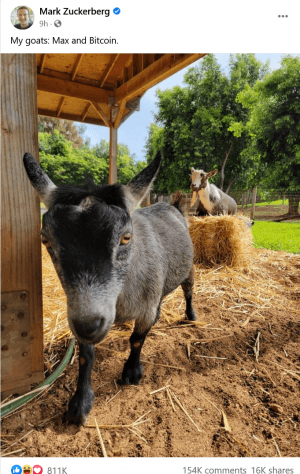
Bitcoin the Goat has become the talk of the net after Zuckerberg posted a photo of the animal frolicking in what appeared to be a hay-lined barn, with a playmate named Max, on his Facebook page.

Will Facebook's Mark Zuckerberg Kill or Save Bitcoin (The Goat)? 102
Source: facebook.com

The BTC community has been debating the significance of the goat and its moniker. On Twitter, Madelon Vos, a Dutch columnist and bitcoiner, indulged in some wordplay, quipping that the secret message behind the naming was that Bitcoin Max(imalists) are GOATs (greatest of all time). In fact, a number of other Bitcoin fans also very similar puns – a welcome distraction, perhaps, to the token’s somewhat erratic slide below the USD 55,000 mark in recent hours.

Crypto advisor and investor Anndy Lian was another to jump on the Bitcoin Maxi joke bandwagon, but also asked if the choice of name indicated that Zuckerberg was prepared to abandon stock investment in favor of a crypto portfolio.

Another crypto enthusiast, the CEO and co-founder of CoinCorner Danny Scott, asked if Zukerberg’s Bitcoin love meant that he had fallen out of love with Libra, his firm’s stablecoin project now known as Diem.

Among the mirth and excitement, a few sober souls clamored to make themselves heard. Bitcoin trader and crypto tweeter @BitBitCrypto appealed for reason, writing:

“Zuckerberg knows about bitcoin and it’s not on Facebook’s balance sheet yet. Instead, he named his goat Bitcoin. Guys? I’m not sure this is a market buy signal.”

But such voices of reason were not to be given much airtime today, with Francis Pouliot, the CEO and Founder of Bull Bitcoin, replying jestfully:

“Why would [Zuckerberg] want to put it on Facebook’s balance sheet instead of suppressing the price long enough to stash up like an emperor?”

The timing of Zuckerberg’s post suggests that he may have been paying close attention to Cryptonews.com, which late last month outlined three compelling reasons why his firm should take up a position in bitcoin.

But there was a macabre twist to all this goat-themed fun – as posters with good memories recalled the bizarre tale of how Zuckerberg once killed a goat he owned…and then served it up to the Twitter boss Jack Dorsey.

Back in 2019, Rolling Stone carried an interview with Dorsey, where the latter explained that Zuckerberg had killed a goat that he had raised “probably with a stun gun and a knife,” before sending it to be butchered.

“Evidently in Palo Alto, there’s a rule or regulation that you can have six livestock on any lot of land, so he had six goats at the time,” Dorsey was quoted as saying.

The meat from the slain goat was then put in the oven, but didn’t quite come out as planned.

Dorsey continued:

“We go in the dining room. He puts the goat down. It was cold. That was memorable. I don’t know if it went back in the oven. I just ate my salad.”

Will Zuck kill Bitcoin? Will he eat it for lunch? Or will Bitcoin The Cryptocurrency appear on the balance sheet of Facebook? Stay tuned to Cryptonews.com to find out!


Original Source: https://cryptonews.com/news/will-facebook-s-mark-zuckerberg-kill-or-save-bitcoin-the-goa-10252.htm


Anndy Lian is an early blockchain adopter and experienced serial entrepreneur who is known for his work in the government sector. He is a best selling book author- “NFT: From Zero to Hero” and “Blockchain Revolution 2030”.

Currently, he is appointed as the Chief Digital Advisor at Mongolia Productivity Organization, championing national digitization. Prior to his current appointments, he was the Chairman of BigONE Exchange, a global top 30 ranked crypto spot exchange and was also the Advisory Board Member for Hyundai DAC, the blockchain arm of South Korea’s largest car manufacturer Hyundai Motor Group. Lian played a pivotal role as the Blockchain Advisor for Asian Productivity Organisation (APO), an intergovernmental organization committed to improving productivity in the Asia-Pacific region.

An avid supporter of incubating start-ups, Anndy has also been a private investor for the past eight years. With a growth investment mindset, Anndy strategically demonstrates this in the companies he chooses to be involved with. He believes that what he is doing through blockchain technology currently will revolutionise and redefine traditional businesses. He also believes that the blockchain industry has to be “redecentralised”.

j j j

Anndy Lian Spoke at Global Roundtable Review: Short Selling: What is it? Why is it Risky and How this will affect Crypto?

Anndy Lian Spoke at Global Roundtable Review: Short Selling: What is it? Why is it Risky and How this will affect Crypto?

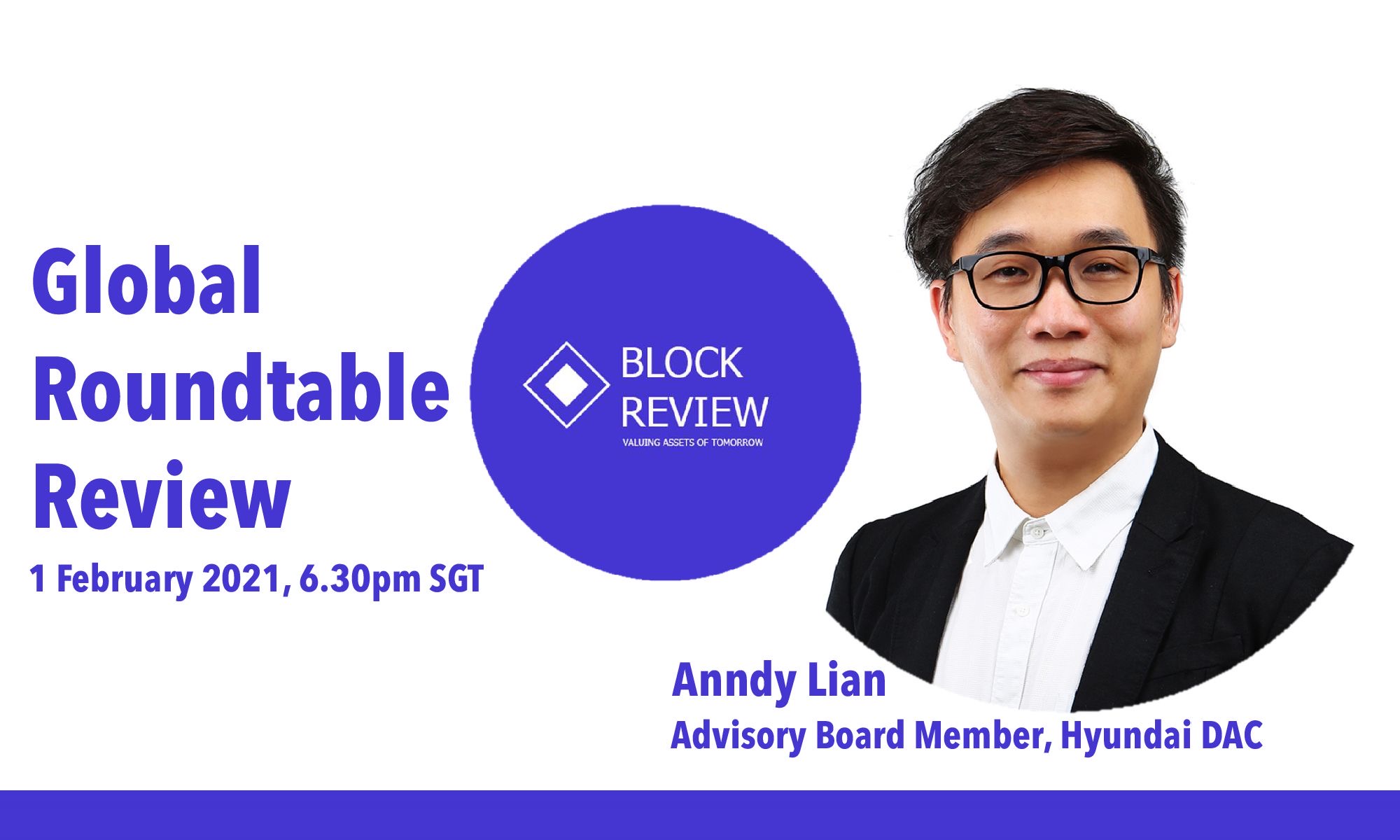
Anndy Lian, Advisory Board Member to Hyundai DAC participated in event “Global Roundtable Review” organised by Block Review. Anndy Lian talked about the recent short selling incident for Gamestop and investors worked through social media to gain an advantage.

The following is a summary of Anndy’s speech:

An overview of the Gamestop saga: What is a short squeeze?

The last week of events is unprecedented in my opinion.
When you buy a stock, you own it and the price goes up due to the company’s performance and all. But when you short it, you are basically betting on the stock to do badly. Some hedge funds are shorting a couple of stocks. They shorted more than a 100%.

The reddit group used publicly available information, went in to buy the stocks and driving the price up, they created a short squeeze. The group drove up the price of the stock, leading to the hedge fund paying more than what they had sold it for before returning the borrowed shares, at the cost of professional traders.

That led to stopping Robinhood app that is targeted at mass retail investors to buy the stock. Forcing a crash and despite all these, the stock went back up. The people are winning.

If Gamestop new shareholders were to hold them long enough, the hedge funds will go out of business. Melvin Capital lost 53% of their investment.
Elon Musk and many other celebrities are also tweeting asking all to buy and hold. This movement has become organic.


What should investors know before shorting stocks?

Investors need to know what kind of risk they are getting themselves in. If you’ve ever lost money on a stock, you’ve probably wondered if there’s a way to make money when stocks fall. There is, and it’s called short selling. Even though it seems to be the perfect strategy for capitalizing on declining stock prices, it comes with even more risk than buying stocks the traditional way. Investing in stocks in the usual way is risky enough. Short selling should be left to very experienced investors, with large portfolios that can easily absorb sudden and unexpected losses.


How risky is it to be following leads on forums (like reddit)

If you are in investment groups or on social media, there are many groups soliciting to jab individual stocks. This is not something new. Social influencers are also doing this, in the stocks and crypto market. I would say it is very dangerous to follow blindly to the “financial advice” on social media as many times the expected outcomes are not what you want. This time this Reddit group managed to make it, but what about the hundreds or even thousands of times where retailor investors got hurt.


In the Gamestop saga, was there institutional money (the other camp) pushing the squeeze? Will blockchain technology help?

I hope not, else we will be losing faith in this so call free, open market in USA. I would believe not all hedge funds are bad. There are a small handful of bad actors right now. Nasdaq CEO is calling regulators to come in and account for what has been done.

Regulators should get to the bottom of this, how is it possible for them to short more than 100% of the stocks. The system must be upgraded. In order to have a fair market, this is also a perfect time to look at blockchain technology, this the same technology that is backing up Bitcoin and many others. Blockchain technology will improve transparency and efficient too.

The reddit group – called SatoshiStreetBets – has driven up price of Doge, similar to how WallStreetBets did for GameStop. DOGE started rallying after a Twitter user calling himself the chairman of WallStreetBets (though who is not affiliated with the subreddit) asked followers about the cryptocurrency.

“What you are seeing on DOGE is not a short squeeze. It is the effects of social media gathering and working together. You cannot short sell or squeeze DOGE. It’s only rising because of speculation.”

This DOGE movement is used to demonstrate how users can manipulate prices if they move together. An individual cannot drive the prices but a group or a community of people who worked on the same goal can do that.


Can a similar short squeeze situation happen in Singapore?

Short-selling is not banned in Singapore, but SGX already requires investors to mark sell orders as “long” or “short” and publishes both daily and weekly reports on short-selling activity. “Abusive” short-selling – for example, with the spread of false rumours – could also be prosecuted as market manipulation or deception under the Securities and Futures Act.
Such policies will improve transparency on short-selling activities in the securities market and enable investors to make more informed trading decisions. With the added on help with technology such as blockchain, it reduces the chance of us being in this situation.

But then again, “Anything can happen.” Maybe less likely in Singapore.


Video:

https://youtu.be/KeoTRTKrwVA


About Anndy Lian:

www.anndy.com/about

Anndy Lian is an early blockchain adopter and experienced serial entrepreneur who is known for his work in the government sector. He is a best selling book author- “NFT: From Zero to Hero” and “Blockchain Revolution 2030”.

Currently, he is appointed as the Chief Digital Advisor at Mongolia Productivity Organization, championing national digitization. Prior to his current appointments, he was the Chairman of BigONE Exchange, a global top 30 ranked crypto spot exchange and was also the Advisory Board Member for Hyundai DAC, the blockchain arm of South Korea’s largest car manufacturer Hyundai Motor Group. Lian played a pivotal role as the Blockchain Advisor for Asian Productivity Organisation (APO), an intergovernmental organization committed to improving productivity in the Asia-Pacific region.

An avid supporter of incubating start-ups, Anndy has also been a private investor for the past eight years. With a growth investment mindset, Anndy strategically demonstrates this in the companies he chooses to be involved with. He believes that what he is doing through blockchain technology currently will revolutionise and redefine traditional businesses. He also believes that the blockchain industry has to be “redecentralised”.

j j j