Linfinity and Momentum Work Together to Incentivize Their Users Globally

Linfinity and Momentum Work Together to Incentivize Their Users Globally

Linfinity signed a strategic cooperation agreement with Momentum Switzerland in Seoul, South Korea on 18th July to reach a cooperation on the commercialization of blockchain industry and jointly promote the commercial development of blockchain.

Momentum is a blockchain marketing platform created by MobileBridge in Switzerland. Its parent company, MobileBridge, is a multinational company with global influence, helping customers around the world, including Burger King, Dansk Supermarked, Praxis and Volkswagen, to better understand and interact with their customers. As its subsidiary company, Momentum is committed to building the world’s first automated marketing platform based on blockchain and cryptocurrency.

Through the Momentum platform, in addition to earning the membership points, users can also check company dynamics and access personal information. This new customer relationship management model will redefine the traditional membership points system. This cooperation will further integrate Linfinity’s commercial resources at the B-end and Momentum’s marketing advantages at the C-end to jointly promote the commercialization and popularization of blockchain industry and create a new ecosystem for millions of users.

Momentum Founder and President Eyal Oster said,“We are thrilled to cooperate with Linfinity as we see them as a great partner for blockchain and supply chain management. We believe that cooperation between strong teams can drive mass adoption and full utilization of the technology. We look forward to a great cooperation and are already eyeing the first mutual use cases.”

“The ultimate value of the emergence of any new technology is to benefit mankind, so that everyone can enjoy the happiness brought by technology,” said Anndy, CEO of Linfinity. “In the blockchain industry, we are constantly looking for more industry partners to promote the development of the entire industry, and cooperation with Momentum is a good start.”

This cooperation will further integrate Momentum’s cooperative resources in Europe and Linfinity’s market advantage in Asia-Pacific region, and will establish a token exchange mechanism between Linfinity and Momentum. In the future, LFT will be able to be redeemed with membership points on the Momentum platform to further expand the circulation area of LFT and its token value, as well as promote Linfinity’s development in European and American markets.

Linfinity has signed strategic cooperation agreements with several international companies in Taiwan and Singapore, including Alishan Group and Scientific Tradition, aiming to build a reliable and traceable anti-counterfeit supply chain solution underlying blockchain technology. At the same time, by combining LFT Token to the business ecosystem, Linfinity is developing more benefit-distribution models under the new safe and credible cooperation. All ecosystem participants, including suppliers, manufacturers, logistics service providers, retailers and consumers can benefit from it. “Blockchain is still a relatively new concept for some people, but there is no doubt that consumers are the real beneficiaries and promoters of it. ” Anndy added. This strategic cooperation is an important milestone in the transformation of blockchain technology from concept to reality and will greatly promote the commercialization of blockchain industry.

About Momentum:

Momentum protocol (Zug, Switzerland) is set to revolutionize the customer loyalty and rewards market by setting a worldwide standard blockchain protocol used by companies and brands to issue and control their own privately branded loyalty and rewards program stable tokens on the blockchain. The Momentum protocol offers instant exchangeability and liquidity between all tokens at the protocol level so as to give the highest value to the brands and their end consumers. The protocol offers connectors to a loyalty and marketing application middleware plus a 3rd party plugin eco-system and a full API stack. The team consists of Ariel Luedi (Chairman, Zug, fmr. CEO of Hybrid, SAP board member), Eyal Oster (President, Tel Aviv, Israel, Shlomo, Kees de Vos (Tel-Aviv, GM Intel, Netherlands)), Professor Youngsook Park (Korean Chair, UN Millennium Project, Global Blockchain Association).

Anndy Lian is an early blockchain adopter and experienced serial entrepreneur who is known for his work in the government sector. He is a best selling book author- “NFT: From Zero to Hero” and “Blockchain Revolution 2030”.

Currently, he is appointed as the Chief Digital Advisor at Mongolia Productivity Organization, championing national digitization. Prior to his current appointments, he was the Chairman of BigONE Exchange, a global top 30 ranked crypto spot exchange and was also the Advisory Board Member for Hyundai DAC, the blockchain arm of South Korea’s largest car manufacturer Hyundai Motor Group. Lian played a pivotal role as the Blockchain Advisor for Asian Productivity Organisation (APO), an intergovernmental organization committed to improving productivity in the Asia-Pacific region.

An avid supporter of incubating start-ups, Anndy has also been a private investor for the past eight years. With a growth investment mindset, Anndy strategically demonstrates this in the companies he chooses to be involved with. He believes that what he is doing through blockchain technology currently will revolutionise and redefine traditional businesses. He also believes that the blockchain industry has to be “redecentralised”.
j j j

Experts: “Ethereum killer” needs to work on its governance issues or risk losing users

Experts: “Ethereum killer” needs to work on its governance issues or risk losing users

Just days after the EOS blockchain activated its mainnet on June 14, it froze seven accounts that it suspected belonged to thieves who had stolen funds from users.

Even before the dust began to settle on that news, the people maintaining the blockchain – called block producers – suspended 27 more accounts on June 22, saying in a statement that the “logic and reasoning for this order will be posted at a later date.” Hong Kong-based EOS is a fierce competitor of Ethereum, prompting some to call it an “Ethereum killer.”

Its move to put accounts on hold, without issuing a complete explanation, has led to an outcry from the cryptocurrency community.

Some pointed out how it goes against blockchain’s decentralized nature. But a few optimists have called the move “pragmatic” and supposedly a small sacrifice to make the blockchain secure.

The suspensions have led to a heavy sell-off of the EOS cryptocurrency, leaving investors who participated in its initial coin offering (ICO) – before the product went live – on the losing end.

                     EOS price volatility over the past 7 days / Image credit: Coinmarketcap

Now that its governance methods are facing increased scrutiny, some are wondering if the EOS blockchain can deliver what it promises.

The EOS blockchain is a smart contract platform advertised as a system for decentralized applications (dApps). The tech behind it is said to be a game-changer for the blockchain industry. It aims to create a more scalable network, offering a throughput of up to 6,000 transactions per second, as opposed to the six transactions per second seen on the Ethereum platform.

The EOS protocol was developed by Block.one in 2017. Its record-breaking ICO raised almost US$4 billion, and the EOS cryptocurrency has rapidly grown to become the fifth-largest crypto by market cap.

A constitutional mess

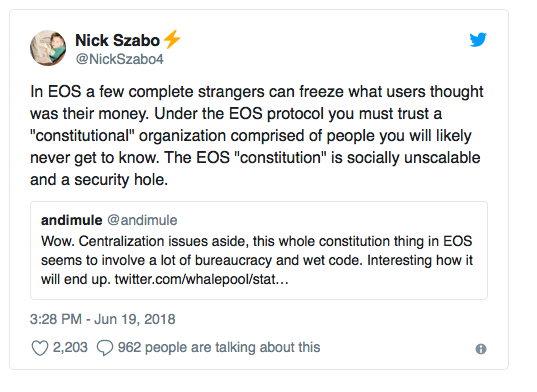
The EOS blockchain’s problems stem from the uncertainty surrounding the chain of command of its “stakeholders.” As such, the lack of a proper governance process has created a constitutional mess.

There are different groups that serve as decision-makers on the EOS blockchain. While 21 chosen block producers keep the platform running, a governing body called EOS Core Arbitration Forum (ECAF) is tasked with resolving disputes.

The problem arose when block producers froze the first seven accounts in a unanimous decision, without getting the go-ahead from ECAF first.

Days later, the reverse happened. ECAF prohibited block producers from processing transactions of the 27 additional accounts, but didn’t immediately clarify the rationale behind the order.

Calling ECAF a mistake, Block.one wants to drop the existing rules and replace them with a new governance framework, with CTO Dan Larimer proposing a version 2.0 of the EOS constitution.

Photo credit: solerf / 123RF

But the team has to act fast before the token’s reputation within the crypto community suffers further damage.

Unexplained decisions could lead to failure

Such a framework will only work if everyone agrees on the rules, says Paul Griffin, director of Singapore Management University’s Masters of IT in Business program.

These rules must then be published and shared with those in the network. And if any changes are made, they must gain everyone’s approval before being implemented. “If there is too much unexplained ruling or censuring, people will stop buying into the EOS cryptocurrency – probably rather quickly,” he warns.

Bobby Ong, co-founder of cryptocurrency data website CoinGecko, says the EOS blockchain needs to resolve its problems quickly and create a process as transparent as possible, or risk losing users.

Freezing accounts without proper authorization is “worrisome,” as Griffin puts it, because “people buying into the cryptocurrency would want to know under what circumstances accounts may be blocked.” He likens this scenario to PayPal suspending accounts while it investigates any suspicious activity, which can be frustrating to users.

Photo credit: logicbomb / 123RF

While a blockchain can be run in a centralized manner, Griffin contends that it makes “no sense as everyone would still have to trust the central authority. They might as well use other technology instead of blockchain.”

He continues, “For people to use the blockchain, there must be trust – which means the governance of the blockchain must be clear and robust. Time will tell if trust is being misplaced or not. And of course, if trust is lost, then the value of cryptocurrency will be lost as well.”

But Ong notes that by agreeing to participate in the EOS blockchain, participants have already implicitly accepted its rules.

“If you are not in agreement with it, you are free to use another blockchain and token. The EOS blockchain by itself is a political system where its ideals are ingrained in its constitution… It is very political in nature [and] there will be more of such situations happening in the future.”

EOS still holds potential

Given the potential of the EOS blockchain, some supporters aren’t willing to give up on it. They see the weeks following the launch as a testing phase.

Anndy Lian, CEO of Singapore-based distributed platform company Linfinity, believes that at the end of the day, the EOS blockchain made the account suspension decisions with its users’ welfare in mind.

“EOS froze those ‘criminal accounts’ to secure and protect people’s property… I believe EOS is doing the right thing.”

Ong observes that having an arbitration process in place ensures that actions will be taken on any suspicious activity. “This means that thieves will not be able to get away with multi-million or billion-dollar hacks to the system.“

“EOS aims to solve scalability at the expense of decentralization. There will be a subset of apps that I believe will grow with the need for less decentralization. All it takes is one dApp on the EOS blockchain to be viral, and opinions will change very quickly,” he concludes.

https://www.techinasia.com/eos-at-risk

Anndy Lian is an early blockchain adopter and experienced serial entrepreneur who is known for his work in the government sector. He is a best selling book author- “NFT: From Zero to Hero” and “Blockchain Revolution 2030”.

Currently, he is appointed as the Chief Digital Advisor at Mongolia Productivity Organization, championing national digitization. Prior to his current appointments, he was the Chairman of BigONE Exchange, a global top 30 ranked crypto spot exchange and was also the Advisory Board Member for Hyundai DAC, the blockchain arm of South Korea’s largest car manufacturer Hyundai Motor Group. Lian played a pivotal role as the Blockchain Advisor for Asian Productivity Organisation (APO), an intergovernmental organization committed to improving productivity in the Asia-Pacific region.

An avid supporter of incubating start-ups, Anndy has also been a private investor for the past eight years. With a growth investment mindset, Anndy strategically demonstrates this in the companies he chooses to be involved with. He believes that what he is doing through blockchain technology currently will revolutionise and redefine traditional businesses. He also believes that the blockchain industry has to be “redecentralised”.
j j j