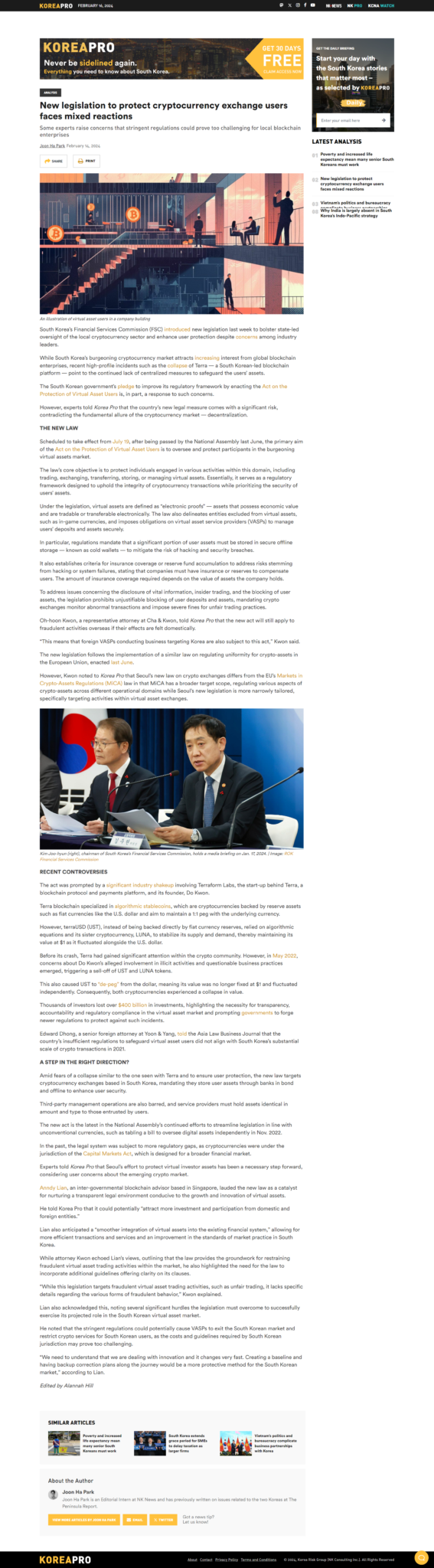
South Korea’s Financial Services Commission (FSC) introduced new legislation last week to bolster state-led oversight of the local cryptocurrency sector and enhance user protection despite concerns among industry leaders.
While South Korea’s burgeoning cryptocurrency market attracts increasing interest from global blockchain enterprises, recent high-profile incidents such as the collapse of Terra — a South Korean-led blockchain platform — point to the continued lack of centralized measures to safeguard the users’ assets.
The South Korean government’s pledge to improve its regulatory framework by enacting the Act on the Protection of Virtual Asset Users is, in part, a response to such concerns.
However, experts told Korea Pro that the country’s new legal measure comes with a significant risk, contradicting the fundamental allure of the cryptocurrency market — decentralization.
THE NEW LAW
Scheduled to take effect from July 19, after being passed by the National Assembly last June, the primary aim of the Act on the Protection of Virtual Asset Users is to oversee and protect participants in the burgeoning virtual assets market.
The law’s core objective is to protect individuals engaged in various activities within this domain, including trading, exchanging, transferring, storing, or managing virtual assets. Essentially, it serves as a regulatory framework designed to uphold the integrity of cryptocurrency transactions while prioritizing the security of users’ assets.
Under the legislation, virtual assets are defined as “electronic proofs” — assets that possess economic value and are tradable or transferable electronically. The law also delineates entities excluded from virtual assets, such as in-game currencies, and imposes obligations on virtual asset service providers (VASPs) to manage users’ deposits and assets securely.
In particular, regulations mandate that a significant portion of user assets must be stored in secure offline storage — known as cold wallets — to mitigate the risk of hacking and security breaches.
It also establishes criteria for insurance coverage or reserve fund accumulation to address risks stemming from hacking or system failures, stating that companies must have insurance or reserves to compensate users. The amount of insurance coverage required depends on the value of assets the company holds.
To address issues concerning the disclosure of vital information, insider trading, and the blocking of user assets, the legislation prohibits unjustifiable blocking of user deposits and assets, mandating crypto exchanges monitor abnormal transactions and impose severe fines for unfair trading practices.
Oh-hoon Kwon, a representative attorney at Cha & Kwon, told Korea Pro that the new act will still apply to fraudulent activities overseas if their effects are felt domestically.
“This means that foreign VASPs conducting business targeting Korea are also subject to this act,” Kwon said.
The new legislation follows the implementation of a similar law on regulating uniformity for crypto-assets in the European Union, enacted last June.
However, Kwon noted to Korea Pro that Seoul’s new law on crypto exchanges differs from the EU’s Markets in Crypto-Assets Regulations (MiCA) law in that MiCA has a broader target scope, regulating various aspects of crypto-assets across different operational domains while Seoul’s new legislation is more narrowly tailored, specifically targeting activities within virtual asset exchanges.
RECENT CONTROVERSIES
The act was prompted by a significant industry shakeup involving Terraform Labs, the start-up behind Terra, a blockchain protocol and payments platform, and its founder, Do Kwon.
Terra blockchain specialized in algorithmic stablecoins, which are cryptocurrencies backed by reserve assets such as fiat currencies like the U.S. dollar and aim to maintain a 1:1 peg with the underlying currency.
However, terraUSD (UST), instead of being backed directly by fiat currency reserves, relied on algorithmic equations and its sister cryptocurrency, LUNA, to stabilize its supply and demand, thereby maintaining its value at $1 as it fluctuated alongside the U.S. dollar.
Before its crash, Terra had gained significant attention within the crypto community. However, in May 2022, concerns about Do Kwon’s alleged involvement in illicit activities and questionable business practices emerged, triggering a sell-off of UST and LUNA tokens.
This also caused UST to “de-peg” from the dollar, meaning its value was no longer fixed at $1 and fluctuated independently. Consequently, both cryptocurrencies experienced a collapse in value.
Thousands of investors lost over $400 billion in investments, highlighting the necessity for transparency, accountability and regulatory compliance in the virtual asset market and prompting governments to forge newer regulations to protect against such incidents.
Edward Dhong, a senior foreign attorney at Yoon & Yang, told the Asia Law Business Journal that the country’s insufficient regulations to safeguard virtual asset users did not align with South Korea’s substantial scale of crypto transactions in 2021.
A STEP IN THE RIGHT DIRECTION?
Amid fears of a collapse similar to the one seen with Terra and to ensure user protection, the new law targets cryptocurrency exchanges based in South Korea, mandating they store user assets through banks in bond and offline to enhance user security.
Third-party management operations are also barred, and service providers must hold assets identical in amount and type to those entrusted by users.
The new act is the latest in the National Assembly’s continued efforts to streamline legislation in line with unconventional currencies, such as tabling a bill to oversee digital assets independently in Nov. 2022.
In the past, the legal system was subject to more regulatory gaps, as cryptocurrencies were under the jurisdiction of the Capital Markets Act, which is designed for a broader financial market.
Experts told Korea Pro that Seoul’s effort to protect virtual investor assets has been a necessary step forward, considering user concerns about the emerging crypto market.
Anndy Lian, an inter-governmental blockchain advisor based in Singapore, lauded the new law as a catalyst for nurturing a transparent legal environment conducive to the growth and innovation of virtual assets.
He told Korea Pro that it could potentially “attract more investment and participation from domestic and foreign entities.”
Lian also anticipated a “smoother integration of virtual assets into the existing financial system,” allowing for more efficient transactions and services and an improvement in the standards of market practice in South Korea.
While attorney Kwon echoed Lian’s views, outlining that the law provides the groundwork for restraining fraudulent virtual asset trading activities within the market, he also highlighted the need for the law to incorporate additional guidelines offering clarity on its clauses.
“While this legislation targets fraudulent virtual asset trading activities, such as unfair trading, it lacks specific details regarding the various forms of fraudulent behavior,” Kwon explained.
Lian also acknowledged this, noting several significant hurdles the legislation must overcome to successfully exercise its projected role in the South Korean virtual asset market.
He noted that the stringent regulations could potentially cause VASPs to exit the South Korean market and restrict crypto services for South Korean users, as the costs and guidelines required by South Korean jurisdiction may prove too challenging.
“We need to understand that we are dealing with innovation and it changes very fast. Creating a baseline and having backup correction plans along the journey would be a more protective method for the South Korean market,” according to Lian.