Bitcoin Ordinals sales dipped 61% in January, halving sparks hope

Bitcoin Ordinals sales dipped 61% in January, halving sparks hope

Bitcoin Ordinals inscriptions have been losing steam despite the interest in Bitcoin exchange-traded funds (ETFs) and the upcoming halving event.

Monthly Ordinals sales fell 61% to $335 million in January, down from $868 million in December, the month with the highest sales in Ordinals history, according to NFT data aggregator CryptoSlam. Ordinals are the first iteration of nonfungible tokens (NFTs) minted on the Bitcoin network.

The oversaturation of the NFT market and collections from other blockchains are among the main reasons behind the decline in Ordinals sales, according to Anndy Lian, an intergovernmental blockchain expert and author of the book NFT: From Zero to Hero.

“With an influx of new projects and artists entering the space, buyers now face a plethora of options. The spoil-for-choices situation got more obvious when other blockchains like Solana were picking up more steam,” Lian told Cointelegraph.

While monthly Ethereum NFT sales also declined by 2.2% to $355 million, NFT sales on Avalanche rose 89% to $46.7 million in January, up from $24.7 million in December.

Dokyo NFTs accounted for the lion’s share of the sales volume, as the collection generated $31.4 million for the Avalanche network in January, which represents 67% of the blockchain’s monthly sales. In comparison, Dokyo only generated $7.64 million worth of sales in December. Dokyo is a collection of 5,555 NFTs launched by pseudonymous creator 0xBrando.

Dokyo NFT sales started surging in November. Dokyo’s 24-hour sales volume surpassed Bored Ape Yacht Club sales on Nov. 24, as it briefly became the most traded NFT collection across all blockchains. Dokyo also climbed to the top of the sales leaderboard on Jan. 15, according to CryptoSlam data.

Beyond competing NFT collections, Lian believes that Ordinals sales were also affected by their controversial status in the Bitcoin community and their technical complexities:

“The launch of Ordinals has been controversial in the Bitcoin community because some believe the activity to be similar to spam email. This could have affected the reputation and legitimacy of Ordinals among some Bitcoin enthusiasts.”

On the other hand, Sebastien Guillemot, co-founder of Web3 gaming engine Paima Studios, said that interest from Ordinals is moving to Bitcoin layer-2 solutions. Guillemot said:

“Many who were working on Ordinals have pivoted to Bitcoin layer 2s, especially with the hype around BitVM and OP_CAT. It wouldn’t surprise me if developers and investors were rotating into this narrative.”

Despite the sales slump, total Ordinals inscriptions keep growing. According to Dune data, there are over 59 million ordinal inscriptions on the Bitcoin network.

Will the Bitcoin halving reignite interest in Ordinals?

Mirroring the sales decrease, the average Ordinals sale price also fell 25% to $1,340 in January, from $1,793 in December. Despite the decrease, large crypto firms continue showing interest, as Binance, the world’s largest crypto exchange, announced the launch of its Ordinals marketplace on Feb. 1.

Lian expects the upcoming Bitcoin halving to reignite interest in Ordinals. He said:

“The reduced supply of Bitcoin could make each satoshi more valuable and scarce, thus increasing the appeal of Ordinals as unique and collectible assets. Additionally, the halving could drive up the transaction fees on the Bitcoin network, which could incentivize miners to process Ordinals transactions and secure the network.”

In the 11th edition of the “State of Crypto” report published on Feb.1, 21Shares, the world’s largest crypto exchange-traded product (ETF) provider, wrote that Ordinals could offer Bitcoin more use cases, beyond just being a store-of-value asset:

“We expect innovations like Ordinals and BRC-20 tokens to drive more demand for Bitcoin and expand use cases on the network.”

Source: https://cointelegraph.com/news/bitcoin-ordinals-sales-decline-january-halving-hope

j j j

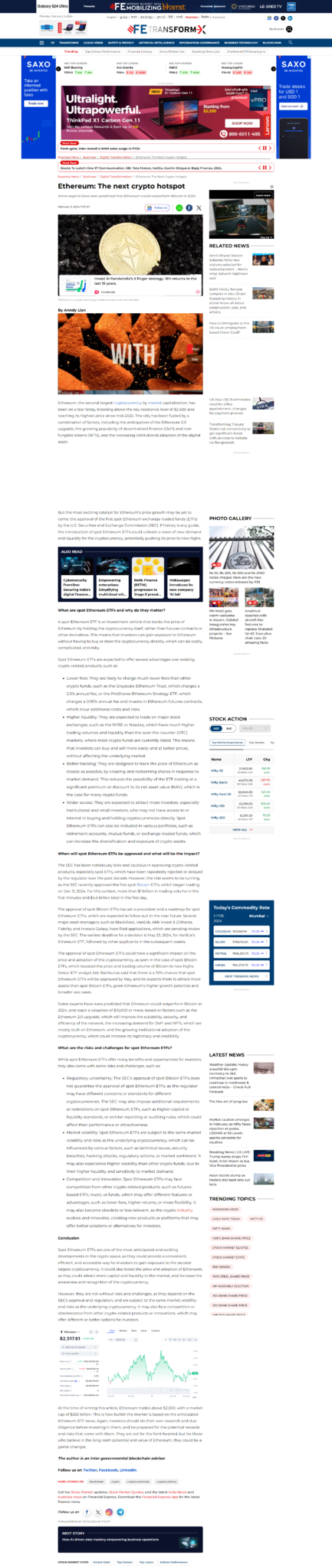
Ethereum: The next crypto hotspot

Ethereum: The next crypto hotspot

Ethereum, the second-largest cryptocurrency by market capitalization, has been on a tear lately, breaking above the key resistance level of $2,400 and reaching its highest price since mid-2022. The rally has been fueled by a combination of factors, including the anticipation of the Ethereum 2.0 upgrade, the growing popularity of decentralized finance (DeFi) and non-fungible tokens (NFTs), and the increasing institutional adoption of the digital asset.

But the most exciting catalyst for Ethereum’s price growth may be yet to come: the approval of the first spot Ethereum exchange-traded funds (ETFs) by the U.S. Securities and Exchange Commission (SEC). If history is any guide, the introduction of spot Ethereum ETFs could unleash a wave of new demand and liquidity for the cryptocurrency, potentially pushing its price to new highs.

What are spot Ethereum ETFs and why do they matter?

A spot Ethereum ETF is an investment vehicle that tracks the price of Ethereum by holding the cryptocurrency itself, rather than futures contracts or other derivatives. This means that investors can gain exposure to Ethereum without having to buy or store the cryptocurrency directly, which can be costly, complicated, and risky.

Spot Ethereum ETFs are expected to offer several advantages over existing crypto-related products, such as:

  • Lower fees: They are likely to charge much lower fees than other crypto funds, such as the Grayscale Ethereum Trust, which charges a 2.5% annual fee, or the ProShares Ethereum Strategy ETF, which charges a 0.95% annual fee and invests in Ethereum futures contracts, which incur additional costs and risks.
  • Higher liquidity: They are expected to trade on major stock exchanges, such as the NYSE or Nasdaq, which have much higher trading volumes and liquidity than the over-the-counter (OTC) markets, where most crypto funds are currently listed. This means that investors can buy and sell more easily and at better prices, without affecting the underlying market.
  • Better tracking: They are designed to track the price of Ethereum as closely as possible, by creating and redeeming shares in response to market demand. This reduces the possibility of the ETF trading at a significant premium or discount to its net asset value (NAV), which is the case for many crypto funds.
  • Wider access: They are expected to attract more investors, especially institutional and retail investors, who may not have access to or interest in buying and holding cryptocurrencies directly. Spot Ethereum ETFs can also be included in various portfolios, such as retirement accounts, mutual funds, or exchange-traded funds, which can increase the diversification and exposure of crypto assets.

When will spot Ethereum ETFs be approved and what will be the impact?

The SEC has been notoriously slow and cautious in approving crypto-related products, especially spot ETFs, which have been repeatedly rejected or delayed by the regulator over the past decade. However, the tide seems to be turning, as the SEC recently approved the first spot Bitcoin ETFs, which began trading on Jan. 11, 2024. For this context, more than $1 billion in trading volume in the first minutes and $4.6 billion total in the first day.

The approval of spot Bitcoin ETFs has set a precedent and a roadmap for spot Ethereum ETFs, which are expected to follow suit in the near future. Several major asset managers, such as BlackRock, VanEck, ARK Invest & 21Shares, Fidelity, and Invesco Galaxy, have filed applications, which are pending review by the SEC. The earliest deadline for a decision is May 23, 2024, for VanEck’s Ethereum ETF, followed by other applicants in the subsequent weeks.

The approval of spot Ethereum ETFs could have a significant impact on the price and adoption of the cryptocurrency, as seen in the case of spot Bitcoin ETFs, which boosted the price and trading volume of Bitcoin to new highs. Senior ETF analyst Eric Balchunas said that there is a 70% chance that spot Ethereum ETFs will be approved by May, and he expects them to attract more assets than spot Bitcoin ETFs, given Ethereum’s higher growth potential and broader use cases.

Some experts have even predicted that Ethereum could outperform Bitcoin in 2024, and reach a valuation of $10,000 or more, based on factors such as the Ethereum 2.0 upgrade, which will improve the scalability, security, and efficiency of the network, the increasing demand for DeFi and NFTs, which are mostly built on Ethereum, and the growing institutional adoption of the cryptocurrency, which could increase its legitimacy and credibility.

What are the risks and challenges for spot Ethereum ETFs?

While spot Ethereum ETFs offer many benefits and opportunities for investors, they also come with some risks and challenges, such as:

  • Regulatory uncertainty: The SEC’s approval of spot Bitcoin ETFs does not guarantee the approval of spot Ethereum ETFs, as the regulator may have different concerns or standards for different cryptocurrencies. The SEC may also impose additional requirements or restrictions on spot Ethereum ETFs, such as higher capital or liquidity standards, or stricter reporting or auditing rules, which could affect their performance or attractiveness.
  • Market volatility: Spot Ethereum ETFs are subject to the same market volatility and risks as the underlying cryptocurrency, which can be influenced by various factors, such as technical issues, security breaches, hacking attacks, regulatory actions, or market sentiment. It may also experience higher volatility than other crypto funds, due to their higher liquidity and sensitivity to market demand.
  • Competition and innovation: Spot Ethereum ETFs may face competition from other crypto-related products, such as futures-based ETFs, trusts, or funds, which may offer different features or advantages, such as lower fees, higher returns, or more flexibility. It may also become obsolete or less relevant, as the crypto industry evolves and innovates, creating new products or platforms that may offer better solutions or alternatives for investors.

Conclusion

Spot Ethereum ETFs are one of the most anticipated and exciting developments in the crypto space, as they could provide a convenient, efficient, and accessible way for investors to gain exposure to the second-largest cryptocurrency. It could also boost the price and adoption of Ethereum, as they could attract more capital and liquidity to the market, and increase the awareness and recognition of the cryptocurrency.

However, they are not without risks and challenges, as they depend on the SEC’s approval and regulation, and are subject to the same market volatility and risks as the underlying cryptocurrency. It may also face competition or obsolescence from other crypto-related products or innovations, which may offer different or better options for investors.

At the time of writing this article, Ethereum trades above $2,500, with a market cap of $302 billion. This is how bullish the market is based on the anticipated Ethereum ETF news. Again, investors should do their own research and due diligence before investing in them, and be prepared for the potential rewards and risks that come with them. They are not for the faint-hearted, but for those who believe in the long-term potential and value of Ethereum, they could be a game-changer.


Source: https://www.financialexpress.com/business/digital-transformation-ethereum-the-next-crypto-hotspot-3381882/
FAQ

What is the significance of spot Ethereum ETFs, and how do they differ from other crypto-related investment products?

According to Anndy Lian, spot Ethereum ETFs are investment vehicles that track the price of Ethereum by holding the cryptocurrency itself, providing advantages like lower fees, higher liquidity, better tracking, and wider access compared to existing crypto funds.

What advantages do spot Ethereum ETFs offer over traditional crypto investment options, and how might these benefits impact investor behavior?

Spot Ethereum ETFs are expected to have lower fees, higher liquidity, better tracking, and wider access, making them more attractive to both institutional and retail investors. These advantages could potentially drive increased demand and liquidity for Ethereum, influencing its price.

When is the expected timeline for the approval of spot Ethereum ETFs, and what factors might influence the SEC's decision?

The SEC has recently approved spot Bitcoin ETFs, setting a precedent for Ethereum. Several major asset managers have filed applications for spot Ethereum ETFs, with the earliest decision deadline being May 23, 2024. The approval process depends on the SEC's evaluation of factors like regulatory concerns, standards, and potential additional requirements.

How might the approval of spot Ethereum ETFs impact the price and adoption of Ethereum, based on the historical example of spot Bitcoin ETFs?

Anndy Lian said that the approval of spot Bitcoin ETFs led to a surge in trading volume and price for Bitcoin. Analysts predict a similar impact on Ethereum, with a senior ETF analyst stating a 70% chance of approval by May. The anticipated effects include increased assets, price growth, and heightened legitimacy for Ethereum.

j j j

Harvest Fund’s Spot Bitcoin ETF Application: A Game-Changer for Hong Kong’s Crypto Landscape

Harvest Fund’s Spot Bitcoin ETF Application: A Game-Changer for Hong Kong’s Crypto Landscape

In a groundbreaking move that could reshape Hong Kong’s financial landscape, Harvest Fund Management has officially submitted the first-ever application for a spot Bitcoin ETF to the Hong Kong Securities and Futures Commission (SFC) on January 26. This development comes hot on the heels of the recent approval of similar ETFs by the US Securities and Exchange Commission (SEC) and marks a pivotal moment for the city’s growing interest in cryptocurrencies.

The SFC has expressed a keen interest in expediting the approval process for Hong Kong’s inaugural spot Bitcoin ETF. Plans are underway to list it on the Hong Kong Stock Exchange shortly after the Chinese New Year in February. This rapid development could set the stage for multiple institutions to enter the market, aligning with the US model where ETF sizes grew rapidly under the influence of key financial players.

While Harvest Fund is the first to apply, several existing crypto companies that launched futures-based ETFs in Hong Kong are expected to follow suit. Samsung Asset Management, known for launching the Samsung Bitcoin Futures ETF in 2023, has expressed openness to exploring a spot ETF. Other financial firms such as Venture Smart Financial Holdings have shown interest in applying for a spot crypto ETF too.

Moreover, Harvest Fund’s ETF might distinguish itself from its US counterparts. There are indications that it could allow not only traditional fiat currency subscriptions but also direct Bitcoin subscriptions. This novel approach could provide investors in the region with a distinctive and flexible investment option.

Implications for Hong Kong’s Financial Landscape

The recent developments in Hong Kong are not surprising given the city’s crypto-ready stance. Hong Kong has been a frontrunner in embracing digital assets, evidenced by its eight-month-old rulebook about digital assets, aimed at protecting investors while encouraging innovation. This forward-thinking approach has positioned Hong Kong as an attractive destination for crypto-related ventures.

The introduction of a spot Bitcoin ETF is bound to have a profound impact on Hong Kong’s financial sector, providing investors with an accessible and regulated gateway to the world of cryptocurrencies. It aligns with the city’s goal to establish itself as a digital-asset hub, fostering innovation while ensuring investor protection.

Growing Acceptance of Crypto in Hong Kong

The submission by Harvest Fund signals a remarkable shift in the perception and acceptance of cryptocurrencies within mainstream financial markets. However, this acceptance is not limited to ETFs. The Hong Kong Monetary Authority (HKMA) has been in discussions with companies like Harvest Global Investments, RD Technologies, and Venture Smart Financial Holdings regarding stablecoin trials within regulatory sandboxes. These developments underline Hong Kong’s commitment to fostering innovation and facilitating the integration of digital assets into its financial ecosystem.

Impact on Investment Opportunities

The potential approval of Harvest Fund’s ETF could open the floodgates for a diverse range of investors, especially those who are traditionally cautious due to the perceived complexity and risks associated with the crypto market. The potential approval aligns with a global trend where institutional investors are increasingly exploring cryptocurrency as an alternative investment, particularly in the wake of traditional market challenges.

Anndy Lian, an intergovernmental blockchain advisor, emphasizes the global context, pointing out that the Chinese stock market had a lackluster performance in 2023. The increasing interest in crypto alternatives is viewed as a positive development for the crypto industry. Harvest Fund, ranking as China’s sixth-largest public fund manager, filing for a Bitcoin ETF could pave the way for more Chinese capital to flow into the crypto market.

Global Impacts

Global Crypto Adoption

The developments of the crypto landscape in Hong Kong are likely to influence other nations in the integration of crypto into traditional financial systems. The approval of a spot Bitcoin ETF in Hong Kong could encourage regulatory bodies in other countries to review their own stance about cryptocurrencies and provide a clearer regulatory framework for digital assets. Hong Kong’s regulatory approach to the spot Bitcoin ETF approval may serve as a blueprint for other regions. Regulators in various jurisdictions are likely to closely observe how Hong Kong balances investor protection with fostering innovation. The approval could set a standard for regulatory frameworks, providing clarity and encouraging other countries to follow suit.

Global Investor Confidence

Furthermore, the potential approval of a spot Bitcoin ETF in Hong Kong is poised to attract investors, especially institutional ones, on a global scale. Hong Kong’s embrace of a spot Bitcoin ETF could instill a sense of confidence in investors worldwide. The move signifies a departure from the skepticism that has surrounded cryptocurrencies in some traditional financial circles. As confidence grows, more investors, both retail and institutional, may be inclined to allocate a portion of their portfolios to digital assets. That’s why investors, both in Asia and beyond, are closely monitoring Hong Kong’s stance on cryptocurrency investment.

Increased Market Capitalization of Cryptocurrencies

It’s also worth mentioning that the approval of a spot Bitcoin ETF in Hong Kong could contribute significantly to the overall market capitalization of cryptocurrencies. As institutional investors gain easier access to Bitcoin through ETFs, a surge in demand is likely, driving up the price of the digital asset. This increased valuation directly contributes to the broader market capitalization of cryptocurrencies.


Disclaimer: The opinions expressed in this article are for informational purposes only. This article does not constitute an endorsement of any of the products and services discussed or investment, financial, or trading advice. Qualified professionals should be consulted prior to making financial decisions.

Source: https://www.bitget.com/en-GB/academy/harvest-fund-filed-the-first-spot-btc-etf-in-hong-kong

j j j