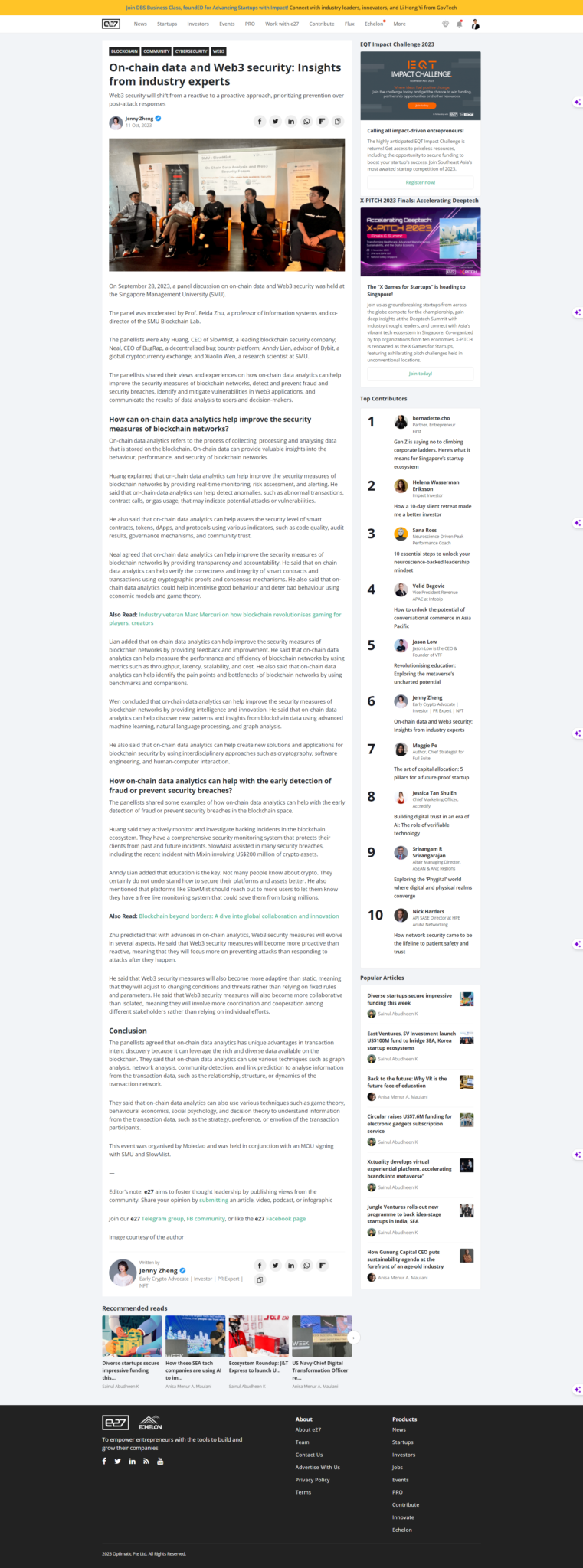
On September 28, 2023, a panel discussion on on-chain data and Web3 security was held at the Singapore Management University (SMU).
The panel was moderated by Prof. Feida Zhu, a professor of information systems and co-director of the SMU Blockchain Lab.
The panellists were Aby Huang, CEO of SlowMist, a leading blockchain security company; Neal, CEO of BugRap, a decentralised bug bounty platform; Anndy Lian, advisor of Bybit, a global cryptocurrency exchange; and Xiaolin Wen, a research scientist at SMU.
The panellists shared their views and experiences on how on-chain data analytics can help improve the security measures of blockchain networks, detect and prevent fraud and security breaches, identify and mitigate vulnerabilities in Web3 applications, and communicate the results of data analysis to users and decision-makers.
How can on-chain data analytics help improve the security measures of blockchain networks?
On-chain data analytics refers to the process of collecting, processing and analysing data that is stored on the blockchain. On-chain data can provide valuable insights into the behaviour, performance, and security of blockchain networks.
Huang explained that on-chain data analytics can help improve the security measures of blockchain networks by providing real-time monitoring, risk assessment, and alerting. He said that on-chain data analytics can help detect anomalies, such as abnormal transactions, contract calls, or gas usage, that may indicate potential attacks or vulnerabilities.
He also said that on-chain data analytics can help assess the security level of smart contracts, tokens, dApps, and protocols using various indicators, such as code quality, audit results, governance mechanisms, and community trust.
Neal agreed that on-chain data analytics can help improve the security measures of blockchain networks by providing transparency and accountability. He said that on-chain data analytics can help verify the correctness and integrity of smart contracts and transactions using cryptographic proofs and consensus mechanisms. He also said that on-chain data analytics could help incentivise good behaviour and deter bad behaviour using economic models and game theory.
Lian added that on-chain data analytics can help improve the security measures of blockchain networks by providing feedback and improvement. He said that on-chain data analytics can help measure the performance and efficiency of blockchain networks by using metrics such as throughput, latency, scalability, and cost. He also said that on-chain data analytics can help identify the pain points and bottlenecks of blockchain networks by using benchmarks and comparisons.
Wen concluded that on-chain data analytics can help improve the security measures of blockchain networks by providing intelligence and innovation. He said that on-chain data analytics can help discover new patterns and insights from blockchain data using advanced machine learning, natural language processing, and graph analysis.
He also said that on-chain data analytics can help create new solutions and applications for blockchain security by using interdisciplinary approaches such as cryptography, software engineering, and human-computer interaction.
How on-chain data analytics can help with the early detection of fraud or prevent security breaches?
The panellists shared some examples of how on-chain data analytics can help with the early detection of fraud or prevent security breaches in the blockchain space.
Huang said they actively monitor and investigate hacking incidents in the blockchain ecosystem. They have a comprehensive security monitoring system that protects their clients from past and future incidents. SlowMist assisted in many security breaches, including the recent incident with Mixin involving US$200 million of crypto assets.
Anndy Lian added that education is the key. Not many people know about crypto. They certainly do not understand how to secure their platforms and assets better. He also mentioned that platforms like SlowMist should reach out to more users to let them know they have a free live monitoring system that could save them from losing millions.
Zhu predicted that with advances in on-chain analytics, Web3 security measures will evolve in several aspects. He said that Web3 security measures will become more proactive than reactive, meaning that they will focus more on preventing attacks than responding to attacks after they happen.
He said that Web3 security measures will also become more adaptive than static, meaning that they will adjust to changing conditions and threats rather than relying on fixed rules and parameters. He said that Web3 security measures will also become more collaborative than isolated, meaning they will involve more coordination and cooperation among different stakeholders rather than relying on individual efforts.
Conclusion
The panellists agreed that on-chain data analytics has unique advantages in transaction intent discovery because it can leverage the rich and diverse data available on the blockchain. They said that on-chain data analytics can use various techniques such as graph analysis, network analysis, community detection, and link prediction to analyse information from the transaction data, such as the relationship, structure, or dynamics of the transaction network.
They said that on-chain data analytics can also use various techniques such as game theory, behavioural economics, social psychology, and decision theory to understand information from the transaction data, such as the strategy, preference, or emotion of the transaction participants.
This event was organised by Moledao and was held in conjunction with an MOU signing with SMU and SlowMist.
Source: https://e27.co/on-chain-data-and-web3-security-insights-from-industry-experts-20231006/