Synergy Unleashed: How AI and Web3.0 are reshaping the digital landscape

Synergy Unleashed: How AI and Web3.0 are reshaping the digital landscape

The digital landscape is constantly evolving, and at the forefront of this evolution are two groundbreaking technologies: Artificial Intelligence (AI) and Web3. These two pillars of innovation are set to reshape the way we interact with the digital world, offering unprecedented possibilities for decentralization, security, and personalization.

Unveiling the Vision of Web3

Web3 represents a radical departure from the current internet paradigm. It envisions a decentralized online ecosystem where users have control over their data, privacy, and finances. Built upon the robust foundation of blockchain technology, Web3 ensures secure and transparent data storage and transfer, revolutionizing the way we perceive the digital realm.

In the realm of Web3, users are emancipated from the clutches of centralized authorities. Instead, they wield the power to shape their online experiences and dictate the destiny of the internet. This liberation has the potential to usher in a new era of digital empowerment and self-sovereignty.

The Power of Artificial Intelligence

Artificial Intelligence, the technological marvel that has captivated human imagination, is a rapidly evolving field with the capacity to mimic human-like capabilities such as reasoning, learning, planning, and creativity. As AI continues its relentless march forward, it brings with it the promise of revolutionizing industries across the board.

Imagine a world where machines collaborate seamlessly with humans, amplifying our abilities and ushering in an era of unprecedented efficiency. This vision is not confined to science fiction; it’s a tangible reality that AI is gradually materializing.

A Symbiotic Relationship: AI Empowering Web3

The synergy between AI and Web3 is poised to be a game-changer, propelling both technologies to new heights of innovation. AI’s transformative potential can be harnessed to further empower the principles of Web3 in several profound ways:

1. Automating Tasks for Enhanced Efficiency

AI’s automation prowess can liberate Web3 users from mundane and time-consuming tasks. From managing digital wallets and trading cryptocurrencies to crafting Non-Fungible Tokens (NFTs), AI can seamlessly shoulder these responsibilities, allowing users to focus on more creative and productive endeavors.

2. Elevating Security to New Heights

The decentralized nature of Web3 provides an avenue for enhanced security, but AI can take it a step further. By analyzing blockchain data for anomalous patterns and preempting potential vulnerabilities, AI can fortify the Web3 ecosystem against fraud and cyberattacks, ensuring a safer digital landscape.

3. Personalizing Experiences for a Unique Web3 Journey

Imagine a digital world where every interaction is tailored to your preferences and interests. AI can make this a reality in Web3 by curating content, products, and services that resonate with each user. This level of personalization fosters deeper engagement and enriches the overall Web3 experience.

Blockchain: The Guardian of AI’s Ethical Evolution

While AI’s potential is awe-inspiring, it also raises concerns about ethical use and transparency. This is where blockchain steps in as a guardian of responsible AI deployment. Blockchain’s decentralized ledger can record, verify, and audit AI data, decisions, and actions, ensuring accountability and transparency in AI governance.

By leveraging blockchain, AI models can be imbued with an audit trail, tracking the data they utilize and the decisions they make. This addresses the challenge of explainable AI, instilling trust in the recommendations AI provides. Moreover, the marriage of blockchain and AI enhances data security, fostering a safer digital environment.

Bridging the Gap: AI, Blockchain, and Everyday Individuals

The fusion of AI and blockchain holds tangible benefits for individuals as well. Consider these scenarios:

  • Fraud Detection and Prevention: AI’s analytical prowess can identify fraudulent activities, and when integrated with blockchain, transactions and records can be verified for authenticity, minimizing the risk of fraud.
  • Copyright Protection: AI can monitor for copyright violations, and blockchain can create an immutable record of intellectual property ownership and usage rights, ensuring creators’ rights are respected.
  • Smart Contracts Revolution: The synergy between AI and blockchain can revolutionize sectors like finance, legal agreements, and supply chain management through self-executing smart contracts that enhance automation and efficiency.
  • Decentralized Power: The decentralized nature of both AI and blockchain mitigates central points of failure, fostering system resilience and reducing risks.

Envisioning the Future: AI + Web3 = Limitless Potential

The collaborative potential of AI and Web3 extends far beyond our current imagination. Here are a few glimpses of what the future may hold:

1. AI-Powered Trading

Integrating AI with Web3 can lead to innovative trading solutions, where AI algorithms analyze market data and provide bespoke insights to traders. This synergy creates a more informed and empowered trading experience.

2. Web4: Decentralization Amplified

Web4 is the logical evolution of Web3, aiming for an internet that is even more decentralized and user-controlled. This evolution would amplify user sovereignty and reshape the online landscape.

3. AI-Enhanced Relationships

AI algorithms can analyze user behavior to create more meaningful and personalized connections online, revolutionizing how we communicate and interact.

The Road Ahead: Trust in Math and Empowerment through AI

As we venture into this exciting era of AI and Web3 synergy, trust takes on a new dimension. Trust in these technologies lies not in human intermediaries but in the mathematical precision that underpins them. This trust in math offers a new paradigm of security and accountability, paving the way for a future where human potential is exponentially magnified.

In this landscape, AI becomes the driving force that empowers blockchain and Web3. The AI assistant becomes the bridge that lowers the entry barrier for Web3 participation, ushering in a new era of inclusivity and accessibility.

AI + Web3: A Journey Towards Zero Knowledge Proof

In the grand tapestry of innovation, blockchain stands as the decentralized brain that connects AI to the world. This interconnectedness forms the bedrock of a future where data privacy, personal empowerment, and security are no longer aspirations but fundamental realities.

As we embark on this journey, the intertwining of AI and Web3 is like a symphony of possibilities, where the harmony of innovation and human potential knows no bounds. Together, they illuminate a path towards a future that is decentralized, secure, and uniquely tailored to each individual’s aspirations and dreams.

 

Source: https://www.financialexpress.com/business/blockchain-synergy-unleashed-how-ai-and-web3-0-are-reshaping-the-digital-landscape-3215163/

j j j

Striking A Balance: Can Decentralized Finance Be Regulated Without Sacrificing Its Core Principles?

Striking A Balance: Can Decentralized Finance Be Regulated Without Sacrificing Its Core Principles?

The rise of decentralized finance has undoubtedly disrupted the financial landscape, offering peer-to-peer transactions recorded on blockchains. However, this newfound anonymity has attracted malicious actors seeking to exploit DeFi for illicit activities like money laundering and sanctions evasion. In response to these challenges, a group of bipartisan U.S. Senators has introduced the Crypto-Asset National Security Enhancement and Enforcement (CANSEE) Act (S. 2355), aiming to subject DeFi services to the same anti-money laundering (AML) and economic sanctions compliance obligations as traditional financial companies.

While it is crucial to protect the financial system from criminal activities, it is equally essential to strike a balance between regulation and innovation in the fast-evolving world of DeFi. The proposed legislation aims to close the loopholes that have been exploited by criminals, such as North Korea, drug cartels, ransomware attackers, and other bad actors. By applying the same national security laws to DeFi as traditional financial institutions, the CANSEE Act intends to ensure DeFi platforms adhere to basic AML programs, customer due diligence, and reporting suspicious transactions to FinCEN.

Are all these feasible?

Understanding The Essence Of DeFi

Decentralized finance has emerged as a game-changing force in the financial world, offering a peer-to-peer alternative that operates without the need for intermediaries. At its core, DeFi aims to make finance more inclusive, providing access to financial services for the unbanked and underserved populations all over the globe. Its open-source nature, transparency, and borderless features have attracted millions of users who seek financial freedom and autonomy.

One of the main advantages of decentralized finance is its ability to bypass traditional intermediaries, like banks or financial institutions. By utilizing blockchain technology, DeFi allows direct transactions between individuals, eliminating the need for a centralized authority to facilitate and validate these transactions. As a result, users can enjoy faster and more efficient transactions while reducing the costs associated with intermediaries.

DeFi’s open-source nature promotes transparency and trust within the system. Anyone can access and review the code behind DeFi protocols, ensuring that there are no hidden agendas or manipulations. This high level of transparency not only fosters trust among users but also encourages continuous innovation through community-led development.

Beyond its disruptive potential in the traditional financial system, DeFi has proven to be a powerful tool for financial inclusion. According to World Bank data, around 1.7 billion adults worldwide still lack access to basic banking services, such as savings accounts or loans. DeFi presents an opportunity to bridge this gap by providing accessible and inclusive financial services on a global scale.

Through decentralized lending platforms for example, individuals without credit history or collateral can access loans based on the value of their digital assets. This stands in stark contrast to traditional lending models, which often exclude those without formal credit histories. Furthermore, stablecoins—cryptocurrencies pegged to fiat currencies like USD—allow individuals in countries suffering from hyperinflation or limited access to stable banking systems to store value and make payments securely through an alternative means.

The borderless nature of DeFi also plays a vital role in extending financial opportunities across geographical boundaries. With just an internet connection and a digital wallet, anyone can participate in various decentralized applications (dApps) that offer features like yield farming, automated market-making (AMM), staking rewards, and more—all designed with accessibility in mind.

Challenges Of Regulating DeFi

Bringing DeFi under the same AML and economic sanctions compliance rules as traditional financial institutions poses a unique set of challenges. A defining aspect of DeFi is its inherent anonymity, empowering users to engage in financial transactions without revealing their identities. This anonymity is one of the reasons why many users trust the system. However, it also opens the possibility for illicit activities.

Regulating DeFi would require finding a delicate balance between preserving user anonymity and complying with AML and economic sanctions rules. Striking this balance is essential to maintain user confidence in the system, as privacy and autonomy are highly valued by DeFi users. But achieving effective regulation is complicated by the decentralized nature of DeFi platforms, which lack a central authority to oversee operations.

To address these challenges, innovative approaches that leverage technology are necessary. For instance, transaction monitoring tools based on blockchain analysis can help identify suspicious activities without compromising individual users’ identities. By focusing on patterns and behaviors rather than personal information, regulators can target potential risks while respecting user privacy.

Effective regulation will require collaboration between regulators, industry participants, and technology experts. Developing robust frameworks for overseeing decentralized platforms will involve bringing together different perspectives to ensure regulations effectively. In the case of CANSEE Act, the legislation recognizes the potential of self-regulation within the DeFi community. Cooperation between regulatory authorities and the DeFi industry can lead to a more comprehensive understanding of DeFi’s intricacies and potential risks. It is crucial for industry participants to proactively educate regulators about DeFi’s benefits and risks, enabling the development of informed and practical policies that protect consumers and promote innovation.

Moreover, the CANSEE Act addresses concerns regarding crypto kiosks, popularly known as crypto ATMs, by requiring operators to verify the identities of each counterparty in transactions. By doing so, the legislation aims to prevent money laundering and other criminal activities facilitated by these kiosks.

As the DeFi space continues to evolve rapidly, it is vital for regulators to remain open to new technologies and flexible in adapting regulatory approaches. While addressing the risks, they must also recognize the transformative potential of DeFi in providing financial services to the unbanked and underserved populations worldwide.

The CANSEE Act is a significant step towards addressing the challenges posed by DeFi. By fostering collaboration between regulatory authorities and the DeFi community, we can create a regulatory framework that protects against illicit activities while nurturing a secure and innovative financial ecosystem.

DeFi’s Anonymity

While it is undeniable that DeFi’s anonymity can pose challenges for regulators, outright subjecting DeFi to traditional regulations may stifle its potential to foster financial inclusion and accessibility. Striking a balance that encourages responsible practices while safeguarding innovation is crucial for the long-term success of DeFi.

The decentralized nature of DeFi makes regulation more challenging compared to traditional financial institutions, it also offers opportunities for experimentation and evolution in regulatory approaches. For instance, regulatory sandboxes or controlled environments could be established to test new compliance methodologies within the DeFi ecosystem before wider implementation.

It’s important to recognize that finding the right balance between regulation and maintaining user confidence will be an ongoing process. As the DeFi industry continues to evolve rapidly, regulators must remain adaptable and responsive to emerging trends while safeguarding the integrity of financial systems.

By proactively addressing these challenges through collaboration, technological innovation, and balanced regulation, we can create a trustworthy environment where DeFi can thrive while effectively combating illicit activities. This approach will be crucial in supporting the growth and legitimacy of this emerging sector.

Implementing AML And KYC Protocols

An important point regarding the regulation of DeFi that should be brought up. Instead of immediately subjecting it to traditional regulations, exploring alternative solutions can be more beneficial. One approach that could strike a balance is requiring DeFi platforms to implement robust AML and Know Your Customer (KYC) protocols.

By introducing verifiable identity checks, suspicious activities can be effectively flagged without compromising the overall privacy of the system. These protocols would allow for increased transparency and accountability within the DeFi space, addressing concerns about illegal activities such as money laundering. Implementing AML and KYC measures in DeFi can help build trust among regulators and traditional financial institutions. It would also provide a level of reassurance to potential users who may be hesitant about adopting decentralized finance due to its perceived lack of safeguards.

By leveraging technologies such as blockchain, these protocols can be implemented in a way that minimizes data breaches or misuse while still complying with regulatory requirements. This approach allows for greater control over illicit activities without stifling innovation or hindering user privacy.

Considering alternative solutions like enhanced AML and KYC protocols demonstrates a willingness to adapt regulations to fit the unique nature of DeFi. This forward-thinking approach encourages dialogue between lawmakers, regulators, and industry participants towards finding effective strategies that foster both innovation and compliance within this emerging space. It’s essential to strike a balance that encourages responsible practices without stifling the potential that DeFi holds for financial inclusion and accessibility. At least for now.

Strengthening Collaboration

I would like to say that fostering collaboration between regulatory authorities and the DeFi community is crucial for the sustainable growth and development of this innovative sector. By working together in a cooperative manner, both parties can benefit from a deeper understanding of each other’s perspectives.

Regulators play a vital role in ensuring that financial systems are secure, transparent, and free from illicit activities. However, it is equally important for them to comprehend the intricacies and potential of DeFi. This will allow them to develop well-informed policies that strike a balance between consumer protection and fostering innovation. On the other hand, the DeFi community has an opportunity to contribute by actively engaging with regulators. By proactively educating authorities about how DeFi works, its benefits, and its potential risks or challenges, industry participants can help shape regulations that are practical yet supportive of innovation.

Self-regulation within the DeFi industry can be an effective way to address concerns related to money laundering and illicit activities. Industry players can collaborate on developing best practices, standards, and guidelines that promote transparency while safeguarding against financial crimes. This proactive approach not only demonstrates commitment towards responsible governance but also builds trust with regulators.

Ultimately, collaboration between regulatory authorities and the DeFi community paves the way for a more inclusive financial ecosystem where innovation thrives under appropriate oversight. It creates an environment where regulators understand evolving technologies like DeFi while allowing industry participants to operate within clear boundaries that protect consumers’ interests. It may sound contradictory to some but I felt that this is one of the many ways we can see DeFi going mainstream.

“By fostering this cooperative approach, we can ensure that DeFi continues to grow responsibly while addressing any potential risks or challenges along the way. Working together, we can create a regulatory framework that fosters innovation, protects users, and ensures the long-term success of decentralized finance.” – Anndy Lian


Source: https://www.benzinga.com/markets/equities/23/08/33912604/tesla-shares-set-for-6th-straight-session-in-red-whats-dragging-them

j j j

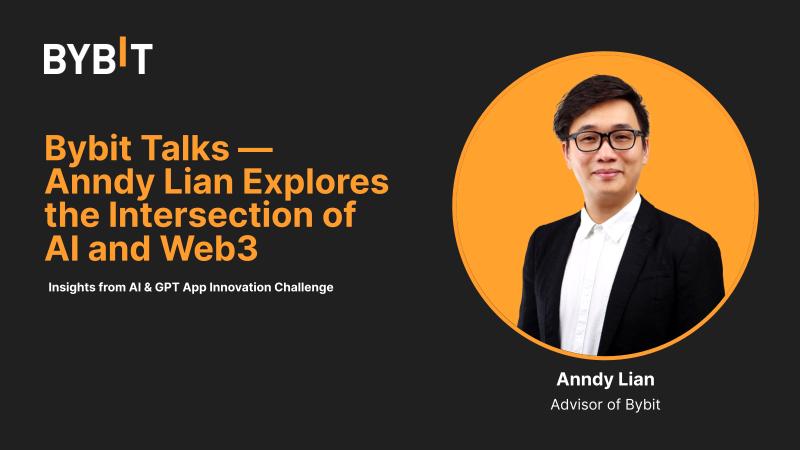
Bybit Talks- Anndy Lian Explores the Intersection of AI and Web3

Bybit Talks- Anndy Lian Explores the Intersection of AI and Web3

Understanding Web3: A Decentralized Vision Web3, often referred to as the “next generation of the internet,” embodies a vision of decentralization and user control. At its core lies blockchain technology, the backbone of secure and transparent data storage and transfer. Web3 aims to liberate users from the clutches of centralized control, offering newfound autonomy over personal data, privacy, and financial transactions. Anndy Lian’s extensive experience across diverse sectors uniquely positions him to advocate for and guide the integration of Web3’s disruptive potential.

AI Unleashed: Beyond Human Capabilities

The concept of AI, an ability for machines to replicate human-like functions such as reasoning, learning, planning, and creativity, is rapidly advancing. Anndy Lian’s multifaceted expertise places him at the intersection of AI’s immense potential and its transformative power across industries. As AI continues to evolve, it carries the promise of revolutionizing sectors, pushing boundaries, and enabling solutions previously thought impossible.

AI Empowering Web3: A Synergistic Future

An intriguing symbiosis emerges as AI complements and enhances Web3’s functionality. By automating tasks traditionally performed by humans, such as wallet management, cryptocurrency trading, and NFT creation, AI streamlines processes and unlocks time for more innovative endeavors. Additionally, AI’s prowess in fraud detection and prevention strengthens Web3’s security infrastructure, ensuring a safer digital landscape. As AI personalizes user experiences, each interaction becomes uniquely tailored, offering content, products, and services aligned with individual interests.

Blockchain’s Safeguard for AI: Ethical Governance

Blockchain-based AI governance introduces a novel approach to ensuring the ethical, transparent, and accountable use of AI systems. Anndy Lian’s intricate grasp of this intersection underscores its significance. Blockchain’s distributed ledger technology records, verifies, and audits AI actions, fostering trust among stakeholders. The integration of blockchain and AI addresses the challenge of explainable AI, enhancing data integrity and bolstering recommendations. The resultant audit trail and heightened data security are poised to redefine our perception of AI’s potential.

Individual Benefits of AI and Blockchain Fusion

The fusion of AI and blockchain extends benefits to individuals on multiple fronts. AI’s adeptness in identifying patterns enables fraud detection, with blockchain’s integration adding a layer of verification, reducing fraud’s potential impact. Additionally, AI’s vigilant monitoring aligns with blockchain’s role in copyright protection, guaranteeing the immutable record of intellectual property ownership and usage rights. The synergy culminates in smart contracts, where blockchain’s decentralized nature augments by AI’s efficiency, streamlining processes across finance, legal agreements, and supply chain management.

Looking forward, Anndy Lian’s insight extends to the emergence of Web4, a decentralized internet controlled by users, eradicating centralized control. AI, in this context, strengthens relationships through its analytical prowess, unraveling user behavior, preferences, and interactions. By optimizing communication, connections, and overall relationship experiences, AI evolves from a tool to an essential component of human interaction.

Final Thoughts: Where Blockchain and AI Converge

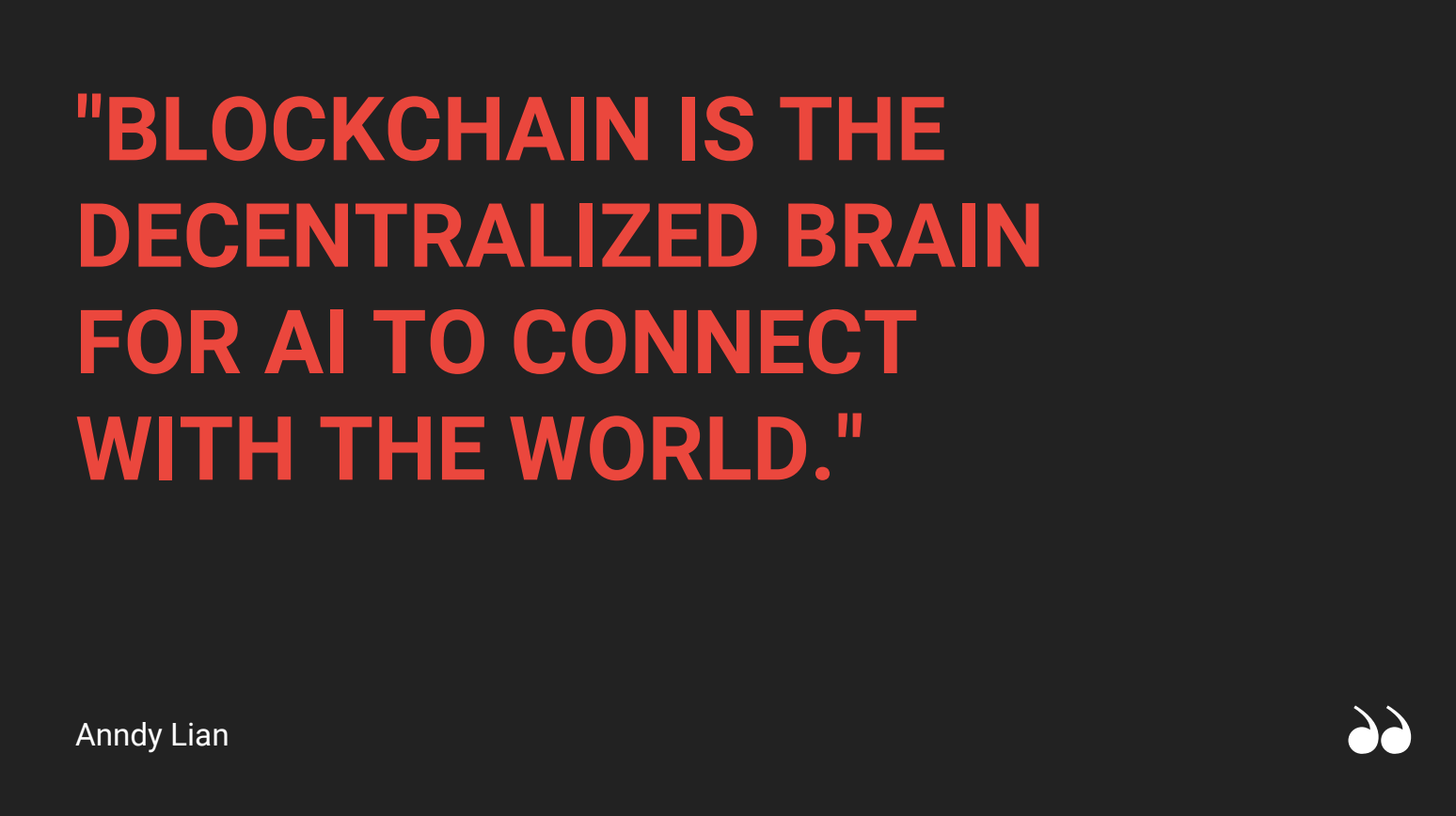
In the midst of this transformative epoch, Anndy Lian’s guiding philosophy resonates powerfully: “Don’t trust human, trust the math.” As AI empowers Web3 and blockchain safeguards its ethical use, a future emerges where technology’s potential is realized, controlled by decentralized networks and informed by data-driven decisions. In this evolving narrative, AI and Web3 unite, forming a decentralized brain for AI to connect with the world, ensuring a future marked by innovation, synergy, and boundless possibilities. End with the quote, “Blockchain is the decentralized brain for AI to connect with the world.”

Check out the full speech from Anndy on AI & GPT App Innovation Challenge!

Also, check out Bybit’s first community-driven research on the intersection of AI and crypto.


Source: https://blog.bybit.com/en-US/post/bybit-talks—ai-web3-crafting-a-future-of-synergy-and-innovation-blta2cd448426e57977/


j j j