What is green satoshi token (GST)? What you need to know about Stepn’s in-game currency token

What is green satoshi token (GST)? What you need to know about Stepn’s in-game currency token

The green satoshi token (GST) is the native cryptocurrency of the first-of-its-kind Web3 lifestyle app STEPN, which encourages users to stay active by rewarding them in GST tokens.

The token started 2022 with a kick, seeing its value surge by more than 300% from its debut in late December 2021 at $1.8 to an all-time high of $7.8 on 29 April 2022. Since then, however, the token dipped, losing over 99.7% of its gains down to $0.0223 as of 25 November 2022.

So, what is green satoshi token (GST) and how does it work?

What is green satoshi token (GST)?

A pioneer in the move-to-earn (M2E) sphere, STEPN inspires crypto fans to exercise or “move around” while earning the platform’s native coin – the green satoshi token (GST).

According to the STEPN platform’s whitepaper: “With Game-Fi, STEPN aims to nudge millions toward a healthier lifestyle, combat climate change and connect the public to Web 3.0, all while simultaneously hinging on it’s Social-Fi aspect to build a long-lasting platform fostering user generated Web 3.0 content.”

STEPN announced its public beta release on 20 December 2021 and was launched by the Australia-based fintech studio, Find Satoshi Lab.

Users get to purchase and equip themselves with non-fungible tokens (NTFs) in the shape of sneakers that are used for jogging, walking or running outdoors.

The game has four types of NFT Sneakers designed to fit different fitness levels. In addition, STEPN Sneakers are ranked by five different qualities that are given to them at random, thus establishing their rarity.

Users can purchase new Sneakers through the in-game NFT marketplace or create their own by “breeding” two Sneakers they already own through what the platform calls a Shoe Minting Event (SME). Each Sneaker can be bred up to seven times. The more a Sneaker was bred, the more tokens it will cost.

STEPN has three game modes.

  • Solo Mode: Users are equipped with NFT Sneakers and can earn GST coins through either walking or running. Their progress is tracked via a GPS signal. Users are given a certain amount of energy which allows them to earn GST tokens. Once that energy runs out, tokens can no longer be earned.
  • Marathon Mode: Users can participate in a weekly or monthly marathon of their chosen distance. At the time of writing, the marathon mode was currently under development.
  • Background Mode: Users will be able to continue gaining GST tokens while the STEPN is running in the background. As long as a user owns an NFT Sneaker, the app will be able to collect the user’s step data from their mobile’s health app. At the time of writing, this mode was also under development.

How does green satoshi token work?

It is important to note that STEPN has a dual token system; the green satoshi token cryptocurrency and the green metaverse token (GMT).

The GST coin is the in-game token of the STEPN ecosystem, while GMT is its governance coin.

So, what is the green satoshi token used for?

GST has an unlimited supply and can be earned by users through moving. GST is paid out for every minute of movement. The amount of GST paid out to users depends on the type of Sneaker they own and its unique attributes.

Because STEPN was built on the Solana (SOL) ecosystem, the GST coin was introduced on the Solana blockchain and then in May 2022 also added to the BNB Chain (BNB), formerly called BNB Smart Chain (BSC).

“To ensure the stability of GST, STEPN is designed with plenty of burn mechanisms. These involve upgrading your in-game assets like shoes and gems, unlocking gem sockets, and repairs. GST is also used to mint new shoes,” STEPN said in a blog post.

GST can be notably considered one of the more successful cryptocurrencies of 2022, despite the overall bear market that followed most cryptocurrencies at the start of the year.

The coin surged by around 350% within four months from $1.7443 on 22 December 2021 to $7.8337 on 29 April 2022 – its all-time high – as the company pledged to combat climate change and achieve carbon neutrality through the purchase of $100,000 worth of Carbon Removal Tonnes and the GTS token was listed on the popular crypto exchange Coinbase.

The positive rally did not last long, however, and GST managed to lose over 45% of its gains overnight dropping to $4.121, ahead of the release of the platform’s Public Beta Phase IV. By 3 May 2022, the token managed to resurface, surging past $6.5.

As hype surrounding STEPN and its native cryptocurrency started to decline, and the economic situation worldwide deteriorated, GST embarked on a bear run, losing over 97% of its gains from its 3 May 2022 value, down to $0.1804 by 13 June 2022.

DappRadar’s third-quarter gaming report published in October 2022 noted that STEPN “has cooled down after a torrid Q2” and its monthly active users decreased by 67%, falling to 482,000. In comparison, during Q2, STEPN registered over 2 million monthly users and over 260,000 new wallets.

By 23 November 2022, GST lost an additional 87.6% of its price down to $0.0223.

Latest GST news and price drivers

STEPN was the first ever earn-to-move blockchain to be released and with no competition at the time managed to surge to certain heights. However, competition was inevitable with the release of Sweat Economy, another move-to-earn blockchain, which according to DappRadar minted a record-breaking 10,000 NFTs in September 2022.

Additionally, uncertainty surrounding the Solana blockchain has been on the rise since the FTX crypto exchange, which is closely tied to Solana, filed for bankruptcy on 11 November. Since STEPN was built on the Solana blockchain, the GST coin is also affected by either positive or negative movements in Solana’s native cryptocurrency SOL.

In other news, STEPN announced on 18 November that it has launched an in-app event to celebrate the FIFA World Cup, top international sporting events of 2022, and encourage users worldwide to move and participate.

Moreover, STEPN has also partnered with ASICS and Solana to “pave the way for the Web3 fitness industry” by launching a new UI sneakers Collection.

Risk and opportunities

Anndy Lian, the chief digital advisor at the Mongolian Productivity Organisation and author of ‘NFT: From Zero to Hero’ told Capital.com that GST being built on the Solana network is both a “risk and opportunity” for the token.

“More than $700m has exited Solana-based applications, a 70% drop from the $1bn in TVL on 2 November alone. And please be mindful that this is the beginning of the whole saga.

“If Solana can continue to function and ride through this massive blow, GST being one of the largest ecosystems on Solana would surely be the first few that will benefit from this; Proving to the world that decentralisation actually works this time.”

Crypto advisor Victoria Kennedy added that GST’s biggest pro is its current burn system, which sees more tokens being burned than released, thus keeping the green satoshi token cryptocurrency deflationary. However, she also noted that due to its massive use function within the STEPN ecosystem, the “selling pressure from the players is much bigger, thus pushing the price down”.

Dr Pooja Lekhi, the vice chair of the Department of Quantitative Studies at University Canada West said that the GST coin “is still very new in the crypto market and hence has a limited track record and has no traceable features on trading views”.

On the other hand, Dr. Lekhi noted that GST has certain unique features including “social and community aspects”.

“With Game-Fi, STEPN aims to encourage people toward a healthier lifestyle, combat climate change and connect the public to Web 3.0, which is the next version of the internet. The GST token can be used to purchase Carbon Removal Credits and has received support from top-notch crypto investors, crypto firms, and big businesses.”

Note that analyst views are not financial advice and shouldn’t be used as a substitute for your own research. Always conduct your own due diligence, and never invest or trade money you cannot afford to lose.


Source: https://capital.com/green-satoshi-token-gst-stepn-crypto-what-is-ultimate-guide

j j j

BWB2022 Day 3 First Mover Stage 앤디 리안Anndy Lian

BWB2022 Day 3  First Mover Stage 앤디 리안Anndy Lian

BWB 2022, hosted by Busan Metropolitan City was held at BEXCO for 3 days from Oct. 27th (Thu.) to the 29th (Sat).

With the theme of “Blockchain, City and Life”, as an extension of last year’s NFT Busan 2021, BWB 2022 featured conferences for the advancement of the blockchain industry and provide a space to obtain insight as well as to share information.

Anndy Lian, Book Author of NFT: From Zero to Hero presented his views on Trends Shaping the Future of NFT.

In his speech, he reminded all to go back to basics.

1. The 5 P’s of Marketing – Product, Price, Promotion, Place and People – are key marketing elements used to position a business strategically. Most of us, whilst still understanding what makes an NFT valuable, have forgotten that these are also the key elements for an NFT project to succeed. The industry is filled with people who are focusing on short-term hypes and price pumps. This is more obvious when the market is bullish; all kinds of projects get a price push upward no matter what you launch and draw.

He went on by saying that the regulation of NFT is a must, and we need to understand its importance.

2. As we can see, the market for NFTs is still growing, and it will take some time until an appropriate regulatory framework for NFTs is put in place. Having said that, governments worldwide have already begun developing NFT norms and standards, proving that they are seriously interested in these digital assets.

Additionally, you should be aware that the phenomenal success of NFTs will undoubtedly result in fraudulent activities. For this reason, it is becoming more and more crucial to conduct your research before purchasing or investing in NFT collections or projects.

3. Lastly, he also hoped that the general public and enthusiasts of NFT should understand what the market is like. Do not just be fooled by fake statistics. He cited NFT wash trading as an example.

Wash trading makes it difficult for non-fungible token enthusiasts to gauge genuine market interest in NFT collections. It also inflates and skews the amount of trading in marketplaces, misleading analysts about what’s going on on trading platforms.

Anndy Lian is an all-rounded business strategist in Asia. He has provided advisory across a variety of industries for local, international, public listed companies and governments. He is an early blockchain adopter and experienced serial entrepreneur, book author, investor, board member and keynote speaker.

j j j

Roughly 48% of Ethereum NFT trades in October were fake

Roughly 48% of Ethereum NFT trades in October were fake

Traders seeking to artificially inflate the price of collections or earn marketplace trading rewards generated $389 million in wash trades during October.

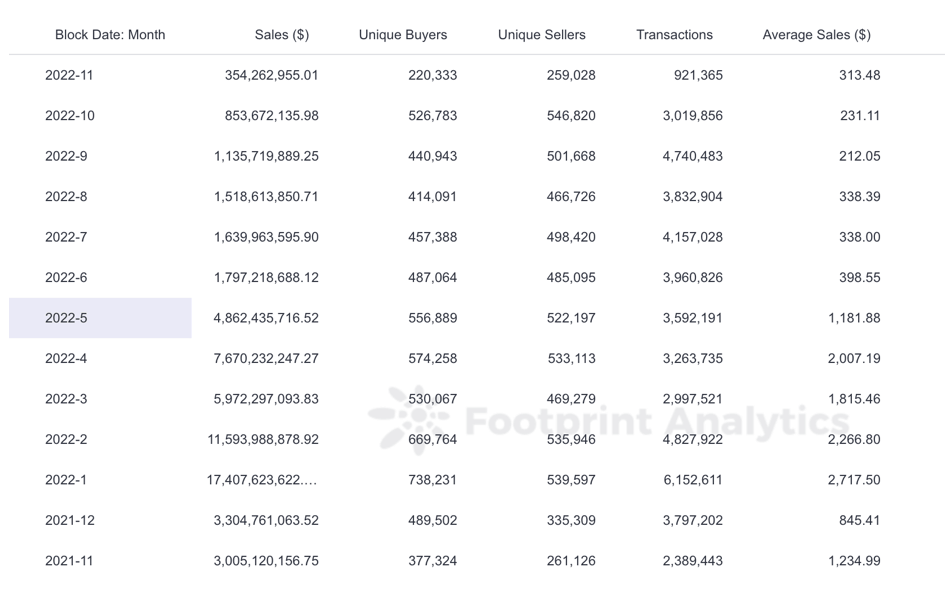
Global NFT sales in October clocked in at more than $850 million over roughly 3 million total transactions. I looked into NFT wash trades last month and that research got me to look at the numbers more closely.

Footprint Analytics – NFT Monthly Sales

The trigger points for me to say that transactions are becoming more fake are as follows:

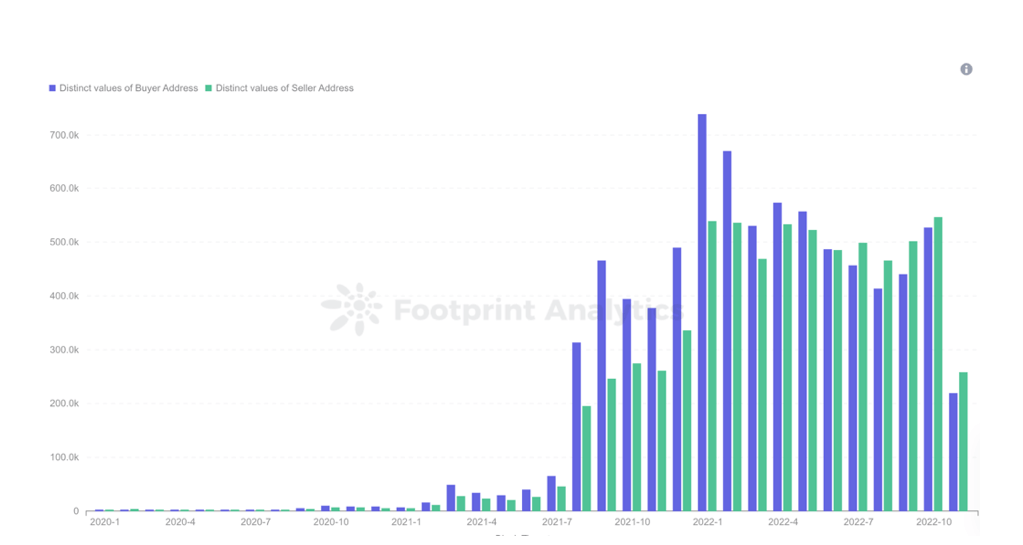
  1. Despite bad market conditions, we continue to see a high number of unique buyers and sellers. In October, we had over 1 million unique buyers and sellers. Both buyers and sellers have increased compared to September.
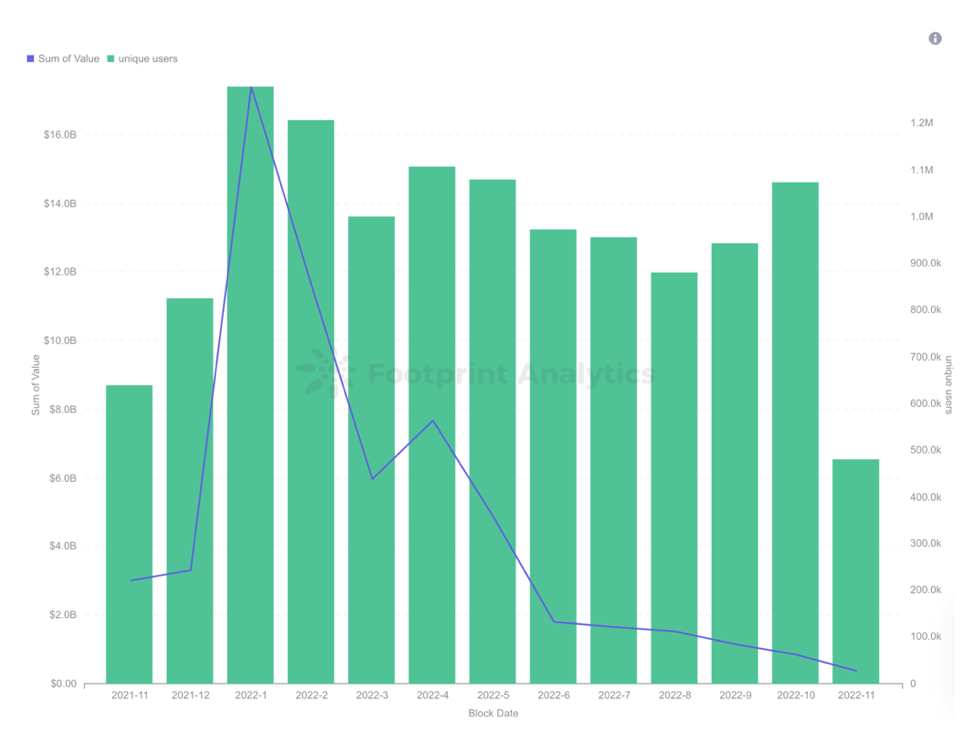
  2. The number of unique buyers and sellers seems to be inconsistent with the growth of sales value and transactions. Around 1 million users contributed more than 4 million sales value in May versus less than 250,000 in October. To me, it seems unlikely to have a growing market demand with less sales value traded.
Footprint Analytics – Sales value vs. Unique users

To look into this further, I spoke with two centralized exchanges that operate NFT marketplaces. The exchanges said that around 80% of new buyers are keeping NFTs in their wallets, rather than selling them. With the market so unfavorable, holding these assets seems to be the sensible move.

So where are all these unique buyers and sellers coming from? I had a word with Footprint Analytics and brought up my points. I realized that the statistics I am looking at are way too big. It involved multiple chains and it is hard to track everything. We agreed to work on only Ethereum-based marketplaces as an example to dive deep into since it is the most popular.

Here are the findings:

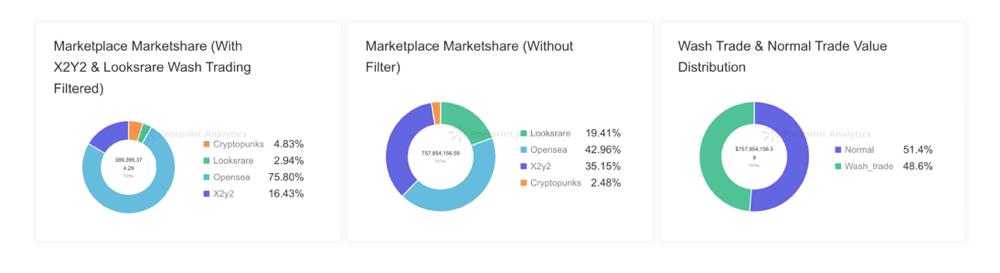
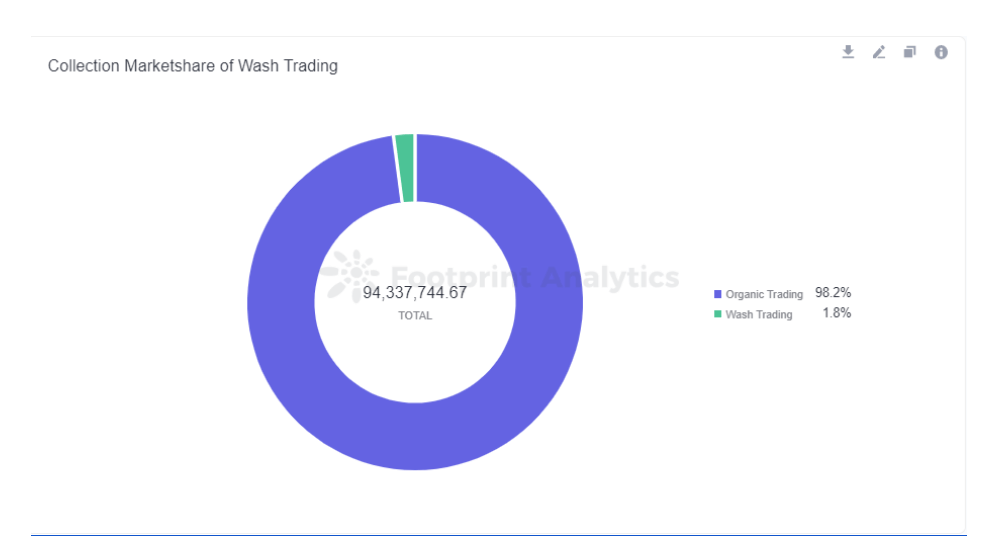
According to Footprint Analytics’ filters, wash trading makes up nearly half of all NFT trading volume.

Footprint Analytics – ETH NFT Market Overview (With Wash Trading Filtered)

Traders seeking to artificially inflate the price of collections or earn marketplace trading rewards generated $389 million in wash trades out of October’s total of $758 million in NFT trading volume — bringing the amount of wash trading in the NFT market close to half that of organic trading.  The number of wash trading users accounts for nearly 46% of total users.

Footprint Analytics – Marketplace Market Share Wash Trading Filtered & Without Filtered
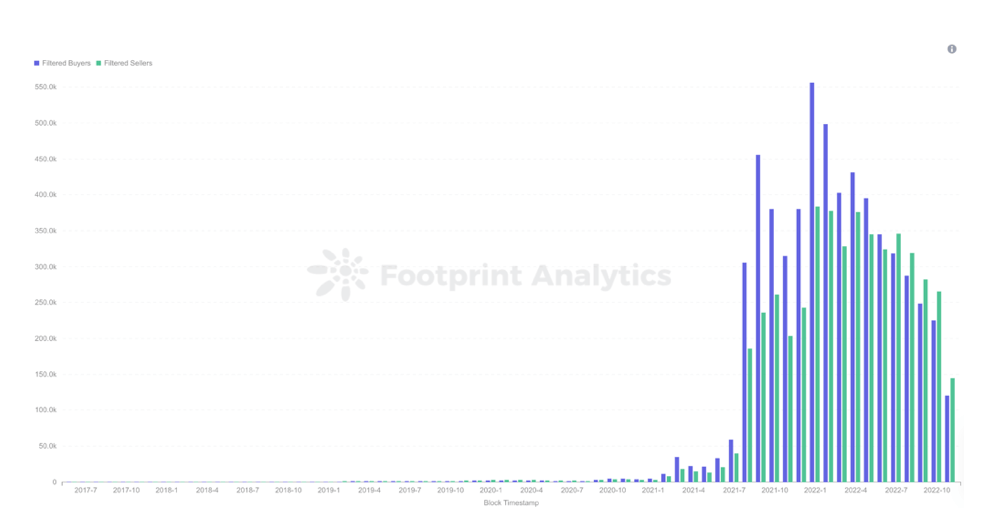
Footprint Analytics – NFT Sellers & Buyers Without Wash Trade
Footprint Analytics – NFT Sellers & Buyers

Wash trading is a form of market manipulation where an investor simultaneously sells and buys the same financial instruments to create misleading, artificial activity in the marketplaceIt creates enormous dissonance in the NFT industry between what most people imagine NFT trading is i.e., someone buying an NFT for speculation, and the behavior which actually underlies the market — hundreds of insiders transferring NFTs between their own wallets.

There are several indicators to identify suspicious trading activity.

Signals and indicators include:

  1. Overpriced NFT trades with 0% creators fees
  2. Specific NFT IDs that are bought more than a normal amount of times in a day
  3. NFTs bought by the same buyer address in a short period of time

The incentives for wash trading are to earn platform rewards and to create an appearance of value or liquidity for assets. Because there is no way to prevent or discourage wash trading in the NFT market today, people have a hugely misguided picture of the amount of organic, genuine trading activity in the industry.

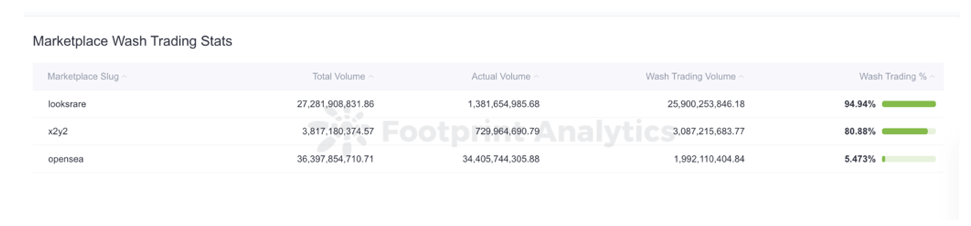
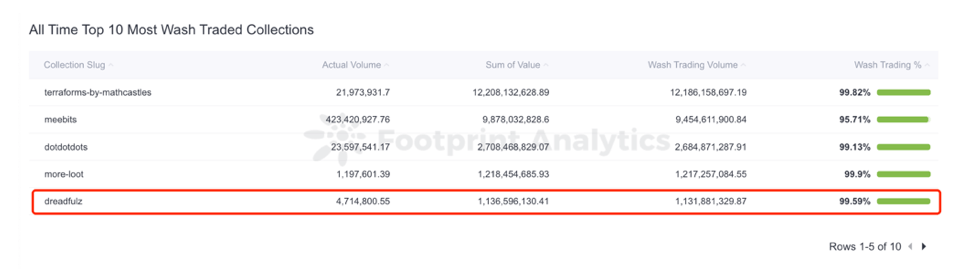
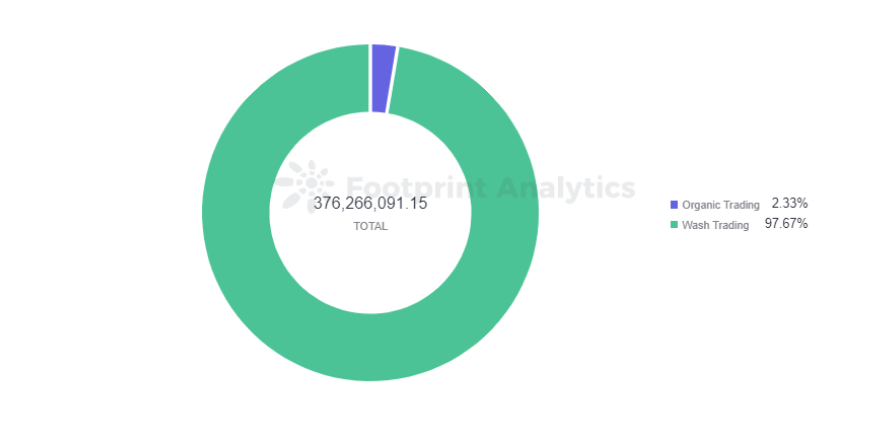
For example, 81% percent of all trades on X2Y2, one of the top 3 NFT marketplaces, were wash trades according to the filters applied. The main reason for X2Y2 wash trading is volume-based daily trading rewards. The larger the percentage of volume a user contributes to X2Y2, the larger the share of daily trading rewards the user will earn. A similar breakdown can be observed when looking at individual collections. For example, of Dreadfulz’ $1.1 billion in total volume, $1.131 billion was flagged as wash trading.

Footprint Analytics – Marketplace Wash Trading Stats
Footprint Analytics – All Time Top 10 Most Wash Traded Collections

An analyst or writer who does not understand this wash trading dynamic risks grossly misunderstanding the current market. For example, here’s what Business2Community wrote on Oct. 12 about Terraforms by Mathcastles:

“Non-fungible token collections continue showing strong resilience amid the current general crypto market downturn so far this year. Here are some of the top-selling NFT collections this week: 1. Terraforms Reclaim The Top Spot. Terraforms, a non-fungible token (NFT) collection from Mathcastles, has reclaimed the top spot after flipping below our ten top-selling lists last week. Terraforms has a 24-hour sales volume of 1,814 ETH.”

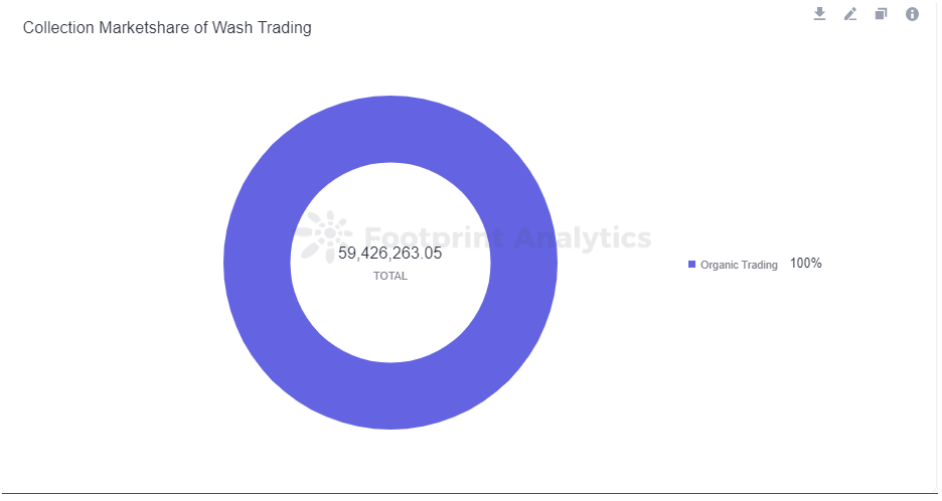
The next collections the article listed were BAYC and CryptoPunks, which have nearly no wash trading. This would give a reader the impression that Terraforms more of a popular collection than those blue chip collections when in reality there were almost no organic trades.

Footprint Analytics – Bored Ape Yacht Club Trading Stats
Footprint Analytics – Cryptopunks Wash Trading Stats
Footprint Analytics – Terraforms-by-mathcastels Wash Trading Stats

By filtering trades for wash trading, traders, analysts and investors can more accurately evaluate NFT assets and the industry. Having accurate datasets and using them are two separate things. My role here is not to whistleblow or break the NFT myths, I am here to share my knowledge and tell my side of the story to everyone.

Using this article, I would like to make a request to analyze CEX NFT marketplaces’ data. Binance or Bybit NFT Marketplace would be ideal.


Source: https://cryptoslate.com/roughly-48-of-ethereum-nft-trades-in-october-were-fake/

j j j