How many cronos tokens are there? CRO token circulation analysis

How many cronos tokens are there? CRO token circulation analysis

Crypto.com is one of the biggest crypto exchanges out there, however, recent negative sentiment and the collapse of the FTX crypto exchange have sent its native token, cronos (CRO), into a downwards spiral, forcing it to lose over 90% of its value from $0.8992 in November 2021 to $0.0698 a year later.

What are the latest token analytics suggesting, and how many cronos tokens are there?

What is CRO?

CRO is the native cryptocurrency of the Crypto.com chain and the Cronos EVM Chain. It was formerly known as the Crypto.org Coin before being renamed to CRO.

Crypto.com is a public, open-source and permissionless blockchain that aims to help drive the mass adoption of blockchain technology through decentralised finance (DeFi), payments and non-fungible tokens (NFTs). The platform has named itself as the “next generation public blockchain”.

The platform was co-founded in 2016 by Kris Marszalek, Rafael Melo, Bobby Bao and Gary Or and is now operated as a desktop and mobile application.
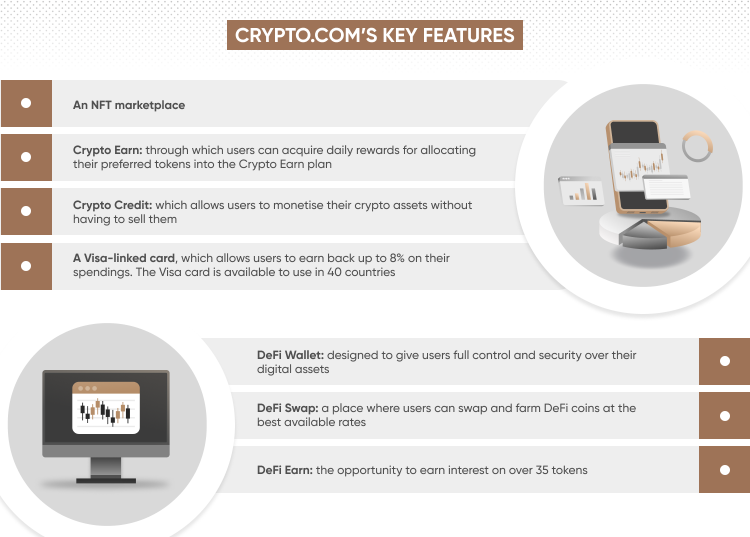
Crypto.com's key features

The Cronos EVM Chain is the first ever Ethereum-compatible blockchain that was built on Cosmos SDK technology. It is an open source, permissionless Layer 1 chain that aims to scale the DeFi, GameFi and overall Web3 communities by letting builders instantly port apps and crypto assets from other chains while benefiting from low transaction fees, high throughput and fast finality.

The CRO token powers the ecosystem and is used for staking, which grants users a number of rewards and helps maintain the platform’s security and decentralisation. The cronos cryptocurrency is also used to settle transaction fees on the Crypto.org Chain.

Latest CRO market news

2022 has not been the best year for CRO. The token has fallen by more than 87% from its all-time high of $0.8992 on 24 November 2021 to $0.1093 on 17 June 2022. The dip in the CRO price was heightened as Crypto.com announced on 1 May 2022 that it would be slashing staking rewards for all tiers of its VISA cards “to ensure long-term sustainability”, effective as of 1 June 2022.
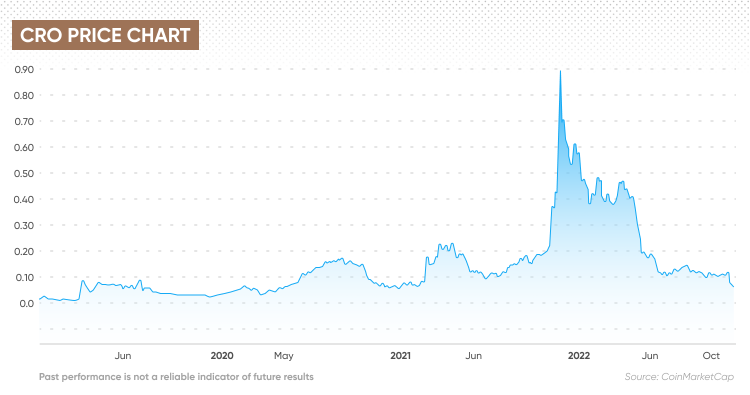
CRO price chart

Between mid-July 2022 and end of September 2022, Crypto.com has received a number of licence updates worldwide, including Italy, Cyprus, South Korea, Australia, Canada, the UK and France. In addition, on 12 October 2022 the firm said that Paris was established as its European Regional Headquarters and invested €150m (around $155m, as of 18 November) in France to support market operations.

Between 25 October 2022 and 28 October 2022, Crypto.com had signed three MOUs: one with the game software developing studio ACT Games; one with the city of Busan in South Korea to advance the blockchain industry; and one more with global content studio A Story to develop NFT collaborations.

However, amid all the positive news, Crypto.com has also been caught in an array of negative news. An article published on 6 October 2022 by Ad Age tech claimed that the platform had cut off deals with a number of big sports organisations, including the Los Angeles’ Angels City Football Club, the 2022 FIFA World Cup in Qatar and the online sports tournament host Twitch Rivals. The article cited unanimous former and current Crypto.com employees.

In addition, according to a series of Tweets by the article’s journalist Asa Hiken, between “June and August, 30-40% of Crypto[dot]com’s entire workforce left the company, per former and current employees. That’s 2,000+ departures — the vast majority of which were layoffs.”

The company did not address the reports.

Now, let’s take a closer look at how many cronos tokens there are now.

How many cronos tokens are there?

So, let’s have a look at how many cronos tokens are available in circulation as of 18 November 2022.

According to data provided by CoinMarketCap, the maximum supply of the cronos tokens is 30.2 billion, meaning that once the total number of cronos tokens in circulation reaches that value, new tokens can no longer be mined. The current circulating supply of the CRO coin surpassed 25 billion.

However, this was not always the case for the cryptocurrency.

When the cryptocurrency was launched in 2018, its maximum supply was fixed at 100 billion coins. But, in order for the Crypto.com network to become fully decentralised at Mainnet Launch, Crypto.com decided to burn 70 billion CRO tokens in what it called “the largest token burn in history”. This was announced by the platform on 22 February 2021.

The platform released a schedule which shows that an initial batch of 59.6 billion CRO tokens was burned on 22 February 2021. Meanwhile, 10.4 billion coins were locked in a smart contract and would be burned every month as they get unlocked. This was aiming to increase the cryptocurrency circulating supply from 24% at the time to over 80%.

The remaining 5.9 billion CRO tokens were distributed in the following way:

  • 5 billion CRO were allocated to mainnet block rewards for Chain validators and delegators
  • 0.9 billion CRO were allocated to the development of the Chain ecosystem

Of that 70 billion burned:

  • 20 billion tokens came from the platform’s capital reserve
  • 5.5 billion coins came from the platform’s community development
  • 10.4 billion tokens came from secondary distribution and launch incentives
  • 20 billion tokens came from ecosystem grants
  • 20 billion tokens came from network long-term incentives

Who are the biggest CRO token holders?

Now that we have established how many cronos tokens are in circulation, let’s take a look at the biggest CRO token holders.

Data provided by etherscan.io showed that, as of 18 November, there were 281,902 CRO holders in total. The 10 biggest CRO holders collectively owned 92.54% of the total token supply in circulation, meanwhile the top 100 owned 95.93%.

The website noted that the top account holding the most CRO tokens in total was a Null Address owning over 77 billion coins, amounting to 77.89% of the total circulating supply. Crypto.com was also among the top CRO holders in the world, owning around 7 billion tokens or approximately 6.9% of the total supply.

Analyst thoughts

Anndy Lian, chief digital advisor at the Mongolian Productivity Organisation and author of ‘NFT: From Zero to Hero’ told Capital.com that while burning 70% of the then maximum CRO token supply was a good decision, doing so in 2021 was a “downside”.

“Personally, I would prefer them to burn and then buyback in stages of burning such a huge amount. The burn back then did make the market perceive that the remaining tokens have more value but that was short lived.”

Lian added that taking into consideration everything that has happened with the FTX crypto exchange in recent weeks, CRO holders are also getting anxious about the wellbeing of the Crypto.com platform, however, Crypto.com CEO Kris Marszalek’s live AMA session on YouTube on 14 November 2022 helped calm those worries down.

“Crypto.com is still facing potential bank run in my humble opinion. This to me is one of the biggest risks that CRO has a direct impact on.”

The bottom line

While knowing key info about the cronos tokenomics and circulating supply is important for accessing the project’s health, it shouldn’t substitute your own research. You should always conduct your own due diligence before trading, looking at the latest news, technical and fundamental analysis, and a wide range of analysts’ opinions before making any trading decision.

Keep in mind that past performance is no guarantee of future returns. And never trade or invest money that you cannot afford to lose.


Source: https://capital.com/how-many-cro-tokens-are-there-crypto-com-circulation-analysis

j j j

5 Reasons Why Trustless DEX Are The Future

5 Reasons Why Trustless DEX Are The Future

DEXes offer strong execution guarantees and increased transparency into the underlying mechanics of trading. Trades are trackable, traceable and data is permanently on-chain. This is one of the core basics and the beauty behind the ideology of DEXes. While many have forgotten, I will remind all of you again.

Amidst talks of growing adoption and decentralization becoming the norm, the great decentralized exchange (DEX) vs centralized exchange (CEX) debate is more prominent now than ever before. This debate has many case studies for us to make reference to. The latest would be FTX. FTX owes nearly US$3.1 billion to the top 50 creditors and is estimated there to be “more than 100,000” creditors.

Let me walk you through why trustless DEX is the way forward.

1. Individual Data and Asset Control

CEX holds custody of your deposited assets and all your personal information. You have no control over how the assets and data are being used. While in a DEX environment, it is non-custodial; typically, only an individual wallet address is connected to the exchange. In other words, you have complete control over your assets.

2. Liquidity and Market Depth

3. User Friendliness

CEX provides a wide range of products, including spot and fiat on-ramps, which is most familiar to traditional and crypto traders, especially beginners. DEX products may be harder to grasp with insufficient onboarding guidelines for traders. Again, this point for DEX is changing. The user interface and experience have improved so much; some of the newer DEXes look and function exactly like CEX.

4. Transaction Costs

CEX is known for high transaction or platform costs, especially when the system is hugely loaded with trades simultaneously. An increasing number of DEXes are integrating scaling solutions that will massively increase transaction workload while keeping costs low and passing the savings on to traders.

5. Community Involvement

CEXes, oftentimes one-way, non-reciprocal communication from a central operator to traders. Individual traders are seen as clients utilizing as service that the CEX provides. While DEXes focus on community-building and involvement, where traders can become stakeholders and have a say in protocol changes or share in transaction fees on the platform.

A New DEX Era

The challenge with CeFi and CEXes boils down to a lack of trust and security. This is continually reinforced time and again; this year is clearly no different, with funds, exchanges and even established projects hitting the buffers and leaving behind affected, concerned investors and traders fearing for their assets. News of increased risk with CEXes coming into the question of insolvency and possible delays in withdrawals, causing widespread panic amongst traders.

As usual, I will end with a quote. “The answer is to return to the basics of what blockchain is supposed to be. It is decentralization and transparency. DeFi is one of the solutions, and we need to work together in the future. For now, it cannot replace CeFi completely for obvious reasons, but this will not stop us from trying.” #AnndyLian


Source: https://www.benzinga.com/22/11/29809200/5-reasons-why-trustless-dex-is-the-future

j j j

Cardano futures: ADA price pressure to persist amid FTX fallout

Cardano futures: ADA price pressure to persist amid FTX fallout

The recent FTX crisis has caused a whirl in the crypto world with many investors pulling out their assets from the market that’s already dominated by bearish sentiment.

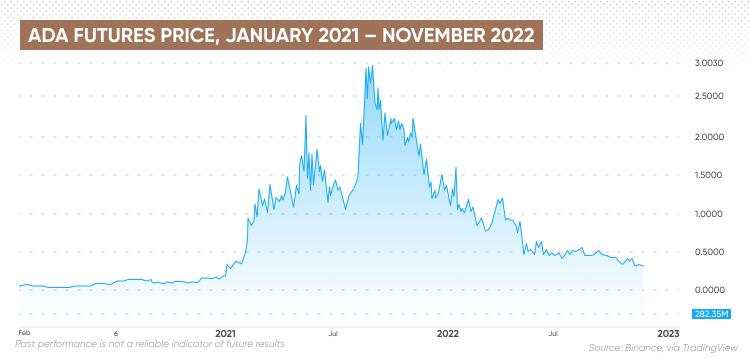
Cardano’s ADA, has been on a bear run in 2022, losing over 89.8% of its gains since the all-time high of $2.9706 on 3 September 2021 to $0.3032 on 21 November 2021.

How do Cardano futures work and where could the cardano futures price be headed? Read on…

What are cardano futures?

Cryptocurrency futures are contracts between two parties that are betting on the future price of a digital asset. When traders purchase a cryptocurrency’s futures contract, they gain exposure without owning the underlying coin, agreeing to pay a certain price for the asset in future. When the futures contract expires, however, the trader has to settle it – in other words, they buy the coin.

The Cardano blockchain was launched in 2017 as a third-generation cryptocurrency platform. It has a Proof-of-Stake (PoS) consensus mechanism and was designed to be a more scalable, sustainable and interoperable version of Ethereum. For this reason, the blockchain’s supporters labelled Cardano the “Ethereum killer”.

In September 2021, Cardano gained smart contract capability, allowing for the creation of decentralised apps (dApps), non-fungible tokens (NFTs), games, new cryptocurrencies and more.

ADA is the blockchain’s native cryptocurrency named after the 19th century mathematician Ada Lovelace. The coins are used as a secure exchange of value and to pay for transaction fees

Cardano futures, therefore, are contracts between two parties that have agreed to buy and sell a specific amount of ADA at a specified price. Cardano futures are often known as Cardano perpetual futures or cardano perpetual swaps.

Traders who purchase ADA futures are betting that the price of the cryptocurrency will surge in the future. If that happens, they will profit from the price increase. If the price of Cardano falls, however, they will lose money.

Cardano futures history

Cardano futures started trading on Binance at the end of January 2021. They enjoyed bullish momentum, jumping by more than 4,100% between January and May 2021. The surge came as Cardano continued development of its smart contract capabilities and launched a peer-to-peer testnet to a small group of users.

After a slight dip in July 2021, the ADA futures price climbed to the all-time high of $2.9706 on 3 September 2021. The rally came ahead of the blockchain’s Alonzo hard fork, which introduced smart contract capabilities to Cardano.

ADA futures price, January 2021 – November 2022

Following the bull run, the ADA futures contract dipped by more than 35% by 27 October 2021 and continued on a downward trend.

Cardano futures price fell  to $0.3032 on 21 November 2022 amid negative market sentiment. The recent news on the downfall of the FTX crypto exchange and its native FTT  token added to the bearish price action.

What is driving cardano futures?

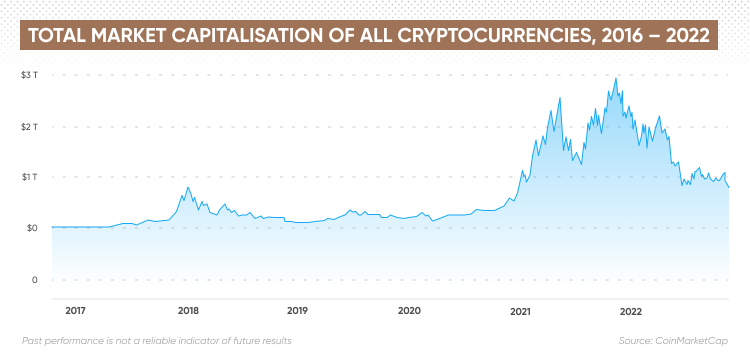
The collapse of the FTX crypto exchange affected many major cryptocurrencies, cooling investor sentiment. CoinMarketCap data showed that the total cryptocurrency market capitalisation fell below $800bn on 11 November, when FTX filed for Chapter 11 bankruptcy, the lowest level since early 2021.

Total market capitalisation of all cryptocurrencies, 2016 – 2022

“Although aftereffects of the FTX shock will still likely surface at some point and the industry will have to adopt more financially transparent operation and come under stricter regulatory oversight, the worst part may have passed,” Bitbank crypto market analyst Yuya Hasegawa said in his weekly view.

Meanwhile, the Cardano blockchain saw a spike in activity between 9 and 14 November as the number of new addresses on the blockchain surged from 0 to 11,240, according to data on Cardano Blockchain Insights.

The network, however, had seen a surge in the number of transactions on 8 November, which surpassed 391,000 as FTX crashed.

Cardano’s founder, Charles Hoskinson, said in a live YouTube stream on 9 November:

“I think this might be the bottom, one of the last ones to deal with. It’s going to be hard to predict how bad it will be, and it could certainly potentially be very bad. There are not many more firms that were like FTX or Alameda or like, Three Arrows Capital, and so forth. At least in this cycle, I truly do hope that this is the last cycle of this nature.”

In other cardano futures news, Hoskinson told CoinDesk on 18 November that Cardano is looking to launch a new privacy blockchain and digital asset which he stated to be something “the enterprise absolutely wants”.

Cardano futures price prediction for 2023 and beyond

Algorithm-based prediction websites did not provide cardano futures forecasts, so let’s have a look at the latest ADA/USD outlook.

In line with the latest downward price action, algorithm-based forecasting service Wallet Investor gave a bearish ADA price prediction at the time of writing (21 November) noting that ADA was “a bad long-term investment”.

Based on its analysis of past price performance, Wallet Investor predicted that the token could fall to $0.01016  in 2023. The site did not provide an ADA price prediction for 2027.

DigitalCoinPrice, on the other hand, gave a bullish ADA to USD price prediction expecting the token to grow to $0.39 by the end of 2022 and reach $1.30 on average in 2025. By 2027, the site predicted that the price of ADA tokens could reach $1.59. Its long-term token forecast showed the cryptocurrency reaching $4.35 by 2030.

Meanwhile,  Anndy Lian, the chief digital advisor at the Mongolian Productivity Organisation and author of ‘NFT: From Zero to Hero’, told Capital.com that mid-term technical indicators looked bearish (as of 21 November). He added:

“Sellers’ pressure increases in the cardano market. I hope the longer term potential factors like Midnight and USDA can change things for the better.”

News that the group behind Cardano, Input Output Global, is planning to release a new privacy-focused blockchain could have a potential effect on ADA futures, Lian added in his cardano futures price prediction.

In addition, the launch of USDA, the first fully fiat-backed regulated stablecoin on Cardano, will start trading in early 2023, could lead to a hike in the cardano futures price.

“If executed well, I see this will help ADA decentralised finance ecosystem, thus bringing in more liquidity and support into the network,” Lian added.

Final thoughts

Remember, analysts’ and algorithm-based predictions can be wrong. If you’re considering entering the cardano futures market, we recommend you always conduct your own due diligence, looking at the latest news, a wide range of analyst commentary, technical and fundamental analysis. Note that past performance does not guarantee future returns and cryptocurrency markets remain extremely volatile. And never trade money you cannot afford to lose.


Source: https://capital.com/cardano-futures-price-prediction-ada

j j j