Who is Anndy Lian? How Does he Turn You Into an NFT Hero?

Who is Anndy Lian? How Does he Turn You Into an NFT Hero?

Anndy Lian is a serial entrepreneur based in Singapore. He is always trying to work hard in the crypto and blockchain industry. When I first met him, he was actively investing in Layer 1 blockchains. Then he was advising a sovereign wealth fund and was the chairperson at an Esports association. He is always busy.


His journey started in 2017 during the ICO times. He started one of the earliest supply chain blockchain companies back then and moved on to advising governments as he felt that there were too many dodgy businesses going on in the crypto scene.


He is a fund manager and partner at a local capital market services licensed firm. He is a philanthropist, giving back to society by donating and spending time serving his Singapore community. His servant leadership and attitude is well-liked by his peers.


His latest book, “NFT: From Zero to Hero”, is aligned with what he does. He likes the technology behind NFT and never likes how projects are managing NFTs as if it is like a valueless Ponzi scheme. That is also why Anndy chooses to launch the book after the hype and not during the hype. He believes that this is the right time to launch a book to tell everyone about the good and bad of NFT and how the market is changing and building stronger than ever at the same time.


During this interview, he emphasized a few points. Firstly, he wants all to know that mastering the logic behind NFT is not difficult. You need only the correct mindset and set up clear purposes when creating the NFTs. There is also a lot of information online for you to read about, and there is no reason why you cannot understand it.


Secondly, he said that there are many good tools online to help you decide what you can consider buying. He has spent time using some of the tools and listed a handful in his book that he thinks are useful. “Instead of guessing what NFT to buy, use the statistics to aid your decision,” Anndy said.


Anndy also went on to share that data could be contradicting. For example, 10,000 NFTs were sold, but when you look at the on-chain wallet addresses, only 10 of them exist. These are the small details you need to catch when making a decision.


Thirdly, he wants people who read his book and look at the trends ahead. The general public knowledge is very superficial. Many people think that NFT is a quick money scheme and we are purely selling “air”. “The fact that NFT is not just about a jpeg profile picture is not known to many. This is disturbing.”


According to Anndy, we can look at creating medical platforms using NFTs and empowering patients with the ability to control their medical records. We can look at digitizing land title deeds using NFT too. “The NFT usage scenarios are limitless.”


I also took the chance to ask Anndy what we should invest in next. He said to follow the simple rules- Consider investing in projects with good utility, strong community, and always building. “If they do not have the above, there is no need to consider who is on their cap table and how strong their team is. Assuming they have a working tech solution.”


Lian added that some people said that investing in Layer 1 blockchain is a sure win is totally wrong. He said starting layer 1 is not difficult; sustaining it with good usage is the challenging part. You need a lot more money to make it work compared to layer 2.


He said that, similarly, some people hate meme coins and said they have no value. “I don’t see eye to eye on this. The value of a meme coin is in its community and the core team. If the community is strong, anything can happen.” He added that bad management is one of the core reasons why meme coins fail. “The tell-tale signs are obvious.”


Just like the same old Anndy we see on Twitter. He ended by saying, “not financial advice”.


Anndy Lian’s new book has sold more than 8,000 copies during its launch at Bybit NFT marketplace. He has subsequently listed them on leading platforms like Amazon and Google books. At the point of this interview, he told me that he had appointed a Singapore distributor who would put his books in major bookstores in the South East Asia region.


I also read that he was awarded an Honorary Doctoral Degree by the Academic Council of Ulaanbaatar Erdem University in recognition of his contribution to the development of productivity science in Mongolia. He is also completing his PhD soon.


Congratulations Anndy.


The Future of NFTs


A number of countries are now actively working on regulatory frameworks for NFT assets, strengthening anti-fraud and anti-manipulation audits of projects, determining the business core of each platform, and solving financial security issues such as illegal fundraising and false fraud.


Nowadays, NFT financial tools are becoming more and more abundant, and the scale of financial derivatives is steadily increasing. At the same time, major public chains are actively upgrading, expanding, and building their own ecological frameworks to provide underlying support for the production, confirmation, pricing, circulation, and traceability of NFT assets. The NFT industry is gradually exploring a development path suitable for blockchain assets.


Due to the short development history of NFTs, we are still in the industry’s infancy, but we can still see its rapid development and gradual maturity. It is believed that under the transformation of the market, the improvement of supervision, and the gradual improvement of the ecosystem, the future of NFTs will never be just about hype but will become an indispensable part of future technological life.


The NFT space is fast-changing. While writing this, new NFT projects are popping up every day. From the Busan Metropolitan Government in Korea announcing an NFT conference to the International Cricket Council launching cricket NFTs to CoinRunners crowdfunding a movie by selling NFTs.


The few consistent NFT trends over the past year have been their steady growth, the rising interest in them, and their ever-expanding applications.


The future these NFT trends depict is an interesting one. While many people are concerned about the implications of the metaverse and the rise of AI, it’s a future full of possibilities.


It’s a future that bridges the gap between consumers and creators gives value and security to digital assets, and one which, for better or for worse, will shake up the world.


The future is bright, but the road is tortuous. The NFT market will eventually mature and deliver on its promise.


Your new asset is in the digital world.


Source: https://hackernoon.com/who-is-anndy-lian-how-does-he-turn-you-into-an-nft-hero?source=rss

 

j j j

Green and sustainable crypto – Is this the way forward?

Green and sustainable crypto – Is this the way forward?

Energy consumption has been a major source of criticism in the cryptocurrency business. Ethereum has finally deployed a huge network upgrade that dramatically transforms how the blockchain validates transactions, mints new currency, and secures its network.

This mechanism, known as proof-of-stake, has cut Ethereum energy use by more than 99 per cent. This sounds good. However, Bitcoin is unlikely to follow suit.

Is Bitcoin now green? No, but at least Bitcoin’s emissions of greenhouse gases are down than before. According to the Cambridge Bitcoin Electricity Consumption Index, Bitcoin’s greenhouse gas emissions decreased from 59 metric tons of carbon dioxide equivalent in October 2021 to 48.88 metric tons.

According to research released by Cambridge University’s Centre of Alternative Finance, Bitcoin is failing to go green, with the cryptocurrency recording only modest increases in its use of renewable energy in the year leading up to January.

Powerful computers connected to a worldwide network process Bitcoin transactions and “mine” new tokens in a competition to solve challenging mathematical puzzles. Policymakers, investors, and environmentalists concerned about the process’s impact on global warming criticise it for guzzling electricity and heavily relying on dirty fossil fuels like coal.

Green cryptocurrencies are those whose mining activities are powered by renewable energy sources.

Things are changing, and there are alternatives to make it “greener”

Solar

Currently, solar is said to as “the cheapest energy source.” Solar energy, which has the greatest pace of growth among all energy sources, presently provides three per cent of the world’s electricity while emitting no noise pollution and scaling up easily. Solar energy has global potential, in contrast to comparatively rare geothermal.

According to Bloomberg, a solar power company in South Africa pays investors with cryptocurrency. Sun Exchange allows investors to spend as little as US$4 on solar cells. Although the cost is lower than what would have been charged for electricity from the grid, the customers who receive the renewable energy nevertheless pay the price for a 20-year contract.

Sun Exchange gets a portion of the revenue to pay for installation and upkeep while also turning a profit. Investors are paid the balance. They can receive South African Rands or Bitcoin, with the latter enabling simple cross-border payments to the more than 35,000 participants thus far across 180 countries.

Biomass

Five per cent of US primary consumption, 10 per cent of global energy, and 1.4 per cent of Canada’s electrical production come from biomass. Most of this energy is used for industrial heating and other activities, which have considerable environmental benefits that include enhancing hygiene by reusing waste and lowering greenhouse gas emissions.

Utilising biodegradable materials as fuel for energy production is not out of place in the race for a sustainable Bitcoin mining business. When compared to solar, it might not offer a more significant arbitrage, but buying these energy choices from a position of strength remains the ideal.

Bitcoin Magazine reported that a Dallas, Texas-based hemp processor, Generation Hemp, sees more peer-to-peer in the future for cannabis than just passing around a pre-roll. They have unveiled plans to mine for cryptocurrency using cannabis as fuel.

Hydro

Compared to other renewable energy sources, hydropower has the best energy extraction (conversion) efficiency (up to 90 per cent), is the most dependable, and has the smallest carbon footprint.

Borgo d’Anaunia is a small municipality in the Trentino-Alto Adige area of northern Italy. The 37-year-old Daniele Graziadei became Italy’s first municipality to run a crypto data centre. Another illustration of the use of hydropower is this.

The need to be more green expands to other tokens too

VeChain is working on green initiatives to increase stakeholder involvement, such as the one agreed with the government of San Marino, or to deliver the future of safe and traceable food. According to the project’s current estimating models, VeChain generates 4.58 metric tons of carbon emissions, which is equivalent to the emissions generated by mining a single BTC.

FRZ Solar System (FRZSS) was created to combat the energy issue using blockchain technologies and web innovations. Given that solar energy is limitless, renewable, endless, pollution-free, and inexpensive, the FRZSS intends to popularise solar power plants as the primary power source. The team has also been working with other companies to reduce the cost of electricity generation.

Tezos is a green energy crypto blockchain similar to Ethereum in that it supports smart contracts and can be used to mint NFTs. The low carbon footprint of Tezos means developers and users can prioritise innovation without compromising sustainability. They have increased energy efficiency per-transaction basis by at least 70 per cent.

IMPT is a blockchain-based technology that allows individuals and businesses to swiftly and safely reduce their carbon footprint. Customers can earn carbon credits while buying online. They could even buy them directly from the platform. Furthermore, IMPT should tokenise carbon credits so users can purchase them as NFTs. The NFTs are then recorded into a decentralised ledger that users view to give traceability and transparency.

Back to Bitcoin

The large carbon footprint associated with Bitcoin mining appears to be at odds with any environmental objectives. The demand that limited electricity is used for the real economy and not for Bitcoin mining is justified in light of escalating energy prices and shortages.

Creating new strategies for the most efficient utilisation of resources is necessary. Bitcoin mining has the potential to hasten the global energy transition by serving as a backup energy buyer for the excess power balance.

Additionally, energy power plants constructed with the intention of mining Bitcoin can generate a higher profit than those built to sell the electricity at market rates, mainly when constructed in remote areas with easy access to renewable energy sources but no infrastructure for integrating them into the grid. Plant owners might use these revenues to fund additional clean energy initiatives that support ESG objectives and the world’s increasing demand for electricity.

But for these projects to be successful, Bitcoin generation and the associated value chains would need to be held to a very high standard of accountability and measurability.


Source: https://e27.co/green-and-sustainable-crypto-is-this-the-way-forward-20221114/

j j j

Bitcoin Has Died Nearly 500 Times as Bear Market Bottom Signals End of Crypto

Bitcoin Has Died Nearly 500 Times as Bear Market Bottom Signals End of Crypto
  • Bitcoin has been declared dead 465+ times from 2010
  • Over 124 articles claimed crypto was dead in 2017.
  • The first such claim was made in 2010 by the Underground Economist when Bitcoin was trading at $0.23.

Renowned Indian Author Chetan Bhagat wrote a column declaring that crypto is dead. Is it the sign at the bottom?

The article from the well-known author Chetan Bhagat focuses on how crypto is dead due to the collapse of FTX. He expressed his strong anti-crypto opinion stating that crypto is like communism which promises decentralization but ultimately leads to power in the hands of a select few.

Bitcoin declared dead 465 times.

Bitcoin has been declared dead 465+ times, according to a page in 99Bitcoins, that counts the total reported Bitcoin obituaries. The Underground Economist made the first such report with the title, “Why Bitcoin can’t be a currency,” when the price of Bitcoin was $0.23. The article is no longer live today.

Satoshi Stacker, a well-known crypto analyst, predicted that as more and more people hear about the damage caused by FTX, there will be more reporting on “Crypto is Dead.”

Is the bottom in?

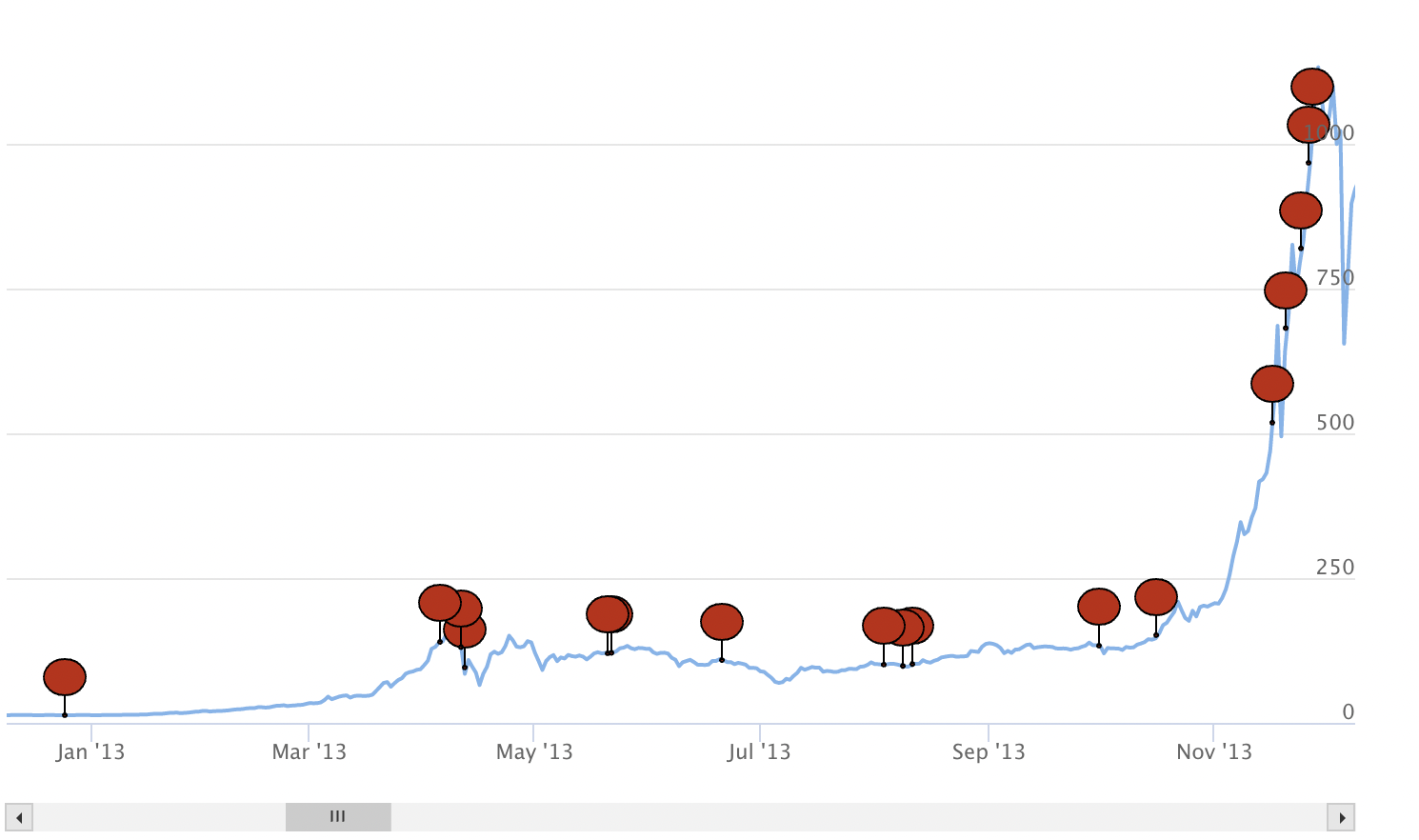
The crypto community believes that such articles are a signal for the bottom. Usually, during the market bottom, the FUD (Fear, Uncertainty, and Doubt) is at its peak. The frequency of articles claiming the death of crypto increases. The chart below shows that most articles with bearish sentiment were written when the market was preparing for a rally in Nov 2013.

Bitcoin bottom
Source: 99Bitcoins

Similarly, 93 obituaries were reported when the market bottomed in 2018. In 2020 various reports claimed Bitcoin was worthless, dead, and rat poison. The exception to this was in 2017 when over 124 articles were written declaring crypto dead due to multiple bans on crypto exchanges, Initial Coin Offering (ICOs) in China.


Source: https://beincrypto.com/bitcoin-has-died-nearly-500-times-as-bear-market-bottom-signals-end-of-crypto/


j j j