SUSHI is well poised to see growth. These are the additional comments that I have.
Let’s track back to around two weeks ago. GoldenTree Asset Management has invested $5.3 million into SUSHI governance token. During that period of time, investors were all excited about the news. Social media mentions spiked to around 0.851%. They gained 14% in 24 hours back then.
5 days ago, we saw a plunge of around 20% when they announced their newly appointed CEO, Jared Grey. He was being accused of being involved in a couple of scam projects and once sexually assaulted a horse. The token price went down to around $1.0962 at that point. Jared has since written his statement and shared it on his personal Medium page to address all the allegations. The token has since traded higher to $1.51 this morning.
All these price movements are driven by news and this is no way sustainable. The need for SUSHI to continue to build, find new niches and new products are important for its growth. SushiSwap started with a “vampire attack” if you remember, it has drawn so much attention back then, personally I hope to see that kind of drive back to the platform.
Retail investors got to know this. In order for SUSHI to grow, SushiSwap got to continue growing in popularity. As much as I believe decentralised exchanges are the way forward, the competition is very high and it is ever changing. SUSHI or not, it all depends on how strong your team is. I look forward to their new developments.
SUSHI / BTC prediction: SushiSwap showing signs of life despite shrinking exchange market share
Since facing major losses in the crypto winter of 2022 cryptocurrencies have been struggling to resurface. Bitcoin (BTC) is down by 70% since its November 2021 highs while SushiSwap’s SUSHI fell by 94% since its all-time high of 14 March 2021, as of 21 October.
How do the two tokens trade against each other and what does the SUSHI to BTC forecast suggest amid the current bear market? Here we take a look at the SUSHI/BTC pair and some of the factors that may shape its exchange rate.
What is SUSHI/BTC?
SUSHI/BTC is the exchange rate between SUSHI, the native cryptocurrency of the decentralised exchange (DEX) platform SushiSwap, and BTC, the native coin of the Bitcoin Network.
Joerg Hansen, Caiz Development GMbh’s CEO, told Capital.com that the SUSHI to BTC value is calculated in the same way that a fixed exchange rate is calculated and is based on the rates of up to 100 exchanges.
Bitcoin is the pioneer cryptocurrency launched in 2009 by a creator or group of creators using the anonymous nickname Satoshi Nakamoto. BTC is built, distributed, exchanged and stored on a collective network known as a blockchain, and the token is used for peer-to-peer payments.
The cryptocurrency is secured by a Proof-of-Work (PoW) consensus mechanism, which is how new bitcoins are mined. Miners gain BTC as rewards for solving mathematical equations that confirm whether a BTC transaction is legitimate.
Approximately every four years or once every 210,000 mined BTC blocks, the blockchain goes through a halving event, which is when the rewards given to miners are cut in half, decreasing the amount of bitcoins in circulation.
SushiSwap is a decentralised finance (DeFi) platform that aims to solve what it describes to be “the inability of disparate forms of liquidity to connect with markets in a decentralized way”. It creates automated liquidity pools through which anyone can swap a crypto token based on the ERC-20 Ethereum protocol for another ERC-20 token.
The platform’s Japanese food-themed ecosystem was launched in 2020 by an anonymous creator who calls themself Chef Nomi. The software is running on the Ethereum blockchain, and is often compared to other similar platforms like Uniswap (UNI) and Balancer (BAL).
SushiSwap uses a number of products to achieve full liquidity and decentralisation, and allows users to exchange, earn, lend and borrow digital assets, stack yields and leverage funds. In addition, SushiSwap has smart contract capabilities, which means it also supports the creation of non-fungible tokens (NFTs).
SUSHI coins are rewarded to users for maintaining liquidity on the platform. They can also be used for staking and governance.
SUSHI has a maximum supply of 150 million coins. Meanwhile, BTC’s maximum supply is capped at 21 million.
SUSHI to BTC price history
The SUSHI to BTC exchange rate surged by more than 235% in the first four days following its launch, up from 0.0002201BTC on 19 August 2020 to 0.0007436BTC, its all-time high. The SUSHI value in USD surged by 250%.
The SUSHI/BTC price chart shows that SUSHI was quick to dip against BTC as the exchange rate’s value lost over 95% of its gains in the following months, down to 0.00003331BTC by mid-November 2020.
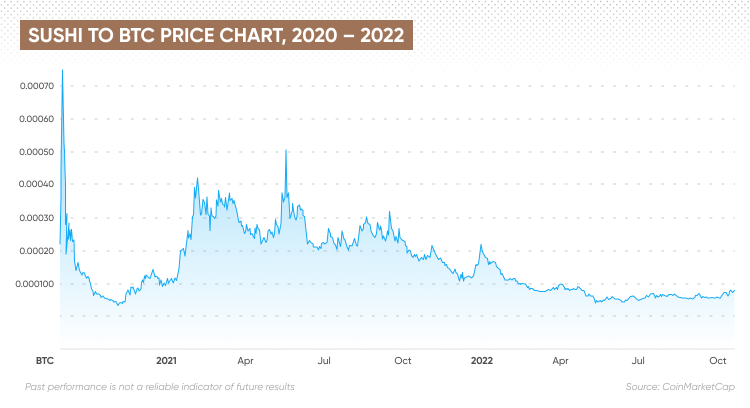
At the start of 2021, SUSHI/BTC jumped 317.5% from 0.0001001BTC on 8 January 2021 to 0.0004179BTC on 5 February 2021, in line with a hike in the SUSHI price in USD as the platform announced the launch of MISO, a suit of open-source smart contracts.
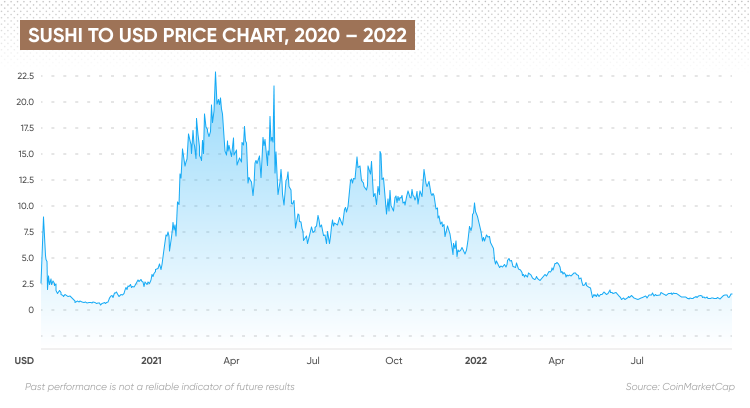
The bull trend in the SUSHI to BTC price chart lasted for the following five months and by 19 May 2021 the exchange rate reached 0.0005008BTC, up by 19.8% as the SUSHI ecosystem became compatible with the Polygon blockchain.
Following the positive trend, SUSHI/BTC fell by 60.2% down to 0.0001994BTC by 26 June 2021 and continued to fluctuate for the following four months seeing minor losses and gains.
By 16 September 2021, SUSHI/BTC reached 0.0003152BTC but within a month fell by 40%. Around this time, the BTC value in USD was picking up the momentum, surging by around 55% to reach its all-time high of $64,158.12 on 13 November 2021, up from $41,551.27 at the end of September 2021.
The SUSHI to BTC exchange rate continued to further decline and reached 0.0001069BTC by the beginning of December 2021. By the end of the month, the rate surged by 103% to 0.0002174BTC as the platform launched a migration to the Optics V2 bridge, but the trend was short lived.
In line with recent negative market sentiment, SUSHI/BTC has lost over 65% of its value with the pairing’s current exchange rate trading at 0.00006957BTC as of 21 October.
Caiz Deveopment’s Hansen noted that in terms of technical analysis, the SUSHI/BTC price is struggling:
News driving SUSHI/BTC
At the start of October, Golden Tree Asset Management announced that it will stake $5.3m into SUSHI. Anndy Lian, chief digital advisor at the Mongolian Productivity Organisation and author of NFT: From Zero to Hero, told Capital.com that the announcement sparked enthusiasm in the online SUSHI community, but the hype was short-lived. Lian explained:
“Five days ago, we saw a plunge of around 20% when [SUSHI] announced their newly appointed CEO, Jared Grey. He was being accused of being involved in a couple of scam projects and once sexually assaulting a horse. The token price went down to around $1.0962 at that point,” Lian noted.
On 11 October, a Twitter user under the handle YannickCrypto alleged in a series of tweets that Grey was involved in a series of scam projects between 2012 and 2020. The user added that they met Grey in 2019. Other users chimed in, alleging that the CEO had also engaged in bestiality with a horse.
Hey @SushiSwap how it comes you elect @JaredGrey, a scammer and con artist, as the new CEO?
Here some details about Grey:
— yannickcrypto.eth (@YannickCrypto) October 10, 2022
Grey addressed the scam allegations, saying they were “100% untrue”. But SUSHI did not resurface.
Today has been interesting. Let me be clear: the accusations towards me are 100% untrue. FYI, in 2019, my business partner stole funds from our community while I was busy raising funds to launch the Bitfineon exchange. /1
— Jared Grey (@jaredgrey) October 11, 2022
Caiz Deveopment’s Hansen told Capital.com that “sharply rising interest rates” have also been “poisonous” for the SUSHI to BTC exchange rate, as well as the declining trading volumes on cryptocurrency exchanges. He noted:
SUSHI/BTC forecast for 2022, 2023 and beyond
Based on the analysis of past performance, as of 21 October, the algorithm-based forecasting service Wallet Investor predicted that SUSHI/USD could fall to $0.0663 in 2023. The platform did not provide a price prediction for 2027.
In terms of its BTC price forecast, the site saw BTC/USD trade at $25,101.65 in 2023 and reach $46,783.81 by 2027.
While Wallet Investor did not provide a direct SUSHI to BTC forecast, data suggested that the exchange rate could be 0.0000025098BTC in 2023.
DigitalCoinPrice predicted that SHIB/USD could rise to $1.63 by the end of 2022. The site’s data, as of 21 October, showed that the coin was expected to trade at $2.18 in 2023 and $3.49 in 2025. Its long-term prediction saw the coin reaching $7.32 in 2030.
The site also gave an upbeat BTC/USD forecast, expecting the coin to grow to $24,108.19 by the end of 2022, $31,466.60 in 2023, $49,830.68 in 2025 and surpass $105,000 in 2030.
DigitalCoinPrice’s SUSHI to BTC forecast for 2022 expected the pair to reach 0.0000676119BTC and 0.0000692798BTC in 2023. The site’s SUSHI/BTC forecast for 2025 stood at 0.0000700372BTC. Its long-term SUSHI/BTC forecast for 2030 was 0.0000697143BTC.
Hansenalso gave a bullish SUSHI to BTC price outlook:
In order for SUSHI to regain past losses, the platform must continue to develop and “find new niches and new products”, Lian said. He added:
Remember that analysts’ and algorithm-based predictions can be wrong and shouldn’t be used as a substitute for your own research.
Always conduct your own due diligence on a cryptocurrency project before trading, looking at the latest news, a wide range of analyst commentary and technical analysis. Note that past performance does not guarantee future returns. And never trade money you cannot afford to lose.
Source: https://capital.com/amp/sushi-btc-prediction-sushiswap-bitcoin-exchange-market-share