Apples and oranges? How the Ethereum Merge could affect Bitcoin (With additional commnets)

Apples and oranges? How the Ethereum Merge could affect Bitcoin (With additional commnets)

Additional comments by Anndy Lian on top of what CoinTelegraph has mentioned.

The Merge is the right direction for cleaner crypto mining. The more direct impact I see after the transition is that bitcoin becomes the biggest target for green activists. There were more reports about bitcoin’s energy usage and mostly negative.

And because of the switch, many experts also said miners would forgo POW mining, but I say otherwise. I see the ETH POW Forks projects are working hard. The miner communities are now more united now than ever. For example, Bitmain also brought down the prices of their Antminers to help the miners get back into profits. These various factors helped the miners offset their operating costs in this bear market, keeping them alive.

Additionally, a good point to highlight is bitcoin’s hash rate. The hash rate continues to surge, recording new all-time high daily. The chip shortage has turned around, and the price of GPU is now at a more reasonable value. Taking GeForce RTX 3090 Ti, for example, the MSRP is $2,000, and it came down to $1,030 in September. These are positive signs for bitcoin.

As I have said before the transition, the impact of The Merge will not have too much boost for the crypto industry in the short run. What Vitalik has planned for Ethereum is a long-term vision. As for bitcoin, it is another kind of animal; it is the big brother. If bitcoin drops, the impact on every other cryptocurrency is inevitable.


Apples and oranges? How the Ethereum Merge could affect Bitcoin

While the Ethereum Merge failed to move Bitcoin from a price standpoint, the industry believes we have yet to see the effects of its shift from PoW to PoS.

It’s been a month since Ethereum said goodbye to an essential feature its blockchain shared with Bitcoin. Called the Ethereum Merge, the long-hyped upgrade was widely celebrated, with the blockchain ecosystem. However, for the mainstream audience or even for the average trader, it felt more like a Star Wars Day celebrated by sci-fi geeks than an early Christmas.

As the Ethereum Merge occurred on Sept. 15, the most extensive blockchain ecosystem parted ways with the proof-of-work (PoW), the energy-hungry consensus mechanism that makes Bitcoin tick. The Ethereum blockchain now works on a more eco-friendly proof-of-stake (PoS) mechanism that doesn’t require any mining activities, leaving thousands of miners worldwide scratching their heads.

Price-wise, Bitcoin is yet to take a hit from the fundamental shift of its closest competitor. A whole month has passed since the Ethereum Merge, and the BTC price is still stuck between $18,000 and $20,000.

However, the overarching mainstream narrative of “Bitcoin should contribute to the world, not destroy it by depleting energy resources” is rekindled with Ethereum’s significant switch to a system that keeps blockchain alive with minimal resource consumption.

Ethereum avoided a dead end

Cointelegraph reached out to industry insiders to get a clearer picture of the Ethereum Merge’s impact on Bitcoin.

“PoW was a dead end for Ethereum,” says Tansel Kaya, a lecturer at Kadir Has University and the CEO of blockchain developer Mindstone, “Because an Ethereum network that doesn’t scale can not live up to its promise.”

However, the Bitcoin community is not happy with the way its biggest price competitor took, according to Kaya. The BTC community often criticizes PoS for being vulnerable to censorship, he remarked, adding:

“If what [Bitcoin maximalists] say is true, Ethereum will either turn into a docile fintech network that is censored by governments, or a centralized structure like EOS, controlled by wealthy investors.”

Speaking to Cointelegraph, Gregory Rogers, CEO and founder of crypto-based gifting platform Graceful.io, noted that the Merge solidified the two distinct blockchains’ positions in the market. “Ethereum remains the transaction chain of choice with its increased speed and reduced fees,” Rogers said, adding, “Bitcoin is now the store of value of choice. They were already headed in this direction, but the Merge simply clarifies it.”

From a price point, though, multichain marketplace UnicusOne founder and CEO Tashish Raisinghani believes that Bitcoin price will take a hit. “The crypto industry had a hard time because of macro-level challenges which resulted in the current bear market,” he said, adding that the Merge would make Ethereum more sustainable compared to Bitcoin, “Which hasn’t yet been able to recover from the Chinese mining crackdown in 2021.”

PoW is unrivaled in network security

Addressing the energy side of the argument, John Belizaire, CEO of eco-focused data center company Soluna Computing, told Cointelegraph that even though Ethereum’s switch to PoS could save energy, “It will also undermine the core decentralization aspect of cryptocurrency.”

Although Bitcoin’s PoW consensus mechanism is energy-intensive, it is also fundamental to the blockchain and “is the best choice for any cryptocurrency that prioritizes network security.”

Co-locating flexible crypto mining centers with renewable energy plants can help stabilize the electric grid, solve renewables’ wasted energy issue, and provide an abundant source of cheap energy to crypto miners, Belizaire added.

The Merge united crypto miners

Bitmain also brought down the prices of Antminers, its flagship crypto mining units, to help miners get back into profits, he added:

Despite the Merge, Ether miners won’t simply forgo PoW mining just because Ethereum Classic is not minted via mining anymore, according to Anndy Lian, author of the book NFT: From Zero to Hero. Lian told Cointelegraph that the EthereumPoW (ETHW) project — the result of a hard fork after the Merge — is working hard and the miner community is more united than ever.

“These various factors helped the miners offset their operating costs in this bear market, keeping them alive.”

Joseph Bradley, the head of business development for Web3 service provider Heirloom, likened Bitcoin to “a global risk asset that is correlated to TradFi markets.” Bradley told Cointelegraph that, although Ether may be traded similarly, it still has neither the market depth nor the size that Bitcoin has. “Do we expect the world to become more or less chaotic in the coming years?” he asks rhetorically, answering:

“Most people would lean towards more chaotic. Security will matter during this time. Bitcoin will become even more important. Expensive energy will create innovation with miners — They will most likely move toward positioning Bitcoin mining as an extension of the electrical grid itself.”

Bitcoin and Ethereum: “Apples and oranges”

Not everyone agrees that the Ethereum Merge will have an impact on Bitcoin, though. Martin Hiesboeck, head of research at crypto exchange Uphold, dismissed a direct comparison between Ethereum and Bitcoin as “apples and oranges.”

Hiesboeck told Cointelegraph that Ethereum is basically a “company controlled by venture capitalists,” that’s why the transition to proof-of-stake aims to improve its economic and environmental credentials:

“Bitcoin doesn’t need to do that. Bitcoin is not a brand. Bitcoin is a computer network. Its output represents money. Nobody owns it. There is no brand. No CEO.”

Khaleelulla Baig, the founder and CEO of crypto investment platform Koinbasket, supported Hiesboeck’s argument, telling Cointelegraph that the Merge won’t have any meaningful impact on Bitcoin as these assets serve different purposes.

Bitcoin’s purpose is “to prove itself as a superior store of value to fiat currencies,” according to Baig. The PoW mechanism goes well with the purpose of Bitcoin, “As it helps the network maintain the scarcity of 21 million BTC via its difficulty adjustment rate,” he added.

Bitcoin as a PoW and Ethereum as a PoS network are making significant contributions to the crypto-asset ecosystem by competing with their best features. Tansel Kaya summarizes: “Having two distinct approaches rather than one is more suitable for the spirit of decentralization.”


Source: https://cointelegraph.com/news/apples-and-oranges-how-the-ethereum-merge-could-affect-bitcoin


j j j

The scourge of NFT wash trading — and how not to get suckered in

The scourge of NFT wash trading — and how not to get suckered in

What are the different kinds of NFT wash trading, and what are the red flags that a prospective investor should look for? Anndy Lian explains.

Wash trading is not a new word for people in the financial world. You probably have heard from friends that cryptocurrencies are highly “washed” and round-tripping with the same buy and systematically sell price. Since you are familiar with this term, let me tell you the NFT market has similar issues with wash trading.

In a nutshell, wash trading makes it difficult for non-fungible token enthusiasts to gauge genuine market interest in NFT collections. It also inflates and skews the amount of trading in marketplaces, misleading analysts about what’s going on on trading platforms.

All in all, NFT wash trading is one of the biggest impediments to accurately evaluating projects and assets in the NFT industry, which includes NFT collections, NFT tertiary tokens (think $X2Y2 and $LOOKS) and the studios and developers who bring products to market.

Using Footprint Analytics’ data set to detect and filter wash trading, let us take a closer look at how wash traders operate and how on-chain data could be analyzed to detect suspicious activity.

What is wash trading?

Wash trading is a form of market manipulation where an investor simultaneously sells and buys the same financial instruments to create misleading, artificial activity in the marketplace.

In terms of NFTs, wash trading occurs when the same user is behind both sides of an NFT transaction. It means that both the seller and buyer address is actually owned by the same person. At the moment, wash trading is very common in NFT markets, which are not subject to government regulation or supervision, unlike traditional securities.

Why do people wash trade NFTs? 

There are two main motives behind wash trading in the NFT space.

Type 1: To earn platform rewards 

Type 2: To create an appearance of value or liquidity 

To create a false sense of liquidity and an inflated value of a specific NFT collection or asset, some unscrupulous creators turn to wash trading to deceive buyers. They profit when genuine buyers are tricked into buying an NFT from them at a pumped-up price. This type of wash trader hides their activities with new wallet addresses that are self-funded from central exchange wallets. This type of wash trading generates a relatively small volume, which is not as disruptive to the market as Type 1 wash trading.

How is wash trading done?

Due to Type 1 wash trading transactions’ disruptiveness to NFT transaction data, Footprint Analytics aimed to filter them out as much as possible. To understand this type of wash trading, we have to understand the token reward system of X2Y2 and LooksRare. In simple terms, X2Y2 and LooksRare distribute tokens daily to both sellers and buyers based on the address’s trading volume as a portion of the marketplace platform’s daily total volume. Token rewards are fixed daily, so wash traders can wash trade and earn reward tokens repeatedly when the daily distribution resets.

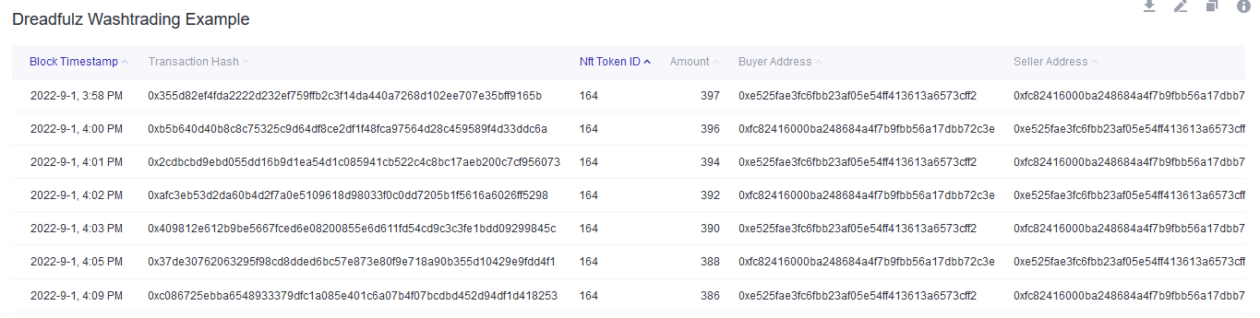
Figure 1 shows an example of wash trading activities on the X2Y2 marketplace— the NFT collection is Dreadfulz.

unnamed
Figure 1 –  Dreadfulz Wash Trading Example (Source: @Hanson520 Footprint Analytics)

As we can see from the figure above, the same NFT (ID 164) was bought back and forth between the same two wallets several times in a day with 300+ ETH sale prices per transaction. On Sept. 1, 2022, these two addresses traded 19 times, generating 7228 ETH in volume and paying 36.14 ETH in X2Y2 platform fees. Keep in mind that the royalty fee rate for Dreadfulz was not set on X2Y2; therefore, no creator fees were paid. Wash traders will choose collections with 0% creator fees to minimize their wash trading costs.

How to detect wash trading

I have looked at how a few analytics platforms, including Footprint Analytics, do their detection and followed their logic. Their methodologies are somewhat similar, to be honest. Along with my own knowledge and analysis, here is a checklist of suspicious data and activity that should trigger any prospective NFT buyer’s alarm bells:

  • A particular NFT is traded by the same address more than X times a day while the rest of the collection remains untouched.
  • The same address is trading the same NFT in a high-frequency manner.
  • A collection of NFT goes into a self-selling in a high-frequency manner when there is no marketing or promotion backing the sale.
  • The average historical price transacted is X times higher on marketplace A vs. B.
  • The sale price of an NFT is transacted X times higher than the lowest-priced NFT available for sale.
  • The same wallet addresses funding all the suspicious wallets that buy and sell the NFTs.
  • An abnormal high trading volume on a constant basis.

The above assumptions are not perfect, and I hope to work with researchers on developing a more comprehensive scorecard to determine NFT trends and behaviors more effectively. The ability to trace multiple wallets over time to identify various levels of relationships would be vital too.

How wash-traded are the top NFT collections?

In Figure 2, Footprint Analytics applied their detection rules to the collections with the most trading volume on X2Y2 and LooksRare.

XljL7xeoh7v7vlHCQfP7GTP5KqAIU2ekU4Q8js1vN7tV39jHQ5m9Z9D7p6wvqsPR 2SLeu0w6Alrf ziAKPaYUW5M9FMhxOUEZ kP70tKaB60k 3aFhbLfwbI1NjIbCVjYCLMulHsKbTP0VYreenoaC9JRIbRnLEjDkmDgpiy40IbK f8NDODMRl47s
Figure 2 – Wash Trades Stats of Selected Collections (Source: Footprint Analytics)   

Based on their rules, they have detected that 95% or more of the trading volume of these collections is wash trading transactions. Wash trading makes up an extremely high percentage of trading volume for these collections, which paints a misleading picture of the collections’ historical volume and sale activities. You can review all the transactions they have filtered at ud_suspicous_txn dataset on their website.

unnamed 1
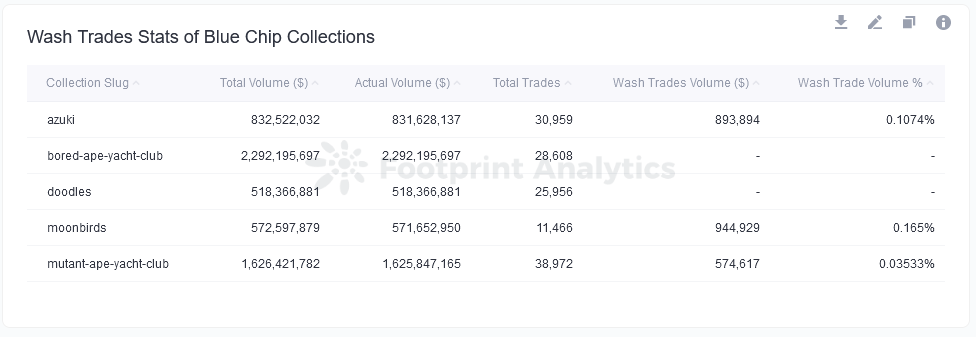
Figure 3 – Wash Trading Stats of Blue Chip Collections (Source: Footprint Analytics) 

For Footprint Analytics to ensure their rules are working as intended, they have applied them to blue chip collections that are not subjected to wash trading activities in Figure 3. You can view the ud_suspicious_txn_bluechip_collections dataset and review the filtered transactions.

unnamed 1
Figure 4 – Wash Trading Stats of LooksRare and X2Y2 (Source: Footprint Analytics) 
unnamed 1
Figure 5 – Unfiltered Trading Stats of Opensea, LooksRare and X2Y2 (Source: Footprint Analytics) 

Figure 4 indicates that 94.71% and 81.04% of the trading volume on LooksRare and X2Y2 are wash trading transactions, which appears consistent with the marketplace statistics, as shown in Figure 5. We can see from the unfiltered data that the average price per transaction on Looksrare almost reaches US$85,000, which is around 90 times the average price of OpenSea and unrealistically expensive.

You can view the ud_suspicious_txn_x2_looks dataset and review the filtered transactions for X2Y2 and Looksrare marketplaces, as shown in Figure 4.

Final takeaways 

zCHJVo912xNmdAG9KAOksGzSoQszjreQog BrjtrjwKiAfBeGavDbf59EI HPAh96tb12h2cJSaPoA7hJwkKd77pCVsnqWWl0ePfWb4I jEKZPxXbe dlOauPS0xE x31 b8eOzFLcnn2sCruNPTYyHzzIZG9Ali0ESy f58G8EBfXQi7CyzdGpasIbKls9lUDq
Figure 6 – Monthly NFT Volume Stats of OpenSea, LooksRare and X2Y2 (Source: Footprint Analytics) 

Looking at the monthly trading statistics of the NFT market since January 2022 in Figure 6, we can see that wash trading volume makes up more than 50% of total volume almost every month. Even though total volume is down by a substantial amount from January highs, the percentage of wash trading volume in the NFT market remains similar every month. This underscores how disruptive wash trading is to having accurate NFT transaction data and the importance of filtering out wash trading for any meaningful NFT data analysis.


Source: How to detect NFT wash trading and not get suckered in (forkast.news)

j j j

Magic Eden, largest Solana-based NFT platform, makes royalty fees optional

Magic Eden, largest Solana-based NFT platform, makes royalty fees optional

The platform said the move was in line with growing market trends, but some are concerned about what it means for the industry.

Magic Eden, the largest non-fungible token (NFT) marketplace in the Solana ecosystem, has moved to make paying NFT creator royalty fees optional, following in the footsteps of rival marketplaces which have eaten into its market share in recent months.

The platform will also be waiving all platform fees for the foreseeable future, Magic Eden said in a Twitter thread announcing the changes on Saturday.

Anndy Lian, author of the new book “NFT: From Zero to Hero,” told Forkast the attempt to win back users by lowering or removing fees surprised him as he was doubtful of the long-term sustainability of the plan.

“For [an] NFT platform, where the secondary market is at a really bad situation right now, I am doubtful whether the zero fees are going to work very well,” he said.

NFT royalties give the original creator a percentage of the sale price each time that NFT creation is sold.

Magic Eden is a giant in the Solana ecosystem, controlling roughly 90% of all sales, and almost nine times the Solana sales of leading NFT marketplace OpenSea, which added support for Solana NFTs in April 2022.

Magic Eden also raised US$130 in series B fundraising in June, bringing its valuation to US$1.6 billion, and cementing its status as a “unicorn,” a privately held start-up with a valuation over US$1 billion.

“This is not a decision we take lightly,” Magic Eden said in a tweet announcing the move, while also acknowledging the industry has been slowly moving towards optional creator royalties for a while. “We understand this move has serious implications for the ecosystem. We also hope it is not a permanent decision.”

Royalties for NFTs are typically set to between 5% and 10% and are often encoded into the smart contract of the NFT itself. Marketplaces are able to rework the code around the sales of these NFTs, however, effectively allowing them to set the fees to whatever they like.

In the case of Magic Eden now, that fee now will be left up to the user to decide whether or not to pay. However, if users choose not to pay the fee, they risk being excluded from the full utility or perks of owning the NFT, the platform warned.

Removing this structure incentivizes creators to lift their prices in order to compensate for this loss of income, he said, which could add extra pressure to an already struggling market that is currently extremely sensitive to pricing.

The issue is compounded if smaller marketplaces follow Magic Eden’s lead, which Lian said they will be incentivized to do.

“So, it goes back to the whole equation: How long is this bear market going to be and how long can you sustain that kind of strategy?” Lian said, “If I’m not wrong, maybe [Magic Eden] can for the next two, three, four years, maybe. But I’m not so sure about the rest.”

Lian explained this was being done to artificially increase an NFT’s trading volume to give the impression it is more highly sought-after than it actually is. This not only discredits the industry but deceives unwitting buyers into potentially paying inflated prices for NFTs.

The issue has become so prevalent on Magic Eden in the few days since fees were removed that OpenSea has since announced it is in the process of temporarily blocking Solana collections from the Top and Trending list on its homepage to avoid “gaming” those numbers.

Secondary monthly NFT sales in September were only US$550 million, an almost 90% decrease from its high in January 2022. NFT creators, marketplaces and collectors alike have had to make difficult choices about how to respond to the difficult market conditions.

“There’s a lot of uncertainty. Based on the current charts, we should still be going down or going sideways for the next quarter or so,” he said.


Source: Magic Eden, largest Solana-based NFT platform, makes royalty fees optional (forkast.news)

j j j