Cosmos crypto price prediction: Where next after Terra’s crash?

Cosmos crypto price prediction: Where next after Terra’s crash?

ATOM, the native token of the Cosmos network, saw a bullish run in 2021, surging 453.3%.  In the beginning of 2022 the token continued the momentum, rising above $40. But, the surge was short-lived amid negative sentiment in the cryptocurrency markets fuelled by Russia’s invasion of Ukraine.

The crash of the LUNA token and the TerraUSD (UST) stablecoin at the start of May 2022, both based on the Cosmos network, were also key driving points in the cosmos cryptocurrency’s decline.

Where is the token headed now? Here we take a look at what factors are shaping the cosmos crypto forecast for 2022 and beyond.

What is cosmos (ATOM)?

Coined as “the Internet of Blockchains” by its founding team, Cosmos aims to build an ecosystem of independent interconnected blockchains, allowing them to “interoperate while retaining their security properties”. It was co-founded by Jae Kwon and Ethan Buchman in 2016.

Blockchains can interact through its architecture of zones. Users can build multi-asset public Proof-of-Authority (PoA) and Proof-of-Stake (PoS) blockchains, like the Cosmos Hub.

Through this the network aims to solve a number of limitations of cryptocurrencies, including scalability, usability and sovereignty. The end goal, the platform’s website notes, “is to create an Internet of Blockchains, a network of blockchains able to communicate with each other in a decentralised way.”

The network’s focus on customisability and interoperability sets it apart from other projects.

Cosmos is based on the Tendermint Byzantine Fault Tolerance (BFT) consensus algorithm designed to ensure finality, order consistency and optional availability. The network also consists of the Cosmos SDK, an industry standard for building blockchains.

Cosmos’ IBC (inter blockchain communication) allows blockchains within the ecosystem to connect so that they can transfer tokens and other data between one another frictionlessly and seamlessly.

In addition, users can also create marketplaces allowing for permissionless global trade. They can build autonomous application-specific blockchains, rather than smart contracts, to avoid high transaction fees and network congestion.

Moreover, users can also create games with unique collectibles in the form of non-fungible tokens (NFTs) and character upgrades that they can monetise without third-party approval or app store fees.

According to the network’s website, there are currently (30 May) 265 apps and services on Cosmos, including the Binance Chain (BNB), Terra (LUNA) and Crypto.org (CRO), with over $66bn of digital assets under management.

While the Cosmos Hub is a multi-asset distributed ledger, it offers ATOM, its native token. ATOM is the only staking token of the Cosmos Hub, and acts as a licence, allowing holders to vote, validate or delegate to other validators.

The token can also be used to pay for fees on the platform to mitigate spam, similar to Ethereum’s ETH. The token provides security to the chain, allows holders to earn rewards and vote.

As of 30 May, there are over 289m tokens in circulation, according to CoinMarketCap. The token has a market capitalisation surpassing $2bn and is ranked as the 29th biggest cryptocurrency on the platform.

The bullish run: Technical view

The ATOM cryptocurrency was listed on CoinMarketCap in March 2019. It was trading in bearish territory until the start of 2021. In February 2021, ATOM  surged by 174.2% from the low of $7.3839 to its first peak of $20.25 on 13 February. Between February and May, the token managed to grow an additional 42.1%, reaching above $28 by 9 May 2021.

The ATOM crypto value bottomed out between May and July, dropping by 67% to $9.4857 on 20 July 2021. This bear trend provided an opportunity for a new bull run, which saw the ATOM/USD price surge to the all-time high of $44.54 on 19 September 2021.

The token’s record level came ahead of the platform’s participation at Mainnet 2021, an immersive, agenda-setting summit held annually for crypto industry leaders.
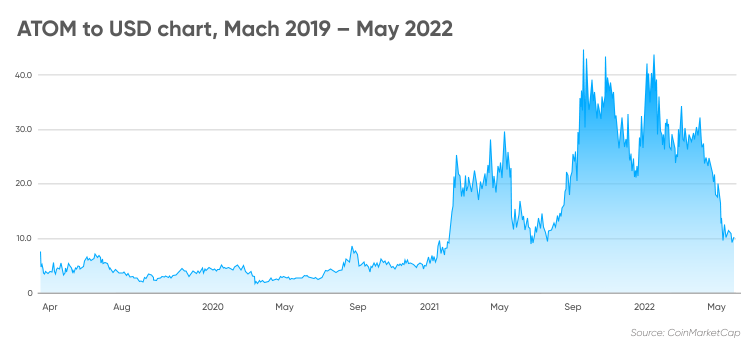
ATOM to USD chart, Mach 2019 – May 2022

ATOM saw new highs once again in October 2021, surging to $43.22 on 26 October 2021 as Cosmos announced that Terra became the latest chain to enable IBC, bringing its native LUNA cryptocurrency as well as its TerraUSD (UST) stablecoin with it.

The cosmos cryptocurrency entered 2022 on a positive note, surging by 97.9% to $41.99 on 4 January 2022 from its $21.22 17 December 2021 low. A second surge followed on 16 January 2022, which saw ATOM’s value rise to $43.61. This was due to several reasons.

Firstly, Cosmos reported to have neared EVM-protocol compatibility, which would allow assets and projects that operate on the Ethereum network to migrate over to Cosmos. Secondly, the project announced that a liquidity staking module was coming to the platform, which would give additional functionality to the stakes chain assets.

That, however, was the last time ATOM was so close to its all-time high as it embarked on a bearish run for the remainder of 2022. Wider negative crypto market sentiment was fuelled by the start of the war between Russia and Ukraine, as well as bitcoin (BTC) falling below $27,000.

What is your sentiment on ATOM/USD?

The token lost around 79% of its value, hitting as low as $9 by mid-May 2022, as seen on the chart above. Today (30 May), the coin is valued at $9.94.

ATOM technical analysis provided by CoinCodex, as of the time of writing (30 May), showed that sentiment on the token was largely bearish.

Relative Strength Index (RSI) reading of 32.5 was neutral yet extremely close to oversold territory. A reading of 30 or below would indicate that the asset has become undervalued and a trend reversal is likely. Meanwhile, the token was trading above its three-day moving average but below its five and 10-day moving averages.

Can ATOM recover?

In the latest cosmos crypto news, the network’s Gravity Bridge announced a number of milestones at the start of March 2022, including the introduction of ATOM with Ethereum DeFi and the Cosmos NFT platform, Stargaze, working with Gravity Bridge to send NFTs from Ethereum to Cosmos.

In April 2022, Cosmos introduced  its Theta upgrade which saw the official launch of Interchain Accounts, a module that has the potential to boost interoperability, traffic and composability.

In May 2022, KYVE, the Web3 data lake solution, joined the Cosmos ecosystem and migrated most of its blockchain protocol from EVM-based chain to the Cosmos SDK-based chain.

At the beginning of May 2022, the prices of the LUNA cryptocurrency and the UST stablecoin crashed, losing over 90% of their values within days. The tokens were based on the Cosmos network.

“As always, the cosmos ecosystem will continue to be a nurturing and safe environment for bold entrepreneurs to bring forth the Internet of Blockchains. Tendermint, IBC and the @cosmos SDK are showing the world how resilient & secure they are under extreme market conditions,” Cosmos said on Twitter during the LUNA crash.

In December 2021, Cosmos promised that its hub will continue to grow in the coming year, announced the launch of interchain security and accounts, more decentralised finance (DeFi) projects and the rise of NFTs.

“Cosmos is not a new token. It has been around since 2017 and has survived through all the down periods. Cosmos constantly remained in the top 50,  although many new investors may not have heard of it as it is not marketed that aggressively unlike Polygon or Binance Smart Chain,” BigOne Exchange chair in Asia, Anndy Lian told Capital.com.

According to Lian, the ATOM token took off because the Cosmos network offers “a simple experience for blockchain developers” with  “easy-to-understand tutorials, tools, and community assistance for developers.”

In 2020, Jae Kwon stepped down from his position as one of the project’s co-founders to focus on a different project. This, according to Lian, is one of the biggest uncertainties for the Cosmos prediction.

“He exited back then after several high-ranked employees left the company in protest of his leadership and it was reported that Kwon’s return to NewTendermint has continued to feud with his former Tendermint colleagues. I am not sure what is the truth and what are the backstories for this, but I think the lack of unity within their group makes this token vulnerable,” he noted.

Lian added that at the moment, ATOM has a strong support around the $9 range.

“Falling below this amount would mean that it may go below its launch price. This could happen too. Apart from the internal risks, I would caution all to look at external risks to manage your portfolio better.”

Cosmos (ATOM) price prediction 2022-2030

Despite the latest downward price action, algorithm-based forecasting service Wallet Investor gave a bullish outlook for its ATOM prediction, as of 30 May, suggesting ATOM is “an awesome long-term investment” with long-term earning potential at 752.13%.

Based on its analysis of past price performance, Wallet Investor’s cosmos coin price prediction suggested that the token could trade at $26.389 in 2023 and $84.685 by 2027.

DigitalCoinPrice also gave a positive ATOM crypto price prediction but saw a much slower pace of growth in future years. The site projected that ATOM could reach the target price of $13.76 by the end of 2022, $18.73 by the end of 2024 and $24.33 by 2025.

By the end of 2027, the site’s cosmos crypto price prediction expected that the coin could reach $34.02. Its long-term ATOM coin price prediction showed the cryptocurrency could trade at $49.10 by 2030.

Note that algorithm-based and analysts’ projections can be wrong. Forecasts and analysts’ expectations shouldn’t be used as substitutes for your own research. Always conduct your own diligence and remember that your decision to trade or invest should depend on your risk tolerance, expertise in the market, portfolio size and goals.

Keep in mind that past performance doesn’t guarantee future returns. And never invest or trade money you cannot afford to lose.


Original Source: https://capital.com/cosmos-atom-price-prediction

j j j

Hong Kong Regulator Steps Up Awareness Campaign on NFTs

Hong Kong Regulator Steps Up Awareness Campaign on NFTs

My original comments to the reporter look like this. I have added additional insights.

“The Securities and Futures Commission (SFC) must do this ASAP as I do see numerous NFT projects started in Hong Kong that are wrapping securities and derivatives around NFTs. In fact, I have said numerous times in my public speeches that such an act is not grey, it is totally illegal.

Tencent and Ant Group changed the descriptions of NFTs on their platforms to ‘digital collectibles’ to play down their links to cryptocurrencies last year. The bigger boys did their homework way beforehand to avoid any possible issues with regulators in China and Hong Kong.

I urge SFC to take put a hard stop to all the bad actors who are trying to operate regulated activities in Hong Kong or targeting Hong Kong investors using NFT as a workaround.”

Hong Kong Regulator Steps Up Awareness Campaign on NFTs

The Hong Kong Securities and Futures Commission (SFC) has stepped up its awareness campaign on non-fungible tokens (NFTs), cautioning investors against investing in them if they do not fully understand the risks.

“As with other virtual assets, NFTs are exposed to heightened risks including illiquid secondary markets, volatility, opaque pricing, hacking, and fraud. Investors should be mindful of these risks, and if they cannot fully understand them and bear the potential losses, they should not invest in NFTs,” the SFC stated.

The SFC noted that there are a number of NFTs that represent the digital representation of an underlying asset and in which case, it has little role to play in the trading of those assets.

However, the financial regulator said, there are NFTs that are portrayed as securities and these types must be licensed before it is offered to residents.

Assets that push the boundary between collectibles and financial assets, such as fractionalized or fungible NFTs structured as securities or collective investment schemes (CIS) in NFTs, do fall under the SFC’s mandate.

A CIS is an investment arrangement, to pool money around a certain asset or property. The Hong Kong Securities and Futures Ordinance (SFO) requires CIS to be managed in escrow, and its participants do not have day-to-day control over its management. They however are subject to receive profits, income, or other returns.

The solicitation of Hong Kong residents by companies engaged in these activities requires the issuer to obtain a license from the SFC unless an exemption applies.

SFC has mandated a license from Hong Kong residents who wish to issue fractionalized NFTs or to target local investors or be subject to certain authorization requirements under the SFO.

Anndy Lian, chairman, BigONE exchange, says a few well-known corporations that are based in China changed the descriptions of NFTs on their platforms to ‘digital collectibles’ to play down their links to cryptocurrencies last year.

“They did their homework way beforehand to avoid any possible issues with regulators in China and Hong Kong. I urge SFC to put a hard stop to all the bad actors who are trying to operate regulated activities in Hong Kong or target Hong Kong investors using NFT as a workaround,” Lian says.

Raj Kapoor, chief advisor of crypto advisory firm Acryptoverse says security issues are just a major legal concern when it comes to NFTs and that each different NFT model presents a unique legal issue.

“License uncertainty is another risk while IP ownership many a time is opaque. Copyright Infringement raises concerns as well. Deceptive and unlawful trade practices for misrepresentation of ownership of the work underlying an NFT is also a deep risk factor,” he added.

Money Laundering including self laundering is another as potential criminals purchase an NFT with illicit funds, transact with themselves to create records of sales on the blockchain, then sell to another party using clean funds.


Original Source: https://uk.investing.com/news/cryptocurrency-news/hong-kong-regulator-steps-up-awareness-campaign-on-nfts-2665065

j j j

Four Good Reasons to Be Optimistic About Bitcoin: Is Bitcoin the cryptocurrency of the future?

Four Good Reasons to Be Optimistic About Bitcoin: Is Bitcoin the cryptocurrency of the future?

So far in 2022, the entire crypto market has been impacted by wider economic and political uncertainties, led by Bitcoin (CRYPTO: BTC), with prices down more than 50% over the past six months and the price heading for the ninth consecutive red weekly candle. And while Terraform Labs successfully airdropped new Luna tokens to previous holders, the market sentiment continues to be bearish, with the Fear and Greed Index remaining in the doldrums.

One way to avoid panic selling when the price of cryptocurrencies drop significantly is to remind yourself of the essentials, to stick to your plan and don’t invest more than you can afford to lose.  Of course, that’s easy to say when you’ve lost money in Luna and seen your Bitcoin investments go down in value. However, there’s also an upside to the current market conditions as users can now buy Bitcoin at the new low price around the $30,000 mark.  But no matter what level your holdings in the current market, you should be optimistic about the long term viability of Bitcoin. Here are four key reasons to consider, to help re-frame your mindset and support your belief in Bitcoin going forward.

Mass adoption of crypto assets

According to relevant data, cryptocurrencies have reached a tipping point in 2021.  It has evolved from what many consider a niche investment to be a global, established asset class.  Venture capitalists are pouring money into the cryptocurrency market.  Among them, venture capital invested more than $30 billion in crypto assets and blockchain startups, with more than $10.5 billion in investment in the fourth quarter of 2021 alone. With an estimated $10 globally in the first quarter of 2022, reportedly the largest amount to date, and double the level for the same quarter in 2021. In fact, investment in crypto has continued to grow despite this year’s decline in Bitcoin price. “This decoupling is demonstrative of investors’ disbelief that a prolonged bear market in digital assets is forthcoming, as well as the significant amount of dry powder held by funds seeking to allocate to the sector,” said Alex Thorn, head of firmwide research at blockchain-focused bank Galaxy Digital in New York earlier this month.

Many major financial institutions are also exploring cryptocurrencies.  Recently, Fidelity, the largest retirement plan provider in the US with over $4.2 trillion in assets under management, said it would allow investors to deposit up to 20% of their retirement savings in the form of Bitcoin into their accounts.  While banking giant JPMorgan recently said that despite the crypto crash, its estimate of Bitcoin’s fair value is $38,000. “The past month’s crypto market correction looks more like capitulation relative to last January/February and going forward we see upside for bitcoin and crypto markets more generally,” the bank’s strategists said. In addition, both Visa and Mastercard have launched their own crypto cards.  And as the regulatory environment is catching up, ironically thanks in part due to the Terra collapse, there is reason to believe that cryptoassets will enjoy mainstream adoption in the future.

Countries adopting Bitcoin as legal tender

El Salvador was the first country to adopt Bitcoin as legal tender, led by President Nayib Bukele, but so far it remains uncertain whether the bold initiative will succeed.  As reported in the Wall Street Journal on May 14, “there are no indications that Mr. Bukele plans to change course. On Monday, he said on Twitter that El Salvador bought 500 bitcoin at an average price of $30,744. “El Salvador just bought the dip!” he added.” It’s not just El Salvador, the Central African Republic also recently approved Bitcoin as its national legal tender.  No one could have imagined that this cryptocurrency, which was only invented some 13 years ago, could become the legal tender of a country today.  If these experiments succeed other countries may adopt Bitcoin or other cryptocurrencies as their legal tender in the future.

Is Bitcoin the cryptocurrency of the future?

One of the appeals of Bitcoin and other cryptocurrencies is that it removes friction in terms of costs and transaction speeds from payments, especially international transfers.  Indeed, according to Ark Invest, cumulative Bitcoin transfers have grown by more than 463% in the last year.  ARK analyst Yassine Elmandjra wrote in the report ‘Big Ideas 2022’ that Bitcoin will settle $13.1 trillion in 2021, a figure that even exceeds Visa’s payment volume.

Ark Invest’s research also highlighted several areas where Bitcoin could take market share from traditional activities. These include international remittances, emerging market currencies, institutional investment and acting as a form of digital gold.  Some experts predict that if Bitcoin can make significant progress in advancing these use cases, its price could exceed $1 million by 2030.

Image

Source: ARK Invests Yassine Elmandjra tweet, Jan 25, 2022

Bitcoin’s innovation continues apace

Although Bitcoin is not run by a centralized organization, it continues to grow along decentralized lines.  There is a small core group of developers working on improving the network, fixing bugs and security issues, and improving functionality.  For example, last year Bitcoin implemented a major upgrade called Taproot to improve privacy, scalability, and security.  Another potentially significant move is the development of the Lightning Network, a layer 2 solution to Bitcoin that reduces costs and increases speed.  As reported in Cointelegraph on May 30, “Bitcoin Lightning Network capacity attained an all-time high of 3915.776 BTC, as evidenced by data from Bitcoin Visuals, displaying a commitment to the cause of improving BTC transaction speeds and reducing fees over the layer-2 protocol.” This follows news from CEO of Strike, Jack Mallers, at the Bitcoin 2022 conference, that the company’s plans to collaborate with point-of-sale behemoths Shopify, NCR, and Blackhawk Network to revolutionize the payments industry. As a result, online retailers that support Shopify can now accept payments via the Lightning Network, in turn allowing US merchants to receive payments from customers globally as US dollars. As the integration of the Strike wallet is with major online players in the US economy, this could potentially do a lot for the broader adoption of Bitcoin in the retail industry.

While there are good reasons to remain optimistic about Bitcoin, there are also still many things that investors and traders need to be careful about when investing in Bitcoin and cryptocurrencies.  Data in recent months confirms once again that cryptocurrencies are a highly speculative and volatile asset.  Cryptocurrencies are still a relatively new sector compared to traditional investments like stocks and funds, and while we don’t have certainty exactly how it will develop in the long term the potential is clear to see. “I believe Bitcoin is a viable long term investment both as a store of value looking to the future, with the price trending significantly upwards after each halving event. But also, I’m excited about the rapid development of the Lightning Network, for both retail players but also for financial inclusion across the globe,” said BigONE Chairman Anndy Lian.

Original Source: https://www.benzinga.com/22/06/27599358/four-good-reasons-to-be-optimistic-about-bitcoin-is-bitcoin-the-cryptocurrency-of-the-future

j j j