Why the Hottest News at Bitcoin 2022 Was Not About Bitcoin

Why the Hottest News at Bitcoin 2022 Was Not About Bitcoin

This year’s Bitcoin 2022 in Miami came after the legalization of Bitcoin in El Salvador in September last year, and the all-time high of over $61k in October before tumbling to a largely stable plateau of around $40k. Last year’s Bitcoin conference focused on the Lightning Network, a payments platform built on the Bitcoin blockchain which is used in El Salvador by the government in creating the wallet, Chivo, which is Lightning-compatible and designed to enable seamless cross-border payments.

So, it’s appropriate that this year’s event, with the decline in the price of BTC followed up on the original intent of Bitcoin to act as a payments system rather than as a long term investment, with the integration of the Strike Lightning-based wallet with mainstream payment platforms including Shopify.
The significance of the Shopify partnership

During the conference, Jack Mallers, CEO of Strike, revealed the company’s plans to collaborate with point-of-sale behemoths Shopify, NCR, and Blackhawk Network to revolutionize the payments industry. As a result, online retailers that support Shopify can now accept payments via the Lightning Network, in turn allowing US merchants to receive payments from customers globally as US dollars. As the integration of the Strike wallet is with major online players in the US economy, this could potentially do a lot for the mainstream adoption of Bitcoin, particularly in the retail industry.

What this means has been perhaps missed by some commentators, who fail to make the distinction between Bitcoin as investment asset and use of the Bitcoin blockchain as a payment network, with the Lightning Network sitting on top of it and processing transactions much faster and cheaper than using Bitcoin itself. In simple terms the Lightning Network (LN) is a “layer 2” payment protocol layered on top of a blockchain-based cryptocurrency such as Bitcoin or Litecoin. Andreas Antonopoulos has referred to the Lightning Network as a ‘second layer routing network’. The payment channels allow participants to transfer money to each other without having to make all their transactions public on the blockchain, according to Wikipedia. So, what did Jack Mallers say about this exciting innovation at Bitcoin 2022 that helps make more sense of this? To understand what Mallers is doing and why it could be so impactful, it’s best to put aside Bitcoin and instead focus on the payment network side of Strike.
After all, that’s how Mallers introduced it to the Bitcoin 2022 audience, giving a quick history lesson about the current payment network used by retailers which began in New York in 1949 with the launch of Diners Club, started by “a bunch of rich plutocrats in New York City that didn’t want to carry cash”. Such was its success that the following year Bank of America announced a mass market payment card, with American Express in 1958. And essentially that same network, with innovations such as the launch of credit cards like Visa, is the same payment network we have today. “And so in reality, payment networks have not innovated in over 50 years. That’s insane. That’s ridiculous,” Mallers said. Following up later with Yahoo Finance Mallers explained that the current system is one of ‘debt promises’ where because it’s based on dollars or whatever fiat currency is involved, the transaction doesn’t involve sending dollars when you spend. Instead, the banks promise each other that the purchaser is good for the transaction, but the merchant pays a fee for this ‘debt promise system’.
Using Bitcoin’s blockchain as a payment network

Instead, what Mallers unveiled at Bitcoin 2022 is a way to send any currency around the world without needing to use the banks and without needing to charge the merchant. In other words, it allows you to send dollars or to a merchant on the other side of the world, using the Bitcoin blockchain via the Lightning Network, and have it converted into say Euros at the touch of the button and instantly.

As Mallers told the audience, “Okay, so $100 spent $100 received. There’s no two to 15 days of settlement. There’s no 3%. The point is we can recreate a superior payments experience with a superior payments network. This thing is not issued by a government. It’s not a company, Bank of America found it rebranded. No, there’s no consortium of banks running this thing. It’s open, it lives in the clouds.” It’s using the Bitcoin blockchain as the infrastructure for the payments system, just as email uses the internet as the global infrastructure that allows you to email all across the world for free. “Anyone can join it, it’s global, it’s uncensorable, it’s cash final,” confirmed Mallers.
“This is not in another country. This is not a test pilot somewhere – no. This is in the United States of America. You’re going to be able to walk into a grocery store, to Whole Foods, to Chipotle… You want to use a Lightning node over Tor? You do that. You want to use the Cash App? You do that… If Chipotle wants Bitcoin, I’ll give them Bitcoin, I’ll settle in Bitcoin,” he added.
What grabbed the headlines of course wasn’t just the theory behind Strike’s payments network, but the partnership with Shopify. With the Strike integration, Shopify merchants can accept payments globally and save costs on processing fees, with cash-final settlement. Strike’s integration enables Shopify merchants to diversify their existing payment options and reach untapped global markets and purchasing power. Strike’s integration also allows Shopify merchants to generate savings through low-cost payment processing. By instantly converting bitcoin payments to dollars, Strike removes certain complexities merchants face in holding bitcoin.
Chairman of BigONE Exchange, Anndy Lian, said he was impressed by the use of the layer 2 Bitcoin blockchain technology deployed by Strike, bringing together fiat and crypto in one global easy to use payment network: “While Bitcoin as a store of value is an impressive investment, it’s about time Satoshi’s original vision of Bitcoin as a payment system from people to people was realized. For me the use of the Lightning Network is certainly attractive in delivering on that promise. It will be interesting to see however if this catches on outside the US, or whether the use of such layer 2 payment networks inspires innovation in places such as South Korea with the crypto friendly new President taking office next month.” Certainly, the impact of the war in Ukraine and banking sanctions on Russia may inspire innovative payment systems using the blockchain for effective p2p payment networks that sit outside the current US-controlled SWIFT system which manages payments between banks globally, Lian added.
j j j

Polkadot crypto price prediction: Connecting all blockchains

Polkadot crypto price prediction: Connecting all blockchains

After a strong April 2022, the price of DOT, the native cryptocurrency of the Polkadot blockchain, declined by over 50% to $11.22 on 16 May 2022.

Triggered by overall negative market sentiment that saw bitcoin (BTC), the number one cryptocurrency by market capitalisation, fall to $26,000 levels for the first time since 2020, the polkadot token has been also acting bearish.

Currently in the final stage of its development, polkadot aims to connect all the blockchains through one platform. Will it be able to succeed, and what is in store for the polkadot crypto forecast? Read on for our analysis.

What is polkadot coin?

Founded in 2016 by Ethereum co-founder Gavin Wood, the Polkadot network is one among many software competitors aiming to incentivise a global network of computers to operate a blockchain, on top of which users will be able to launch and operate their own blockchains.

The project is being developed by Web3 Foundation’s Parity Technologies, which focuses on the development of innovations that break down centralised online services and enable institutional innovation.

Unlike similar projects such as Ethereum, Cosmos and EEOSIO, Polkadot’s protocol connects a whole network of purpose-built blockchains, allowing them to seamlessly operate with one another, through its so-called parachains.

Polkadot allows for a number of transactions to be conducted at once and is easy and open for more innovations and collaborations due to its collaboration with other blockchain protocols.

Additionally, the network enables blockchains to upgrade without having to fork the chain, which used to take months and at times split the community.

The Polkadot network is powered by DOT, which has three leading purposes:

  • Governance: DOT holders have complete control over the Polkadot protocol like deciding which events take place within the protocol (upgrades and fixes) through voting.
  • Staking: through storing funds in a digital wallet, users can earn DOT tokens by running operations on the blockchain. There are four ways in which DOT holders can interact with the staking system.
  • Bonding: DOT holders can block a certain number of tokens for a certain period of time.

DOT holders can become:
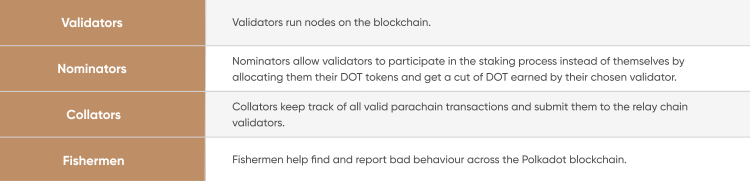
table

As of 16 May, the total supply of DOT coins stands at over 1.1 billion, with over 987 million tokens in circulation, according to data provided by CoinMarketCap. The cryptocurrency has a market cap surpassing $10bn, ranking it as the 11th biggest cryptocurrency.

Polkadot chart analysis: Does Polkadot have a future?
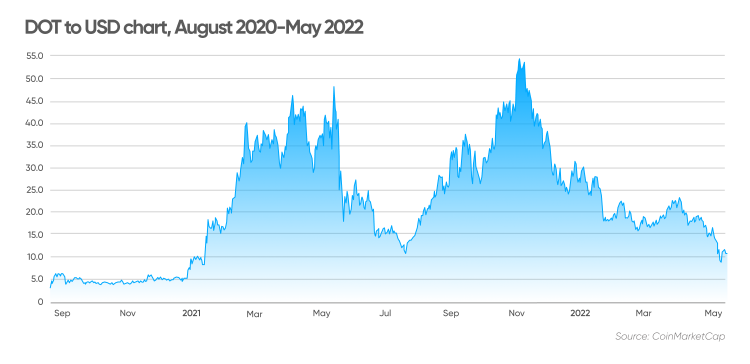
DOT to USD chart, August 2020-May 2022

Polkadot launched in late August 2020 at $2.875. For the next six months, the DOT token price moved sideways before gaining some momentum in mid-January 2021. It jumped 187.4% since its launch to hit $8.2641 by 12 January 2021.

The token continued on a bullish trend, skyrocketing to $39.7 by 21 February 2021 – a 380% surge in a little over a month. However, positive sentiment did not last long as DOT dropped below the $32 mark in the next four days and continued to fluctuate between $33 and $38 for the entirety of March 2021.

By 14 May 2021, the DOT cryptocurrency surged to $47.95, a then all-time high, ahead of Polkadot’s launch of parachains – the network’s final launch in a series of multi-phase processes. On 23 May 2021, however, the token dipped by over 60% to $18.03 as Polkadot nodes failed with an out of memory error while trying to build a block. While the nodes themselves did not crash, their runtime did. It kept a bearish trend throughout the summer months, falling as low as $10.98 in mid-July.

The polkadot coin price started to resurface once again at the start of September 2021 following news that the crypto was planning the launch of its cross-consensus messaging format.

On 4 November 2021, DOT reached its all-time high, surging by over 390% since its July lows to $53.88, as the network announced the passing of referendum 42 in a community vote that would enable parachain registration and ‘crowdloans’.

The following day, Polkadot announced the passing of referendum 41 in a separate community vote, which saw the registration of its first parachain, keeping the polkadot token valued above $50 for the next few days.

A Polkadot technical analysis provided by CoinCodex showed the short-term sentiment for the token was largely bearish at the time of writing (16 May).

What is your sentiment on DOT/USD?

A Relative Strength Index (RSI) reading of 38.73 indicated neutral territory. A reading of 30 or below would indicate the asset has become undervalued and a trend reversal is likely. Meanwhile, the token was trading above its three and five-day moving averages (MAs) but below its 10-day MA.

Following its November 2021 success, the token embarked on a bearish trend losing over 79% of its value since its all-time high and reaching $11.22 by 16 May 2022.

Is polkadot a good investment?

Recent DOT crypto news has seen the platform developing its parachain rollout stage, the final part of the Polkadot v1 launch process. As of 16 May 2021, the Polkadot community is on the final stage of voting to enable parachain functionality via a runtime upgrade. Once the vote is complete, parachains will be live on Polkadot and the network’s launch will be complete.

SmartBlocks and Fanatics Media fonder Mark Fidelman told Capital.com:

“Overall, the DOT is down but it’s not as down as other tokens. So, this is a good sign. What’s driving it, of course, are all the parachains… I believe the infrastructure that Polkadot is creating is driving the [token’s] value because there’s true value here.”

On 3 May 2022, cross-chain functionality went live on Polkadot which, according to BigOne Exchange chair in Asia Anndy Lian, “sets an example for interoperability and sets the tone for their network expansion of substrate-native assets and tokens”.

“DOT can now be used on several DeFi apps and on their parachains involving yield farming, borrowing, lending and liquidity sharing. As their cross-chain use cases increase within their ecosystem, I hope to see positive trends in their pricing too,” Lian noted.

Future Polkadot upgrades include the development of the Cross-Chain Message Passing, which will allow parachains to exchange messages with other parachains. As well as the launch of parathreads, that temporarily participate in Polkadot security without needing to lease a dedicated parachain slot.

Following the recent crypto crash surrounding stablecoins, many investors are looking to turn towards more trustworthy cryptocurrencies. Media Coin LLC founder Jeff Freiberger told Capital.com:

“There have been some recent press mentions that [DOT] is a good one to invest in and it shows how hard the market is looking for some hope to bounce back with many people ready to buy in. I think people are finding value in its uniqueness to connect to several different blockchains.”

Freiberger added that the DOT/USD future price had a lot of potential to resurface due to recent positive coverage around the cryptocurrency.

“The fact that news is circling it in a manner that gives the consumer hope is a good thing. I also see a lot of cryptos eventually growing again after the final current sell off is reached.”

SmartBlocks’ Fidelman added that the token has potential to be better adopted by the wider market, however, it also runs several risks, like a failed mission to unite all blockchains in one.

Polkadot prediction 2022-2025, 2030

Despite the latest downward price action, algorithm-based forecasting service Wallet Investor gave a bullish DOT crypto price prediction at the time of writing (16 May). The site noted that DOT was “an awesome long-term investment”, adding that it has a long-term earning potential amounting to 348.53%.

Based on its analysis of past price performance, Wallet Investor expected that DOT could be valued at $20.549 in 2023. The polkadot long-term price prediction was expected to reach $50.379 by 2027.

DigitalCoinPrice supported the positive DOT coin price prediction but saw a much slower pace of growth in the following years, projecting that the polkadot 2022 value could grow to $14.62, reach $20.26 by the end of 2024 and jump to $25.48 in 2025.

By the end of 2028, the site predicted the DOT coin could reach $39.37. The price of polkadot in 2030 was projected to grow to $54.12.

Note that predictions about the future of DOT can be wrong. Forecasts and analyst expectations shouldn’t be used as a substitute for your own research. Always conduct your own due diligence and rely on your own projections. And never invest or trade money you cannot afford to lose.


Original Source: https://capital.com/polkadot-forecast-will-dot-price-rise

j j j

The Road Ahead for Play-To-Earn Games – Thought Leaders

The Road Ahead for Play-To-Earn Games – Thought Leaders

The success of the pay-to-earn gaming sector, led by Axie Infinity, has taken a bit of a knock recently with the recent $600 million hack of their Ronin bridge. Up until this news play-to-earn games threatened to take a slice out of the multi-billion dollar video gaming market by allowing users to earn money for completing game objectives. Investments in such projects have surged drastically this year. Earlier this year we reported that Solana Ventures, FTX, and Lightspeed recently announced the formation of a $100 million joint GameFi fund, which FTX followed up with a $2bn fund of its own. Web3 venture capitalists BITKRAFT and Galaxy Interactive each announced over $400 million in investment funds aimed at the space. While tech giant Microsoft’s $69 billion takeover of Activision Blizzard, the publisher of Call of Duty and World of Warcraft, was the largest acquisition in gaming history. And according to one expert, over six out of every ten gamers want the chance to exchange their virtual assets for a currency that could be used across various platforms.

Source: ‘7 business models for web3 games,’ Sophia Weng, Medium

Does Axie Infinity’s market leading success (gross income of $781.6 million for the third quarter of 2021, and its token price all-time high of $155 by the end of 2021), now look under threat following the hack? In fact, its user engagement (measured as daily active users: DAUs) was already in decline 40% from its peak last November.  Taken together, does this mean the hype around this emerging sector is overblown? Consider some of the key adoption barriers acknowledged by BITKRAFT. These include the slow speed afforded by Ethereum, used by most crypto gaming platforms, the associated high costs of buying NFTs thanks to high gas costs on Ethereum, not to mention its environmental impact. But perhaps more tellingly from a growth perspective is the fact that few large game developers have ventured in the space. A key obstacle is the key play-to-earn nature of the innovative gaming model itself: “It is a difficult sell to switch from a model where 100% of in-game economy sales go to developers to one where a much larger percentage of transaction volume is earned by the player community.” In other words, this means developers have less control of in-game economies in a decentralized ecosystem, where community ownership is baked in.

Rasa Petuch, Head of Growth at Block Games, which is based at West Palm beach in Florida, in an interview with BigONE said she believed the basic obstacle right now in play-to-earn gaming, was remembering it was first and foremost about gaming. And that in order for the play-to-earn games industry to grow, there needed to be an influx of regular gamers, whereas at the moment users were engaging primarily to earn rather than to play, and with developers concentrating on small games focusing on the tokenomics rather than the game itself. “Traditional gamers are not here yet”, because for one thing, the games are not here “and many traditional gamers are skeptical and not really crypto native”, Petuch said.

She added that she thought that play-to-earn gaming would really change when there were really quality games in the sector that are fun to play with. “That was one point I was thinking about, the other is about console games. They are not ready for blockchain yet and they are a big part of the gaming industry overall. So that kind of limits that you know, potential audience as well as many players you know, love playing console games, too. And these, like big console companies, they seem pretty skeptical,” Petsch pointed out. Indeed, during an Electronic Arts’ recent earnings call, CEO Andrew Wilson suggested that while the market for NFTs and play-to-earn was still early, it did point to the future development of gaming. “The play-to-earn or the NFT conversation is still really, early..there’s at some level, a lot of hype about it. I do think it will be an important part of the future of our industry on a go-forward basis,” Wilson added.

Talking about Shatterpoint, Petuch said their new play-to-earn game, she said the issue wasn’t so much about getting the word out, but that the general level of trust and skepticism was proving difficult to overcome: “I think people are excited and they want to see new products coming out. What’s difficult, in my opinion, is if you’re trying to build a big quality game, it takes time, right? So, then the challenge is to keep people engaged for a long time, while you still have no game to show them. But I think it’s all doable.

“It’s all about community anyway. And yeah, allowing, you know, people who decide to be a part of your community to like really to be that part. And like, you know, share like in-game art and share decisions and like, talk to them and have some of the NFT sales in between and kind of keep it moving. I think you have to be open and honest with where things are. Because, yeah, there’s like a lot of scams out there,” Petuch added.

In an interview with BigONE Federico Gallucci, CEO & Founder at gaming studio Deep Monolith based in Turin, which specializes in play to earn games said gamers are still reluctant to understand the value of NFTs, as in game assets, because they see them as game producers trying monetize even more. As a gaming developer himself Gallucci said part of the problem was that blockchain gaming is “not sophisticated enough” for an experienced gamer who is used to high quality games. “But I think that it’s only a matter of time before gamers start to realize that it’s good for gaming and that this technology can bring awesome improvements,” he added.

A key area for growth in play to earn is around esports, suggested Gallucci: “This is a huge opportunity because you know, there are thousands of people who are gamers and fans that follow esports, but currently this is only restricted to the biggest development studios where they have a ton of cash and can afford to spend a bigger reward.” But the adoption of crypto technology could be a “disrupting point” allowing multiple developers to offer big prizes. “I think that’s the way it’s gonna break through, It’s through esports,” he concluded.

Chairman of BigONE Exchange, Anndy Lian, said despite the problems for users caused by the Axie Infinity hack the level of demand showed the play to earn sector was still growing, even as the general market for NFTs was slowing down compared to 2021, with Axie topping $4 billion in all-time NFT sales in February. “I believe that there is plenty of potential for the growth of play-to-earn games that has yet to be tapped into. For example, the election of a new President in South Korea may pave the way for legislation allowing in-game tokens to be converted into cash.” Lian said he agreed with the assessment of esports as a new avenue which would allow smaller studios to win a slice of the action. “It’s time the dominance of the large gaming studios and console makers had a shake-up. Play-to-earn isn’t just good for gamers but also for up-and-coming developers who want a new way to compete on a more level playing field.”


Original Source: https://www.securities.io/the-road-ahead-for-play-to-earn-games-thought-leaders/

j j j