Opinion Article on Forkast : How Yuga Labs’ NFT sale failed to put its community first

Opinion Article on Forkast : How Yuga Labs’ NFT sale failed to put its community first

The ‘virtual land’ sale that broke Ethereum was also a fiasco for buyers. Should Yuga Labs have seen it coming and taken preventative action?

The largest and perhaps most highly anticipated NFT sale so far this year took place recently when Yuga Labs launched their sale of virtual land to ApeCoin holders for around US$5,800 (the clearing price was set at 305 ApeCoin). The huge level of demand for the hugely popular Otherdeed NFT mint, which raised about US$320 million, created a two-fold problem for the Ethereum-based sale. Firstly, the steep rise in the volume of transactions led to a spike in the price of Ethereum gas fees, requiring people to spend around two ETH (approximately US$6,000) in fees to mint. Secondly, many of the participants in the sale, due to the bottleneck in demand, both missed out on the minting and lost their Ethereum in the process.

Such was the chaos that soon after the sale, Yuga Labs tweeted: “We are aware that some users had failed transactions due to the incredible demand being forced through Ethereum’s bottleneck.” While YugaLabs promised “we’ve got your back” and that they would be “refunding your gas,” there was considerable pushback from the NFT (non-fungible tokens) community. Considering the stature of the sale, it is worth examining what happened in greater detail to understand what this means both for the NFT market going forward, not to mention its implications for the ideal of the core importance of the Web 3.0 community to the future of NFTs and the metaverse.

After Yuga Labs acquired CryptoPunks earlier this year, which put the VC-backed company valued at US$4 billion in the spotlight, this latest event certainly raises the stakes. Yuga Labs admitted the scale of the minting event not only crashed Etherscan but also seriously impacted Ethereum. “It seems abundantly clear that ApeCoin will need to migrate to its own chain in order to properly scale. We’d like to encourage the DAO to start thinking in this direction,” they added. But clearly with all the resources at their disposal, the chaotic result only created more skepticism on crypto Twitter.

But before diving into the organizational aspects, the upset among NFT newbies should not be ignored when crypto is so keen to gain mass adoption. That upset was voiced by NFT influencer ap3father.eth, who pointed out that he’d brought many friends into the space for the drop: “My friends said things like, ‘who would ever use Ethereum?’ ‘NFTs are only for rich people’ … and to be honest I agreed with them … although my initial reactions were filled with emotion … I agreed … How was this going to prove we are ‘innovating.’” It’s worth noting that Yuga Labs raised around US$320 million through the minting, with 55,000 tokens sold out in under three hours.

The key problem is that it’s not only an issue with scaling the number of transactions but also the number of smart contracts (“trustless computation”) — an issue also faced by so-called Ethereum killers like Polygon, Avalanche and Solana. While these chains may boast of a fast transaction per second (TPS) performance, only a small percentage is available for smart contract operations. It is interesting that in the example from U.K.-based Radix DLT that they’ve done away with the EVM (Ethereum Virtual Machine) and instead built their own engine, which meant “a transaction is a transaction, it doesn’t matter if that is minting NFTs, swapping on DEXs or taking out a crypto loan,” tweeted Radix Works CEO Piers Rudyard in response to the Yuga Labs mint bottleneck and proposed scaling solutions. “That means that TPS performance and DeFi performance on Radix are basically the same thing,” Now, while I appreciate Rudyard is using this opportunity to plug his solution, the Yuga Labs mint controversy is also highlighting the significant blockchain bottleneck challenges ahead for mass adoption.

Putting that high-level critique of Ethereum smart contract functionality aside, using optimized smart contracts, such as ERC-721A, could have made the mint more equitable by reducing gas fees to the bare minimum. As Will Papper, co-founder of SyndicateDAO, tweeted: “Modifying a few words would have saved $80M+.”

Furthermore, limiting the number of KYC (know-your-customer)-approved wallets to only those required for the mint would have helped avoid gas wars and provided a positive minting experience for all parties involved. But for some, such as @DrNickA of FactoryDAO, this was missing the point because the fact that the number of NFTs outstripped KYC’d wallets was intentional. After all, Yuga had the KYC information in advance for all the prospective buyers, they could have created a whitelist to manage demand.

While Yuga Labs has since confirmed it would refund the fees for transactions that failed due to the problems, it’s clear that lessons need to be learned from its minting debacle. While the likes of Yuga’s VC backers, a16z, point to the core importance of “community ownership” to Web3, including NFTs and the metaverse, surely how that ownership is delivered is important?

Particularly coming so closely after its purchase of CryptoPunks, it’s worrying — and not helpful to the cause of mass adoption — when the leading NFT company is so careless with its community. It’s certainly my hope that ApeCoinDAO, which styles itself as independent of BAYC and community-led, lives up to its responsibilities and shows that Web3 is more than a business model for the metaverse, but also a way for people to engage in this new (virtual) world.


Original Source: https://forkast.news/how-yuga-labs-otherdeed-nft-mint-failed-put-community-first/

j j j

Industry experts weigh in on SEC hiring more crypto cops + Additional Comments

Industry experts weigh in on SEC hiring more crypto cops + Additional Comments

Additional comments from Anndy Lian to the reporter at CoinTelegraph: 

What are your thoughts on crypto firms working with regulators?

Crypto firms should be working alongside with the regulators to make sure that they comply with the laws and regulations. By working along side, it does not mean seeking approval on every steps they take. On a need to know basis, regulators should be kept informed. Many times the contact points at the regulators side are not people from the industry, you may be taking too much time trying to explain the technology side of things to them which is not necessary.

How can the two sides work together to create a mutually beneficial relationship?

I deal with governments and regulators from different countries. In order for the relationship to be mutually beneficial, the regulators must “listen” and give feedback promptly. This does back to my point that the regulators must hire people who are subject matter experts and “not paperwork boys”.

Would you say that the relationship between cryptos and regulators is healthy at the moment?

It really depends on which country you are talking about. I think in general, it is not healthy. Many times, it is a one way communication and it is extremely biased if you do not know the people inside.

Do you think there is a danger of over-regulation when it comes to cryptocurrencies?

Yes and no. We are at a phase where regulations started to kick in, it is not overly regulated yet. For those who think that there are too many restrictions right now, wait for 2025 where more countries are ready with their crypto regimes. You will know that what we see now is nothing.

Are you confident in the ability of regulatory bodies to properly regulate the cryptocurrency industry?

No. 100% no. I have interacted with many of them to come out with this answer. Most of the regulatory bodies are trying to use old laws and rules to regulate the cryptocurrency industry. This resulted in a catching up game where they have to be constantly changing. To make things worst, regulators are not hiring subject matter experts, most of them are just merely “paperwork boys”.

What do you think about the community’s perception of the relationship between regulators and crypto exchanges?

The community at large would rather be indifferent. The community consists of mainly retail investors, they just want to make the money. As long as they are making the money, they do not really care about the regulators. But when they lose their money, they will find ways to contact the regulators to get a refund. This is the truth and this means the industry is still at a very young stage.

————————————————-


Industry experts weigh in on SEC hiring more crypto cops

The SEC’s decision to expand its digital assets section was well received by industry experts and came as no surprise, given the growing interest in cryptocurrencies.

The United States Securities and Exchange Commission (SEC) is seeking to hire more people to focus on digital assets, raising the number of personnel charged with safeguarding investors in cryptocurrency markets by almost twofold.

The SEC’s Cyber Unit, which comprises the Crypto Assets and Cyber team, is expected to hire 20 new people for 50 dedicated roles as reported by Cointelegraph on May 3. This development comes as the regulatory body attempts to keep up with the rise in the popularity of virtual assets.

The SEC’s decision to expand its cryptocurrency assets unit has been praised by industry experts, with Dr. Anna Becker, CEO and co-founder of EndoTech, calling it “a welcome development.” She believes that enhanced security, regulation and complex financial investment solutions will enable digital currencies to become more accepted.

On the crypto firms collaborating with regulators, she told Cointelegraph that “When we collaborate to set and uphold the rules, we will create a market that serves the public and gives them the opportunity to make money with proper protection.” She added:

“This market is still in its infancy. When it comes to crypto trading, we need the same types of safeguards that have developed in equity and other mainstream markets over the years. These will enable crypto to develop into a more robust asset class with more advanced financial tools.”

Jay Fraser, head of the strategy at BSTX, believes that crypto companies should interact with regulators. He noted that the severity of recent price declines might be partly attributed to a lack of depth and the number of active participants in cryptocurrency markets. According to Fraser, a consistent and predictable regulatory environment would potentially encourage more institutional traders to participate in dampening the price swings.

Andrea Gordon, a compliance expert and counsel at Eversheds Sutherland, stressed the importance of crypto businesses working with regulators. She told Cointelegraph that in an ideal world, firms would be able to have an open dialogue with authorities about particular offerings because the regulatory climate for cryptocurrency is always changing.

According to Gordon, some firms may not want to deal with authorities because the procedure might be costly and time-consuming (resulting in a product launch’s delay) or perhaps result in an enforcement action. She cited Coinbase’s experience with the SEC over its Lend service as a cautionary tale. She said

“In September 2021, Coinbase’s chief legal officer announced in a blog post that, after Coinbase had engaged with the SEC about the product for nearly six months, the SEC threatened to sue if Coinbase launched Lend.”

On how the two sides collaborate to build a mutually beneficial relationship, she said that education is crucial in the cryptocurrency world. The sector should seek methods to educate regulators while also encouraging a regulatory approach that makes sense.

“Regulators often issue proposed rules for public comment. These are great opportunities for the industry to weigh in on and explain the potential effects or (perhaps unanticipated) consequences of regulation.”

Anndy Lian, a thought leader and chief digital advisor to the Mongolian Productivity Organisation, stated that regulatory bodies could regulate the cryptocurrency sector adequately. Lian claims that most regulatory bodies are attempting to apply old rules and laws to the cryptocurrency industry in order to catch up, and it has “resulted in a catching up game where they have to be constantly changing.”

Pratik Gauri, founder and CEO of 5ire, addressed the present situation between crypto businesses and regulators. According to him, “there is still great mistrust on both sides.” He told Cointelegraph that “crypto people have demonized regulators ” as working for the banking lobby or other organized interests, and regulators have characterized all crypto operations as illegal activities. However, he added that recent innovation and the volatility in the crypto space have caused the two parties to reconsider their stance.


Original Source: https://cointelegraph.com/news/industry-experts-weigh-in-on-sec-hiring-more-crypto-cops

j j j

Apecoin (APE) price prediction: Will the debut surge keep up?

Apecoin (APE) price prediction: Will the debut surge keep up?

Ape coin (APE), the native cryptocurrency of the popular non-fungible token (NFT) collection Bored Ape Yacht Club (BAYC), became the biggest metaverse token by market capitalisation a little over a month after its release. The coin has dethroned Decentraland’s coin (MANA), which has been around since early 2020.

Recent news that ApeCoin will implement a staking mechanism in the coming weeks as well as Elon Musk briefly changing his profile picture on Twitter to a collage of a number of avatars from the BAYC NFT collection, drove the APE NFT coin price up on 5 May as it managed to gain nearly 19% of its value in less than 24 hours.

Will the future APE coin price prediction be as bullish as its early start, and what are the key projections for the popular NFT cryptocurrency?

What is ApeCoin?

ApeCoin (APE), was launched on 17 March 2022 by the founders of the BAYC NFT collection Yuga Labs, which also formed the APE Foundation, a means of aiding the decentralised development of the APE ecosystem.

Created with the goal of becoming the “heart of art, gaming, entertainment and events on the blockchain”, the APE Foundation will be in charge of overlooking the decisions of the ApeCoin Decentralised Autonomous Organisation (DAO).

The crypto will be responsible for administration, bookkeeping, project management and other tasks necessary to ensure the DAO community can build new Web3 applications and services, such as the APE NFT coin itself.

ApeCoin’s main focus is decentralisation and through the APE Improvement Proposal Process it will allow ApeCoin DAO members to make decisions regarding Ecosystem Fund allocations, governance rules, upcoming projects, partnerships and more.

The ApeCoin Foundation is managed by a board which oversees  the community and carries out DAO proposals. The initial board serves a term of six months and is voted in by DAO members.

The current members of the board are:

  • Reddit co-founder Alexis Ohanian
  • FTX head of ventures and gaming Amy Wu
  • Sound Ventures principal Maaria Bajwa
  • Animoca Brands co-founder and chair Yat Siu
  • Horizen Labs president and general counsel Dean Steinbeck

The APE NFT coin is an ERC-20 cryptocurrency designed on the Ethereum protocol. Apart from governance, the token:

  • Provides holders with access to certain parts of the ecosystem unavailable to others, such as exclusive games, merchandise, events and services.
  • Can be incorporated into other services, games and projects.

ApeCoin was launched through an airdrop, which allowed certain groups of holders to receive the tokens as rewards. The cryptocurrency’s total supply stands at one billion. No new tokens can be minted.

Upon release, the tokens’ total supply was distributed as follows:

  • 62% was allocated to the ecosystem’s fund and given to BAYC and Mutant Ape Yacht Club (MAYC) NFT holders.
  • 16% was allocated to Yuga Labs and charity.
  • 14% was allocated to the companies and people that helped to create the project.
  • 8% was allocated to the BAYC founders.

At the time of writing (9 May), over 284 million APE coins were in circulation according to CoinMarketCap. APE’s market capitalisation surpassed $3.18bn, making it the 33rd biggest cryptocurrency.

Apecoin price analysis following successful debut

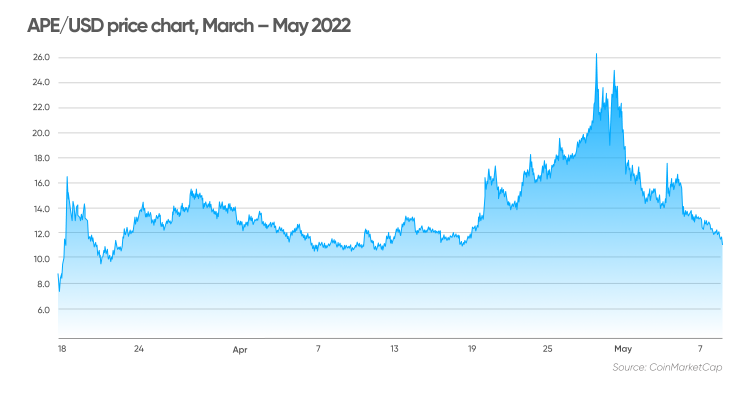
The APE NFT coin saw its value surge 126.8% on the first day of launch, reaching $16.47, up from $7.2604 in less than 24 hours, as seen on the price chart below. The coin retreated to $14. 03 by the end of the day and continued to move sideways throughout 19 March 2022 before falling to values just above $9 on 21 March 2022.

By 24 March, the APE token price climbed back to over $14 as anticipation grew ahead of the first ever ApeCoin DAO voting event, which was due to take place on the day. The cryptocurrency peaked at $15.43 on 28 March 2022 before embarking on a bearish journey into April 2022.

APE/USD price chart, March – May 2022

In April 2022, the APE token price peaked on three occasions:

  • On 10 April at $12.27 – the Bored & Hungry restaurant in California became the first ever catering establishment to accept payments in ether (ETH) and APE.
  •  On 21 April at $17.31–  following announcements that ApeCoin was cooperating with the OliveXFitness Metaverse to grant APE token holders special access to the metaverse’s move-to-earn Dustland games.
  • On 29 April at $26.19 – its all-time high value, as three new proposals were opened for ApeCoin DAO members to vote on.

On 30 April 2022, one of the largest NFT marketplaces, OpenSea, announced that it would start accepting the APE cryptocurrency for NFT purchases on its platform. This led to an over 30% one-day gain as the APE price rose to just below $25.

Following 102% April 2022 gains, the APE NFT coin chart started on a downwards trend, losing over 45% of its value by the time of writing (9 May). Today the coin is trading at $11.24.

In terms of APE token technical analysis, short-term sentiment for the token at the time of writing (9 May) was largely bearish.

Relative Strength Index (RSI) reading of 41.89 was pointing towards neutral territory. A reading of 30 or below would indicate that the asset is becoming undervalued. Meanwhile, the token was trading below its three, five and 10-day moving averages, indicating a bearish trend.

Will apecoin go back up? Future outlook

The debut success of the coin and its speedy price reversal leaves a question on investors’ lips: is apecoin a good investment? There are multiple factors at play.

Recent ApeCoin news saw ApeCoin DAO members approve two measures that would let them lock their tokens for a period of time in exchange for more apecoins in future. The finalisation of this decision on 5 May 2022 led to a mini surge in the APE price, which jumped by 23.9%, up from $14.13 on the previous day to $17.52.

In an announcement in a Twitter thread, ApeCoin noted that the new updates would be implemented “within the next week or two” following the end of the voting.

In addition to that, on 5 May, another proposal was going live for a community-wide vote to deal with security tools and education. The vote is set to end by 12 May 2022. If successful, the plan will be implemented in three phases.

Other ApeCoin news that could move the APE price in the future includes the launch of Otherside on 1 May 2022 – the largest expansion of the Bored Ape NFT universe, powered by apecoin.

Otherside is an online metaverse and role-playing game connected to the BAYC ecosystem where players can purchase lands and real estate. It was reported that 45 minutes after the metaverse’s launch BAYC sold over $100m worth of digital real estate.

Following the 1 May successes, crypto analyst and the founder of Eight Global, Michaël van de Poppe, said on Twitter that the APE price prediction had potential to embark on a bullish trend towards $19 and even $20.

One of the main reasons to why the APE cryptocurrency has managed to generate a lot of buzz was because it was built on the Ethereum blockchain, BigOne Exchange chair in Asia, Anndy Lian, told Capital.com.

“Looking at some of the volumes transacted on Whalealert and Whalestats, I can safely say that APE is one of the most purchased altcoins amongst the Ethereum whales. This is a very positive sign for the token and I must say APE is not just another ordinary meme coin,” he added.

However, the token could benefit from some more utility, Lian noted.

“The faith and comradeship within their community help keep the price and volume going, while doing so the other immediate thing they should really look at is to increase utility online and offline. APE is currently being used in Benji Bananas as an in-game currency and E11EVEN Residencies in Miami has also accepted APE as payment.”

Lian concluded that the proposal from APE owners to lock up and stake their coins are “very sound measures to keep the token sustainable, especially in bear markets”.

ApeCoin price prediction 2022-2025, 2030

Algorithm-based forecasting service Wallet Investor gave a bullish outlook on the future of the APE/USD forecast at the time of writing (9 May), calling apecoin “an awesome long-term investment”.

Based on its analysis of past price performance, Wallet Investor expected the APE target price to grow to $30.501 by 2023, $43.940 by 2024 and reach $87.357 by 2027.

DigitalCoinPrice echoed an upbeat apecoin crypto price prediction, projecting that the token’s value could steadily grow in the coming years. The site noted that APE could end this year at $16.23 and reach $25.30 by the end of 2025.

By the end of 2027, the site’s APE crypto price prediction suggested that the coin could trade at $35.25. Its long-term APE prediction showed that the cryptocurrency has the potential to reach $54.26 by 2030.

Note that predictions can be wrong. Forecasts and analysts’ expectations shouldn’t be used as a substitute for your own research. Always conduct your own due diligence. And never invest or trade money you cannot afford to lose.


Original Source: https://capital.com/apecoin-ape-price-prediction

j j j